Angled vs Straight Spotting Scope: Which One Should You Buy?
Angled vs straight spotting scope, compared on 4 scopes: viewing angle, zoom, objective size, weight, weather sealing and who each body style suits.

On this page
Top picks at a glance
As an Amazon Associate I earn from qualifying purchases.
- 1
 Vortex Razor HD 13-39x569.7/10View on Amazon
- 2
 Vortex Diamondback 20-60x809.6/10View on Amazon
- 3
 Vortex Diamondback 20-60x609.6/10View on Amazon
- 4
 Celestron Ultima 20-60x809.5/10View on Amazon
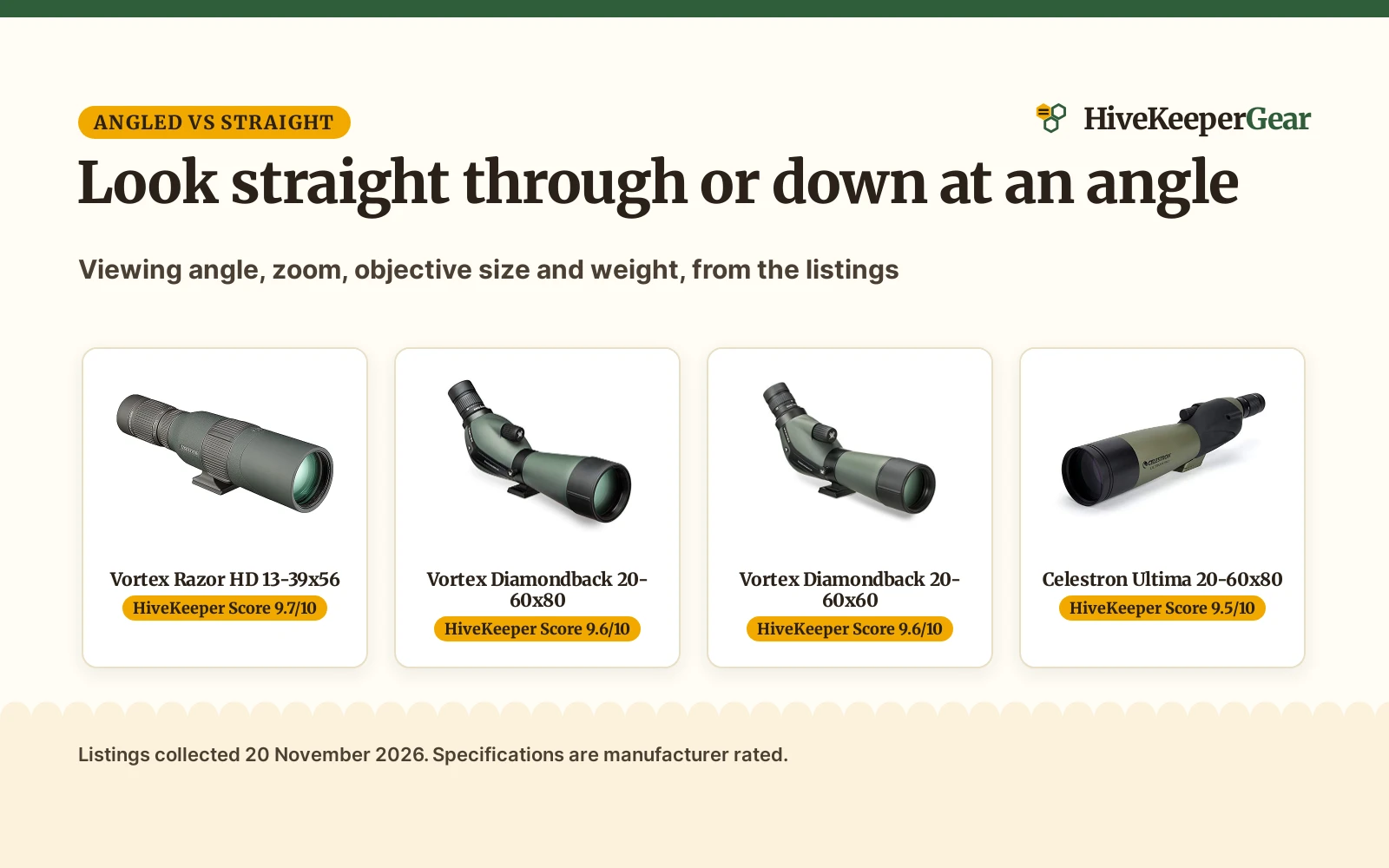
Watching birds at the edge of the yard asks for a steady view at long range, and the shape of the scope decides how you hold that view. The angled vs straight spotting scope choice comes down to the viewing angle: an angled body lets you look down into the eyepiece, while a straight body lines the eyepiece up with the objective. This comparison covers 4 spotting scopes from the listings, two angled and two straight.
HiveKeeperGear earns a commission when you buy through links on this page, at no extra cost to you. As an Amazon Associate I earn from qualifying purchases. Affiliate disclosure.
Quick verdict: choose an angled spotting scope if you want the eyepiece set at an angle to the body, as on the 2 Diamondback models here; choose a straight spotting scope if you want the eyepiece in line with the objective, as on the Celestron Ultima and the Razor HD here.
The 4 picks
| # | Product | HiveKeeper Score | Buy |
|---|---|---|---|
| 1 | Vortex Razor HD 13-39x56 | 9.7/10 | Buy on Amazon |
| 2 | Vortex Diamondback 20-60x80 | 9.6/10 | Buy on Amazon |
| 3 | Vortex Diamondback 20-60x60 | 9.6/10 | Buy on Amazon |
| 4 | Celestron Ultima 20-60x80 | 9.5/10 | Buy on Amazon |
Vortex Razor HD 13-39x56
A 13-39x56 straight spotting scope with HD optics, XR Plus lens coatings, a helical focus and an Arca-Swiss compatible foot.
Pros
- HD optical system with XR Plus lens coatings
- Helical focus dials in sharp resolution
- Integrated foot is Arca-Swiss compatible
- Argon gas purged, waterproof and fog proof
Cons
- 13-39x zoom tops out below the 20-60x models here
- 56 mm objective is the smallest in this comparison
- No close focus distance is stated
- No built-in sunshade is stated
Vortex Diamondback 20-60x80
A 20-60x80 angled spotting scope with XR fully multi-coated lenses, a retractable sunshade and stated eye relief of 20-16.5 mm.
Pros
- 20-60x zoom with an 80 mm objective lens
- Retractable, built-in sunshade
- Twist-and-lock collar moves the scope for various glassing positions
- Eye relief is stated at 20-16.5 mm
Cons
- 2.94 lb is heavier than the 20-60x60 Diamondback at 2.1125 lb
- 18.5 in long, the longest of the 2 Diamondback models
- No close focus distance is stated
- No tripod mounting plate is stated
Vortex Diamondback 20-60x60
A 20-60x60 angled spotting scope with XR fully multi-coated lenses, a retractable sunshade and a stated close focus of 20 feet.
Pros
- 20-60x zoom with a 60 mm objective in a compact angled body
- Retractable, built-in sunshade
- Close focus is stated at 20 feet
- 2.1125 lb is the lowest weight stated in this comparison
Cons
- 60 mm objective is smaller than the 80 mm models here
- No eye relief figure is stated
- No tripod mounting plate is stated
- No carrying case is stated in the box
Celestron Ultima 20-60x80
A 20-60x80 straight spotting scope with fully multi-coated optics, a zoom eyepiece with a T-adapter for digiscoping and an extended tripod mounting plate.
Pros
- 20-60x zoom with an 80 mm objective lens
- Zoom eyepiece has an integrated T-adapter for digiscoping
- Extended tripod mounting plate, carrying case and lens cloth are in the box
- Large focus dial for bringing subjects into focus
Cons
- 3.56 lb is the heaviest weight stated in this comparison
- No sunshade is stated
- No eye relief figure is stated
- No close focus distance is stated
As an Amazon Associate I earn from qualifying purchases.
Other hives and gear to compare
 Vortex Crossfire HD Spotting ScopesCheck price on Amazon
 Athlon Optics Argos HD 20-60x85 Spotting ScopeCheck price on Amazon
 Vortex Viper HD Spotting ScopeCheck price on Amazon
 Vortex Diamondback HD Spotting Scope 20-60x85 AngledCheck price on Amazon
 Vortex Razor HD Spotting ScopeCheck price on Amazon
 Leupold SX-2 Alpine HD Gen 2 20-60x60mm AngledCheck price on Amazon
Angled vs straight spotting scope: side by side
| Spec | Vortex Razor HD 13-39×56 | Vortex Diamondback 20-60×80 | Vortex Diamondback 20-60×60 | Celestron Ultima 20-60×80 |
|---|---|---|---|---|
| Body style | Straight | Angled | Angled | Straight |
| Zoom | 13-39x | 20-60x | 20-60x | 20-60x |
| Objective lens | 56 mm | 80 mm | 60 mm | 80 mm |
| Eye relief | Not stated | 20-16.5 mm | Not stated | Not stated |
| Close focus | Not stated | Not stated | 20 feet | Not stated |
| Focus | Helical focus | Focus wheel | Focus wheel | Large focus dial |
| Weather sealing | Argon gas purged, waterproof and fog proof | O-ring sealed, nitrogen purged, waterproof and fogproof | O-ring sealed, nitrogen purged, waterproof and fogproof | Waterproof |
| Item weight | 2.2 lb | 2.94 lb | 2.1125 lb | 3.56 lb |
| Item dimensions | 23.0 x 15.5 x 8.75 in | 7.0 x 18.5 x 4.7 in | 7.0 x 17.1 x 4.2 in | 19.7 x 3.5 x 4.7 in |
| Warranty | Unlimited, unconditional lifetime | Unlimited | Unlimited | Two-year US warranty |
All specs repeat what the manufacturer lists, not our own measurements, read on 20 November 2026.
Viewing angle and comfort
The angled Diamondback models list a twist-and-lock collar for various glassing positions and an adjustable eyecup. The straight Celestron Ultima has a straight-through viewing angle, and the straight Razor HD has a removable eyepiece with a twist up and down eyecup.
Zoom and objective size
Zoom is 20-60x on the 2 Diamondback models and the Celestron Ultima, and 13-39x on the Razor HD. Objective size is 80 mm on the Diamondback 20-60×80 and the Celestron Ultima, 60 mm on the Diamondback 20-60×60 and 56 mm on the Razor HD. The Razor HD lists HD optics and XR Plus lens coatings; the Diamondback models list XR fully multi-coated lenses and a retractable, built-in sunshade.
Weather sealing and build
Both Diamondback models are O-ring sealed and nitrogen purged, with waterproof and fogproof performance and rubber armor. The Razor HD is argon gas purged, with waterproof and fog proof performance, Armortek lens coatings and rubber armor, and the maker calls it shockproof. The Celestron Ultima states waterproof performance.
Weight
Weights run 2.1125 lb for the Diamondback 20-60×60, 2.2 lb for the Razor HD, 2.94 lb for the Diamondback 20-60×80 and 3.56 lb for the Celestron Ultima.
Listing gaps to check
Eye relief is stated only for the Diamondback 20-60×80, at 20-16.5 mm, and close focus is stated only for the Diamondback 20-60×60, at 20 feet. The Celestron Ultima gives two warranty terms, a two-year US warranty and a limited lifetime warranty, so confirm the term with the seller before ordering.
Which should you choose?
Choose an angled spotting scope if you want the eyepiece set at an angle to the body and a twist-and-lock collar for various glassing positions, as listed on the 2 Diamondback models. The best spotting scope for birding picks compare more scopes for watching birds.
Choose a straight spotting scope if you want the eyepiece in line with the objective, as on the Celestron Ultima or the Razor HD. The best spotting scope for long distance picks compare more scopes for faraway viewing.
Inside the HiveKeeper Score
| Product | HiveKeeper Score | Perf. /35 | Build /25 | Value /25 | Safety /10 | Warranty /5 |
|---|---|---|---|---|---|---|
| Vortex Razor HD 13-39×56 | 9.7 | 32 | 22 | 20 | 5 | 4 |
| Vortex Diamondback 20-60×80 | 9.6 | 29 | 21 | 21 | 5 | 0 |
| Vortex Diamondback 20-60×60 | 9.6 | 28 | 21 | 21 | 5 | 0 |
| Celestron Ultima 20-60×80 | 9.5 | 28 | 20 | 20 | 4 | 0 |
We map points onto a band running from 9.2 up to 9.8 in a straight line, so ranking by score is ranking by points.
The HiveKeeper Score weighs performance, build, value, safety and warranty; How we pick explains the weights. The Razor HD scores highest on performance for its HD optics and helical focus. The Celestron Ultima scores lower on build for its stated weight of 3.56 lb. All four state a warranty: the Razor HD states an unlimited, unconditional lifetime warranty, the Diamondback models state Unlimited, and the Celestron Ultima states a two-year US warranty.
FAQs for beekeepers
What is the difference between an angled and a straight spotting scope?
An angled scope sets the eyepiece at an angle to the body; a straight scope lines it up with the objective. The 2 Diamondback models here are angled, and the Celestron Ultima and Razor HD are straight.
Which spotting scope here has the widest zoom range?
The 2 Diamondback models and the Celestron Ultima all list 20-60x zoom. The Razor HD lists 13-39x zoom.
Which spotting scope here has the lowest weight?
The Diamondback 20-60×60 has the lowest weight at 2.1125 lb. The Razor HD follows at 2.2 lb, then the Diamondback 20-60×80 at 2.94 lb and the Celestron Ultima at 3.56 lb.
Do these spotting scopes state a warranty?
All 4 state a warranty: the Razor HD states an unlimited, unconditional lifetime warranty, the Diamondback models state Unlimited, and the Celestron Ultima states a two-year US warranty.
More hive guides
Related: best spotting scope for birding, best spotting scope for bird watching, best spotting scope for glasses, and birding optics.