Bentonite vs Liquid Pond Sealant: Which One Should You Buy?
Bentonite vs liquid pond sealant, compared on two bentonite clay listings: expansion, application rates, soil prep and pack sizes, with the liquid side unlisted.

On this page
Top picks at a glance
As an Amazon Associate I earn from qualifying purchases.
- 1
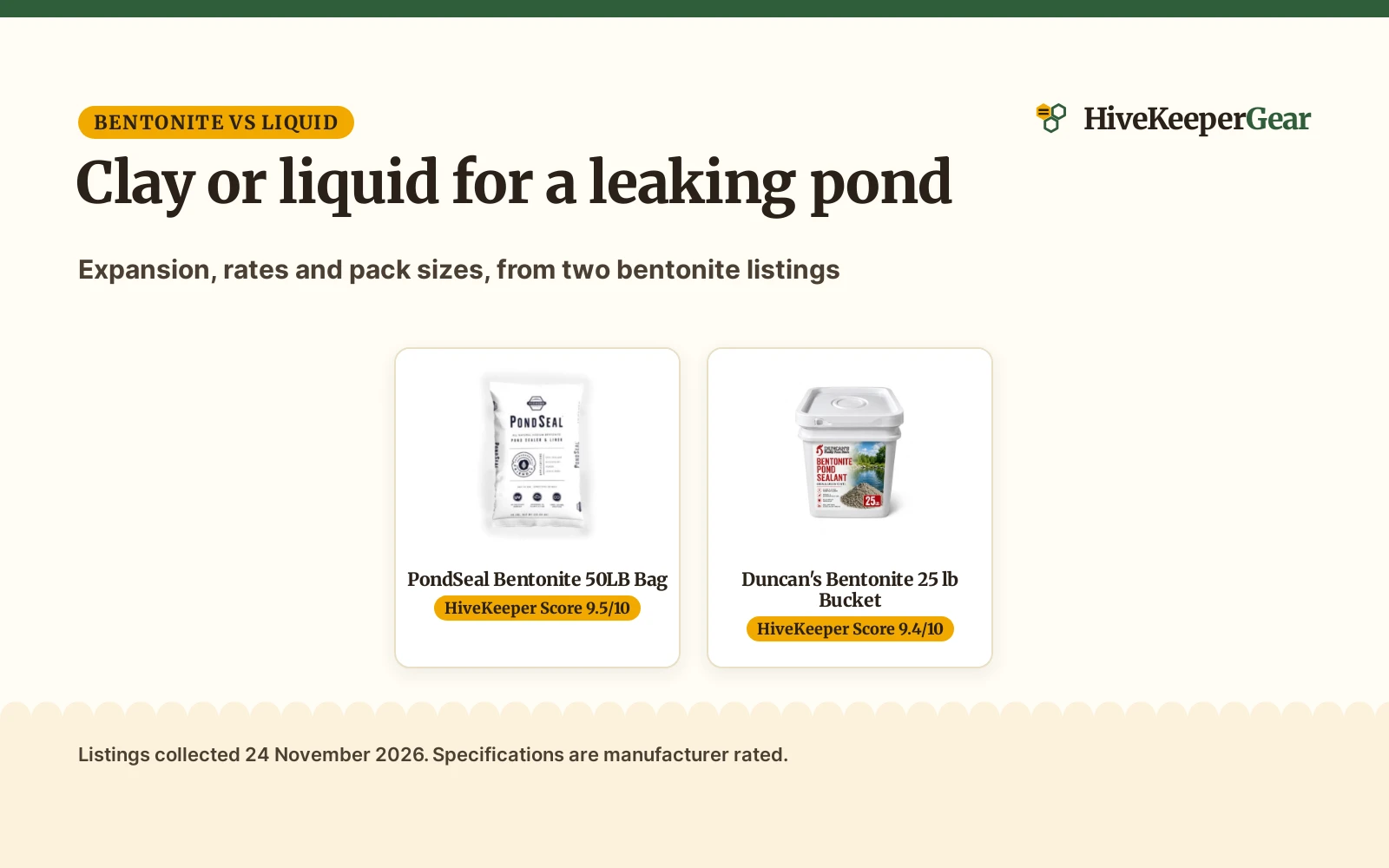
 PondSeal Bentonite 50LB Bag9.5/10View on Amazon
- 2
 Duncan's Bentonite 25 lb Bucket9.4/10View on Amazon
A garden pond that loses water through its bed leaves the keeper topping it up all season, and the choice comes down to bentonite vs liquid pond sealant. Both listings supplied for this comparison are bentonite clay, and no liquid pond sealant listing was supplied, so only the bentonite side has stated figures here. The verdict is plain: bentonite fits a pond that can be drained, blended and compacted as the listings describe, while the liquid side cannot be scored here because no liquid listing states its figures.
HiveKeeperGear earns a commission when you buy through links on this page, at no extra cost to you. As an Amazon Associate I earn from qualifying purchases. Affiliate disclosure.
Quick verdict: choose bentonite if the pond can be emptied and the bed blended, dampened and compacted as the listings describe, since both listings describe blending, dampening and compacting clay into prepared soil. Choose a liquid sealant only if a liquid listing states its coverage and method in plain figures, which no listing here does. With no liquid example supplied, bentonite is the only side this comparison can score.
Two examples
PondSeal Bentonite 50LB Bag
A 50 lb bag of natural bentonite clay that expands up to 15 times when hydrated, for mixed blanket application at 4-7 lbs per square foot.
Pros
- Expands up to 15 times when hydrated, per the maker
- 50 lb bag for mixed blanket work
- Mixed blanket rate of 4-7 lbs per square foot is stated
- Lists ponds, lagoons, canals and decorative water features as uses
Cons
- No warranty term is stated
- Blanket method needs prepared soil, blending, dampening and compacting
- No bucket or resealable container is stated
- Application rate varies with soil conditions, per the maker
Duncan's Bentonite 25 lb Bucket
A 25 lb bucket of granular bentonite clay for mixed blanket application, with stated rates of 2-6 lbs per square foot.
Pros
- Granular clay in a 25 lb bucket suits smaller projects and repairs
- Mixed blanket rate of 4-7 lbs per square foot is stated
- Till depth of 3-5 inches is stated for soil prep
- Lists ponds, lagoons, canals and decorative water features as uses
Cons
- No warranty term is stated
- Bucket holds less clay than the 50 lb PondSeal bag, so larger ponds need more buckets
- No item dimensions are stated
- Blanket method needs soil tilled, blended, dampened and compacted before filling
As an Amazon Associate I earn from qualifying purchases.
Bentonite vs liquid pond sealant: side by side
| Sealant | HiveKeeper Score | Form | Item weight | Mixed blanket rate |
|---|---|---|---|---|
| PondSeal Bentonite 50LB Bag | 9.5/10 | Natural bentonite clay, 50LB bag | 50 lb | 4-7 lbs per square foot |
| Duncan’s Bentonite 25 lb Bucket | 9.4/10 | Granular bentonite clay, 25 lb bucket | 25 lb | 4-7 lbs per square foot |
All specs repeat what the manufacturer lists, not our own measurements, read on 24 November 2026.
How bentonite seals a pond
Bentonite is a natural clay that swells when it meets water. The PondSeal listing says the clay can expand up to 15 times or more when hydrated, helping create a dense barrier layer when properly installed and compacted. The Duncan’s listing says the clay expands significantly when hydrated, helping form a dense, low-permeability barrier when properly mixed, compacted and installed. Both listings describe the same idea: wet clay swells into the gaps in the soil and slows water moving through it. Neither listing gives a figure for how long the barrier lasts, so that question stays open.
Application rates and soil prep
Both listings give the same rate guidance. General use runs 2-6 lbs per square foot, and mixed blanket work commonly uses 4-7 lbs per square foot. The PondSeal listing blends the clay into the top 3 inches of native soil, while the Duncan’s listing tills native soil 3-5 inches deep, removes rocks, roots and debris, then spreads, blends, dampens and compacts the clay before gradually filling the pond. The rates vary with soil conditions, per both listings, so the figures are a starting range rather than a fixed amount for every bed.
| Step | PondSeal 50LB Bag | Duncan’s 25 lb Bucket |
|---|---|---|
| General rate | 2-6 lbs per square foot | 2-6 lbs per square foot |
| Mixed blanket rate | 4-7 lbs per square foot | 4-7 lbs per square foot |
| Soil prep depth | Top 3 inches | 3-5 inches deep |
| Pack | 50 lb bag | 25 lb bucket |
Bag and bucket sizes
The PondSeal listing is a 50 lb bag that measures 28.0 x 5.0 x 18.0 inches, while the Duncan’s listing is a 25 lb bucket that the maker describes as suited to smaller projects and repairs. The Duncan’s listing states no dimensions, so its footprint cannot be compared with the PondSeal bag.
Listing gaps to check
Neither listing states a warranty term, and neither states a safety feature, so neither side earns points for those in the scoring below. The Duncan’s listing states no dimensions. The liquid side has no listing at all, so its coverage, pack size and method cannot be compared with the bentonite figures here. Check the pack size and the stated rates against the pond bed before ordering, since rates vary with soil conditions.
Which should you choose?
Choose bentonite if the pond can be emptied and the bed blended, dampened and compacted as the listings describe, and the stated rates of 2-6 lbs per square foot fit the job. Our pond liner vs pond sealant guide compares another way to hold water in a pond.
Choose a liquid pond sealant if a liquid listing states its coverage and application method in the same plain figures used here, so the two sides can be compared on equal terms. No liquid listing was supplied for this comparison, so none is scored or named here. For a liner instead of a sealant, see our best black pond liner picks.
Whichever side fits the pond, read the stated rates first and match them to the bed, and keep a pump for emptying a pond on hand for the drain-down before blanket work.
Inside the HiveKeeper Score
| Product | HiveKeeper Score | Perf. /35 | Build /25 | Value /25 | Safety /10 | Warranty /5 |
|---|---|---|---|---|---|---|
| PondSeal Bentonite 50LB Bag | 9.5 | 30 | 21 | 21 | 0 | 0 |
| Duncan’s Bentonite 25 lb Bucket | 9.4 | 28 | 20 | 20 | 0 | 0 |
We map points onto a band running from 9.2 up to 9.8 in a straight line, so ranking by score is ranking by points.
The HiveKeeper Score weighs performance, build, value, safety and warranty, as explained on our how we pick page. The PondSeal bag scores higher on performance for its stated expansion figure of up to 15 times and its stated bag dimensions. The Duncan’s bucket scores lower on performance because it states no expansion figure and no dimensions. Neither listing states a warranty term or a safety feature, so neither earns warranty or safety points. How we pick explains the weights.
FAQs for beekeepers
How much bentonite do I need per square foot?
Both listings state general rates of 2-6 lbs per square foot, with mixed blanket work commonly using 4-7 lbs per square foot. The rates vary with soil conditions, so check the stated range against the pond bed before ordering.
How deep should the soil be tilled for a bentonite blanket?
The Duncan’s listing says to till native soil 3-5 inches deep, while the PondSeal listing blends clay into the top 3 inches of native soil. The Duncan’s listing then calls for spreading, blending, dampening and compacting before gradually filling the pond, while the PondSeal listing calls for blending into the top layer, dampening and compacting.
How much does bentonite expand when wet?
The PondSeal listing says bentonite clay can expand up to 15 times or more when hydrated. The Duncan’s listing says the clay expands significantly when hydrated but gives no figure.
What size bag or bucket should I buy?
The PondSeal bag holds 50 lb and measures 28.0 x 5.0 x 18.0 inches, while the Duncan’s bucket holds 25 lb and states no dimensions. The Duncan’s listing describes its bucket as suited to smaller projects and repairs.
Can bentonite seal a pond that already holds water?
The listings here describe applying bentonite over prepared native soil, then dampening and compacting before filling the pond, which describes work on a drained bed. The Duncan’s listing adds gradually filling the pond after compacting. No liquid sealant listing was supplied to compare a wet application.
More hive guides
Related: pond liner vs pond sealant, silicone pond sealant, best black pond liner, and HDPE vs PVC pond liner.