Best Bachelor Button Seeds for Pollinators (2026)
Tall blue and dwarf bachelor button seed packs compared by seed count, height, germination and pollinator value for bee-friendly gardens.

On this page
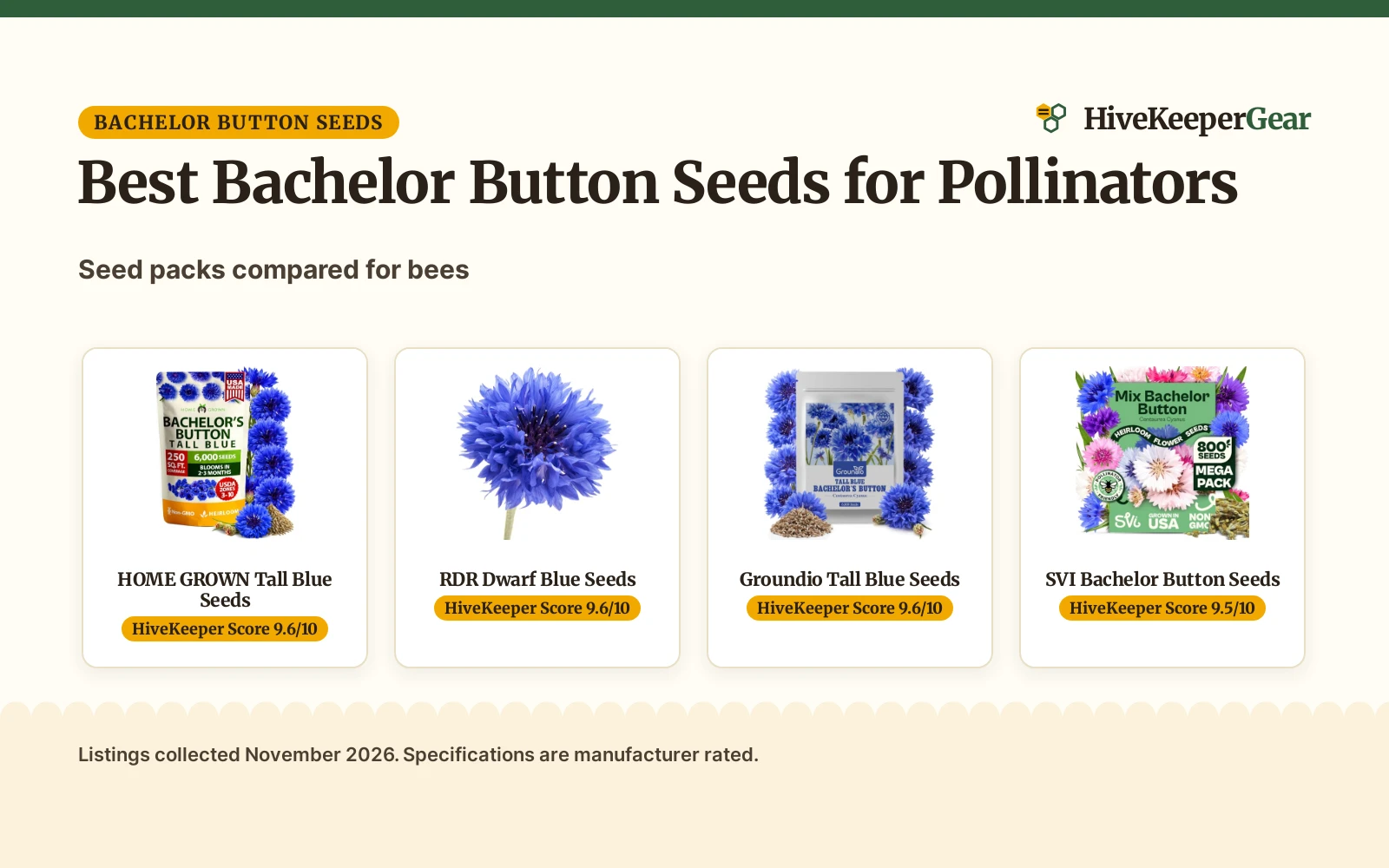
Top picks at a glance
As an Amazon Associate I earn from qualifying purchases.
- 1
 Best OverallHOME GROWN Tall Blue Seeds9.6/10View on Amazon
- 2
 Best Dwarf PickRDR Dwarf Blue Seeds9.6/10View on Amazon
- 3
 Best Bulk PackGroundio Tall Blue Seeds9.6/10View on Amazon
- 4
 Best Color MixSVI Bachelor Button Seeds9.5/10View on Amazon
- 5
 Best Small PackKVITER Mix Bachelor Seeds9.5/10View on Amazon
The best bachelor button seeds for pollinators turn a quiet strip of ground beside the hives into steady forage. A drift of blue blooms draws honeybees and wild insects to the garden, and this comparison covers Centaurea cyanus seed packs by seed count, height, germination and zones. Each listing was scored on performance, build, value, safety and warranty.
HiveKeeperGear earns a commission when you buy through links on this page, at no extra cost to you. As an Amazon Associate I earn from qualifying purchases. Affiliate disclosure.
Quick picks
- Best Overall HOME GROWN Tall Blue Seeds: 6,000 tall blue seeds, AAS winner, zones 3 to 11 Check price on Amazon
- Best Dwarf Pick RDR Dwarf Blue Seeds: Compact 12 to 24 inch habit, 1000 seeds, clear grow guide Check price on Amazon
- Best Bulk Pack Groundio Tall Blue Seeds: 6000+ tall blue seeds, deer resistant, 24 to 36 inch stems Check price on Amazon
- Best Color Mix SVI Bachelor Button Seeds: 800 seeds in red, white, pink and blue on 30 inch stems Check price on Amazon
- Best Small Pack KVITER Mix Bachelor Seeds: 800 mixed color seeds, germination in 7 to 10 days Check price on Amazon
Picks for the bee yard
| # | Product | HiveKeeper Score | Buy |
|---|---|---|---|
| 1 | HOME GROWN Tall Blue Seeds | 9.6/10 | Buy on Amazon |
| 2 | RDR Dwarf Blue Seeds | 9.6/10 | Buy on Amazon |
| 3 | Groundio Tall Blue Seeds | 9.6/10 | Buy on Amazon |
| 4 | SVI Bachelor Button Seeds | 9.5/10 | Buy on Amazon |
| 5 | KVITER Mix Bachelor Seeds | 9.5/10 | Buy on Amazon |
HOME GROWN Tall Blue Seeds
A 6,000-seed pack of tall blue heirloom bachelor buttons, an All-America Selections winner, listed as pollinator friendly in zones 3 to 11.
Pros
- 6,000 seeds per pack, tied for the largest count here
- All-America Selections winner, the only award mention here
- Hardy in zones 3 to 11 and frost resistant
- Blooms stated as edible, with a sweet-spicy taste
Cons
- No germination time is stated
- No plant height is stated
- No warranty term is stated
RDR Dwarf Blue Seeds
A 1000-seed pack of dwarf blue bachelor buttons, 12 to 24 inches tall, for small beds and containers.
Pros
- Grow guide with sowing depth, spacing, temperatures and sprouting time
- Compact 12 to 24 inch habit suits small beds and containers
- 1000 seeds can cover about 140 to 390 square feet under good conditions
- USA grown and packed, non-GMO heirloom seed
Cons
- Coverage range is wide and depends on spacing, thinning and weather
- No hardiness zones are stated
- Direct sow is recommended, as transplants dislike root disturbance
- No warranty term is stated
Groundio Tall Blue Seeds
A 6000+ seed pack of tall blue heirloom bachelor buttons listed as deer resistant and drought tolerant once established.
Pros
- 6000+ seeds per pack, tied for the largest count here
- Tall 24 to 36 inch stems for borders and plantings
- Listed as deer resistant and drought tolerant once established
- Non-GMO heirloom seed, open-pollinated
Cons
- Germination line reads 714 days, which looks like a misprint, so no usable germination figure is stated
- Listing calls the seed perennial, while another listing here describes bachelor buttons as commonly grown as an annual
- No hardiness zones are stated
- No warranty term is stated
SVI Bachelor Button Seeds
An 800-seed pack of bachelor buttons in red, white, pink and blue on 30 inch stems, listed as deer resistant.
Pros
- Colors in one pack: red, white, pink and blue
- Germination in 7 to 10 days at 65 to 70 degrees Fahrenheit when sown 1/2 inch deep
- Zones 1 to 12 in full sun, with 30 inch stems
- Listed as deer resistant and a pollinator favorite
Cons
- Title calls it a wildflower blend, but the listing describes a single species in several colors
- Only 800 seeds per pack, the smallest count alongside KVITER
- Tall stems may need support, as the listing advises
- No warranty term is stated
KVITER Mix Bachelor Seeds
An 800-seed mix of bachelor buttons in blue, pink, red, white and purple, for gardens or containers in zones 1 to 12.
Pros
- Germination in 7 to 10 days when planted 1/2 inch deep in full sun
- Colors: blue, pink, red, white and purple
- Listed for zones 1 to 12 in gardens or containers
- Spacing of 6 to 8 inches and height up to 30 inches
Cons
- Only 800 seeds per pack, the smallest count alongside SVI
- No packet dimensions are stated
- Deadheading is needed for continuous flowering
- No warranty term is stated
As an Amazon Associate I earn from qualifying purchases.
Other hives and gear to compare
 The Old Farmer's Almanac Bachelors Buttons SeedsCheck price on Amazon
 Blue Cornflower SeedsCheck price on Amazon
 CarpetC 3000+ Blue Cornflower Seeds for PlantingCheck price on Amazon
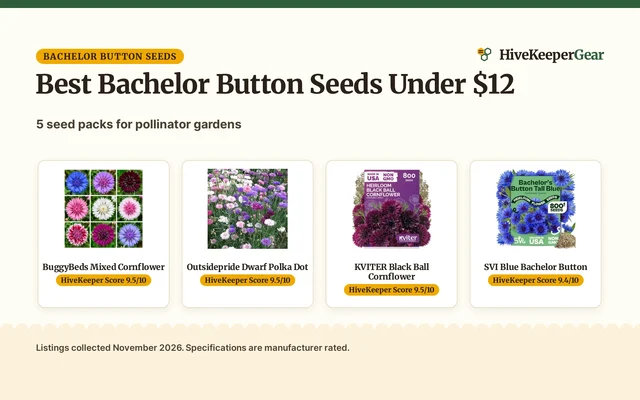
 Outsidepride Dwarf Polka Dot Mix Cornflower SeedsCheck price on Amazon
 5200+ Mixed Cornflower SeedsCheck price on Amazon
Head to head
| Seed Pack | HiveKeeper Score | Seeds per Pack | Height | Germination | Zones |
|---|---|---|---|---|---|
| HOME GROWN Tall Blue Seeds | 9.6/10 | 6,000 seeds | Not stated | Not stated | 3 to 11 |
| RDR Dwarf Blue Seeds | 9.6/10 | 1000 seeds | 12 to 24 inches | 7 to 14 days | Not stated |
| Groundio Tall Blue Seeds | 9.6/10 | 6000+ seeds | 24 to 36 inches | Not stated | Not stated |
| SVI Bachelor Button Seeds | 9.5/10 | 800 seeds | 30 inches | 7 to 10 days | 1 to 12 |
| KVITER Mix Bachelor Seeds | 9.5/10 | 800 seeds | Up to 30 inches | 7 to 10 days | 1 to 12 |
These figures come from the product listings and are the brand’s own claims, gathered 12 November 2026.
How to choose the best bachelor button seeds for pollinators
Seed count and coverage
Seed count sets the size of the planting. HOME GROWN and Groundio list 6,000 and 6000+ seeds per pack, while RDR lists 1000 seeds and SVI and KVITER list 800 seeds each. RDR states 1000 seeds can cover about 140 to 390 square feet under good conditions. A large count suits a meadow strip or border; a smaller count suits a trial bed. For a wider forage planting, see best pollinator seed mix for apiaries.
Height and habit
Height shapes where each pack fits. RDR lists a compact 12 to 24 inch habit for small beds and containers, while Groundio lists tall 24 to 36 inch stems for borders and wildflower plantings. KVITER lists growth up to 30 inches tall, and SVI lists 30 inch stems. HOME GROWN gives no plant height.
| Seed Pack | Seeds per Pack | Height | Germination |
|---|---|---|---|
| HOME GROWN Tall Blue Seeds | 6,000 | Not stated | Not stated |
| RDR Dwarf Blue Seeds | 1000 | 12 to 24 inches | 7 to 14 days |
| Groundio Tall Blue Seeds | 6000+ | 24 to 36 inches | Not stated |
| SVI Bachelor Button Seeds | 800 | 30 inches | 7 to 10 days |
| KVITER Mix Bachelor Seeds | 800 | Up to 30 inches | 7 to 10 days |
Germination and sowing
Germination times are close across the packs that state them. KVITER and SVI list germination in 7 to 10 days, KVITER when planted 1/2 inch deep in full sun and SVI at 65 to 70 degrees Fahrenheit, while RDR lists sprouts in 7 to 14 days. Spacing is 6 to 12 inches for RDR and 6 to 8 inches for KVITER. Groundio gives no usable germination figure, as its germination line reads 714 days.
Color and pollinator value
Color runs from tall blue to mixed shades. HOME GROWN and Groundio list tall blue blooms, KVITER lists blue, pink, red, white and purple, and SVI lists red, white, pink and blue. Each listing describes the blooms as pollinator friendly; SVI names butterflies, bees and songbirds. HOME GROWN states the opened marginal flowers are edible, and KVITER lists edible blooms. For more bee forage color, see best zinnia seeds for pollinators and best cosmos seeds for pollinators.
In the Bee Yard
- Sow directly outdoors after frost, or start indoors earlier.
- Keep packets dry; RDR notes a waterproof packet that protects seeds from humidity and moisture.
- Deadhead spent blooms to keep color going, as the KVITER and SVI listings advise.
- Save seed heads or let plants reseed, as the SVI listing suggests.
Inside the HiveKeeper Score
The HiveKeeper Score weighs performance, build, value, safety and warranty. For seed packs, safety means stated non-GMO and heirloom status. None of the listings state a warranty. How we pick explains the weights.
| Product | HiveKeeper Score | Perf. /35 | Build /25 | Value /25 | Safety /10 | Warranty /5 |
|---|---|---|---|---|---|---|
| HOME GROWN Tall Blue Seeds | 9.6 | 30 | 21 | 21 | 8 | 0 |
| RDR Dwarf Blue Seeds | 9.6 | 30 | 21 | 20 | 7 | 0 |
| Groundio Tall Blue Seeds | 9.6 | 29 | 20 | 21 | 7 | 0 |
| SVI Bachelor Button Seeds | 9.5 | 29 | 20 | 19 | 7 | 0 |
| KVITER Mix Bachelor Seeds | 9.5 | 28 | 19 | 19 | 7 | 0 |
Shown scores begin at a 9.2 minimum and reach a 9.8 maximum; an item climbs that scale only by earning more points.
FAQs for beekeepers
How long do bachelor button seeds take to germinate?
KVITER and SVI list germination in 7 to 10 days, and RDR lists sprouts in 7 to 14 days.
How tall do bachelor button plants grow?
RDR lists a compact 12 to 24 inch habit, KVITER lists growth up to 30 inches, SVI lists 30 inch stems, and Groundio lists 24 to 36 inch stems.
What hardiness zones suit bachelor buttons?
HOME GROWN lists zones 3 to 11, and KVITER and SVI list zones 1 to 12.
Are bachelor button blooms edible?
HOME GROWN states the opened marginal flowers are edible, with a sweet-spicy taste. KVITER also lists edible blooms.
Do bachelor buttons attract pollinators?
Each listing describes the blooms as pollinator friendly; SVI names butterflies, bees and songbirds.
More hive guides
See every beekeeping tools guide. Also see best pollinator seed mix for apiaries and best zinnia seeds for pollinators.
More picks: lavender seeds for pollinators, borage seeds for pollinators, and sunflower seeds for pollinators.