Best Insect Field Guides (2026): 4 Guides for North America
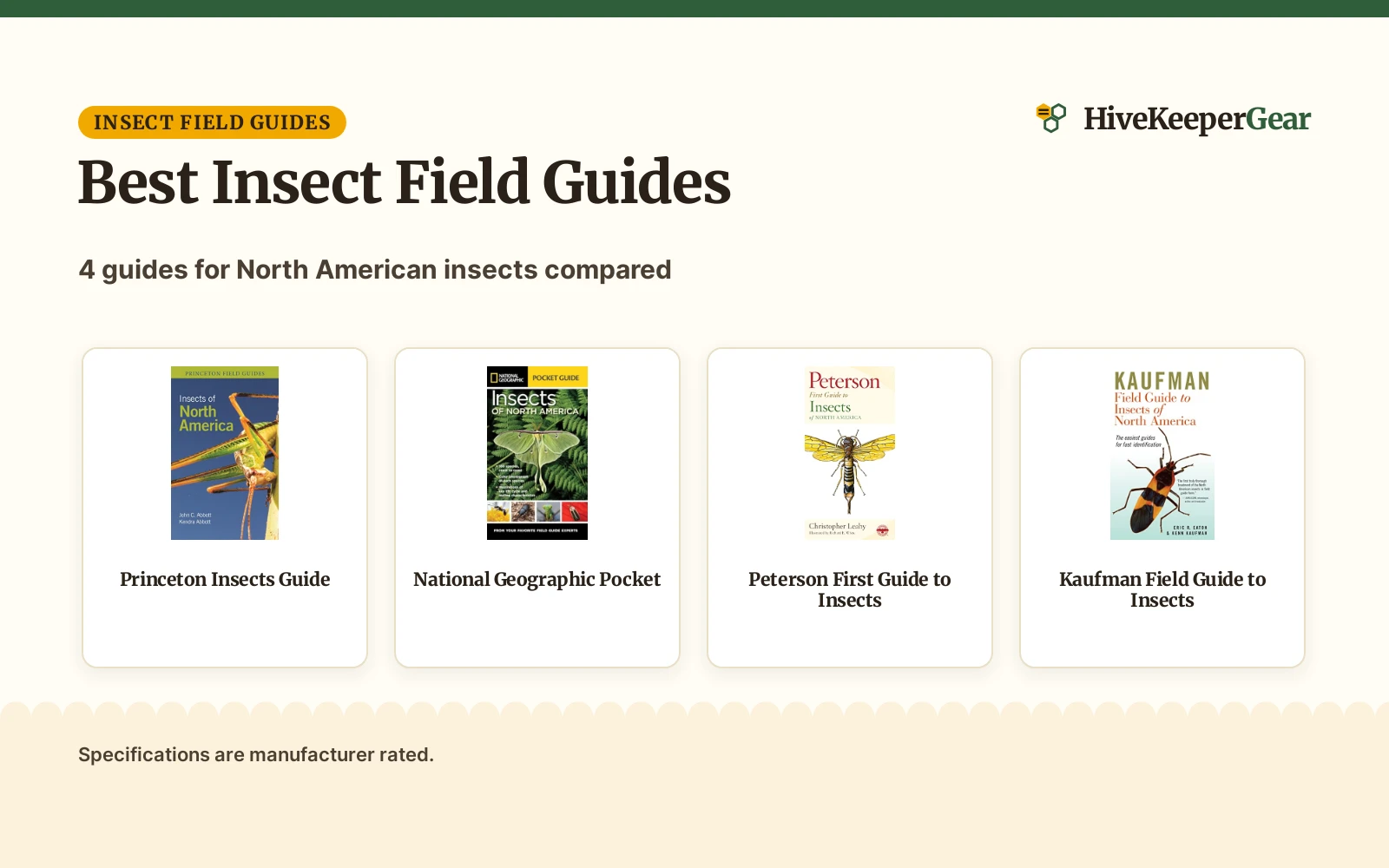
4 insect field guides for North America compared by family coverage, photos, size and weight, from a beginner first guide to a 783-family reference.

On this page
A beetle crosses the path during a spring hive check, and the best insect field guides give the keeper a name for it before the next visit. A field guide turns that moment into an identification, with photos and keys that sort look-alike insects into families. This roundup compares the best insect field guides for North American insects, scoring each on coverage, photos, size and weight.
HiveKeeperGear earns a commission when you buy through links on this page, at no extra cost to you. As an Amazon Associate I earn from qualifying purchases. Affiliate disclosure.
Quick picks
- Best Overall Princeton Insects Guide: 783 families and more than 3,700 color photos with keys Check price on Amazon
- Best Pocket Guide National Geographic Pocket: 160 colour photographs and 160 illustrations in pocket size Check price on Amazon
- Best for Beginners Peterson First Guide to Insects: Beginner-friendly first guide, simplified and illustrated Check price on Amazon
- Best Classic Guide Kaufman Field Guide to Insects: Kaufman field guide to insects of North America Check price on Amazon
Picks for the bee yard
| # | Product | HiveKeeper Score | Buy |
|---|---|---|---|
| 1 |  Princeton Insects Guide | 9.5/10 | Buy on Amazon |
| 2 |  National Geographic Pocket | 9.5/10 | Buy on Amazon |
| 3 |  Peterson First Guide to Insects | 9.4/10 | Buy on Amazon |
| 4 |  Kaufman Field Guide to Insects | 9.4/10 | Buy on Amazon |
Princeton Insects Guide
A photographic field guide covering 783 insect families with more than 3,700 color photos, identification keys and an illustrated glossary.
Pros
- Covers 783 insect families in the United States and Canada
- More than 3,700 color photos, nearly every photo identified to species level
- Identification keys to families for many orders
- Illustrated glossary and introduction on classification and collecting techniques
Cons
- Heaviest guide here at 2.31 lb
- Thickest guide here at 1.6 in, not a pocket guide
- No warranty term is stated
- Depth of coverage suits study more than a quick field check
National Geographic Pocket
A pocket guide to insects of North America with 160 colour photographs and 160 illustrations, published in 2016.
Pros
- 160 colour photographs and 160 illustrations
- Pocket size at 4.29 x 0.43 x 7.24 in
- Light at 0.5 lb
- From National Geographic field guide experts
Cons
- No family count is stated
- No identification keys are stated
- No illustrated glossary is stated
- 160 photographs cover fewer insects than the Princeton guide's 3,700
Peterson First Guide to Insects
A beginner-friendly first guide to North America's common insects, simplified and illustrated for young naturalists.
Pros
- Beginner-friendly, simplified and illustrated
- Made for young naturalists
- Lowest-weight guide here at 0.25 lb
- Slimmest guide here at 0.36 in thick
Cons
- No photo count is stated
- No family count is stated
- No identification keys are stated
- Published in 1998, the oldest guide here
Kaufman Field Guide to Insects
A field guide to insects of North America from Mariner, published in 2007.
Pros
- Covers insects of North America
- Field guide format at 5.0 x 7.75 in
- From Mariner, publisher of the Peterson first guide
- Full-size format, larger than the pocket guides here
Cons
- No photo count is stated
- No family count is stated
- No identification keys are stated
- No warranty term is stated
As an Amazon Associate I earn from qualifying purchases.
Head to head
| Guide | HiveKeeper Score | Families | Photos | Dimensions | Weight |
|---|---|---|---|---|---|
| Princeton Insects Guide | 9.5/10 | 783 families | More than 3,700 color photos | 4.8 x 1.6 x 7.3 in | 2.31 lb |
| National Geographic Pocket | 9.5/10 | Not stated | 160 colour photographs, 160 illustrations | 4.29 x 0.43 x 7.24 in | 0.5 lb |
| Peterson First Guide to Insects | 9.4/10 | Not stated | Not stated | 3.75 x 0.36 x 7.25 in | 0.25 lb |
| Kaufman Field Guide to Insects | 9.4/10 | Not stated | Not stated | 1.0 x 5.0 x 7.75 in | 1.25 lb |
All specs repeat what the manufacturer lists, not our own measurements, read on 24 November 2026.
How to choose the best insect field guides
Coverage and photos
Coverage is the first split among the 4 guides. The Princeton guide covers 783 insect families currently recognized in the United States and Canada, with more than 3,700 color photos, and nearly every photo is identified to species level. The National Geographic pocket guide lists 160 colour photographs and 160 illustrations. The Peterson first guide and the Kaufman guide state no family count and no photo count, so a reader who wants a stated count should look at the Princeton or National Geographic guide.
| Guide | Families | Photos | Size |
|---|---|---|---|
| Princeton Insects Guide | 783 families | More than 3,700 color photos | 4.8 x 1.6 x 7.3 in |
| National Geographic Pocket | Not stated | 160 colour photographs, 160 illustrations | 4.29 x 0.43 x 7.24 in |
| Peterson First Guide to Insects | Not stated | Not stated | 3.75 x 0.36 x 7.25 in |
| Kaufman Field Guide to Insects | Not stated | Not stated | 1.0 x 5.0 x 7.75 in |
Size and weight for the field
A guide that stays home does no good on the path. The Peterson first guide measures 3.75 x 0.36 x 7.25 in and weighs 0.25 lb, the lowest-weight and slimmest guide here. The National Geographic pocket guide measures 4.29 x 0.43 x 7.24 in and weighs 0.5 lb. The Kaufman guide measures 1.0 x 5.0 x 7.75 in and weighs 1.25 lb. The Princeton guide measures 4.8 x 1.6 x 7.3 in and weighs 2.31 lb, the heaviest and thickest guide here, so it suits study at home more than a pocket. The 4 guides span a wide range of sizes, so a reader should measure a jacket pocket or a shelf before choosing.
Beginner or reference
The Peterson first guide is beginner-friendly, simplified and illustrated, and the title describes it as ready for young naturalists. The Princeton guide adds identification keys to families for many orders, an illustrated glossary, and an introduction covering classification, nomenclature, insect diversity and modern collecting techniques, which suits a reader building a reference shelf. A guide pairs well with an insect habitat kit or an insect keeping box for a closer look at a live insect before release.
Publication dates
The Peterson first guide was published in 1998, the Kaufman guide in 2007, the National Geographic pocket guide in 2016, and the Princeton guide in 2023. The Princeton guide notes that it is the first field companion of its kind since the Peterson guide in 1970. A reader who wants the most recent family coverage should start with the Princeton guide.
In the Bee Yard
- Carry the pocket guides in a jacket pocket: the Peterson guide measures 3.75 x 0.36 x 7.25 in and the National Geographic guide measures 4.29 x 0.43 x 7.24 in.
- Keep the Princeton guide on the shelf: at 2.31 lb and 1.6 in thick, it suits study at home more than a pocket.
- Store all 4 guides in a dry spot away from the smoker and damp hive tools.
- Match the guide to the season: the Peterson first guide suits young naturalists learning common insects.
Inside the HiveKeeper Score
The HiveKeeper Score weighs performance, build, value, safety and warranty. For field guides, performance means family coverage and photos, build means the size and weight a reader carries, and value means what the guide offers for its format. None of the 4 guides states a safety certification or a warranty term, so safety and warranty score nothing for every guide. How we pick explains the weights.
| Product | HiveKeeper Score | Perf. /35 | Build /25 | Value /25 | Safety /10 | Warranty /5 |
|---|---|---|---|---|---|---|
| Princeton Insects Guide | 9.5 | 32 | 21 | 20 | 0 | 0 |
| National Geographic Pocket | 9.5 | 29 | 21 | 20 | 0 | 0 |
| Peterson First Guide to Insects | 9.4 | 28 | 20 | 21 | 0 | 0 |
| Kaufman Field Guide to Insects | 9.4 | 27 | 19 | 19 | 0 | 0 |
We map points onto a band running from 9.2 up to 9.8 in a straight line, so ranking by score is ranking by points.
FAQs for beekeepers
What is a field guide?
A field guide is a book that helps readers identify insects by photos, descriptions and keys. The guides here cover insects of North America, and the Princeton guide adds identification keys to families for many orders and an illustrated glossary.
Which insect field guide covers the most families?
The Princeton guide covers 783 insect families currently recognized in the United States and Canada, with more than 3,700 color photos, nearly every photo identified to species level.
Which guide is best for a beginner?
The Peterson first guide is beginner-friendly, simplified and illustrated for young naturalists. It is also the lowest-weight guide here at 0.25 lb.
Which guide is smallest for carrying in the field?
The Peterson guide measures 3.75 x 0.36 x 7.25 in and weighs 0.25 lb. The National Geographic pocket guide measures 4.29 x 0.43 x 7.24 in and weighs 0.5 lb.
More hive guides
See every worm and insect keeping guide and all maple sugaring guides. Also see our best insect habitat kit. Also see our insect observation habitat vs bug viewer.
More picks: insect keeping boxes, stick insect habitats, and mealworm feeders for bluebirds.