Best Lemon Balm Seeds for Pollinators (2026): 5 Seed Packs Compared
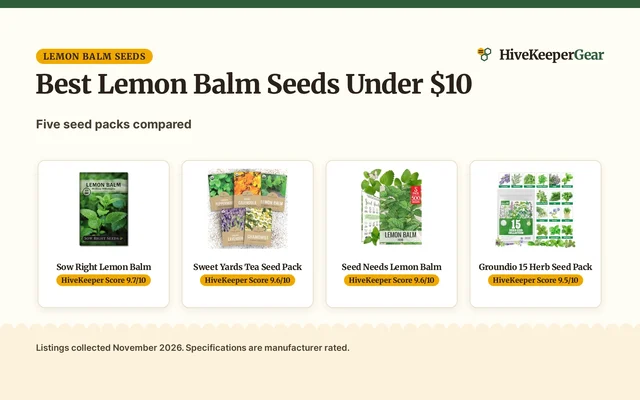
Five heirloom, non-GMO lemon balm seed packs compared by seed count, germination, plant height, and growing zones for a pollinator bed near the hives.

On this page
Top picks at a glance
As an Amazon Associate I earn from qualifying purchases.
- 1
 Best OverallSVI 1000 Lemon Balm Seeds9.7/10View on Amazon
- 2
 Best Two-PackSweet Yards Lemon Balm Seeds9.5/10View on Amazon
- 3
 Best Mid-Size PackKVITER 700 Lemon Balm Seeds9.5/10View on Amazon
- 4
 Best Germination RateHOME GROWN 403 Lemon Balm Seeds9.5/10View on Amazon
- 5
 Best XL PackSeed Needs Lemon Balm Seeds9.5/10View on Amazon
On a still morning in late spring, the hives hum louder as foragers stream out toward the open blooms, and the keeper watches the flight lines to see which plants draw the most visits. The best lemon balm seeds for pollinators turn a spare bed or a row of pots into a steady patch of small white flowers that bees work through the warm season. We compared lemon balm seed packs by seed count, germination guidance, plant height, growing zones, and packet details.
HiveKeeperGear earns a commission when you buy through links on this page, at no extra cost to you. As an Amazon Associate I earn from qualifying purchases. Affiliate disclosure.
Quick picks
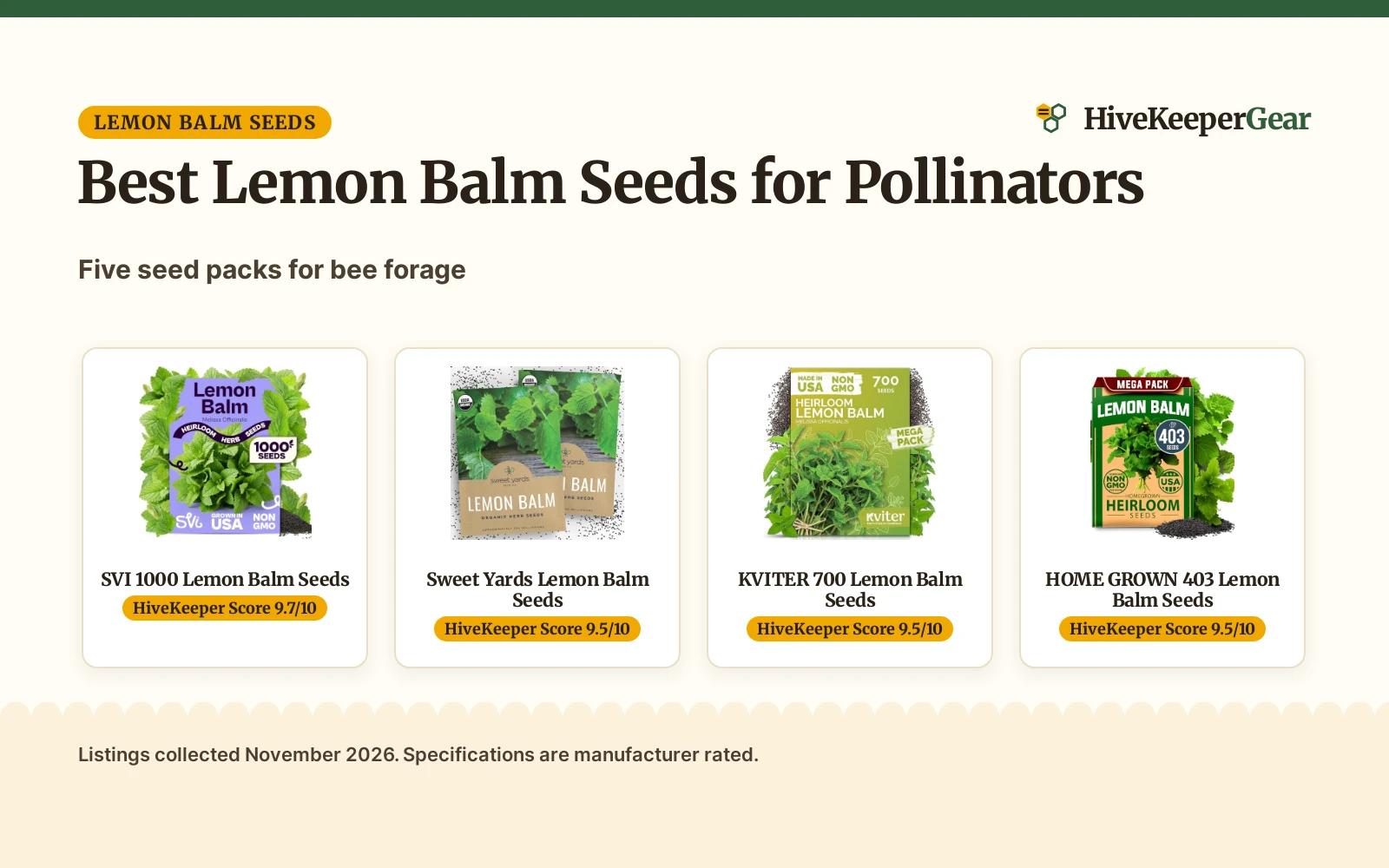
- Best Overall SVI 1000 Lemon Balm Seeds: 1000 heirloom seeds with 7 to 14 day germination Check price on Amazon
- Best Two-Pack Sweet Yards Lemon Balm Seeds: Two packets, approx. 682 seeds, with a 30-day refund term Check price on Amazon
- Best Mid-Size Pack KVITER 700 Lemon Balm Seeds: 700 heirloom seeds with 65 °F germination guidance Check price on Amazon
- Best Germination Rate HOME GROWN 403 Lemon Balm Seeds: Stated 85 to 90 percent germination rate, 403 seeds Check price on Amazon
- Best XL Pack Seed Needs Lemon Balm Seeds: Untreated heirloom seed in illustrated 3.5 by 5 inch packets Check price on Amazon
Picks for the bee yard
| # | Product | HiveKeeper Score | Buy |
|---|---|---|---|
| 1 | SVI 1000 Lemon Balm Seeds | 9.7/10 | Buy on Amazon |
| 2 | Sweet Yards Lemon Balm Seeds | 9.5/10 | Buy on Amazon |
| 3 | KVITER 700 Lemon Balm Seeds | 9.5/10 | Buy on Amazon |
| 4 | HOME GROWN 403 Lemon Balm Seeds | 9.5/10 | Buy on Amazon |
| 5 | Seed Needs Lemon Balm Seeds | 9.5/10 | Buy on Amazon |
SVI 1000 Lemon Balm Seeds
A 1000-seed pack of heirloom, non-GMO lemon balm for indoor and outdoor herb gardens, with small white flowers that attract bees and other beneficial pollinators.
Pros
- Largest seed count here at 1000 seeds per pack
- Quickest stated germination at 7 to 14 days
- Suited to USDA zones 4 to 9 in full sun to partial shade
- Perennial growth reaching 24 to 36 inches tall
Cons
- No warranty term is stated
- No packet dimensions are stated
- Listing states no sowing temperature
- Listing states no germination rate
Sweet Yards Lemon Balm Seeds
Two seed packets holding approx. 682 open-pollinated, non-GMO lemon balm seeds, with small white edible flowers and planting instructions on the back of each packet.
Pros
- Two packets for more than one spot or a later sowing
- Approx. 682 seeds across the two packets
- Refund within 30 days if the seeds do not germinate
- Open-pollinated, non-GMO seed from the 2026 season
Cons
- Seed count is approximate rather than exact
- Listing states no germination time in days
- Listing states no plant height, spacing, or growing zones
- Listing states no packet dimensions
KVITER 700 Lemon Balm Seeds
A 700-seed pack of heirloom, non-GMO lemon balm in moisture proof packets, with citrus aroma and blooms that lure bees.
Pros
- 700 heirloom seeds in moisture proof packets
- Germination in 10 to 14 days at 65 °F
- Suited to USDA zones 4 to 9 in full sun or partial shade
- Plants grow 24 to 36 inches tall with blooms that lure bees
Cons
- No warranty term is stated
- Listing states no germination rate
- Smaller seed count than the largest pack in this comparison
- Single pack only, with no second packet for a later sowing
HOME GROWN 403 Lemon Balm Seeds
A 403-seed pack of heirloom, non-GMO lemon balm with a stated 85 to 90 percent germination rate and surface-sowing instructions.
Pros
- Stated germination rate of 85 to 90 percent
- 403 seeds per pack for a large herb garden or sharing
- Surface-sowing guidance: press seeds onto moist soil, do not bury them deep
- Heirloom, non-GMO seed sourced from farms in the USA
Cons
- No warranty term is stated
- Listing states no germination time in days
- Listing states no plant height, spacing, or growing zones
- Smallest seed count among the packs that state a count
Seed Needs Lemon Balm Seeds
An XL pack of heirloom, non-GMO, untreated lemon balm seed in illustrated 3.5 by 5 inch packets, with small white flowers that attract bees, butterflies, and beneficial insects.
Pros
- Heirloom, non-GMO, untreated seed, mostly open-pollinated
- Small white flowers attract bees, butterflies, and beneficial insects
- Illustrated 3.5 by 5 inch packets with sowing guides on the back
- Tear and moisture-resistant packaging from a controlled facility
Cons
- No warranty term is stated
- No seed count is stated anywhere in the listing
- No germination time in days is stated, only results in a few days
- No plant height, spacing, or growing zones are stated
As an Amazon Associate I earn from qualifying purchases.
Other hives and gear to compare
 HOME GROWN Lemon Balm SeedsCheck price on Amazon
 SVI 1500 Lemon Mint Heirloom Herb Seeds Monarda citriodoraCheck price on Amazon
 Sow Right SeedsCheck price on Amazon
 500+ Bee Balm Flower Seeds Perennial Monarda Didyma Bee BalmCheck price on Amazon
 Outsidepride Bee Balm Mix SeedsCheck price on Amazon
Head to head
| Seed Pack | HiveKeeper Score | Seed count | Germination | Plant height | Zones | Packet |
|---|---|---|---|---|---|---|
| SVI 1000 Lemon Balm Seeds | 9.7/10 | 1000 seeds | 7-14 days | 24-36 in | Zones 4-9 | Not stated |
| Sweet Yards Lemon Balm Seeds | 9.5/10 | Approx. 682 seeds | Not stated | Not stated | Not stated | Two packets |
| KVITER 700 Lemon Balm Seeds | 9.5/10 | 700 seeds | 10-14 days | 24-36 in | Zones 4-9 | 4.5 x 3.25 x 0.2 in |
| HOME GROWN 403 Lemon Balm Seeds | 9.5/10 | 403 seeds | 85-90% rate | Not stated | Not stated | 1.0 x 1.0 x 1.0 in |
| Seed Needs Lemon Balm Seeds | 9.5/10 | Not stated | A few days | Not stated | Not stated | 3.5 x 5 in |
Sizes, materials and capacities are the manufacturer’s ratings as each listing states them, collected 11 November 2026.
How to choose the best lemon balm seeds for pollinators
Seed count and pack size
Seed count sets how much ground one pack covers. SVI lists 1000 seeds, KVITER lists 700 seeds, Sweet Yards lists approx. 682 seeds across two packets, and HOME GROWN lists 403 seeds. Seed Needs lists an XL pack but states no seed count. Two packets let a keeper sow in more than one spot or save one for later. A keeper comparing lemon balm with a close cousin can read lemon balm seeds vs bee balm seeds before choosing.
Germination and sowing depth
SVI states seeds sprout in 7 to 14 days when sown 1/4 inch deep. KVITER states 10 to 14 days at 65 °F when barely covered, 1/4 inch deep at most, and lightly misted. HOME GROWN states a germination rate of 85 to 90 percent, with surface sowing on moist soil. Seed Needs states only results in a few days, and Sweet Yards states no germination time.
| Seed Pack | Germination | Sowing depth | Spacing |
|---|---|---|---|
| SVI | 7-14 days | 1/4 in | 20-24 in |
| KVITER | 10-14 days | 1/4 in max | 20-24 in |
| HOME GROWN | 85-90% rate | Surface sow | Not stated |
| Seed Needs | A few days | Not stated | Not stated |
| Sweet Yards | Not stated | Not stated | Not stated |
Height, spacing, and growing zones
KVITER and SVI both state plants reach 24 to 36 inches tall, with 20 to 24 inch spacing, in full sun to partial shade, for USDA zones 4 to 9. That height suits a bed edge or a border where bees can reach the blooms. The other three listings state no height, spacing, or zones. For a wider forage plan, see best pollinator seed mix for apiaries.
Flowers for pollinators
KVITER states blooms that lure bees, SVI states small white flowers that attract bees and other beneficial pollinators, and Seed Needs adds butterflies and beneficial insects. Sweet Yards describes small, white edible flowers with a lemon scent, for teas, fresh salads, or mixed with fruits. Keepers adding more bloom can compare best zinnia seeds for pollinators.
In the Bee Yard
- Sow where foragers can reach the blooms, in beds, borders, or pots near the hives.
- Press tiny seeds onto moist soil and keep them under a light source; covering them with soil prevents sprouting.
- Keep spare packets in their moisture-resistant packaging until sowing day.
- Give each plant room at the stated spacing; lemon balm returns year after year from its root networks.
- With two packets, keep one sealed for a later sowing while the other goes into the ground.
Inside the HiveKeeper Score
The HiveKeeper Score weighs performance (germination guidance and pollinator bloom), build, value, safety, and warranty. For lemon balm seeds, safety means stated non-GMO, heirloom, untreated, and open-pollinated seed. One of the five listings states a refund term. How we pick explains the weights.
| Product | HiveKeeper Score | Perf. /35 | Build /25 | Value /25 | Safety /10 | Warranty /5 |
|---|---|---|---|---|---|---|
| SVI 1000 Lemon Balm Seeds | 9.7 | 32 | 21 | 22 | 7 | 0 |
| Sweet Yards Lemon Balm Seeds | 9.5 | 28 | 20 | 19 | 7 | 2 |
| KVITER 700 Lemon Balm Seeds | 9.5 | 30 | 21 | 20 | 7 | 0 |
| HOME GROWN 403 Lemon Balm Seeds | 9.5 | 30 | 20 | 20 | 7 | 0 |
| Seed Needs Lemon Balm Seeds | 9.5 | 28 | 20 | 19 | 8 | 0 |
HiveKeeper Scores sit between 9.2 and 9.8, and a hive item’s weighted total lands on that range in proportion, so a higher total always gives a higher score.
FAQs for beekeepers
How long do lemon balm seeds take to sprout?
SVI states 7 to 14 days, KVITER states 10 to 14 days at 65 °F, and Seed Needs states results in a few days. HOME GROWN states a germination rate of 85 to 90 percent, and Sweet Yards states no germination time.
How deep should lemon balm seeds be sown?
KVITER and SVI state 1/4 inch deep, with KVITER adding 1/4 inch deep at most. HOME GROWN states to press seeds onto moist soil and not bury them deep.
How tall does lemon balm grow?
KVITER and SVI state plants reach 24 to 36 inches tall. The other three listings state no plant height.
Which growing zones suit lemon balm?
KVITER and SVI state USDA zones 4 to 9, in full sun to partial shade. The other three listings state no growing zones.
What pollinators visit lemon balm flowers?
Small white flowers attract bees and other beneficial pollinators, as SVI states, and Seed Needs adds butterflies and beneficial insects.
How many seeds come in each pack?
SVI lists 1000 seeds, KVITER lists 700, Sweet Yards lists approx. 682 across two packets, and HOME GROWN lists 403. Seed Needs states no seed count.
More hive guides
See every beekeeping tools guide and all beekeeping guides. Also see our lemon balm seeds vs bee balm seeds. Also see our best zinnia seeds for pollinators. Also see our best pollinator seed mix for apiaries. Also see our how to attract mason bees.
More picks: bee balm seeds for gardens, borage seeds, and coneflower seeds. New to beekeeping? Start with our beekeeping equipment list for beginners.