Cellular vs Non Cellular Trail Camera: Which One Should You Buy?
Four non-cellular trail cameras compared by photo resolution, trigger speed, night vision and power, with a clear answer on which side of the cellular question fits your ground.

On this page
Top picks at a glance
As an Amazon Associate I earn from qualifying purchases.
- 1
 Tactacam Reveal Pro 4.0 Solar Cellular Trail Camera9.8/10View on Amazon
- 2
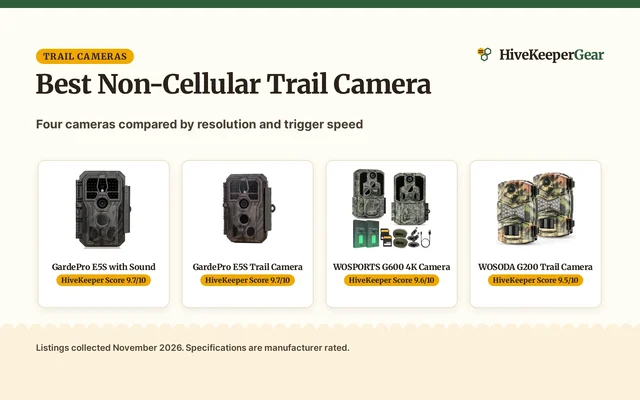
 GardePro E5S Non-Cellular Trail Camera with Sound9.7/10View on Amazon
- 3
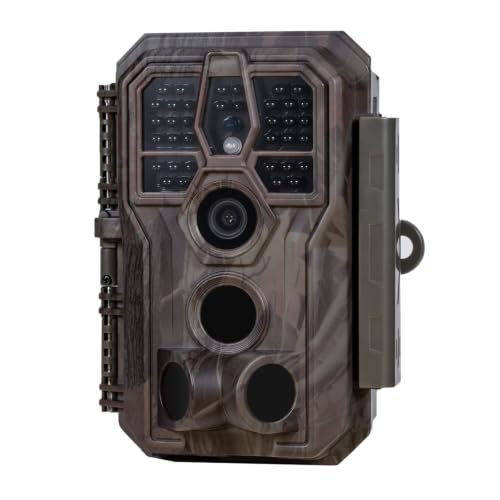 GardePro E5S Non-Cellular Trail Camera9.7/10View on Amazon
- 4
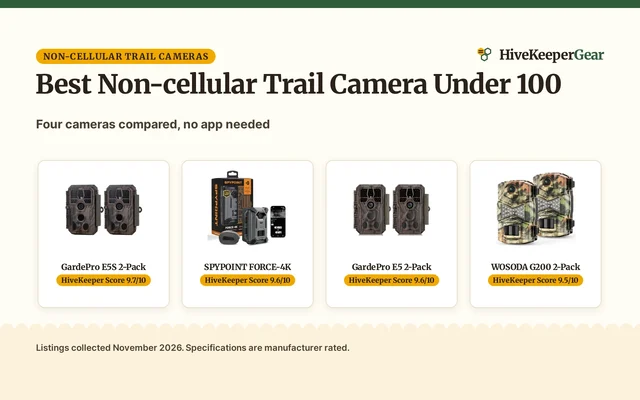
 GardePro A3S 2-Pack Non-Cellular Trail CameraView on Amazon
- 5
 GardePro A3 Non-Cellular Trail CameraView on Amazon
- 6
 Stealth Cam Browtine 16MP Durable Trail Camera BundleView on Amazon
- 7
 SPYPOINT FORCE-24View on Amazon
- 8
 SPYPOINT FORCE-24 Twin PackView on Amazon
- 9
 GardePro E5 Non-Cellular Trail CameraView on Amazon
A cellular vs non cellular trail camera choice comes down to how the photos reach you: a non-cellular camera stores photos and video on an SD card you collect in person, while a cellular camera sends images to your phone without a visit. All four cameras in this guide are non-cellular models, and no cellular model is featured here. If you visit your ground often, the 64MP GardePro A3S 2-pack leads the four picks on photo resolution; if you want photos without the trip, a cellular model is the other side of this choice.
Other hives and gear to compare
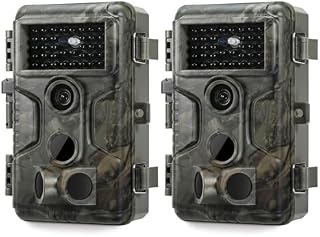 GardePro A3S 2-Pack Non-Cellular Trail CameraCheck price on Amazon
 GardePro A3 Non-Cellular Trail CameraCheck price on Amazon
 Stealth Cam Browtine 16MP Durable Trail Camera BundleCheck price on Amazon
 SPYPOINT FORCE-24Check price on Amazon
 SPYPOINT FORCE-24 Twin PackCheck price on Amazon
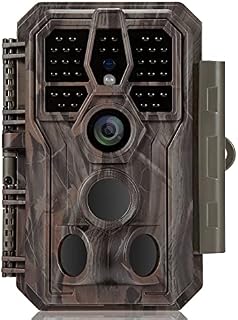 GardePro E5 Non-Cellular Trail CameraCheck price on Amazon
HiveKeeperGear earns a commission when you buy through links on this site, at no extra cost to you. As an Amazon Associate I earn from qualifying purchases. Affiliate disclosure.
Cellular vs non cellular trail camera: how the two sides differ
A non-cellular camera is a self-contained recorder. Motion trips the sensor, the camera writes to its SD card, and nothing leaves the camera until you walk out and view the files, either on the camera itself or from the card. The GardePro listings state non-cellular and non-WiFi operation, and the WOSODA listing states that it never connects to the internet and stores everything locally on an SD card. That independence is the point: the camera needs no signal where it hangs, and the GardePro maker states minimal power use for its non-cellular and non-WiFi models.
A cellular camera works the other way around. It still records to a card, but it also sends captures onward over a mobile signal, so you see new photos without visiting the camera. That suits ground you cannot reach often. Where the signal is weak, the sending side of a cellular camera cannot do its job, while a non-cellular camera keeps recording to its card regardless.
The gear: four non-cellular cameras
Every camera below is a non-cellular model, ranked by stated photo resolution, trigger speed and night vision range. The GardePro A3S 2-pack sits first on 64MP photos and a 0.1s trigger, the GardePro A3 follows with 48MP photos and the same trigger speed, the WOSODA follows with 40MP photos and a rechargeable battery, and the Stealth Cam Browtine bundle closes the list as a 4-pack with cards and a reader.
| Camera | Photo | Trigger | Night vision | Power | Storage |
|---|---|---|---|---|---|
| GardePro A3S 2-pack | 64MP | 0.1s | 100ft no-glow | 8 AA batteries | Up to 512GB SD card |
| GardePro A3 | 48MP | 0.1s | 100ft no-glow | 8 AA batteries | Up to 512GB SD card |
| WOSODA G300Plus | 40MP | 0.2s | Not stated | 2200mAh lithium battery | Up to 256GB SD card |
| Stealth Cam Browtine 4-pack | 14MP | Not stated | 18 IR LEDs | 8 AA batteries | 32GB card included |
GardePro A3S 2-pack. The A3S captures 64MP photos and 1296P HD video with sound through a Sony Starvis sensor, with night vision to 100 feet. Its trigger speed is 0.1s with a 120 degree PIR detection angle and up to 5-shot bursts, with invisible 940nm no-glow infrared. It runs on 8 AA batteries, which are not included, and it supports the GardePro SP350 solar panel, sold separately. Recording modes cover Motion Detection, Time-Lapse and Hybrid Mode, with support for up to 512GB SD cards, not included, plus loop recording. The maker states a 1 Year Manufacturer warranty.
GardePro A3. The A3 captures 48MP photos and 1296P HD video with sound through the same Sony Starvis sensor, with night vision up to 100 feet. Its 0.1s trigger pairs with a 120 degree PIR detection angle and up to 100ft detection range, plus 5-shot burst mode and 940nm no-glow infrared. It runs on 8 AA batteries, not included, supports the GardePro SP350 solar panel, sold separately, and offers Motion Detection, Time-Lapse and Hybrid Mode with support for up to 512GB SD cards, not included. Its housing carries an IP66 waterproof rating, and the maker states a 1 Year Manufacturer warranty.
WOSODA G300Plus. The WOSODA captures 40MP photos (8/16/32/40MP adjustable), and 2K HD videos at 1920 by 1080 or 2560 by 1440. Its 0.2s trigger detects movement up to 80ft away, with a 120 degree detection angle and 1 to 3 burst mode. It runs on a built-in 2200mAh lithium battery, and the maker states a clear note: remove the battery to charge separately, and do not charge via the camera Type-C port. Storage is local on an SD card up to 256GB, not included, and a built-in 2-inch color display previews images and videos without removing the card. Its housing carries an IP66 waterproof rating.
Stealth Cam Browtine 4-pack. The Browtine bundle includes 4 Stealth Cam Browtine 14MP cameras, 4 32GB Ultra SDHC UHS-I memory cards and an All-In-One High Speed USB 2.0 card reader, 9 items in total. Its rapid-fire burst mode takes multiple exposures per triggering, and 18 IR LEDs light night photos. Quick Set options give pre-programmed options or a custom configuration. It requires 8 AA batteries and a class 10 SD card in each camera, and it weighs 1.0 pound.
How to choose the best cellular vs non cellular trail camera
Start with how often you visit the camera
Visit frequency decides the side. If you walk your ground every week, a non-cellular camera costs you nothing in waiting: you collect the card and reset the camera on the same trip. If the camera hangs on ground you reach rarely, the cellular side sends photos without the trip, and our trail camera that sends pictures to your phone guide compares those models. Where there is no mobile signal, the choice is already made: a non-cellular camera keeps recording to its card.
Compare photo resolution and trigger speed
Photo resolution runs from 64MP on the GardePro A3S through 48MP on the GardePro A3 and 40MP on the WOSODA to 14MP on the Stealth Cam Browtine. A higher photo figure means more pixels in each frame. Trigger speed runs from 0.1s on both GardePro models to 0.2s on the WOSODA; the Stealth Cam listing states no trigger speed. A 0.1s trigger catches fast-moving wildlife sooner, and the 120 degree PIR detection angle covers a wide area in front of the camera. The GardePro models add up to 5-shot bursts while the WOSODA offers 1 to 3 burst mode.
Check night vision range
Night vision range runs to 100 feet on both GardePro models, with invisible 940nm no-glow infrared. The WOSODA detects movement up to 80ft away, and the Stealth Cam lights its night photos with 18 IR LEDs without stating a range. A longer range reaches farther across a clearing, while a shorter range still covers a feeder or a narrow path.
Power and storage
Three of the four picks run on 8 AA batteries, and the WOSODA runs on a built-in 2200mAh lithium battery that you remove to charge separately. The GardePro models also support the SP350 solar panel, sold separately, for continuous power in remote spots. Storage runs to 512GB SD cards on both GardePro models and 256GB on the WOSODA, cards not included, while the Stealth Cam bundle includes 4 32GB cards and a card reader. The WOSODA adds a built-in 2-inch color display for previewing captures; our trail camera with viewing screen guide compares more models with screens. For a full set of non-cellular options, see our non-cellular trail camera picks.
FAQs for beekeepers
Do non-cellular trail cameras need WiFi?
No. The GardePro models state non-cellular and non-WiFi operation, and the WOSODA never connects to the internet. All four picks store captures locally on an SD card.
How far can these cameras see at night?
Both GardePro models give night vision to 100 feet with 940nm no-glow infrared. The WOSODA states no night vision range figure; its sensor detects movement up to 80ft away. The Stealth Cam lights night photos with 18 IR LEDs and states no range figure.
What size SD card fits these cameras?
Both GardePro models support SD cards up to 512GB, not included. The WOSODA supports SD cards up to 256GB, not included. The Stealth Cam bundle includes 4 32GB memory cards, one per camera, plus a card reader.
How are these cameras powered?
The GardePro A3S, the GardePro A3 and the Stealth Cam Browtine each run on 8 AA batteries, not included. The WOSODA runs on a built-in 2200mAh lithium battery that you remove to charge separately. The GardePro models also support the SP350 solar panel, sold separately.
Do any of these cameras record video with sound?
Yes. The GardePro A3S and the GardePro A3 both record 1296P HD video with sound. The WOSODA records 2K HD video; the Stealth Cam listing states no video figure.
More hive guides
See every backyard wildlife guide and all wildlife cameras guides.