Best Disposable vs Reusable Beekeeping Gloves Compared
Four disposable glove listings ranked from most featured to simplest, with clear advice on when disposables beat reusable beekeeping gloves in the bee yard.

On this page
Top picks at a glance
As an Amazon Associate I earn from qualifying purchases.
- 1
 100 pcs Plastic Disposable GlovesView on Amazon
- 2
 8 Mil Heavy Duty Disposable Nitrile Gloves with DiamondView on Amazon
- 3
 GUSTO 8 Mil Disposable Orange Nitrile Gloves HEAVY DUTYView on Amazon
- 4
 GLOVEWORKS Nitrile Gloves Disposable Orange 8 mil Heavy DutyView on Amazon
- 5
 Inspire Black Nitrile Disposable GlovesView on Amazon
Late summer in the bee yard means sticky frames, propolis on every tool, and the recurring question of disposable vs reusable beekeeping gloves. The answer depends on the chore: quick, messy jobs favor a glove you can peel off and toss, while unhurried work at the frames favors a sturdy reusable pair you keep season after season.
Other hives and gear to compare
 100 pcs Plastic Disposable GlovesCheck price on Amazon
 8 Mil Heavy Duty Disposable Nitrile Gloves with DiamondCheck price on Amazon
 GUSTO 8 Mil Disposable Orange Nitrile Gloves HEAVY DUTYCheck price on Amazon
 GLOVEWORKS Nitrile Gloves Disposable Orange 8 mil Heavy DutyCheck price on Amazon
 Inspire Black Nitrile Disposable GlovesCheck price on Amazon
HiveKeeperGear earns a commission when you buy through links on this page, at no extra cost to you. As an Amazon Associate I earn from qualifying purchases. Affiliate disclosure.
Disposable vs reusable beekeeping gloves: the short answer
Choose disposable gloves for messy, quick tasks where you want a fresh pair each time: handling honey supers, cleaning feeders, scraping propolis, mixing feed. Choose reusable beekeeping gloves for inspections, frame handling, and lifting boxes, where longer cuffs and tougher material matter. The four listings compared below are all marked disposable, so they cover the first half of that answer; the second half is about knowing when to leave them in the box.
When disposable gloves fit the bee yard
Disposables shine wherever stickiness or dirt is the main problem. Honey harvest is the classic case: you can handle supers, uncap, and clean up with a fresh pair for each stage, then toss them instead of washing honey out of fabric. They also suit feeding, equipment wipe-downs, and any chore where propolis would gum up a good reusable glove. All four listings here are marked disposable in their reusability fields, with counts of 100 except the NEOTRIL at 50, so a box lasts through many such jobs.
When to reach for reusable gloves instead
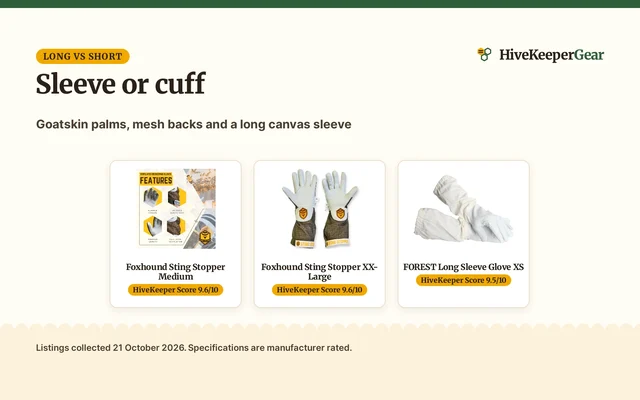
Reusable beekeeping gloves exist for the work disposables cannot do well: full inspections, pulling frames, and moving colonies. Their long gauntlets cover the wrist and forearm where a bee can crawl under a short cuff, and their leather or canvas builds stand up to season after season. None of the four listings below claims sting protection, and all four have short cuffs, so treat them as chore gloves. Our work gloves comparison covers the reusable side in more detail.
The gear: four disposable listings, ranked
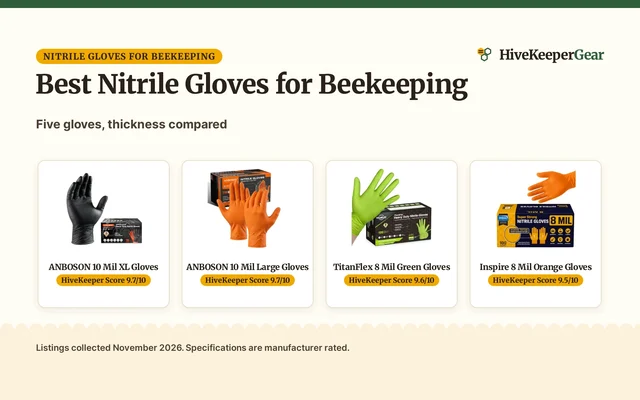
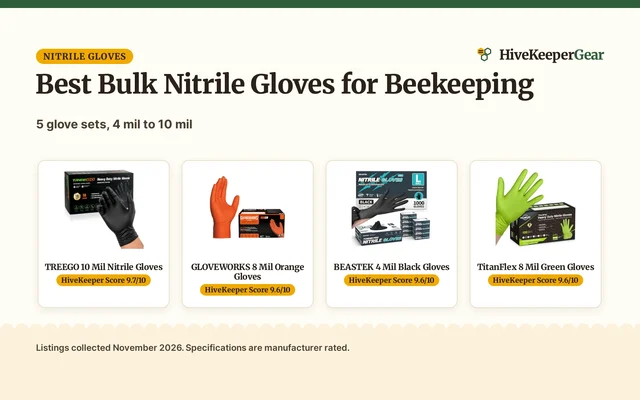
We compared four disposable glove listings on thickness, grip, count, sizes, waterproof claims and warranty, and list them here from the most featured to the simplest. The ANBOSON leads on stated thickness at 10 mil, a food-grade safety claim, and a 3 Year Manufacturer warranty. The TitanFlex and NEOTRIL both list 8 mil nitrile with diamond texture grip; the TitanFlex comes in a 100 count box with sizes S to XXL, while the NEOTRIL is a 50 count box in large only. The MoloTAR is uncoated plastic with a loose fit, the simplest of the four.
| Gloves | Thickness | Count | Grip | Waterproof | Warranty |
|---|---|---|---|---|---|
| ANBOSON 10-Mil Nitrile | 10 mil | 100 | Diamond texture | Water resistant | 3 year |
| TitanFlex 8-Mil Nitrile | 8 mil | 100 | Raised diamond texture | Waterproof | Not stated |
| NEOTRIL 8-Mil Nitrile | 8 mil | 50 | Diamond texture | Waterproof | Not stated |
| MoloTAR Plastic 100 | Not stated | 100 | Uncoated | Not water resistant | Not stated |
Two listings need a note on thickness. The ANBOSON spec table writes 10 millimeters while its title and bullets say 10 mil; we trust the title and bullets. The NEOTRIL title says 8 mil while its spec table says 0.01 inches; we trust the title. The TitanFlex spec table writes 0.2 millimeters beside its 8-mil title, which lines up. The MoloTAR states no thickness at all.
How to choose the best disposable vs reusable beekeeping gloves
Match the glove to the chore
Start from the task, not the box. If the job is sticky, dirty, or quick, a disposable from the table above is the right call. If the job involves open frames, lifting, or time with the colony open, put the disposables aside and use reusable beekeeping gloves with gauntlets. The four listings here are honest about their scope: their recommended uses run from food handling to industrial work, not hive inspections.
Thickness and grip
Thickness is stated in mil, and thicker generally means more puncture resistance for the same material. The ANBOSON at 10 mil is the thickest stated here, then the TitanFlex and NEOTRIL at 8 mil. All three nitrile picks use a diamond texture on the palm for grip, and the ANBOSON maker claims its palm texture gives 60% stronger grip than rubber gloves. The MoloTAR is uncoated plastic with a loose fit, best for dry, light tasks.
Count, sizes and waterproofing
Three listings are 100 count and the NEOTRIL is 50 count, so match the box to how fast you go through pairs. Sizes run M, L and XL on the ANBOSON, S to XXL on the TitanFlex, Large only on the NEOTRIL, and one size on the MoloTAR. On water, the TitanFlex and NEOTRIL state waterproof, the ANBOSON states water resistant, and the MoloTAR states not water resistant, which matters for wet cleanup. See our honey harvesting gloves guide for the reusable options used at harvest.
Food handling and cleanup
If the gloves will touch honey or equipment that touches honey, the ANBOSON states that it meets food grade safety requirements, and the TitanFlex lists food grade among its features. On care, the ANBOSON says do not wash while the other three say hand wash, but all four are marked disposable, so treat washing as a one-off refresh rather than a routine. Our beekeeping gloves category has more on matching gloves to tasks.
FAQs for beekeepers
Can I wear disposable gloves for a full hive inspection?
You can, but the listings above are task gloves with short cuffs and no gauntlet, while inspections usually call for reusable beekeeping gloves that cover the wrist and forearm.
Are any of these gloves food grade?
The ANBOSON states that it meets food grade safety requirements, and the TitanFlex lists food grade among its special features. The other two make no food-grade claim.
Which disposable glove here is thickest?
The ANBOSON at 10 mil, then the TitanFlex and NEOTRIL at 8 mil. The MoloTAR states no thickness.
Can disposable gloves be washed and reused?
All four listings mark the gloves disposable. The ANBOSON care instructions say do not wash, and the other three say hand wash.
Do these gloves protect against bee stings?
None of the four listings claims sting protection. Treat them as chore gloves for handling and cleanup, not as protective gear.
More hive guides
See every protective gear guide and all honey harvesting guides.
More picks: gloves vs work gloves, cowhide vs sheepskin gloves, gloves for honey harvesting. New to beekeeping? Start with our beekeeping supplies for beginners.