Hive Staple vs Hive Strap: Which One Should You Buy?
Staples or straps for securing hives? How 12-gauge copper hive staples lock boxes for transit, when a strap is the better call, and which to buy.

On this page
Top picks at a glance
As an Amazon Associate I earn from qualifying purchases.
- 1
 Foxhound Bee Company Beetle Traps for Beekeeping9.6/10View on Amazon
- 2
 HunterBee Hive Beetle Traps9.5/10View on Amazon
- 3
 Small Hive Beetle Traps9.5/10View on Amazon
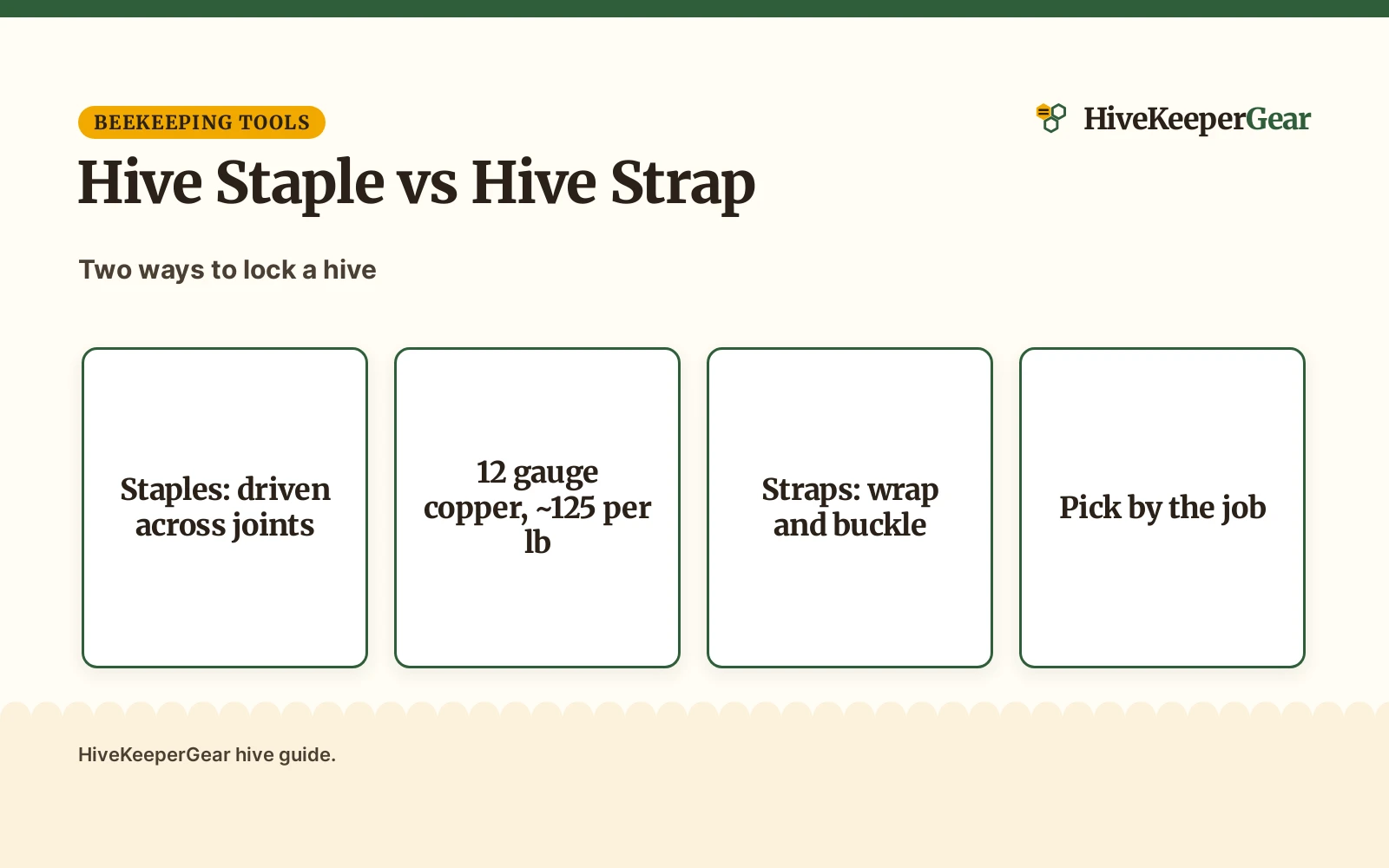
Hive staple vs hive strap is a choice between two ways to hold a hive together. Hive staples are driven across the joints between boxes to lock the stack for transit, while a hive strap wraps around the whole hive and buckles tight. The Mann Lake listing describes heavy-duty 12 gauge copper hive staples, sold by the pound at about 125 per pound, made to fasten hive bodies together for transit. Straps are the reusable, tool-free alternative. This guide compares the two on security, convenience and use case.
HiveKeeperGear earns a commission when you buy through links on this site, at no extra cost to you. As an Amazon Associate I earn from qualifying purchases. Affiliate disclosure.
Hive staple vs hive strap at a glance
| Aspect | Hive staples | Hive straps |
|---|---|---|
| What it is | Driven across box joints | Wraps the whole stack |
| Stated example | Mann Lake: 12 gauge copper, about 125 per pound | Not in these listings |
| Best for | Moving hives | Wind, storms, quick securing |
| Reusable | Usually one use | Yes |
| Tools needed | Hammer | None |
The practical upshot: staples lock boxes together for the road, straps hold the stack together where it stands. Many keepers own both.
How hive staples work
A hive staple is driven across the seam where two boxes meet, pinning them together so the stack holds its alignment in transit. The Mann Lake listing calls its staples heavy-duty 12 gauge copper, sold in a 1-pound size with about 125 staples per pound, and describes their purpose plainly: fastening hive bodies together for transit. That is the staple’s natural job. A hive on a truck or trailer takes bumps, turns and sudden stops, and stapled boxes hold their alignment through the trip. A 1-pound box holds about 125 staples, so one box goes a long way when several hives need securing before a move.
How hive straps work
A hive strap wraps around the entire hive, usually from under the bottom board to over the outer cover, and tightens with a buckle or ratchet. It squeezes the whole stack into one unit without putting holes in the wood. Straps shine where staples are awkward: holding a hive together through a windstorm, keeping a lid on against curious animals, or securing a hive quickly when there is no time to drive staples. They are reusable season after season, and one strap can serve many hives in turn.
Hive staple vs hive strap: which should you buy?
Match the tool to the job. If you move hives, staples are the purpose-built answer: the Mann Lake listing exists for exactly that use, fastening hive bodies together for transit, and a 1-pound box at about 125 staples covers many hives. If your hives stay put and you want protection against wind and weather, a strap is the simpler choice: no tools, no holes, and it comes off in seconds when you need to open the hive. For storm season, many keepers strap the hives that stand and staple the ones that travel. For the rest of the apiary kit, see our beekeeping tools guides.
What this guide does not cover
This guide compares securing methods. It does not cover moving-hive logistics, strapping regulations for migratory beekeeping or storm-proofing the whole apiary: take those from an experienced beekeeper or a current beekeeping manual. Every tool guide on the site is collected in our beekeeping tools section.
Buying advice: staples, straps and the job
Start with the arithmetic the listing gives you. The Mann Lake box is a 1-pound size holding about 125 staples, and the listing does not state a per-hive count, so buy by the job: a keeper moving a small yard needs far fewer than a keeper loading a trailer. Copper staples are consumables, since they bend on removal, so a spare box on the shelf beats a mid-move discovery that you are short. At about 125 per pound, a misdriven staple costs almost nothing; drive a fresh staple rather than straightening a bent staple.
Know what the staple is. The listing describes heavy-duty 12 gauge copper in a U-shape, bronze in color, model HD235, with a 0.11 in compatible groove diameter. Copper does not rust the way steel does, which matters on equipment that lives outdoors through rain and winter. The U-shape straddles the seam between boxes so each leg bites into a different box.
Read the spec table with suspicion here. The Mann Lake spec table talks about bee feed, high protein pollen substitute patties and ready-to-feed patty form, which has nothing to do with staples. The title and bullets describe the staples correctly, so trust those and treat the spec table as a listing error, not a specification.
For straps, the listings on hand name none, so here is general guidance without figures. A strap should wrap the whole stack from under the bottom board to over the cover with a buckle or ratchet that holds tension. Look for wide webbing that will not cut into wood, a buckle that operates with gloves on, and material rated for outdoor UV exposure. A strap per hive is the norm, kept on the shelf and thrown on when storms are forecast.
Drive staples with intent. A hammer is the only tool the job needs: drive each staple across the seam where boxes meet, on opposite sides of the hive, so the stack cannot shift in any direction. Staple the night before a move, not weeks ahead, so boxes can still be opened for inspections. After the move, pull the staples and inspect the holes; they are cosmetic and fill easily at repainting time.
Place staples where the stack wants to separate. Box-to-box seams are the priority, with the lid and bottom board stapled on moves over rough roads. On a tall stack, staple every seam; on a short stack, the middle seam matters most. For straps, check the webbing each spring for sun damage and check the buckle before storm season, since a strap that slips is decoration.
FAQs for beekeepers
How many staples does it take to hold a hive together?
The Mann Lake listing sells staples at about 125 per pound but does not state a per-hive count. A common approach is a few staples per box joint on opposite sides.
Do staples damage the boxes?
They leave small holes where they are driven in. For working hives that is cosmetic, and the holes can be filled when the boxes are repainted.
Can I reuse hive staples?
Usually not. Staples bend when pulled out, which is why straps are the reusable option and staples are treated as consumables.
Do straps work in high wind?
Yes, that is one of their main jobs: a tight strap keeps the lid on and the boxes aligned through storms. For a hive that must be moved, though, staples lock the boxes more rigidly.
More hive guides
See every beekeeping tools guide.