Honey Harvesting Process: Step-by-Step Guide
The honey harvesting process, from clearing bees from the supers to uncapping, spinning, straining and bottling, with the gear each step needs.

On this page
Top picks at a glance
As an Amazon Associate I earn from qualifying purchases.
- 1
 BeeCastle 2PCS Honey Gate9.7/10View on Amazon
- 2
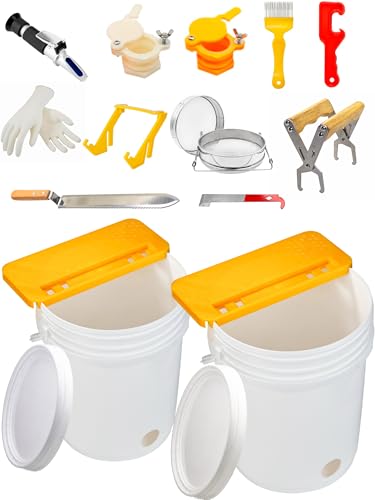 Duseu 15-Piece Harvest Kit9.6/10View on Amazon
- 3
 Bee-Quick Bee Repellent9.6/10View on Amazon
- 4
 Little Giant 5 Gal Bucket9.5/10View on Amazon
The honey harvesting process runs from clearing the bees from the supers to uncapping the frames, spinning out the honey, straining it and bottling it. Late in the flow, the supers fill with capped honey and the hives grow heavy, and the keeper plans the harvest around the weather and the strength of the colony. Each step has its own gear, and the 4 pieces below cover the clearing, uncapping, straining and bottling steps.
HiveKeeperGear earns a commission when you buy through links on this site, at no extra cost to you. As an Amazon Associate I earn from qualifying purchases. Affiliate disclosure.
| # | Product | HiveKeeper Score | Buy |
|---|---|---|---|
| 1 | BeeCastle 2PCS Honey Gate | 9.7/10 | Buy on Amazon |
| 2 | Duseu 15-Piece Harvest Kit | 9.6/10 | Buy on Amazon |
| 3 | Bee-Quick Bee Repellent | 9.6/10 | Buy on Amazon |
| 4 | Little Giant 5 Gal Bucket | 9.5/10 | Buy on Amazon |
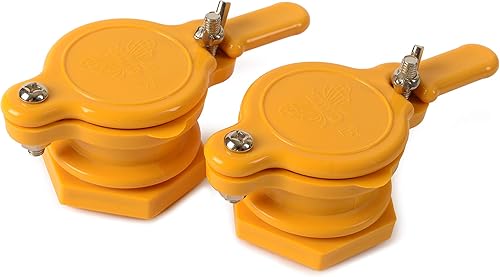
BeeCastle 2PCS Honey Gate
A 2-pack of food-grade nylon honey gate valves with stainless steel wing nuts and dual O-ring gaskets for 5-gallon buckets.
Pros
- Constructed from food-grade nylon for direct honey contact
- Equipped with stainless steel wing nuts and corrosion-resistant hardware
- Dual O-ring gaskets provide leak-proof sealing against bucket walls
- Includes 2 gate valves with clear product measurements of 4.72 by 2.38 by 1.81 inches
Cons
- No warranty term is stated
- Requires following picture 3 for correct metal gasket placement to prevent leaks
Duseu 15-Piece Harvest Kit
A 15-piece kit with 2 5-gallon buckets with gates, a 58-90% refractometer, a double-sieve strainer and uncapping tools for harvesting, straining and bottling.
Pros
- 15 pieces cover buckets, refractometer, strainer and tools
- 2 5-gallon buckets with gates for bottling
- 58-90% refractometer reads honey moisture
- 50 pairs of food-grade gloves in the kit
Cons
- Title calls it an extractor kit but no spinning extractor is included
- No warranty term is stated
- No total weight is stated
- No jars for bottling are included in the 15 pieces
Bee-Quick Bee Repellent
An 8 oz pump spray that moves bees from honey supers so frames come out clear for harvest.
Pros
- Certified for use in USDA Certified Organic honey production, as the listing states
- Trusted by beekeepers for over 25 years, per the listing
- Moves bees from supers without harming them, per the maker
- Pump spray bottle for easy use, per the listing
Cons
- For beekeeper use only and for honey bees only
- No warranty term is stated
- Only the 8 oz bottle size is listed
- No coverage figure is stated for how many supers one bottle clears

Little Giant 5 Gal Bucket
A 5-gallon HDPE plastic honey bucket assembled in the USA with a tight-fitting lid, sturdy metal handle, and pre-installed honey gate.
Pros
- Durable HDPE plastic bucket construction assembled in the USA
- Full 5-gallon (20 quart) capacity fits standard extractors and syrup refills
- Sturdy metal carrying handle supports the weight of collected honey
- Tightly fitting lid and honey gate both close securely to prevent honey loss
Cons
- Manufacturer warranty description states 'Warranty' without providing a concrete term
- Spec table contradicts bullets by listing capacity as 12 ounces rather than 5 gallons
As an Amazon Associate I earn from qualifying purchases.
Honey harvesting process: the steps in order
The harvest follows the same order every time: clear the bees, pull the frames, uncap the wax, spin the frames, strain the honey and bottle it. Skipping a step leaves bees in the honey or wax in the jars, so work through the steps in order and keep the gear for the next step close at hand.
| Step | What happens | Gear for the step |
|---|---|---|
| 1 | Clear the bees from the supers | Bee-Quick spray |
| 2 | Uncap the frames | Duseu knife, fork and scraper |
| 3 | Spin and strain the honey | Separate or borrowed extractor, Duseu strainer, Little Giant bucket |
| 4 | Bottle the honey | Duseu buckets with gates, BeeCastle valves |
Clear the bees from the supers
Start by moving the bees off the frames you plan to take, so the frames come out clear. The Bee-Quick spray is made for this step: the maker lists it as a bee repellent for removing honey bees from honey supers, and states it is for beekeeper use only and for honey bees only. Use it only on the supers at harvest, and keep it away from hummingbird feeders, pools and walls, where the listing states it does not belong.
Pull only frames that are capped across the face, and leave the rest for the bees. A frame that is capped across the face is ready, and one with open cells needs more time in the hive. Carry the pulled frames in a covered box so bees do not follow them back to the house.
Uncap the frames
Uncapping opens the wax seals so the honey can spin out. The Duseu kit includes an uncapping knife and fork and a 16-inch honeycomb scraper for this step, plus a wooden frame gripper that holds the frame while you work. Work over a tray so the cappings fall where you can save them.
Save the cappings: they hold honey that drains off and can be strained with the rest of the harvest. Keep the knife and fork for the wax only, and wipe them clean before they go back in the box.
Spin the frames and strain the honey
Load the uncapped frames into the extractor and spin the honey out of the comb. The Duseu kit holds no spinning extractor, so this step needs a separate extractor or a borrowed one; many clubs lend extractors to members, which is worth asking about before you buy one. Place the Little Giant bucket (on Amazon) under the extractor, since the listing states the bucket goes under the extractor to collect the honey.
Let the honey run from the extractor through the strainer into the bucket. The Duseu strainer has a double-sieve design: the top coarse filter catches wax and debris, while the lower fine mesh removes smaller particles. The honey gate on the bucket gives flow control for bottling, and the BeeCastle valves fit the same buckets when a spare gate is needed.
Bottle and store the harvest
Bottle the honey through the gate once the straining is done, and close each container as you fill it. The Duseu kit includes 2 5-gallon buckets with gates for storing, extracting and bottling, so the harvest has room to settle before it goes into jars. Check the honey with the refractometer before bottling: the Duseu refractometer reads 58 to 90 percent on the Brix scale, and the listing states it gives instant readings of honey moisture content.
Wear the food-grade gloves from the kit when handling frames and jars at bottling. The kit includes 50 pairs, so a fresh pair is close at hand for each session at the bench.
The gear for the honey harvesting process
The clearing, uncapping, straining and bottling steps above each need a piece of gear, and these 4 pieces cover them.
These are scored on the HiveKeeper Score, which weighs performance, build, value, safety and warranty. Safety here means stated food-grade materials and organic certification for honey contact, and 3 of the 4 carry a safety score. None of the 4 states a warranty term. How we pick explains the weights.
For the full harvest setup, see our honey extractor guide and our honey strainer guide, plus the uncapping knife picks.
FAQs for beekeepers
When is honey ready to harvest?
When the frames in the super are capped across the face. Pull only capped frames and leave the rest for the bees, so the colony keeps its stores for the season.
Do I need an extractor to harvest honey?
The spinning step needs one, but the Duseu kit in this guide holds no spinning extractor. Many clubs lend extractors to members, so ask about borrowing one before you buy.
What does Bee-Quick do at harvest?
It moves bees from honey supers so the frames come out clear. The maker lists it for beekeeper use only and for honey bees only, so do not use it on hummingbird feeders, pools or walls.
How do I bottle honey without a mess?
Let the honey run through the strainer into a bucket with a gate, then bottle through the gate with its flow control. The Duseu buckets are 5-gallon buckets with gates built in, and the BeeCastle valves fit 5-gallon buckets when a spare gate is needed.
Can I use the same buckets for syrup?
The Little Giant bucket can. The listing states it can also carry syrup to the hive box to refill feeders, so that bucket can serve both jobs.
More hive guides
Browse every guide by category: honey harvesting, beehives and hive tools.