How to Keep Bees From Hummingbird Feeders
Bee-guard ports, a clean feeding zone and the right fit keep bees from hummingbird feeders while hummingbirds feed freely.

On this page
Top picks at a glance
As an Amazon Associate I earn from qualifying purchases.
- 1
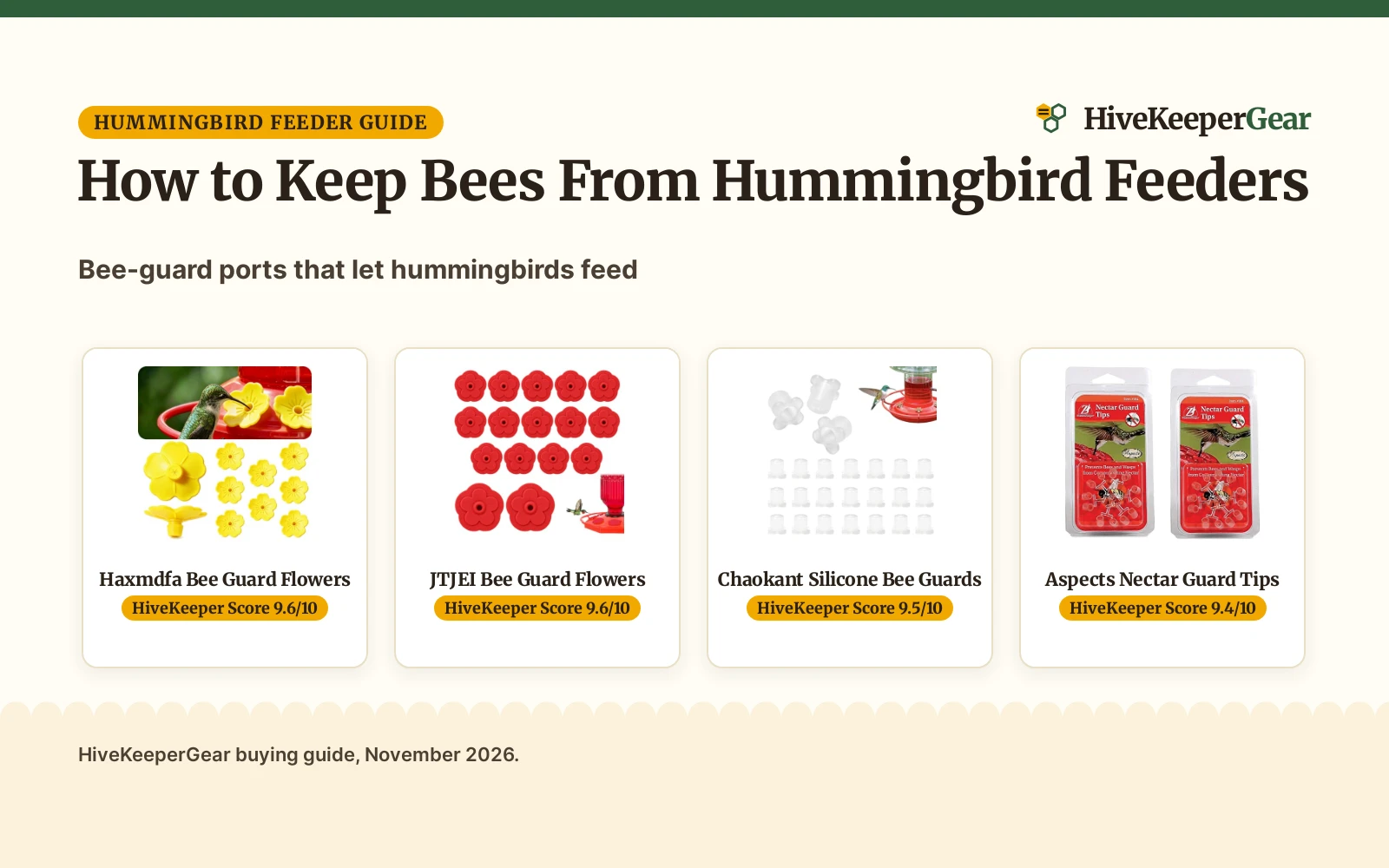
 Haxmdfa Bee Guard Flowers9.6/10View on Amazon
- 2
 JTJEI Bee Guard Flowers9.6/10View on Amazon
- 3
 Chaokant Silicone Bee Guards9.5/10View on Amazon
- 4
 Aspects Nectar Guard Tips9.4/10View on Amazon
Bees at a hummingbird feeder turn a quiet garden visit into a scramble for the nectar, and learning how to keep bees from hummingbird feeders starts with blocking their access while leaving the ports open to hummingbirds. Bee-guard ports do that job: each one guards a feeding hole, either with a soft valve or membrane that closes again after a hummingbird feeds, or with a hole sized so hummingbird beaks reach the nectar while bees are kept out. This guide walks through the steps that keep bees off the feeder, then compares the guard ports that fit the job.
HiveKeeperGear earns a commission when you buy through links on this site, at no extra cost to you. As an Amazon Associate I earn from qualifying purchases. Affiliate disclosure.
| # | Product | HiveKeeper Score | Buy |
|---|---|---|---|
| 1 | Haxmdfa Bee Guard Flowers | 9.6/10 | Buy on Amazon |
| 2 | JTJEI Bee Guard Flowers | 9.6/10 | Buy on Amazon |
| 3 | Chaokant Silicone Bee Guards | 9.5/10 | Buy on Amazon |
| 4 | Aspects Nectar Guard Tips | 9.4/10 | Buy on Amazon |
Haxmdfa Bee Guard Flowers
An 8-pack of yellow silicone bee-guard flowers with cross-slit self-sealing valves for hummingbird feeders.
Pros
- Cross-slit self-sealing valve shuts after feeding to reduce nectar exposure
- BPA-free food-grade silicone stated, soft enough to protect hummingbird beaks
- Silicone resists cracking, fading and deformation for outdoor use
- Flower shape replaces worn feeder parts and suits the feeding habit of hummingbirds
Cons
- No warranty term is stated
- Listing asks the buyer to measure feeder caliber before ordering, so fit is not universal
- Yellow color only; no other color is listed
- Spec table gives overall dimensions of 1.0 inches rather than port opening size
JTJEI Bee Guard Flowers
A 16-pack of red one-piece silicone bee-guard flowers with a 7 mm stem and a 3 mm feeding hole for standard feeders.
Pros
- 7 mm stem fits standard feeders and 3 mm hole admits hummingbirds while deterring bees
- One-piece silicone has no weak joints or seams that can tear
- Soft silicone cushions hummingbird beaks and tongues during feeding
- Tool-free install and removal; rinse under water or soak in mild soapy water to clean
Cons
- No warranty term is stated
- No BPA-free or food-grade claim is stated
- Red color only; no other color is listed
- Listing states stem diameter but not stem length
Chaokant Silicone Bee Guards
A 24-pack of clear silicone bee-guard tips with a storage box, UV resistant and leak-proof for standard feeder flower ports.
Pros
- 24-pack plus storage box covers multiple feeder ports
- UV resistant silicone resists moisture and extreme temperatures
- Stretch opening adapts to slight size variations for a snug seal
- Anti-slip skirt keeps guard tips in place without loosening
Cons
- No warranty term is stated
- No BPA-free or food-grade claim is stated
- Fit bullet is repeated word for word in the listing
- Clear color only; no other color is listed
Aspects Nectar Guard Tips
A 2-pack of flexible membrane nectar guard tips that slide onto the feeding ports of listed Aspects hummingbird feeders.
Pros
- Flexible membrane opens for hummingbird beaks and closes when beaks are removed
- Creates a barrier flying insects cannot penetrate
- Slides onto feeding ports on the underside of the feeder cover
- Lists the Aspects feeder models it works with
Cons
- No warranty term is stated
- Works only with the listed Aspects feeders, not with other brands
- Pack holds 2 tips, the smallest pack in this comparison
- Listing states no material
As an Amazon Associate I earn from qualifying purchases.
Before you fit bee-guard ports
Check the feeder before ordering parts. JTJEI and Chaokant ports are made to fit standard feeder flower ports, while Aspects tips (on Amazon) work only with the listed Aspects feeders. Haxmdfa asks buyers to measure the caliber and size of the existing feeder before ordering, and Chaokant asks buyers to check the feeder port size before purchase. A port that fits loosely leaves a gap bees can use, and a port that fits too tightly is hard to seat. Match the port to the feeder, then move on to the steps below.
How to keep bees from hummingbird feeders: the steps that work
| Step | What to do | What it needs |
|---|---|---|
| 1 | Fit bee-guard ports | Ports matched to the feeder |
| 2 | Keep nectar covered | Self-sealing valves, membranes or sized holes |
| 3 | Keep the feeding zone clean | Rinse ports and wipe drips |
| 4 | Replace worn ports | Spare ports from the pack |
1. Fit bee-guard ports
Start with the ports themselves. A bee guard is a small silicone flower or tip that sits in the feeder port: a valve or membrane stays shut until a hummingbird beak pushes through, then closes again after feeding, while a sized feeding hole admits hummingbird beaks and deters bees. Haxmdfa lists a cross-slit self-sealing valve, JTJEI lists a feeding hole sized to admit hummingbirds while deterring bees, and Aspects lists a flexible membrane that opens for beaks and closes when beaks are removed. Measure the feeder port before ordering, since the Haxmdfa and Chaokant listings ask buyers to check the size before ordering.
2. Keep nectar covered and the feeding zone clean
Bees find exposed nectar, so the less nectar shows, the fewer bees gather. A self-sealing valve shuts after feeding to reduce nectar exposure, and Haxmdfa notes that its ports cut down nectar waste and keep the feeding zone tidy. Chaokant notes that keeping insects from the ports helps extend nectar freshness and keeps the feeding zone cleaner. Rinse JTJEI’s silicone ports under running water or soak them in mild soapy water, as JTJEI describes, and let the non-porous surface dry before refitting.
3. Replace worn ports
Silicone ports can wear with seasons outdoors, and a cracked or loose port leaves the nectar open again. Haxmdfa describes its flower ports as a way to refurbish old feeders by replacing worn and damaged parts, and its silicone resists cracking, fading and deformation. Chaokant adds a storage box with its pack, so spare tips stay together until a port needs swapping. Check ports when the feeder is cleaned, and swap any that no longer sit snugly.
Bee-guard ports for hummingbird feeders
The ports below fit the steps above: each covers a feeder port so bees stay out while hummingbirds feed, and each handles a different part of the job, from the self-sealing valve to the membrane tip.
What bee guards cannot do
Guard ports block bees at the feeding hole, but they do not change what the feeder holds or where it hangs. They are feeder parts, not a way to move bees or to treat a colony, and this guide gives no advice on bee health or on handling bees. For colony questions, contact a local beekeeping club or extension office.
FAQs for beekeepers
Do bee guards stop hummingbirds from feeding?
No. Hummingbird beaks reach the nectar through the guards in this guide: Haxmdfa states that hummingbirds feed freely through its ports, JTJEI sizes its feeding hole so hummingbirds reach the nectar while bees are deterred, and Aspects states that its membrane opens when beaks are inserted and closes when beaks are removed.
Which bee-guard port fits a feeder?
Measure the feeder port before ordering, as the Haxmdfa and Chaokant listings advise. JTJEI states a 7 mm stem diameter that fits standard feeders, while Aspects names the feeder models its tips work with, including HighView (429), Jewel Box (407) and Gem (437).
How are silicone bee-guard ports cleaned?
Rinse them under running water or soak them in mild soapy water, as JTJEI describes. The listing states that the non-porous silicone surface resists residue buildup and dries quickly.
Can bee-guard ports fix an old feeder?
They can replace worn parts. Haxmdfa describes its bright flower-shaped ports as a way to refurbish old feeders by replacing worn and damaged feeder components.
Do guard ports work on any hummingbird feeder?
Not every port fits every feeder. Aspects tips work with the listed Aspects feeders, JTJEI and Chaokant ports are made for standard feeder flower ports, and Haxmdfa ports (on Amazon) are made for matched feeders, so check the size before ordering.
More hive guides
More hummingbird feeder guides: best hummingbird feeder, what is the best hummingbird feeder, how to fill a hummingbird feeder and glass vs plastic hummingbird feeder.