Knee High vs Ankle Beekeeping Boots: Which One Should You Buy?
Knee high vs ankle beekeeping boots for the apiary: when tall shafts earn their keep, when short boots do the job, and how to close the gap at the suit leg.

On this page
Top picks at a glance
As an Amazon Associate I earn from qualifying purchases.
- 1
 NINGO Men's Steel Toe Waterproof PVC Knee High Rain Boots9.7/10View on Amazon
- 2
 Womens Tall Rain Boots Mens Waterproof Knee-High Rubber BootsView on Amazon
- 3
 Amoji Mens Rubber Rain Boots Knee High Waterproof PackableView on Amazon
- 4
 Amoji Womens Rubber Rain Boots Knee High Waterproof PackableView on Amazon
- 5
 Women’s Rain Boots Waterproof Knee High Rubber Garden BootsView on Amazon
- 6
 SUREWAY Men's PVC Rain Work BootsView on Amazon
- 7
 Frelaxy Leg Gaiters Ultra HIGH-Performance Hunting GaitersView on Amazon
Spring inspection season is here, the hives are waking up, and you are standing at the apiary gate wondering whether to pull on the tall boots or the short ones. Knee high vs ankle beekeeping boots comes down to how much leg you want covered: knee-high boots close the gap between boot top and suit leg so bees cannot find a way in, while ankle boots keep your feet light and cool for quick checks. Both work in the bee yard; the right height depends on how defensive your colonies run and how long you stay suited up.
Other hives and gear to compare
 Womens Tall Rain Boots Mens Waterproof Knee-High Rubber BootsCheck price on Amazon
 Amoji Mens Rubber Rain Boots Knee High Waterproof PackableCheck price on Amazon
 Amoji Womens Rubber Rain Boots Knee High Waterproof PackableCheck price on Amazon
 Women’s Rain Boots Waterproof Knee High Rubber Garden BootsCheck price on Amazon
 SUREWAY Men's PVC Rain Work BootsCheck price on Amazon
 Frelaxy Leg Gaiters Ultra HIGH-Performance Hunting GaitersCheck price on Amazon
HiveKeeperGear earns a commission when you buy through links on this site, at no extra cost to you. As an Amazon Associate I earn from qualifying purchases.
The quick answer
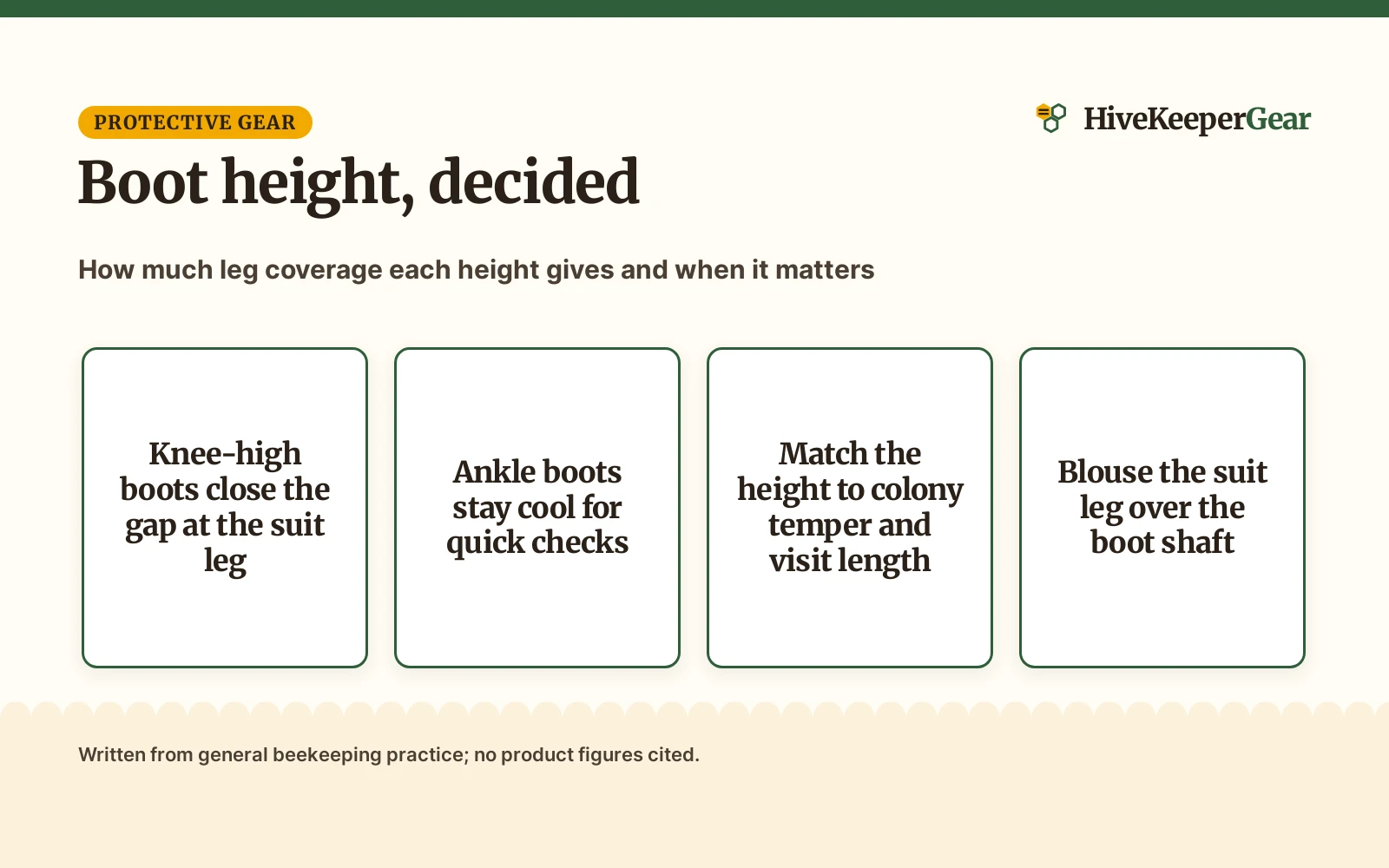
Choose knee-high boots for full inspections, defensive colonies and tall grass around the hives, because the tall shaft meets the suit leg and leaves bees no opening. Choose ankle boots for quick checks, hot weather and light yard work, because they breathe better and weigh less on the foot. If you keep one pair, the knee-high boot covers more situations; if your bees are gentle and your visits are short, the ankle boot is the easier wear.
What knee-high boots do well
Knee-high boots are about coverage. The tall shaft rises to meet the suit leg, and that overlap is the whole point: bees explore upward along the leg, and a tall boot with the suit leg over it closes the route. In tall grass and brush around the hives, the shaft also keeps stems, dew and the odd curious bee off the calf. For full inspections, when the hive is open and the colony is at its most alert, that coverage is worth the extra warmth.
The trade-offs are heat and bulk. A tall rubber shaft holds warmth on a still summer afternoon, and the boot is heavier to walk in across the yard. Pulling them on and off takes a moment longer, and they want a place to stand upright so the shaft does not fold and crack over time.
What ankle boots do well
Ankle boots are about ease. They slip on fast for a quick look at the entrance or a feeder refill, they breathe around the ankle, and they feel like ordinary shoes on the walk to the hives. In hot weather, when the bee yard shimmers and the suit is already warm, the lighter boot keeps the whole kit more bearable.
The trade-off is the gap. An ankle boot leaves the lower leg to the suit, so the suit leg must do the covering alone, usually with an elastic cuff or a strap. On a calm colony during a short visit, that is plenty. On a defensive colony, or when you kneel in the grass to work a lower hive, the exposed inches between boot top and suit cuff become the opening bees will find.
Knee high vs ankle beekeeping boots: the real difference
The real difference is not the foot but the leg. Both styles protect the foot the same way; they differ in how much of the leg they cover and how they meet the suit. The knee-high boot overlaps the suit leg generously, forgiving a suit that rides up when you bend. The ankle boot asks the suit cuff to do the work, which suits calm bees and short visits.
Think of it as a sliding scale of defensiveness. Gentle bees, quick checks, hot afternoons: ankle boots. Full inspections, honey harvest, requeening, or any colony that runs hot: knee-high boots. Many beekeepers end up owning both, reaching for the tall pair when the veil goes on for real work and the short pair for everything else.
Mind the gap between boot and suit
Whichever height you choose, the junction between boot top and suit leg is where stings happen. With knee-high boots, blouse the suit leg over the boot shaft so the overlap faces downward; bees walking up meet fabric lying over rubber, not an opening. With ankle boots, check that the suit cuff sits snug over the boot and does not ride up when you kneel. Socks matter too: a tall sock under an ankle boot adds a layer bees must cross, and light-colored socks let you spot a bee before it finds skin.
Through the season
Spring brings the first full inspections, and the colonies are still finding their temper; the knee-high boot earns its place here. Summer brings heat, and the ankle boot tempts every beekeeper who has sweated through an afternoon inspection; on calm hives it is the right call. Autumn brings robbing season, when colonies turn defensive over their stores, and the tall boot goes back on. Winter brings the quiet months, when the hives need little more than a glance at the entrance and the ankle boot handles the walk.
FAQs for beekeepers
Can bees sting through boots?
Through the rubber shaft, no; bees sting exposed skin, not boot rubber. Stings around boots happen at the gap between boot top and suit leg, which is why the overlap matters more than the boot itself.
Do I need special beekeeping boots?
Any smooth rubber boot works; bees cannot grip smooth rubber the way they grip fabric. What matters is the height, the fit around the calf or ankle, and how it meets the suit leg.
Are ankle boots safe for inspections?
For calm colonies and short inspections, yes, with a snug suit cuff over the boot. For defensive colonies or long open-hive work, the knee-high boot gives the coverage the situation deserves.
How do I keep boots from getting propolis everywhere?
Rinse the soles and shafts after yard visits and store the boots upright by the door. Propolis wipes off smooth rubber far more easily than off fabric or leather.
Should the suit leg go inside or outside the boot?
Outside, bloused over the shaft, so the overlap faces downward. A suit leg tucked inside the boot creates an upward-facing pocket that guides bees straight to the opening.
Related: best beekeeping boots for tall men, best beekeeping boots for women, kids vs adult bee suit and ventilated vs leather beekeeping gloves.