Pond Aerator vs Pond Heater: Which One Should You Buy?
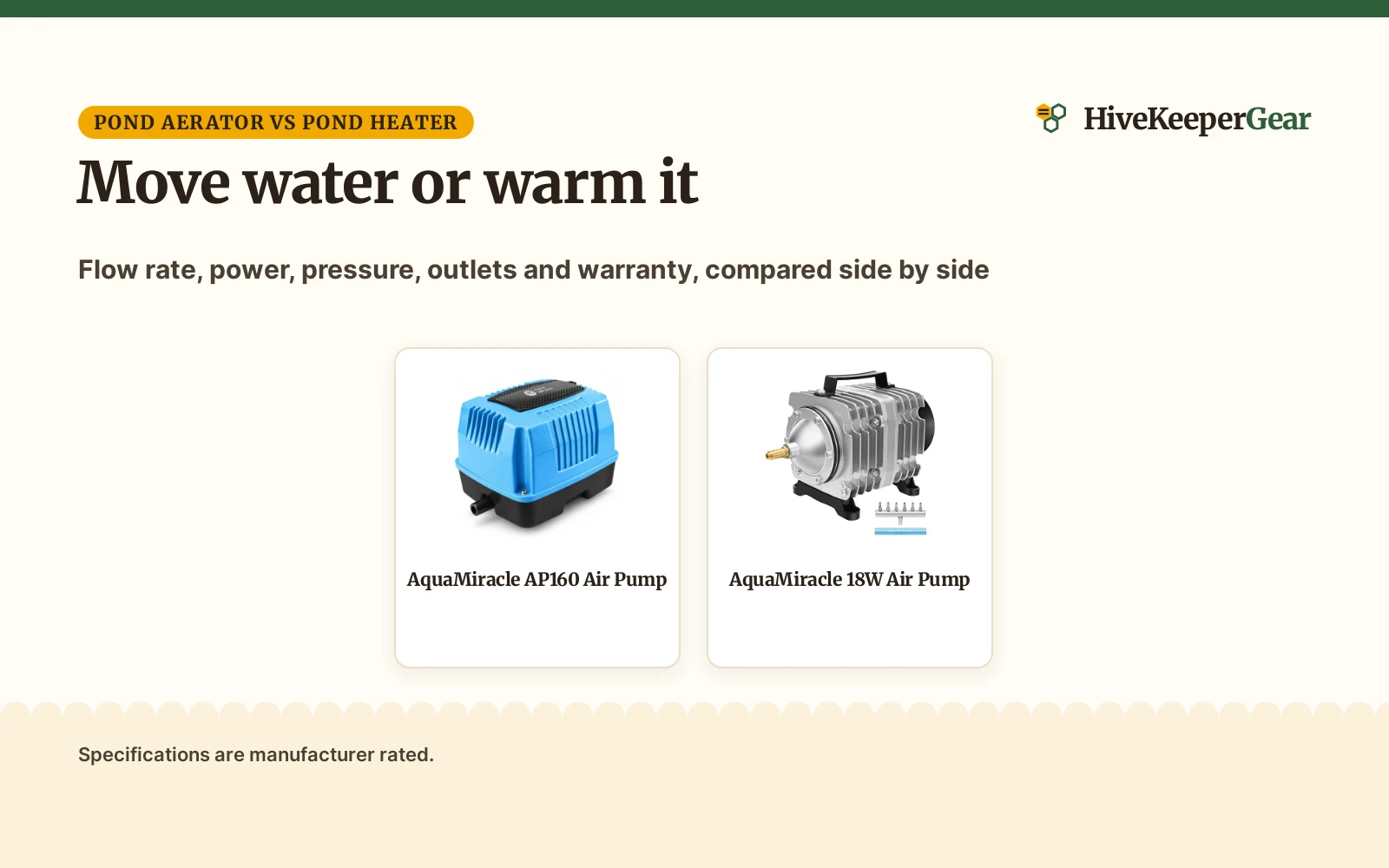
Pond aerator vs pond heater, compared on two AquaMiracle air pumps: flow rate, power, pressure, outlets and warranty, with the heater side described by the job it does.

On this page
Top picks at a glance
As an Amazon Associate I earn from qualifying purchases.
- 1
 AquaMiracle AP160 Air Pump9.7/10View on Amazon
- 2
 AquaMiracle 18W Air Pump9.6/10View on Amazon
The pond aerator vs pond heater choice comes down to what the pond needs: moving water and oxygen, or warmth through cold weather. Both products here are pond aerators, and no pond heater is included, so the heater side is described by the job it does rather than by a machine in this comparison. An aerator suits a pond that needs oxygen and circulation, while a heater suits a pond that must stay open and warm through a cold season.
HiveKeeperGear earns a commission when you buy through links on this page, at no extra cost to you. As an Amazon Associate I earn from qualifying purchases. Affiliate disclosure.
Quick verdict: choose an aerator if the pond needs oxygen and circulation for fish, plants or hydroponics. Choose a heater if the pond must stay warm through cold weather. The aerators here differ mainly in size and output: the AP160 lists far more air flow, while the 18W pump lists the lower flow rate and power draw.
Two examples
AquaMiracle AP160 Air Pump
A 105W linear air pump with 2550GPH flow, a diffuser with 46 outlets and a 1 Year Warranty.
Pros
- 2550GPH flow rate, 160LPM, at 0.042MPa pressure
- Full copper coil motor listed for high efficiency
- Diffuser with 46 outlets connects to air stones
- Diaphragm rebuild kit available if the diaphragm breaks
Cons
- 15.43 lb, the heavier pump here
- Airline tubing and air stones are purchased separately
- No noise figure is stated, only low noise operation
- 105W power use is higher than the 18W pump
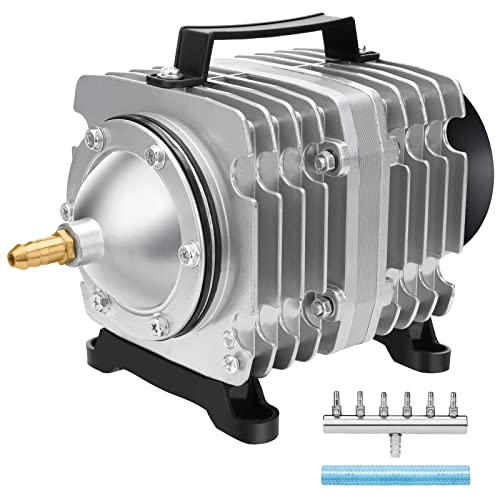
AquaMiracle 18W Air Pump
An 18W air pump with 600GPH flow, a 6-outlet manifold and a 1 Year Warranty.
Pros
- 600GPH flow at 0.02Mpa pressure from an 18W motor
- Aluminum alloy housing with enlarged surface for heat dissipation
- 6-outlet manifold with an adjustable knob on each outlet
- Lubricant-free design with wear-resistant cylinder and piston
Cons
- Lower flow rate than the AP160 at 600GPH
- Maker recommends a well-ventilated location, and a cooling fan helps extend pump life
- No diffuser is included, only the manifold
- No noise figure is stated
As an Amazon Associate I earn from qualifying purchases.
Pond aerator vs pond heater: side by side
| Pump | HiveKeeper Score | Flow rate | Power | Pressure | Outlets | Warranty |
|---|---|---|---|---|---|---|
| AquaMiracle AP160 Air Pump | 9.7/10 | 2550GPH (160LPM) | 105W | 0.042MPa | Diffuser with 46 outlets | 1 Year Warranty |
| AquaMiracle 18W Air Pump | 9.6/10 | 600GPH | 18W | 0.02Mpa | 6-outlet manifold | 1 Year Warranty |
We quote the beekeeping gear makers’ rated specs from each listing (as of 25 November 2026).
What each side does
An aerator moves air into the water. Both pumps here are built for oxygenation: the maker lists aquariums, ponds, hydroponics, fish farms and seafood restaurants among the uses, and the AP160 adds septic systems and waste treatment. A heater warms the water instead, which is a different job for cold weather. If the pond needs oxygen and circulation, the aerator side fits; if it needs warmth, the heater side fits, and no heater is included here to compare.
Output and power
The smaller pump lists 600GPH at 18W with 0.02Mpa pressure, while the AP160 lists 2550GPH at 105W with 0.042MPa pressure and 160LPM. The AP160 lists the higher flow rate and the higher power draw, while the 18W pump lists the lower figures on both. No heater power figure is stated anywhere here, so the heater side cannot be ranked on power from this comparison.
Outlets and hookup
The 18W pump comes with a chrome coated metal manifold with 6 outlets, and the air output of each outlet adjusts with a knob. The AP160 comes with an air diffuser with 46 outlets to connect to air stones, while airline tubing and air stones are purchased separately. Count the outlets against the spots that need air: the AP160 covers more points in the pond, while the smaller pump covers fewer with finer control at each outlet.
Build and heat
Both pumps use an aluminum alloy housing built to shed heat. The 18W pump adds an enlarged housing surface for heat dissipation, a lubricant-free design and a wear-resistant cylinder and piston, and the maker recommends a well-ventilated location, with a cooling fan helping to extend the life of the pump. The AP160 adds a full copper coil motor and multiple layers of denoising for low noise operation, plus a diaphragm rebuild kit if the diaphragm breaks.
Gaps to check
No pond heater is included, so heater power, size and warranty are not compared here. The AP160 needs airline tubing and air stones bought separately. Only the AP160 claims low noise operation, and neither pump states a noise figure, so the claim cannot be compared in numbers. Both pumps state a 1 Year Warranty.
Which should you choose?
Choose a pond aerator if the pond needs oxygen and circulation for fish, plants or hydroponics, and the water stays warm enough through the seasons. Our pond pumps and filters guides compare more aeration gear.
Choose a pond heater if the pond must stay warm through cold weather and the fish need steady warmth. No heater is included here, so compare heater models on their own stated watts and coverage before buying. Our garden ponds guides cover more pond gear.
If you pick the 18W pump, set it where air can move around it, since the maker recommends a well-ventilated location for that pump.
Inside the HiveKeeper Score
| Product | HiveKeeper Score | Perf. /35 | Build /25 | Value /25 | Safety /10 | Warranty /5 |
|---|---|---|---|---|---|---|
| AquaMiracle AP160 Air Pump | 9.7 | 32 | 22 | 21 | 5 | 2 |
| AquaMiracle 18W Air Pump | 9.6 | 29 | 21 | 21 | 4 | 2 |
Each item’s weighted total is converted onto a scale that starts at 9.2 and ends at 9.8, linearly and in the same order.
The HiveKeeper Score weighs performance, build, value, safety and warranty, as explained on our how we pick page. The AP160 scores higher on performance for its larger flow rate and earns build points for its copper coil motor and rebuild kit. Both earn warranty points for a stated 1-year term, and both earn safety points for aluminum housings built to shed heat.
FAQs for beekeepers
Which aerator here moves more air?
The AP160, which lists 2550GPH against 600GPH for the 18W pump.
What else do I need to run the AP160?
The pump comes with a diffuser with 46 outlets, but airline tubing and air stones are purchased separately.
What warranty do these pumps carry?
Both list a 1 Year Warranty.
Can an aerator replace a heater in cold weather?
An aerator and a heater do different jobs: the aerator adds oxygen and moves water, while a heater warms it. If the pond must stay warm through cold weather, pick the heater side; if it needs oxygen and circulation, pick the aerator.
More hive guides
Related: best pond aerator with backflow prevention, pond rake vs pond vacuum, variable vs fixed speed pond pump, and best garden pond filter.