Raw vs Refined Beeswax: Which One Should You Buy?
Raw wax keeps more hive character, while refined wax is filtered for cleaner, more uniform candles, balms, polish and soap.

On this page
Top picks at a glance
As an Amazon Associate I earn from qualifying purchases.
- 1
 Sukh 290g Yellow Beeswax Bars9.6/10View on Amazon
- 2
 TooGet Pure White Beeswax Blocks9.6/10View on Amazon
- 3
 Sukh 12 White Beeswax Bars9.6/10View on Amazon
- 4
 Nate's 100% PureView on Amazon
- 5
 Fischer’s 100% PureView on Amazon
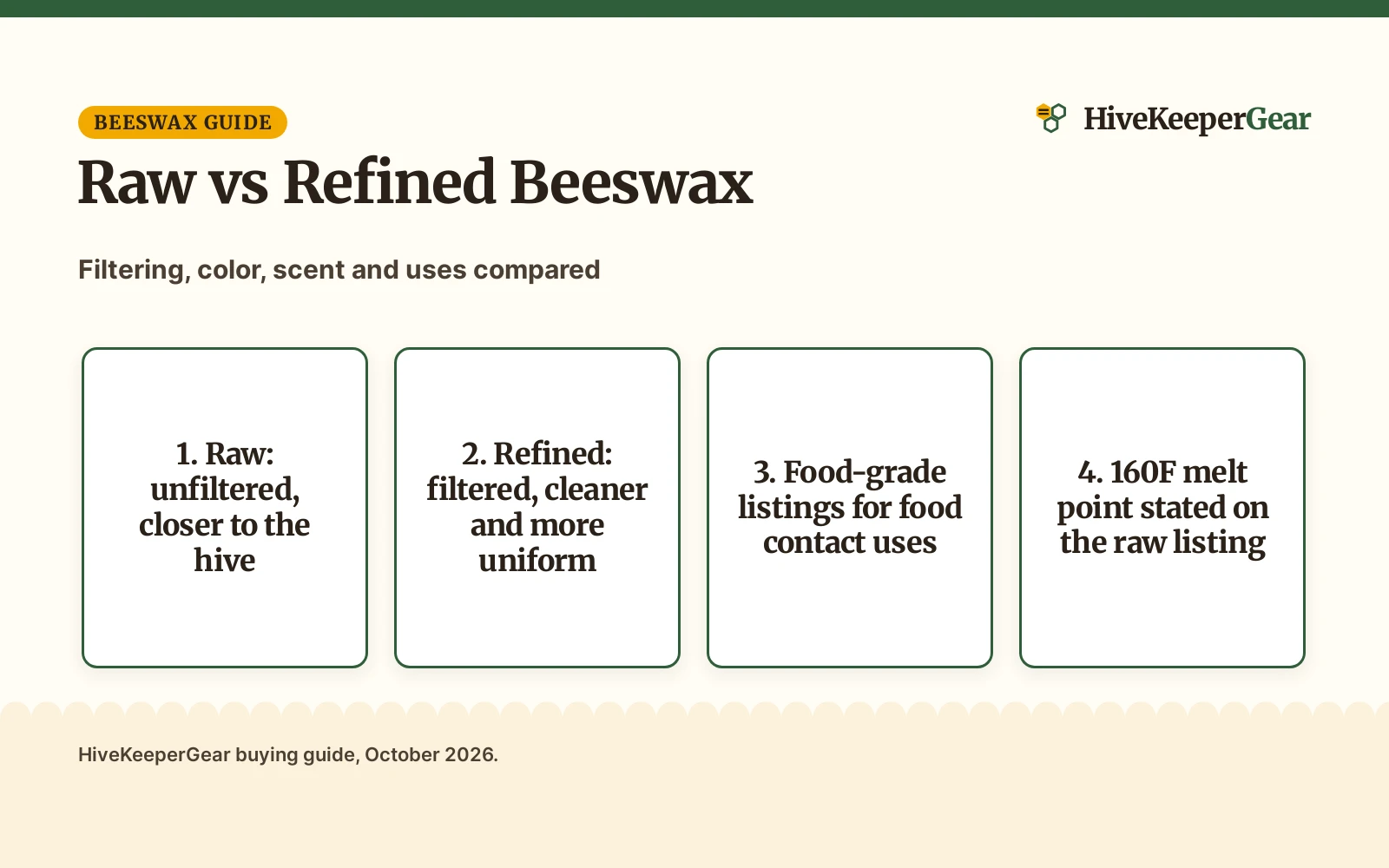
Raw vs refined beeswax comes down to filtering: raw wax is the less filtered wax, closer to the hive, while refined wax is filtered for a cleaner, more uniform bar or pellet. At harvest time, when wax comes off the frames, the choice shows up in color, scent and how the wax melts. This guide compares both grades and the listings below, so the grade fits the job: candles, balms, polish or sealing.
Other hives and gear to compare
 Nate's 100% PureCheck price on Amazon
 Fischer’s 100% PureCheck price on Amazon
HiveKeeperGear earns a commission when you buy through links on this site, at no extra cost to you. As an Amazon Associate I earn from qualifying purchases. Affiliate disclosure.
Raw vs refined beeswax at a glance
| Raw | Refined | |
|---|---|---|
| Filtering | Unfiltered, unrefined | Triple-filtered or ultra-filtered |
| Color | Yellow | Yellow |
| Scent | Subtle honey aroma | Honey scent or unscented |
| Form | Bars | Pellets and bars |
| Melt point stated | 160F | Not stated |
| Food-grade listings | Weeks Honey Farm | The Beeswax Co. |
| Uses listed | Candles, wood and leather care, sealing | Candles, lip balm, soap, lotion, polish |
What raw beeswax is
Raw beeswax is wax with little or no filtering beyond the hive. The weeks honey farm listing describes its wax as 100% pure unfiltered American yellow beeswax, unrefined, with a subtle honey aroma. It keeps its natural color and scent, and the listing states a high melt point of 160F, which suits durable coatings on envelopes, cheese wraps and wood. Raw wax suits jobs where hive character matters more than a uniform look.
What refined beeswax is
Refined beeswax is filtered to remove impurities and even out the wax. The Beeswax Co. listing describes an ultra-filtered process that siphons off impurities down to the size of a grain of pollen, while the TRINIDa and NORVENCE listings describe triple filtration. Refined wax reads cleaner and more uniform in color, and the listings describe it for candles, lip balm, soap, lotion and polish. Refined wax suits jobs where a clean look matters more than hive character.
The gear: four beeswax listings, ranked
The four listings below are ordered with the raw listing first.
1. Weeks Honey Farm: unfiltered, food grade, 1 oz bars
The weeks honey farm listing is the raw pick: 100% pure unfiltered American yellow beeswax in 1 oz bars, in a pack of 3, with a stated melt point of 160F. The listing describes it as food grade, notes it is kosher, and lists uses across candles, crafts, wood and leather care, plus sealing. The maker describes it as a non-toxic leather conditioner, and the listing notes a subtle honey aroma.
One contradiction is worth noting. The title states 1 oz in a pack of 3, while the spec table lists a size of 3 Ounce in a pack of 1 and an item weight of 4 ounces. The title and bullets read as the working description, so this guide follows the 1 oz bar size. The small bar size suits beginners and small jobs, while larger 1 pound options are listed for bigger projects.
2. The Beeswax Co.: ultra-filtered Texas bar, 1 lb
The Beeswax Co. listing is a 1 lb bar of 100% pure Texas beeswax, described as ultra-filtered and certified food-grade. The listing notes a natural honey scent, with Texas wildflowers, prairie grasses, citrus, herbs, wild berry and honey among the sources, and lists uses from specialty recipes and candle making to household uses indoors and outdoors. The bar is listed at 16 ounces, and the listing notes it is a product of the USA.
The size description disagrees with itself. The bullets describe a one-pound bar of 5.25 by 2 inches, while the spec table lists 5.38 x 3 x 2.25 inches and a width and height of 2.75 by 2.25 inches. The bullets read as the working size, so this guide follows them. The food-grade listing suits uses that touch food, which is the listing’s own stated edge over cosmetic-grade wax.
3. TRINIDa: triple-filtered organic pellets, 2 lb
The TRINIDa listing is a 2 lb bag of organic yellow beeswax pellets, 32 oz, described as triple-filtered and 100% pure organic beeswax, unscented. The listing lists candle making, lip balm, body cream, hand cream, soap and furniture maintenance among the uses, and the pellet form suits melting and mixing in small batches.
One contradiction is worth noting. The title describes yellow beeswax, while the bullets describe white beeswax undergoing triple filtration. The title reads as the working color, so this guide follows yellow. The listing also makes skin claims this guide does not repeat, and the uses above are the listing’s stated uses, not promises.
4. NORVENCE: triple-filtered pellets, 200G
The NORVENCE listing is a 200G bag of pure and natural yellow beeswax pellets, described as triple-filtered and cosmetic grade. The listing describes candle making, skin care, lip balm, soap, lotion, creams, wood polishing, furniture polish and leather care among the uses, and notes the pellet form melts evenly using a microwave, double boiler or wax melting pot. The listed weight is 6.7 ounces, and the listed dimensions are 3.15 x 3.94 x 0.39 inches.
The title lists 200G, 5LB and 20LB options, while this listing is the 200G variant, so the 200G size is the one this guide follows. The listing is the thinnest of the four on stated detail, with no food-grade claim and no melt point stated. It suits small craft batches where a pellet form matters more than a stated grade.
How to choose between raw and refined beeswax
Match the grade to the job. For sealing, wood care and leather care with hive character intact, the raw listing fits, with its stated 160F melt point. For candles, lip balm, soap and lotion, a filtered pellet or bar fits, with triple-filtered or ultra-filtered listings to choose from. For any use that touches food, pick a listing that states food grade, since only two of the four listings state it.
FAQs for beekeepers
What is the difference between raw and refined beeswax?
Filtering. Raw beeswax is unfiltered or lightly filtered and keeps its hive color and scent, while refined beeswax is filtered, in these listings triple-filtered or ultra-filtered, for a cleaner and more uniform wax.
Which beeswax listings state food grade?
Two of the four: the weeks honey farm listing, described as food grade, and The Beeswax Co. listing, described as certified food-grade. The TRINIDa and NORVENCE listings state cosmetic grade instead.
What melt point does the raw listing state?
160F, stated on the weeks honey farm listing for durable coatings and candle making. The other three listings state no melt point.
Do pellets or bars melt easier?
Only the NORVENCE listing notes that its pellets melt evenly, using a microwave, double boiler or wax melting pot. Only the weeks honey farm listing states a melt point, 160F, and the other three listings state no melt point, so these listings do not support a general melt comparison between pellets and bars.
Can beeswax be used on wood and leather?
Yes, per the listings. The weeks honey farm listing lists wood and leather care, and the NORVENCE listing lists furniture polish, leather care and wood finishing. The raw listing is also described as a non-toxic leather conditioner by its maker.
More hive guides
See every beekeeping tools guide and all honey harvesting guides.