Solar vs Battery Outdoor Thermometer: Which One Should You Buy?
A solar gauge and a battery-free dial compared by range, accuracy, size, mounting and warranty for use at the bee yard and beyond.

On this page
Top picks at a glance
As an Amazon Associate I earn from qualifying purchases.
- 1
 defull 5-Inch Dial9.7/10View on Amazon
- 2
 BaldrTherm Solar Gauge9.6/10View on Amazon
At the bee yard in spring, a glance at the thermometer before opening a hive saves a cold morning of guesswork, and the solar vs battery outdoor thermometer choice comes down to where the gauge will live. Pick the solar gauge for a pack or a spot with no outlet, and pick the dial for a fixed wall where a big readout matters. This comparison uses 2 examples, a solar gauge with a humidity readout and a battery-free dial, and compares them on power, range, accuracy, size and mounting, using only what each maker states.
HiveKeeperGear earns a commission when you buy through links on this page, at no extra cost to you. As an Amazon Associate I earn from qualifying purchases. Affiliate disclosure.
Quick verdict: choose the solar gauge if you want a portable gauge with humidity readings that runs on solar power with a CR2032 backup, and you have light for the panel. Choose the dial if you want a large readout on a wall or a table, with no battery at all. Both state a 1-year warranty, so the real difference is power, portability and what each one measures.
Two examples
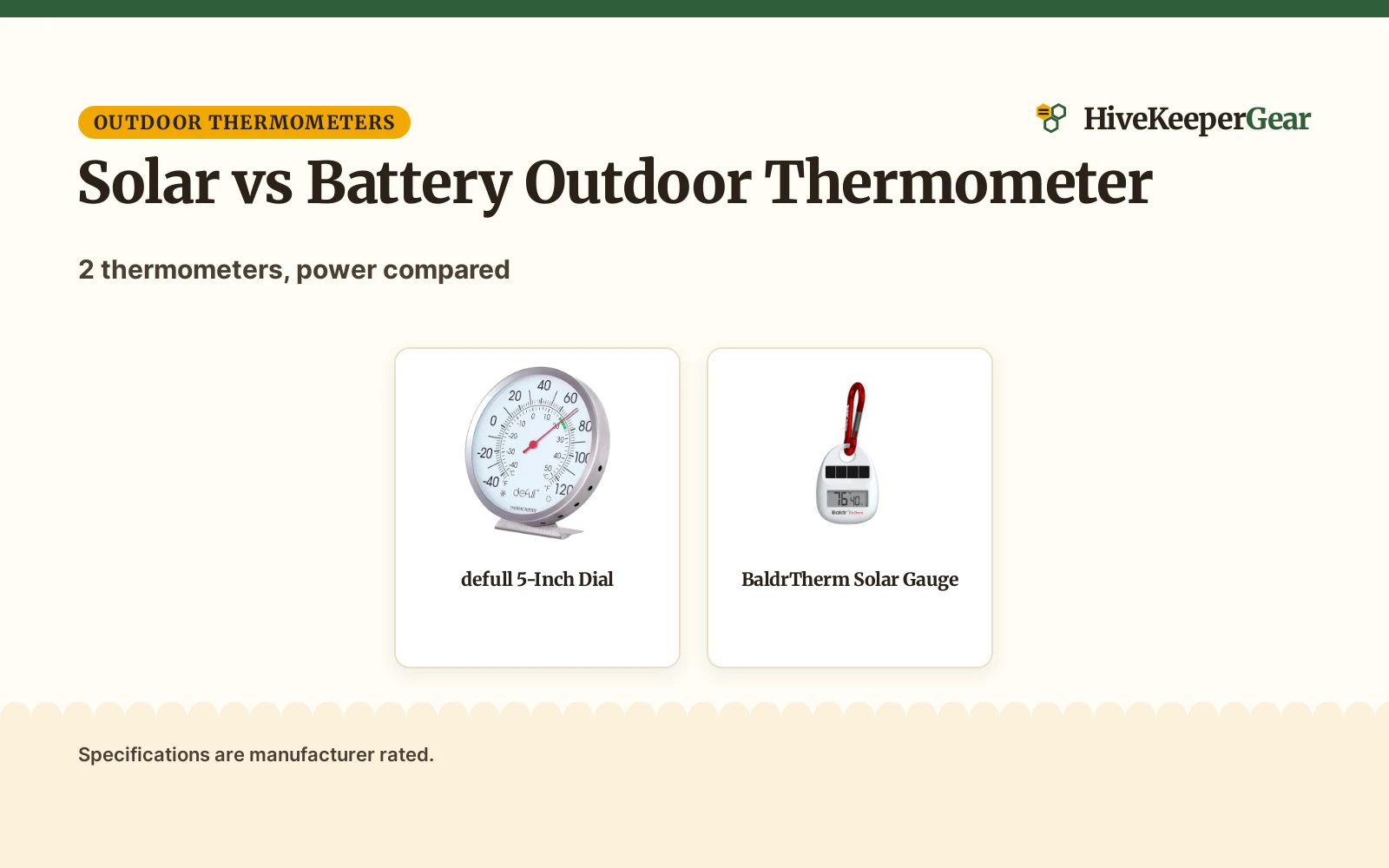
defull 5-Inch Dial
A battery-free dial thermometer with a 5-inch display, dual Fahrenheit and Celsius scales, and a stainless steel case for wall or table use.
Pros
- 5-inch dial with dual Fahrenheit and Celsius scales stated
- Battery-free, so no battery to change
- Stainless steel casing with shatter-resistant lens stated
- Wall mount or table stand with a detachable bracket stated
Cons
- No humidity reading is stated
- No precision figure is stated
- 5-inch dial needs a wall or a table spot
- Reads temperature only; the solar gauge also reads humidity
BaldrTherm Solar Gauge
A solar-powered thermometer and hygrometer with a carabiner, a 30-second refresh and a range from -40°F to 158°F.
Pros
- Solar panel with a CR2032 backup battery stated
- Temperature and humidity readings together in one gauge
- Precision of ±0.9°F and ±3%RH stated
- 2.90 x 1.99 x 0.63 in size with a carabiner for a pack
Cons
- Small size is harder to read at a distance than the 5-inch dial
- No wall mount is stated, only a carabiner loop
- Solar power needs light; a shaded spot leaves it on the CR2032 backup
- Carabiner clip suits a pack, not a fixed wall
As an Amazon Associate I earn from qualifying purchases.
Solar vs battery outdoor thermometer: side by side
| Thermometer | HiveKeeper Score | Power | Range | Size | Warranty |
|---|---|---|---|---|---|
| defull 5-Inch Dial | 9.7/10 | Battery-free | -40°F to 120°F | 5-inch dial | 1 year |
| BaldrTherm Solar Gauge | 9.6/10 | Solar panel, CR2032 backup | -40°F to 158°F | 2.90 x 1.99 x 0.63 in | 1 year |
Sizes, materials and capacities are the manufacturer’s ratings as each listing states them, collected 26 November 2026.
Power and upkeep
Power is the split the keyword names. The BaldrTherm gauge runs on solar panels with a built-in CR2032 backup battery, and the maker states long-lasting continuous operation with no frequent battery swaps. The defull dial is battery-free, so it needs no battery of any kind and no panel at all. The battery side example here uses no battery, so this comparison has no battery-powered thermometer in it; the choice is solar power against no power source at all. Neither gauge asks for charging or a cord, which suits a spot with no outlet.
Range and accuracy
The solar gauge states a temperature range from -40°F to 158°F and humidity from 1% to 99%RH, with precision of ±0.9°F and ±3%RH and a 30-second refresh. The dial states a temperature range from -40°F to 120°F, with no humidity reading and no precision figure. The solar gauge and the dial share a -40°F low end; the solar gauge states a higher top end. The dial states its range but no precision figure, so the two cannot be compared on stated accuracy. If humidity matters, only the solar gauge states it.
Size and mounting
Size is where the two part ways. The solar gauge measures 2.90 x 1.99 x 0.63 in, weighs little enough to clip to a pack, and comes with a carabiner loop for backpacks, tents or gear belts. The dial has a 5-inch display in a stainless steel frame with a detachable bracket, and it mounts on a wall or stands on a table with no tools needed. The solar gauge suits a gauge that moves; the dial suits a gauge that stays put. Neither states a wall bracket for the solar gauge, and neither states a carabiner for the dial.
Listing gaps to check
The solar gauge calls its power lifetime, but the listing also names a CR2032 backup battery, so the gauge still carries a battery behind the panel. The dial states no humidity reading and no precision figure, so it cannot be compared with the solar gauge on those points. The battery side example is battery-free, so this comparison has no battery-powered example at all. Ask the seller to confirm what ships before you order.
Which should you choose?
Choose a solar outdoor thermometer if you hike, camp or move the gauge between spots, want humidity readings and a 30-second refresh, and have light for the panel. Our best solar powered outdoor thermometer picks compare more solar models.
Choose the battery-free dial if you want a large dial on a wall or a table, no battery to change, and a stainless steel case that stands up to rain and snow. The dial here needs no battery at all. Our best digital indoor outdoor thermometer roundup covers more dial and digital models.
Whichever you choose, check the range and the mounting first, and read our outdoor thermometer vs hygrometer guide before deciding whether you need humidity readings.
Inside the HiveKeeper Score
| Product | HiveKeeper Score | Perf. /35 | Build /25 | Value /25 | Safety /10 | Warranty /5 |
|---|---|---|---|---|---|---|
| defull 5-Inch Dial | 9.7 | 29 | 22 | 21 | 8 | 3 |
| BaldrTherm Solar Gauge | 9.6 | 30 | 21 | 21 | 0 | 3 |
HiveKeeper Scores sit between 9.2 and 9.8, and a hive item’s weighted total lands on that range in proportion, so a higher total always gives a higher score.
The HiveKeeper Score weighs performance, build, value, safety and warranty. The dial scores higher on build and safety for its stainless steel casing, shatter-resistant lens and rust-proof construction. The solar gauge scores on performance for its humidity readout, stated precision and wide range. Both state a 1-year warranty. How we pick explains the weights.
FAQs for beekeepers
Is a solar outdoor thermometer worth it?
It depends on where the gauge lives. The solar gauge here runs on a panel with a CR2032 backup, refreshes in 30 seconds and reads humidity as well as temperature, so it suits a pack or a sunny spot. On a shaded wall, a dial that needs no power at all may serve better.
What temperature range do these thermometers cover?
The solar gauge states -40°F to 158°F, and the dial states -40°F to 120°F. The solar gauge and the dial share a -40°F low end; the solar gauge states a higher top end.
Do outdoor thermometers need batteries?
Not always. The solar gauge uses a panel with a CR2032 backup battery, and the dial here is battery-free, so it needs no battery of any kind.
Which thermometer is more accurate?
The solar gauge states precision of ±0.9°F and ±3%RH. The dial states no precision figure, so the two cannot be compared on stated accuracy.
More hive guides
Related: best solar powered outdoor thermometer, best digital indoor outdoor thermometer, outdoor thermometer vs hygrometer, and indoor vs outdoor thermometer.