What Is Veil in Beekeeping: Styles, Mesh, and Setup Guide
A beekeeping veil is protective head netting that shields your face and neck from honey bees while maintaining clear visibility during hive work.

On this page
Top picks at a glance
As an Amazon Associate I earn from qualifying purchases.
- 1
 Beekeeping Veil Hat for Beekeepers 360° Protective High9.7/10View on Amazon
- 2
 2 Pack Beekeeping Hat with Veil9.6/10View on Amazon
- 3
 Mann Lake Square Folding Veil with String9.6/10View on Amazon
- 4
 Three Layer Ventilated Beekeeping Veil in RoundView on Amazon
- 5
 Bee Jacket with Fencing VeilView on Amazon
- 6
 Luwint Folding Square Beekeeping Veil HatsView on Amazon
- 7
 Humble Bee 211 Polycotton Beekeeping Veil with Fencing HoodView on Amazon
- 8
 Beekeeping Three Layer Mesh ventilated Jacket Fencing Veil inView on Amazon
- 9
 Sting Stopper Ventilated Beekeeping Jacket with VeilView on Amazon
During a routine apiary inspection when the honey flow is underway, opening a hive brings worker bees into the air around you. What is veil in beekeeping? In beekeeping, a veil is specialized protective headwear fitted with fine mesh netting that covers the face, head, and neck. Its core function is to shield sensitive facial skin, eyes, and mouth from bee stings while preserving clear vision and cooling ventilation. While beekeepers may occasionally inspect gentle colonies without heavy gloves or thick coveralls, experienced beekeepers widely recommend wearing a veil whenever managing colonies, as facial protection remains the primary safety priority.
Other hives and gear to compare
 Three Layer Ventilated Beekeeping Veil in RoundCheck price on Amazon
 Bee Jacket with Fencing VeilCheck price on Amazon
 Luwint Folding Square Beekeeping Veil HatsCheck price on Amazon
 Humble Bee 211 Polycotton Beekeeping Veil with Fencing HoodCheck price on Amazon
 Beekeeping Three Layer Mesh ventilated Jacket Fencing Veil inCheck price on Amazon
 Sting Stopper Ventilated Beekeeping Jacket with VeilCheck price on Amazon
HiveKeeperGear earns a commission when you buy through links on this site, at no extra cost to you. As an Amazon Associate I earn from qualifying purchases. Affiliate disclosure.
Why head and facial protection matters most
Honey bees communicate colony defense through alarm pheromones and instinctively target dark, contrasting areas like the eyes, as well as the carbon dioxide exhaled from the breath, nose, and mouth. A sting to an arm or leg causes localized swelling, but a sting to the eyelid or lip is far more painful and disruptive. Wearing a reliable veil prevents guard bees from reaching these sensitive areas, allowing you to remain composed during hive inspections.
Staying calm is essential when handling frames. Sudden movements or swatting jar hive boxes and agitate the colony. By keeping bees away from your face and ears, a veil provides the confidence needed to handle frames slowly and smoothly.
What is veil in beekeeping: styles and configurations
A beekeeping veil consists of a structured hat or crown combined with a fine mesh drape that surrounds the neck and shoulders. Beekeepers choose between standalone veils worn over standard work clothing or integrated veils that fasten directly to protective suits and jackets. Different veil styles balance visibility, airflow, shade, and storage convenience.
| Veil style | Structure and brim | Key advantage | Related guide |
|---|---|---|---|
| Round veil | Rigid circular brim with full perimeter netting | Consistent spacing from face and wide field of view | Beekeeping veils |
| Fencing veil | Arched hood design with front zip opening | Collapses flat for storage and allows quick face access | Hooded bee jackets |
| Cowboy veil | Western-style brimmed hat with underarm ties | Broad shade under direct sun with secure strap anchor | Bee hats and veils |
| Integrated suit veil | Zippers directly onto jacket or suit neck collar | Eliminates lower gaps where crawling bees can enter | Self-supporting veils |
How veil netting and spacing prevent stings
A beekeeping veil protects the wearer by creating an air gap rather than being impenetrable. A worker bee can pierce woven screening if the mesh rests directly against skin. The brim of a hat or the ribs of a hood push the mesh outward, keeping the screen beyond the reach of a bee’s stinger. A properly spaced veil ensures that even if a bee lands on the outer netting, its stinger cannot reach your skin.
Manufacturer specifications demonstrate how brim dimensions establish this clearance. NIZEFEI publishes measurements for its beekeeping hat and veil: the hat top measures 14 cm (5.51 inches) across, the circumference is 64 cm (25.2 inches), the veil length is 43 cm (16.93 inches), and the overall diameter is 38 cm (14.96 inches). In this design, a stated diameter of 38 cm holds the mesh away from the cheeks and nose when turning your head. Similarly, Xuhal lists an opened hat diameter of 13.8 inches (35 cm) and a compact folded size of 8.7 inches (22 cm), showing how this model uses steel material to maintain its shape when opened.
Mesh color and visual clarity in the brood nest
Looking through wire or fabric netting can cause eye strain if the mesh is poorly chosen. Quality beekeeping veils feature dark netting, typically black or charcoal, across the front viewing panel. While white fabric reflects ambient sunlight into your eyes and obscures fine details inside hive boxes, dark mesh absorbs light rays and virtually disappears from focus when examining comb frames. This clarity is vital when searching for small honey bee eggs in dark brood cells or identifying the queen bee among active workers.
Some designs pair a light-colored hat with dark facial netting. For example, Bee Proof specifies black mesh for 360° visibility on its white round veil hat, allowing the light-colored brim to reflect solar heat while keeping dark screening in front of the eyes. For ultraviolet shielding, HunterBee lists an outdoor veil with a sun protection factor of 50 using 100% nylon mesh.
Veil materials, fabric weights, and ventilation layers
Beekeeping veils use materials ranging from lightweight cotton screening to layered synthetic mesh. The crown often uses tightly woven fabric to shield the scalp from direct sun, while the lower skirt uses porous netting to promote airflow on warm days.
Lightweight hats with integrated netting offer easy portability. NAVADEAL lists a lightweight 100% cotton beekeeping hat with veil weighing 4.16 ounces, packaged in dimensions of 8.15 by 8.11 by 0.83 inches. For heavier fabric builds, Humble Bee lists its model 210 round veil constructed from medium-weight polycotton, weighing 14.4 ounces and backed by a 2 Year Manufacturer warranty. For keepers who prefer denim fabric and wide western brims, witbee lists a cotton denim cowboy hat and veil combination weighing 15.2 ounces with package dimensions of 16.93 by 8.46 by 4.69 inches.
In hot weather, multi-layer ventilated veils provide cooling without sacrificing clearance. Bee Proof lists a ventilated veil featuring 3 breathable layers and a total weight of 9.9 ounces. Similarly, Be Noble lists a round veil with a three-layer ventilated mesh construction weighing 14.1 ounces.
Standalone veils versus attached apiary suits
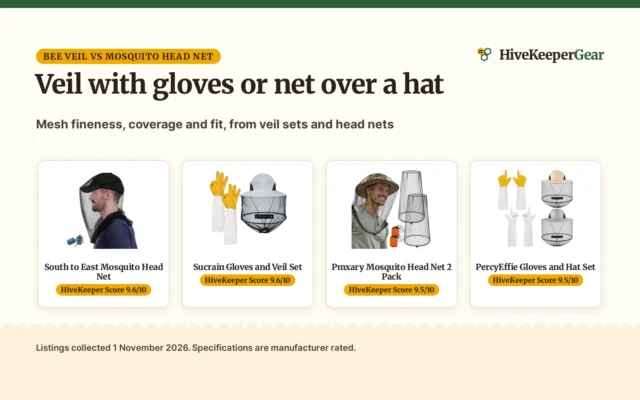
Beekeepers choose between standalone veils and garments with integrated hoods. Standalone veils slip over your head independently and rest over ordinary clothing. They are convenient for quick yard checks, inspecting entrance activity, or refilling a feeder. However, because standalone veils drape over the shoulders, they rely on elastic cords to cinch against the chest. If an elastic cord shifts, a gap can develop where crawling bees might enter.
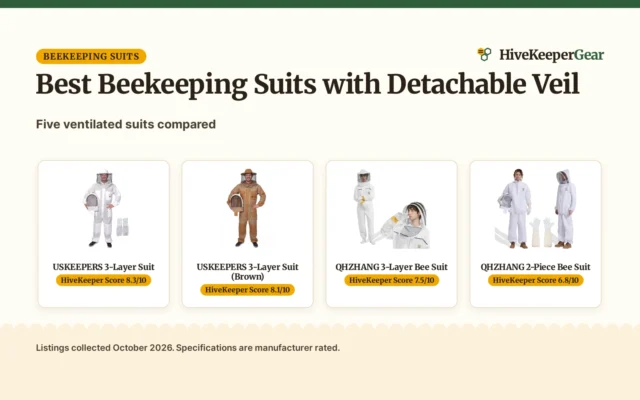
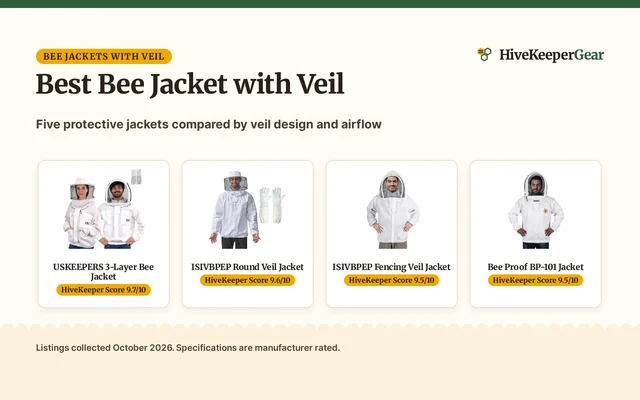
Integrated veils zip directly onto the collar of a specialized beekeeping jacket or full beekeeping suit. The zipper forms a continuous seal around the neck, and overlapping fabric flaps cover the zipper sliders to block tiny openings. Beekeepers who want versatility can explore beekeeping suits with detachable veil designs, or compare options in our bee jacket with veil guide.
Securing the veil: straps, cords, and closures
Honey bees rarely fly through fine netting; instead, they land on fabric and crawl upward toward dark openings. A veil must maintain a snug seal along its lower edge to keep crawling bees outside.
Standalone veils utilize distinct closure methods. Some models feature elasticated neckbands that gather around the neck or collar, such as the camouflage pullover veils offered in a 2Pack format by NYKKOLA. Other models incorporate drawstrings or underarm straps. NIZEFEI includes a fixed cord to keep the hat anchored in breezy conditions, while witbee equips its cowboy hat veils with two adjustable elastic underarm straps plus an internal crown rope. Looping underarm straps beneath your arms anchors the skirt firmly against your chest, preventing the netting from riding up when you lean over hive boxes.
Care, storage, and keeping spare veils
Hive inspections leave propolis, wax, and smoke residue on gear. Keeping mesh clean ensures unobstructed sightlines into dark comb cells. Humble Bee, HunterBee, and NAVADEAL list their veils as hand wash only. Soaking the netting in cool water with mild soap and air drying protects fine seams and preserves the shape of structured brims. Store your veil flat or hanging on a wall hook to prevent crushing the brim.
Keeping a spare veil in your apiary shed is also practical for guests or helpers. Multi-pack options make stocking backup gear straightforward: NYKKOLA provides a 2Pack of head nets, and witbee offers a 2-Pack of cowboy hat veils. Having spare headwear ensures visitors can observe hive activity with proper facial protection.
FAQs for beekeepers
Can bees sting through a beekeeping veil?
Honey bees can sting through mesh netting if the fabric rests directly against your skin. A properly fitted veil prevents this by using a wide brim or internal frame to keep screening held away from your face and neck. Multi-layer designs, such as the 3 breathable layers listed by Bee Proof or the three-layer build listed by Be Noble, provide physical depth that keeps bees separated from the wearer.
Why is beekeeping veil mesh black instead of white?
Dark mesh absorbs ambient sunlight rather than reflecting glare into your eyes. When looking into deep hive boxes to inspect brood frames, black netting allows your eyes to focus past the screen onto the comb, whereas white netting reflects sunlight and obscures your view.
What is the difference between a round veil and a fencing veil?
A round veil uses a continuous circular brim that holds netting away from the head on all sides, providing open sightlines and cooling airflow. A fencing veil features an arched hood with a front zipper opening, allowing the beekeeper to fold the hood back or unzip the front without removing their hat.
How do standalone veils seal against clothing?
Standalone veils rely on elasticated neckbands, drawstrings, or underarm elastic straps. For example, witbee includes two adjustable elastic straps that loop under the arms to anchor the lower skirt flat against the torso, preventing bees from crawling beneath the hem.
How do you wash a beekeeping veil without damaging it?
Makers including Humble Bee, NAVADEAL, and HunterBee state that veils should be hand washed only. Soaking the mesh in cool water with mild soap and air drying protects delicate screen stitching and preserves the shape of structured brims and seams.
More hive guides
See every bee jackets and veils guide and all protective gear guides.
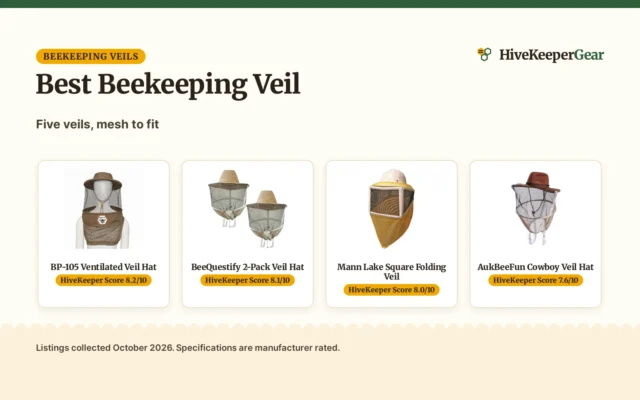
More picks: explore our guides to the best beekeeping veil, best bee jacket with veil, and best beekeeping suit. New to beekeeping? Start with our beekeeping equipment list for beginners.