8×30 vs 8×42 Binoculars: Which One Should You Buy?
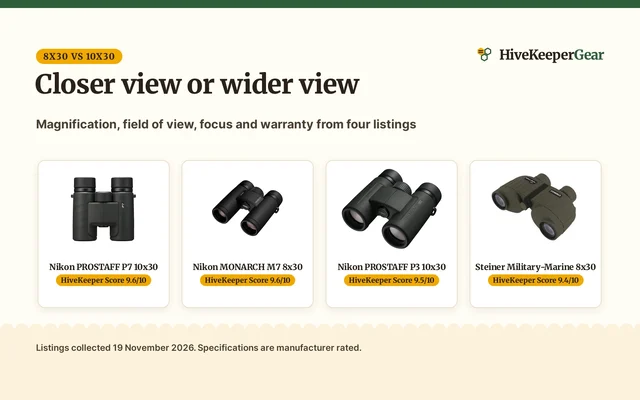
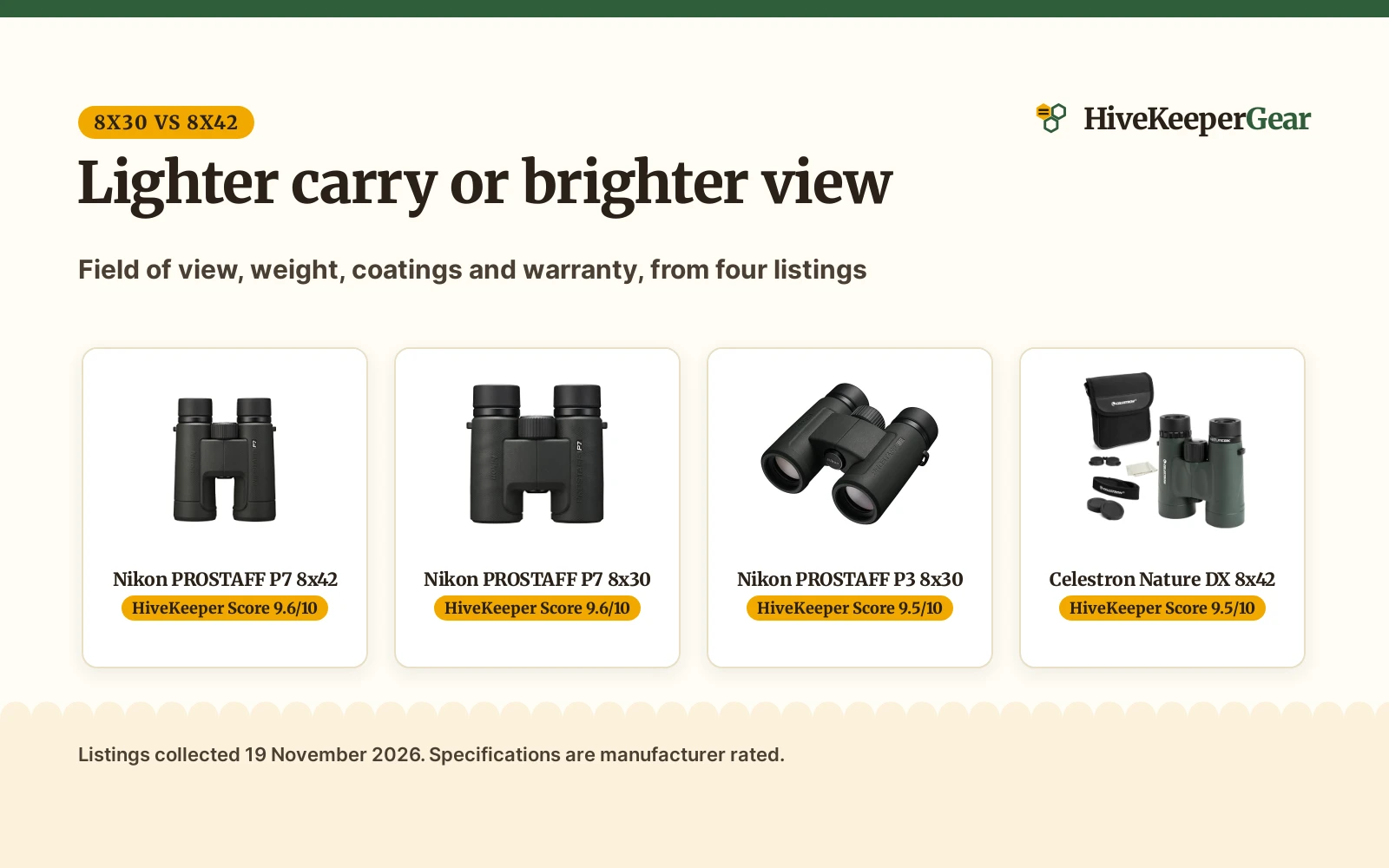
8x30 vs 8x42 binoculars compared on two Nikon PROSTAFF P7 examples, a Nikon P3 and a Celestron: field of view, weight, coatings and warranty.

On this page
Top picks at a glance
As an Amazon Associate I earn from qualifying purchases.
- 1
 Nikon PROSTAFF P7 8x429.6/10View on Amazon
- 2
 Nikon PROSTAFF P7 8x309.6/10View on Amazon
- 3
 Nikon PROSTAFF P3 8x309.5/10View on Amazon
- 4
 Celestron Nature DX 8x429.5/10View on Amazon
On a still morning in the bee yard, when the hives are busy and the far fence line calls for a closer look, 8×30 vs 8×42 binoculars comes down to carry weight against low-light brightness. We compared both sides by field of view, weight, coatings, weather sealing and warranty term, using only what each listing publishes.
HiveKeeperGear earns a commission when you buy through links on this page, at no extra cost to you. As an Amazon Associate I earn from qualifying purchases. Affiliate disclosure.
Quick verdict: choose the 8×30 side if you want the lighter carry and the wider field of view the Nikon P7 8×30 lists at 456 ft at 1,000 yds. Choose the 8×42 side if you want the brighter low-light view the Nikon P7 8×42 lists with 42mm objectives.
Four examples
| # | Product | HiveKeeper Score | Buy |
|---|---|---|---|
| 1 | Nikon PROSTAFF P7 8x42 | 9.6/10 | Buy on Amazon |
| 2 | Nikon PROSTAFF P7 8x30 | 9.6/10 | Buy on Amazon |
| 3 | Nikon PROSTAFF P3 8x30 | 9.5/10 | Buy on Amazon |
| 4 | Celestron Nature DX 8x42 | 9.5/10 | Buy on Amazon |
Nikon PROSTAFF P7 8x42
A full-size 8x42 binocular with 42mm objectives, a 377 ft field of view and phase-correction coated roof prisms.
Pros
- 42mm objectives for low-light viewing
- 377 ft field of view at 1,000 yds
- Phase-correction coated roof prisms
- Locking diopter ring preserves focus
Cons
- Heavier than the 8x30 examples at 1.3 lb
- Narrower field of view than the P7 8x30
- Full-size body takes more room
- Green color only, as stated
Nikon PROSTAFF P7 8x30
A compact 8x30 binocular with a 456 ft field of view, phase-correction coated roof prisms and a locking diopter.
Pros
- 456 ft field of view at 1,000 yds
- Phase-correction coated roof prisms
- Locking diopter ring preserves focus
- Oil- and water-repellent lens coatings
Cons
- 30mm objectives are smaller than the 42mm objectives
- No tripod adapter socket is stated
- Green color only, as stated
- No low-light objective claim is stated
Nikon PROSTAFF P3 8x30
A compact 8x30 binocular with multilayer-coated lenses, a silver-alloy prism coating, O-ring seals and nitrogen purging.
Pros
- Lightest example here at 1.05 lb
- Multilayer-coated lenses, silver-alloy prism coating
- O-ring seals and nitrogen purging
- Turn-and-slide eyecups, long eye relief
Cons
- No field of view figure is stated
- No locking diopter ring is stated
- No oil- and water-repellent coating is stated
- Black color only, as stated
Celestron Nature DX 8x42
An 8x42 binocular with 42mm objectives, fully multi-coated lenses, phase-coated BaK-4 prisms and a tripod adapter socket.
Pros
- 42mm objectives, fully multi-coated lenses
- Phase-coated BaK-4 prisms
- Tripod adapter socket for steady viewing
- 7.4 degree angular field of view
Cons
- Heaviest example here at 1.75 lb
- Field of view in degrees, not feet
- No locking diopter is stated
- Tripod adapter is not included
As an Amazon Associate I earn from qualifying purchases.
Other hives and gear to compare
 Steiner Military-Marine 8x30 BinocularsCheck price on Amazon
 Vortex Crossfire HD 8x42 BinocularsCheck price on Amazon
 Nikon PROSTAFF P3 8x42 BinocularCheck price on Amazon
 Celestron Outland X 8x42 Binoculars for Birding & NatureCheck price on Amazon
 NIKON MONARCH M7 BinocularsCheck price on Amazon
 Nikon Action 8x42 BinocularCheck price on Amazon
8×30 vs 8×42 binoculars: side by side
| Spec | Nikon PROSTAFF P7 8×42 | Nikon PROSTAFF P7 8×30 | Nikon PROSTAFF P3 8×30 | Celestron Nature DX 8×42 |
|---|---|---|---|---|
| Magnification | 8x | 8x | 8x | 8x |
| Objective | 42mm | 30mm | 30mm | 42mm |
| Field of view | 377 ft at 1,000 yds | 456 ft at 1,000 yds | Not stated | 7.4 degrees |
| Weight | 1.3 lb | 1.07 lb | 1.05 lb | 1.75 lb |
| Prism coating | Phase-correction, dielectric | Phase-correction, dielectric | Silver-alloy | Phase-coated BaK-4 |
| Weather sealing | Waterproof, fogproof | Waterproof, fogproof | Waterproof, fogproof | Waterproof, fogproof |
| Warranty | Limited Lifetime | Limited Lifetime | Limited Lifetime | Limited Lifetime |
These figures come from the product listings and are the brand’s own claims, gathered 19 November 2026.
Objective size and low light
Objective size is the number that defines the two sides. The 8×42 examples list 42mm objectives, and the P7 8×42 listing ties them to low-light viewing, for a view in fading light. The 8×30 examples list 30mm objectives, and the P7 8×30 listing says details stay sharp in low-light conditions.
Field of view
The two Nikon P7 examples can be compared directly, because both state field of view in feet at 1,000 yds. The P7 8×30 lists 456 ft, the widest in the series, against 377 ft for the P7 8×42. The other two state it differently: the P3 8×30 states no field of view figure, and the Celestron states 7.4 degrees, a different unit that this guide does not convert.
Weight and carry
Weight is stated for all four examples. The 8×30 examples list 1.05 lb for the P3 and 1.07 lb for the P7 8×30, while the 8×42 examples list 1.3 lb for the P7 8×42 and 1.75 lb for the Celestron. The lightest example here is the P3 8×30, and the heaviest is the Celestron.
Coatings, eyecups and focus
The P7 8×30 and P7 8×42 both list phase-correction coated roof prisms with a dielectric multilayer prism coating, a locking diopter ring, turn-and-slide eyecups and long eye relief, plus oil- and water-repellent lens coatings. The P3 8×30 lists multilayer-coated lenses with a silver-alloy prism coating and turn-and-slide eyecups with long eye relief, without a locking diopter. The Celestron lists fully multi-coated lenses with phase-coated BaK-4 prisms and a tripod adapter socket.
Which should you choose?
Choose the 8×30 side if you want the lighter carry, the wider field of view the P7 8×30 lists, and a compact body.
Choose the 8×42 side if you want the brighter low-light view the P7 8×42 lists with 42mm objectives, and a tripod socket on the Celestron.
Whichever you choose, read our guide on roof vs porro prism binoculars before you buy.
In the Bee Yard
- Store the binoculars dry between outings; all four state waterproof and fogproof construction.
- Set the turn-and-slide eyecups for your eyes; the Nikon examples state long eye relief.
- Lock the diopter once focus is set on the P7 examples.
- Mount the Celestron on a tripod through its adapter socket.
Inside the HiveKeeper Score
| Product | HiveKeeper Score | Perf. /35 | Build /25 | Value /25 | Safety /10 | Warranty /5 |
|---|---|---|---|---|---|---|
| Nikon PROSTAFF P7 8×42 | 9.6 | 32 | 22 | 21 | 0 | 4 |
| Nikon PROSTAFF P7 8×30 | 9.6 | 30 | 22 | 21 | 0 | 4 |
| Nikon PROSTAFF P3 8×30 | 9.5 | 28 | 21 | 21 | 0 | 4 |
| Celestron Nature DX 8×42 | 9.5 | 29 | 20 | 20 | 0 | 4 |
Shown scores begin at a 9.2 minimum and reach a 9.8 maximum; an item climbs that scale only by earning more points.
The HiveKeeper Score weighs performance, build, value, safety and warranty, as explained on our how we pick page. The P7 8×42 scores highest on performance for its 42mm objectives, while the P7 8×30 follows for its wider field of view. No listing states a safety certification, so no example earns safety points.
FAQs for beekeepers
Do 8×42 binoculars show more than 8×30 binoculars in low light?
The P7 8×42 listing says its 42mm front objectives gather maximum light for low light situations. The 8×30 examples list 30mm objectives, and the P3 listing also claims sharp images at dawn or dusk.
Which binocular has the widest field of view here?
The P7 8×30 lists 456 ft at 1,000 yds, against 377 ft for the P7 8×42. The Celestron lists 7.4 degrees, a different unit, and the P3 states no field of view figure.
Are these binoculars waterproof?
Yes, all four state waterproof and fogproof construction. The P3 also states O-ring seals and nitrogen gas purging.
What warranty do these binoculars carry?
All four state a limited lifetime warranty: the three Nikon examples state Limited Lifetime, and the Celestron states a Limited Lifetime Warranty.
More hive guides
Related: roof vs porro prism binoculars and best monocular for wildlife viewing.