8×42 vs 10×50 Binoculars: Which One Should You Buy?
8x42 vs 10x50 binoculars, compared on Nikon, Celestron and Bushnell glasses: magnification, objective lens, weight, field of view and warranty.

On this page
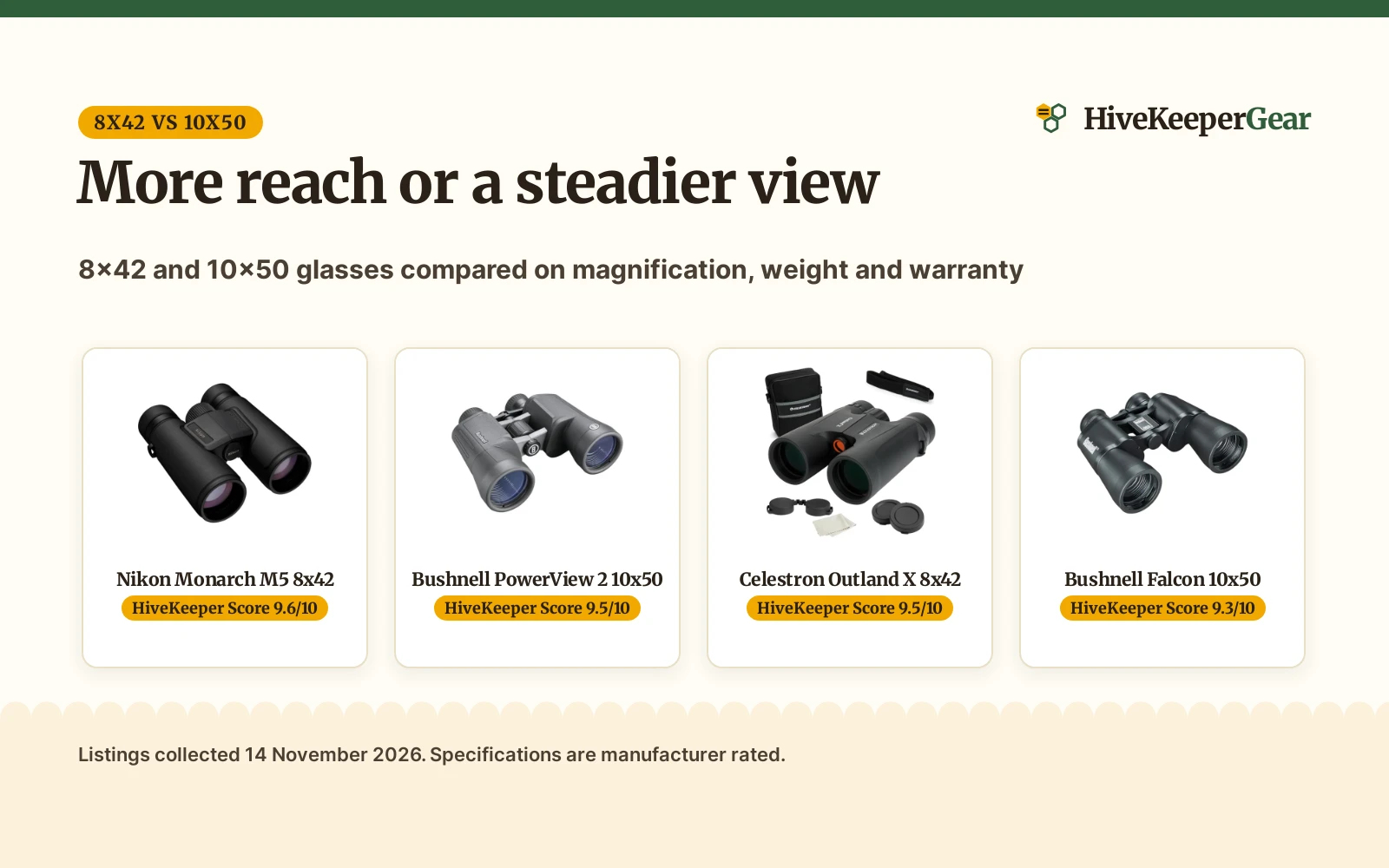
Top picks at a glance
As an Amazon Associate I earn from qualifying purchases.
- 1
 Nikon Monarch M5 8x429.6/10View on Amazon
- 2
 Bushnell PowerView 2 10x509.5/10View on Amazon
- 3
 Celestron Outland X 8x429.5/10View on Amazon
- 4
 Bushnell Falcon 10x509.3/10View on Amazon
The 8×42 vs 10×50 binoculars choice comes down to reach against a steadier hold. The 8×42 examples here give the steadier handheld view, while the 10×50 examples here bring more magnification and a larger objective lens. We compared the glasses on both sides, using only what each maker publishes.
HiveKeeperGear earns a commission when you buy through links on this page, at no extra cost to you. As an Amazon Associate I earn from qualifying purchases. Affiliate disclosure.
Quick verdict: choose 8×42 for a steadier handheld view, and choose 10×50 for more reach. The Nikon Monarch M5 leads the 8×42 side, while the Bushnell PowerView 2 leads the 10×50 side.
The examples
| # | Product | HiveKeeper Score | Buy |
|---|---|---|---|
| 1 | Nikon Monarch M5 8x42 | 9.6/10 | Buy on Amazon |
| 2 | Bushnell PowerView 2 10x50 | 9.5/10 | Buy on Amazon |
| 3 | Celestron Outland X 8x42 | 9.5/10 | Buy on Amazon |
| 4 | Bushnell Falcon 10x50 | 9.3/10 | Buy on Amazon |
Nikon Monarch M5 8x42
An 8x42 binocular with ED glass, dielectric prism coating and a close focus as near as 8.2 ft, in a water resistant, fogproof, nitrogen-purged housing with O-ring seals.
Pros
- ED glass lenses minimize chromatic aberration and color fringing
- Dielectric prism coating for brighter, more natural colors
- Close focus as near as 8.2 ft for detail up close
- Water resistant and fogproof housing with O-ring seals
Cons
- 8x magnification gives less reach than the 10x50 examples here
- 42 mm objective lens is smaller than the 50 mm objective lens on the 10x50 examples here
- Field of view is described as broad, with no figure stated
- No tripod adapter threads for steady long looks
Bushnell PowerView 2 10x50
A 10x50 binocular with multi-coated lenses in a durable aluminum alloy chassis with soft touch rubber and an ultra-smooth focus wheel.
Pros
- Aluminum alloy chassis provides durability without added bulk
- Multi-coated optics for clear, vibrant images, even in low light
- Soft touch rubber and easy grip texture along the sides and bridge
- Ultra-smooth focus wheel for quick focus on a subject
Cons
- 10x magnification needs a steadier hold than the 8x42 examples here
- 1.74 lb, more than the 1.3875 lb stated for the Nikon example
- No water resistance is stated, unlike the Celestron and Nikon examples
- No close focus figure is stated, unlike the Nikon example
Celestron Outland X 8x42
An 8x42 binocular with BaK-4 prisms, multi-coated optics and a wide 7° angular field of view, in a rubber-armored polycarbonate housing with built-in tripod adapter threads.
Pros
- BaK-4 prisms produce sharp, color-accurate images
- Wide 7° angular field of view for scanning open landscapes
- Water resistant and nitrogen-purged to prevent fogging in rain, snow or humidity
- Built-in tripod adapter threads for shake-free viewing on a standard tripod
Cons
- 8x magnification gives less reach than the 10x50 examples here
- Tripod adapter is not included
- 1.8 lb, more than the 1.3875 lb stated for the Nikon example
- 42 mm objective lens is smaller than the 50 mm objective lens on the 10x50 examples here
Bushnell Falcon 10x50
A 10x50 Porro prism binocular with fully coated optics, an InstaFocus system, fold-down eyecups and non-slip rubber grip pads.
Pros
- Porro prism with fully coated optics for light transmission
- InstaFocus system for fast focus on moving targets
- Fold-down eyecups
- Non-slip rubber grip pads
Cons
- No warranty term is stated
- 10x magnification needs a steadier hold than the 8x42 examples here
- 1.83 lb, more than the 1.3875 lb stated for the Nikon example
- No close focus figure is stated, unlike the Nikon example
As an Amazon Associate I earn from qualifying purchases.
Other hives and gear to compare
 Vortex Viper HD Roof Prism Binoculars 10x50Check price on Amazon
 Celestron Outland X 10x50 Binoculars for Low-Light WildlifeCheck price on Amazon
 Celestron Nature DX 8x42 Waterproof Binoculars for BirdCheck price on Amazon
 Celestron UpClose G2 10x50 Porro Binoculars for Wildlife &Check price on Amazon
 Vortex Optics Diamondback 10x50 Roof Prism BinocularCheck price on Amazon
 Sogries 10x50 Binoculars for Adults High Powered WaterproofCheck price on Amazon
8×42 vs 10×50 binoculars: side by side
| Binocular | HiveKeeper Score | Magnification | Objective lens | Prism | Weather sealing | Warranty |
|---|---|---|---|---|---|---|
| Nikon Monarch M5 8×42 | 9.6/10 | 8x | 42 mm | ED glass, dielectric coating | Water resistant, fogproof | Limited Lifetime |
| Bushnell PowerView 2 10×50 | 9.5/10 | 10x | 50 mm | Not stated | Not stated | Lifetime Ironclad Warranty |
| Celestron Outland X 8×42 | 9.5/10 | 8x | 42 mm | BaK-4 prisms | Water resistant, nitrogen-purged | Limited Lifetime |
| Bushnell Falcon 10×50 | 9.3/10 | 10x | 50 mm | BK7 Porro prism | Not stated | Not stated |
All specs repeat what the manufacturer lists, not our own measurements, read on 14 November 2026.
Magnification and objective lens
The sides differ first on magnification and objective lens: 8x with a 42 mm lens against 10x with a 50 mm lens. The Nikon and Celestron examples give 8x magnification, while the Bushnell PowerView 2 and Falcon examples give 10x. The Falcon example is the odd one out, giving magnifications of 10x and 12x, so check before ordering.
Weight and handling
The Nikon example lists 1.3875 lb, the Celestron example lists 1.8 lb, the PowerView 2 example lists 1.74 lb and the Falcon example lists 1.83 lb. The Nikon example carries the lowest weight stated here, and the Falcon example carries the highest. The Celestron example at 1.8 lb weighs more than the PowerView 2 example at 1.74 lb, so weight does not split cleanly by side.
The Falcon example has fold-down eyecups and non-slip rubber grip pads, the Nikon example has turn-and-slide eyecups for eyeglass wearers, and the PowerView 2 example has soft touch rubber with an easy grip texture. The Celestron example has a rubber-armored polycarbonate housing.
Optics and coatings
The Nikon example leads on glass, with Extra-low Dispersion (ED) glass lenses and dielectric high-reflective multilayer prism coatings. The Celestron example uses BaK-4 prisms with multi-coated lenses, the PowerView 2 example uses multi-coated optics, and the Falcon example uses a BK7 Porro prism with fully coated optics. No prism type is stated for the PowerView 2 example.
Field of view and close focus
Only the Celestron example states a field of view figure, a wide 7° angular field of view. The Nikon and PowerView 2 examples describe a broad or wide field with no figure stated, and the Falcon example gives no field figure either. Only the Nikon example states a close focus, as near as 8.2 ft.
Weather resistance and build
The Celestron and Nikon examples are the weather-ready pair here. The Celestron example is water resistant and nitrogen-purged to prevent fogging in rain, snow or humidity. The Nikon example pairs a water resistant and fogproof nitrogen-purged housing with O-ring seals. The PowerView 2 example states no water resistance, and the Falcon example claims all-weather grip pads with no water figure stated.
Listing gaps to check
Some figures need a check before ordering. The Falcon example gives magnifications of 10x and 12x, and the Celestron example gives warranty terms of Limited Lifetime and 2 Year. The Falcon example states no warranty term, only a Manufacturer Warranty with no term given. Field of view figures are missing for the Nikon, PowerView 2 and Falcon examples, and close focus is stated only for the Nikon example.
Which should you choose?
Choose 8×42 if you want a steadier handheld view for birding. Our best birding binoculars roundup compares more glasses for the field.
Choose 10×50 if you want more magnification and a larger objective lens, and you can hold the higher magnification steady. Our 8×42 vs 10×42 binoculars comparison covers a closer pairing.
In the Bee Yard
Handle and store the glasses by what each maker states:
- Mount the Celestron example on a standard tripod with its built-in adapter threads for shake-free viewing; the adapter is not included.
- Turn-and-slide eyecups on the Nikon suit eyeglass wearers, and the Falcon example has fold-down eyecups.
- The Celestron example is nitrogen-purged to prevent fogging in rain, snow or humidity, and the Nikon example has a fogproof nitrogen-purged housing with O-ring seals.
- The Falcon example is the heaviest glass here at 1.83 lb, and the 10x examples need a steadier hold than the 8x examples.
Inside the HiveKeeper Score
| Product | HiveKeeper Score | Perf. /35 | Build /25 | Value /25 | Safety /10 | Warranty /5 |
|---|---|---|---|---|---|---|
| Nikon Monarch M5 8×42 | 9.6 | 32 | 22 | 21 | 0 | 4 |
| Bushnell PowerView 2 10×50 | 9.5 | 29 | 21 | 20 | 0 | 4 |
| Celestron Outland X 8×42 | 9.5 | 30 | 21 | 20 | 0 | 3 |
| Bushnell Falcon 10×50 | 9.3 | 26 | 19 | 19 | 0 | 0 |
We map points onto a band running from 9.2 up to 9.8 in a straight line, so ranking by score is ranking by points.
The HiveKeeper Score weighs performance, build, value, safety and warranty. How we pick explains the weights. The Nikon example scores highest for its ED glass, dielectric coating and close focus, and it earns warranty points for its Limited Lifetime term. The PowerView 2 example earns warranty points for its Lifetime Ironclad Warranty, while the Falcon example earns none. No example earns safety points, since none states a safety listing or certification.
FAQs for beekeepers
What does 8×42 mean on binoculars?
8x is the magnification and 42 mm is the objective lens size. The Celestron example states both figures, and the Nikon example is an 8×42 glass with the same figures.
What does 10×50 mean on binoculars?
10x is the magnification and 50 mm is the objective lens size. The PowerView 2 example is a 10×50 glass, and the Falcon example states a 50-millimeter objective lens.
Are 8×42 binoculars better for birdwatching than 10×50?
Neither side wins outright here. The Nikon example carries the lowest weight stated here at 1.3875 lb, and the Falcon example carries the highest at 1.83 lb, while the Celestron example at 1.8 lb weighs more than the PowerView 2 example at 1.74 lb. The Celestron example states a wide 7° angular field of view. Pick 8×42 for a steadier handheld view and 10×50 for more reach.
Can these binoculars be used with a tripod?
Only the Celestron example states a tripod mount, with built-in tripod adapter threads; the adapter is not included. The other examples state no tripod mount.
What is the close focus on these binoculars?
Only the Nikon example states a close focus, as near as 8.2 ft. The other examples state no close focus figure.
More hive guides
See every birding optics guide and all backyard wildlife guides.
Related: best birding binoculars, 8×42 vs 10×42 binoculars, compact vs full-size binoculars, and best spotting scope for bird watching.