Bait Hives for Honey Bees: Swarm Trap Setup Guide (2026)
How to set up bait hives for honey bees: choosing cavity boxes, baiting with comb, selecting elevated locations, protecting entrances, and hiving captured swarms.

On this page
Top picks at a glance
As an Amazon Associate I earn from qualifying purchases.
- 1
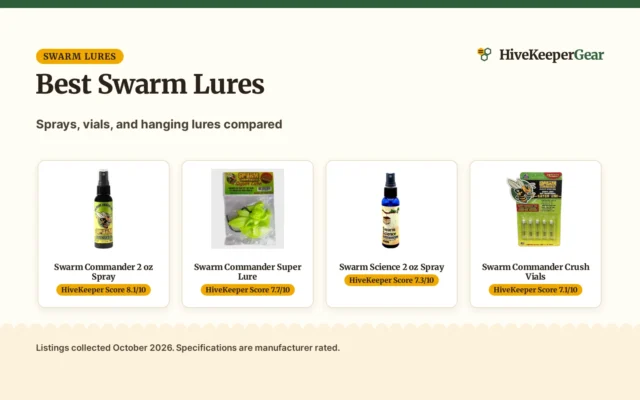
 Swarm Commander Premium Swarm Lure 2 oz Spray Bottle with9.6/10View on Amazon
- 2
 8 Frame Hoover Hives Wax-Coated Medium Honey Super BoxView on Amazon
- 3
 AukBeeFun 8 Pack Bee Feeders for Hives Mason Jar Sugar WaterView on Amazon
Bait hives for honey bees are empty hive boxes set out during swarm season to attract and house wild honey bee swarms looking for a new nesting cavity. Using a bait hive lets you expand an apiary with local survivor stock without buying packaged bees or nucleus colonies. Setting up an effective trap requires choosing an attractive cavity size, adding drawn comb or lure scents, positioning the box high and firmly, and inspecting regularly so moving bees into a permanent hive goes smoothly.
Other hives and gear to compare
 8 Frame Hoover Hives Wax-Coated Medium Honey Super BoxCheck price on Amazon
 AukBeeFun 8 Pack Bee Feeders for Hives Mason Jar Sugar WaterCheck price on Amazon
HiveKeeperGear earns a commission when you buy through links on this site, at no extra cost to you. As an Amazon Associate I earn from qualifying purchases. Affiliate disclosure.
Before you start: scout local swarm conditions
Colonies reproduce in spring when expanding populations outgrow their brood nest and prepare to swarm. The resident queen departs with the primary swarm cluster, gathering temporarily on a nearby tree branch while scout bees search the surrounding landscape for a dry, hollow cavity. Understanding scout bee behavior helps you position bait boxes where searching bees naturally look. Beekeepers should also verify municipal ordinances and apiary registration guidelines through an extension office or state apiary program before placing traps near property lines or public areas. A local beekeeping club offers regional insight into when spring nectar flows trigger swarm preparations in your specific climate.
Setting up bait hives for honey bees, step by step
| Stage | Component | Role in swarm trapping | Helpful guide |
|---|---|---|---|
| Cavity box | Deep hive body | Provides hollow volume scout bees seek | Bee hive boxes |
| Frames | Drawn comb and frames | Gives scouts familiar beeswax scent and foundation | Beehive frames |
| Cavity size | Standard box dimensions | Matches the interior space swarms prefer | Deep box dimensions |
| Entrance | Sliding mouse guard | Narrows access and blocks mice or unwanted intruders | Mouse guards |
| Mounting | Strap and cleats | Fastens the box firmly against trees or platforms | 8-frame hives |
| Protection | Veil and suit | Shields you during trap checks and ladder work | Bee suits |
| Calming | Smoker and fuel | Calms newly captured swarms before transfer | Bee smokers |
| Prying | Hive tool | Pries frames apart without jarring the new cluster | Hive tools |
| Feeding | In-hive feeder | Provides syrup so new arrivals draw fresh wax quickly | Bee feeders |
| Permanent hive | Langstroth setup | Houses the established colony on a level apiary stand | Langstroth hives |
1. Cavity box and volume
In nature, feral honey bee swarms prefer an enclosed hollow cavity that is dry, dark, and defensible. A standard deep Langstroth hive body or a deep nucleus box serves as an effective bait trap because it provides the cavity space bees naturally favor while accepting standard frames for easy apiary management. For beekeepers choosing standard wooden boxes, BeeCastle lists an adjustable stainless steel sliding mouse guard for 8 or 10 frame hives that adjusts in length from 7 7/8 inches to 16 inches, supplied in a pack of 4 with 16 screws. Its round entry holes allow worker bees to pass while barring rodents from entering and damaging comb.
2. Comb and scent lures
Scout bees evaluate potential nest cavities using olfactory cues and physical inspection. An empty wooden box with bare foundation alone rarely attracts scout bees from a distance. Beekeepers widely consider dark drawn brood comb placed toward the center of the box to be the most effective attractant. Old comb carries propolis and cocoon residues that signal a successful past nesting site. Flank the drawn comb with empty wooden frames fitted with wax-coated foundation so the swarm has immediate workspace to build fresh comb once they arrive.
In addition to brood comb, swarm lures containing lemongrass oil provide a potent attractant because citral components mimic worker bee orienting pheromones. Beekeepers often add drops of lemongrass oil or commercial lure onto top bars or place an absorbent swab inside a small plastic vial near the entrance hole. Avoid over-scenting the cavity, as overpowering odors can drive searching scouts away.
3. Location and mounting height
Where you place a bait hive determines how quickly passing scout bees discover the cavity. Wild swarms search along recognizable linear landscape features such as tree lines, forest borders, fence rows, and edges of open pastures. Position the trap so the entrance faces southeast or south toward morning sun to warm the flight opening, while locating the box under a tree canopy to protect the cavity from overheating during hot afternoons.
Mounting the trap off damp ground is essential for visibility and predator defense. Beekeepers often anchor traps high on a straight tree trunk, in a sturdy tree fork, or on the flat roof of an outbuilding. Fasten the box firmly to the tree using heavy ratchet straps, lag screws, or wooden support cleats so strong spring gusts cannot dislodge or wobble the trap. Inspecting scout bees generally prefer stable tree hollows and tend to reject swaying or unstable boxes. Ensure the location allows safe ladder access when the time comes to bring an occupied, heavy hive down.
4. Entrance and pest protection
A bait hive entrance must balance ease of scout bee access against colony defense and pest exclusion. An entrance opening allows scout bees to enter and walk across the interior to inspect cavity dimensions. However, an unguarded cavity left in wooded areas can attract mice, birds, squirrels, and wax moths seeking shelter.
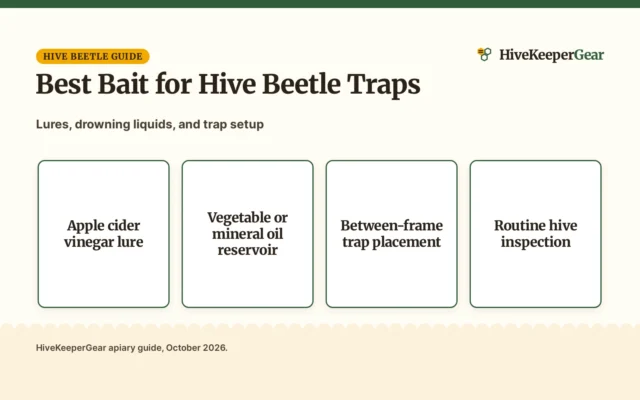
A metal entrance reducer or sliding mouse guard prevents rodents from entering and chewing combs while still permitting worker bees to come and go freely. While unoccupied bait traps primarily rely on entrance guards to exclude rodents and nesting birds, beekeepers managing apiary equipment also monitor for hive pests once colonies become active. For apiary pest management between frames, TIHOOD lists small hive traps in a 12 pack weighing 7 ounces, while HunterBee lists reusable plastic traps in a 20 pack that fit between outer frames in a hive. In an unpopulated bait trap, however, avoid liquid or oil traps that could spill during high winds or transit before bees arrive.
5. Moving the colony into an apiary hive
Recognizing when a swarm has chosen your bait hive requires observing flight patterns at the entrance. When scout bees investigate, you will see bees flying around the box, landing on the walls, and walking in and out of the entrance hole. In contrast, when an actual swarm arrives, a swirling cloud of bees fills the air before entering the box in an orderly march, with workers fanning their Nasonov glands at the entrance. Over subsequent days, bees carrying bright pollen pellets on their hind legs confirm that a queen is present and the colony has begun brood rearing.
Once a swarm has occupied the trap, plan to relocate the box to your permanent apiary within a few days. Wait until dusk when foraging field bees have returned to the hive. Close the entrance with wire mesh or screen so the bees have adequate ventilation during transport without escaping. Carefully unfasten the box from the tree and lower it to the ground. Transport the box to your apiary and set it on a permanent stand. If the bait hive was a standard deep box, you can keep the colony in that box and add an inner cover, outer cover, and feeder. If you used a dedicated swarm trap or nuc box, transfer the frames individually in their exact order into a full-sized Langstroth hive body, filling remaining space with foundation frames.
Once the colony is installed on its permanent apiary stand, provide sugar syrup in an internal feeder to help the bees draw fresh wax quickly. For preparing syrup to feed an installed colony, Hive Alive lists a liquid feed concentrate containing lemongrass oil in a 100 ml bottle, with manufacturer directions to mix 2.5 ml per liter or 2 tsp per gallon of syrup for 1 hive.
A swarm trapping timeline
Late winter: inspect your spare woodenware, clean old boxes, assemble foundation frames, and repair covers and bottom boards. Prepare your lure supplies, straps, and mounting brackets so everything is ready ahead of warm weather. Early spring: hang bait hives along field edges and tree lines before local dandelions and fruit trees bloom, catching early scout bees exploring the area. Mid to late spring: this is the peak swarming window in most regions, when overcrowded colonies swarm naturally; inspect traps weekly from a distance to spot new arrivals. Summer: move captured swarms to permanent apiary stands, transfer frames into full equipment, and provide syrup so colonies draw wax and store winter reserves. Fall: remove remaining empty bait traps from trees, scrape away propolis, store equipment in a dry shed away from mice, and reduce entrances on established apiary colonies.
Helpful extras for catching swarms
- A telescopic swarm net or pole basket, for scooping low-hanging clusters from tree limbs.
- A ratchet strap with a quick-release buckle, making fastening boxes to tree trunks faster and firmer.
- Spare mesh entrance screens, allowing safe ventilation when moving occupied traps at dusk.
- A sturdy transport board or hive carrier, easing the carry from remote woodlots to your vehicle.
- A field notebook or apiary log, recording trap locations, compass bearings, scout sightings, and capture dates.
Keeping an apiary notebook allows you to track which tree lines and compass directions yield the highest capture rates year after year, refining your trap placement over time.
What bait hives do not do
Bait hives attract wild reproductive swarms, but colonies do not arrive in every location or season, as swarm frequency depends on regional weather, colony strength, and local forage. We also do not provide veterinary diagnoses or chemical treatment recommendations. For colony health questions or state registration guidelines, contact your local beekeeping association or state apiary inspector.
FAQs for beekeepers
How to bait a bee hive?
Bait a hive by placing dark drawn brood comb inside a clean, weather-tight hive body and applying lemongrass oil or swarm lure near the entrance. Position the box firmly above the ground facing the morning sun along an established tree line, and inspect periodically for scout bee traffic.
What is bar bait?
Bar bait refers to rubbing beeswax, propolis, or swarm lure along the wooden top bars of a top bar hive to attract swarms and encourage straight comb building. Our top bar hive bait hive guide compares lures and equipment tailored to alternative hive formats.
What size box works best for a bait hive?
Scout bees prefer an enclosed cavity with volume comparable to a deep hive body, though beekeepers use either nucleus boxes or full-sized woodenware. For full-width boxes, BeeCastle lists sliding mouse guards sized for 8 or 10 frame equipment that bar mice and robbers while allowing worker flight.
When should you set out bait hives for honey bees?
Set bait hives outdoors in early spring before the primary swarming season begins in your region. Traps placed before spring nectar flows allow scout bees to identify the cavity while parent colonies are expanding and preparing reproductive swarms.
How do scout bees choose a bait hive?
Scout bees evaluate volume, structural dryness, entrance dimensions, and elevation above damp ground. Familiar hive scents like beeswax and propolis confirm that the cavity has supported bees previously, prompting scouts to recommend the location to the swarm cluster.
How soon should you move a swarm after it enters a bait hive?
Move the occupied bait hive within a few days of arrival so foraging bees do not fix their flight orientation permanently to the trap site. Wait until dusk when foragers have returned, close the entrance with breathable mesh, and transport the box to its permanent apiary stand.
More hive guides
Browse every guide by category: beehives, protective gear, hive tools and honey harvesting.
More guides: top bar bait hives, bee hive boxes, and mouse guards. New to beekeeping? Start with our beekeeping equipment list for beginners.