Bee Blower vs Bee Brush: Which One Should You Buy?
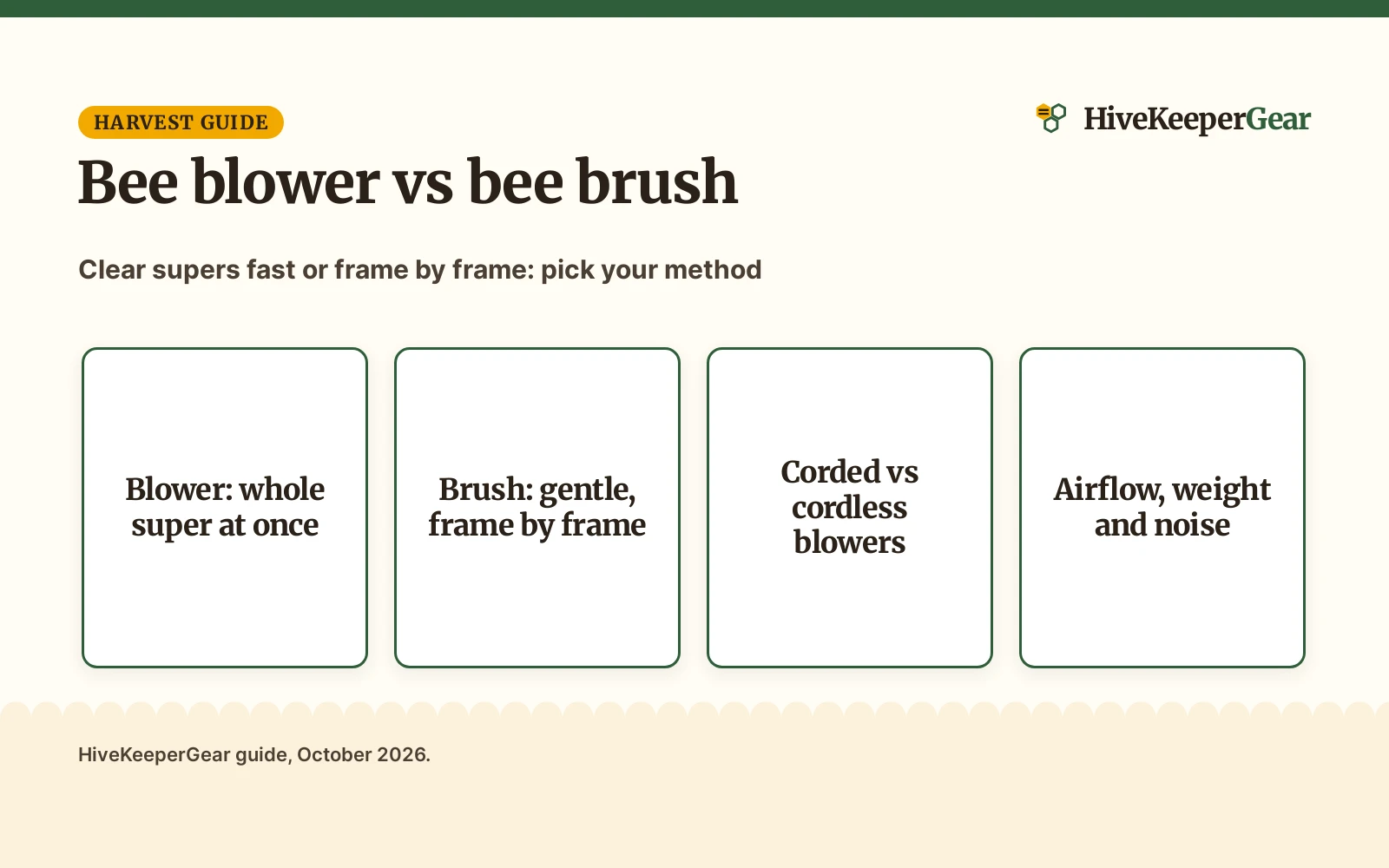
A bee blower clears whole supers with air in minutes, while a bee brush clears bees frame by frame; pick by hive count, noise and power at the yard.

On this page
Top picks at a glance
As an Amazon Associate I earn from qualifying purchases.
- 1
 Patelai 3 Pcs Bee Brush 15.7" Beekeeping Supplies Brush9.7/10View on Amazon
- 2
 ZffXH 2Pack Bee Brush for Beekeepers9.6/10View on Amazon
- 3
 13.8" Soft Natural Horsehair Beekeeping Brush for Beekeepers9.6/10View on Amazon
- 4
 15 Inch Natural Horse Hair Beekeeping bee Brush byView on Amazon
Harvest day in the bee yard starts with a full super and a question: how do you get the bees off the frames so you can take the honey home? For bee blower vs bee brush, the answer is about speed and scale. A bee blower, usually a leaf blower put to bee duty, clears a whole super far faster than brushing, with a stream of air. A bee brush clears bees frame by frame with soft bristles, slower but gentler. Keepers with several hives to harvest usually reach for the blower; keepers with one or two hives often find the brush is all they need.
Other hives and gear to compare
 Acostop 13.8" Soft Natural Horsehair Beekeeping Brush forCheck price on Amazon
 15 Inch Natural Horse Hair Beekeeping bee Brush byCheck price on Amazon
HiveKeeperGear earns a commission when you buy through links on this site, at no extra cost to you. As an Amazon Associate I earn from qualifying purchases. Affiliate disclosure.
bee blower vs bee brush: the short answer
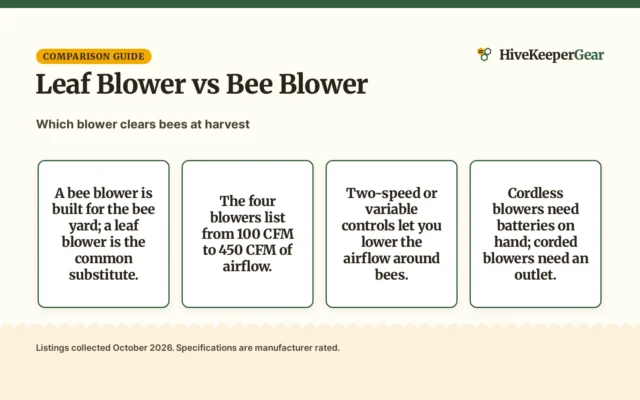
- A bee blower moves bees off the comb with air. Leaf blowers in these listings range from 110+ to 180 MPH, corded and cordless.
- A bee brush moves bees with soft bristles, one frame at a time. The listings cited here cover blowers; brush technique below is general beekeeping practice.
- Blowers are quicker for multiple supers; brushes are quieter and disturb the colony less.
- Many keepers own both: the blower for harvest day, the brush for inspections and small jobs.
How a bee blower works
A bee blower is not a special machine: it is a leaf blower aimed at bee work. You lift the super, stand it on end and blow the bees out from between the frames, working from one side. Corded models like the BLACK+DECKER LB700 list 180 MPH and 180 CFM from a 7-amp motor at 4.4 lb, with a cord retention clip; it needs an outlet within cord reach of the hives. Cordless models trade the cord for batteries: the YOOVL lists two 4.0Ah batteries, six speed modes plus turbo, airflow of 48 to 60 m/s and up to 6 minutes at full power or 5 hours at low speed; its bullets list 2.4 lb while the spec table lists 4.6 lb, so treat the weight as approximate. The YUQUESEN lists 980,000 RPM, airflow over 50 m/s (110+ mph), two batteries with 13+ minutes each and 2.8 lb. The SEYVUM lists 350 CFM, 150 MPH, 15000 RPM, two 2.0Ah batteries with up to 25 minutes at high speed and 3.4 lb with the battery. The laapee lists up to 65 m/s and up to 30 minutes per battery at low speed; note its listing is inconsistent on weight, with the bullets saying 1.12 pounds and the spec table saying 2.67 kg.
Two details matter in the yard. Noise: the VIBOGEN lists 75 dB, and the Saker ships a pair of earplugs and advises against running more than 30 minutes continuously. And nozzles: narrow nozzles like the ones on the YUQUESEN and SEYVUM concentrate the stream between frames, which is what you want.
How a bee brush works
A bee brush is a soft-bristled brush made for the job: you sweep bees gently off each frame before you lift it out. Work frame by frame, brushing downward into the hive so dislodged bees fall back among their sisters rather than onto the ground. A light touch matters: pressing hard rolls bees and can injure them, and a brush full of honey gets sticky fast. Brushes shine during inspections and small harvests, where you clear one or two frames at a time and want the colony as calm as possible. They are also the tool for delicate moments, like brushing bees off a frame you want to check closely.
Blower or brush: picking by the job
- Harvest day with several supers: the blower. Clearing a whole super with air takes a fraction of the time of brushing each frame, and time matters when supers are off and bees are in the air.
- One or two hives: the brush is plenty. Fewer frames means less time, and the colony settles sooner afterward.
- Noise and neighbors: blowers are loud (the VIBOGEN lists 75 dB) and the sound carries; a brush is silent. If your hives sit close to neighbors, the brush keeps the peace.
- Power at the hives: no outlet nearby points to cordless. The listings show two-battery kits as standard, with runtimes from 6 minutes at full power to 5 hours at low speed depending on the model and setting.
- Weight in the hand: listed weights run from 1.12 lb (laapee bullets) to 4.6 lb (YOOVL spec table), so check which figure you trust before you buy for a long harvest day.
Keeping harvest day calm
Whichever tool you pick, the bees set the pace. Work while foragers are out, move slowly and keep the blower stream or brush strokes steady rather than jabbing. Wear your veil and suit as usual, and have a plan for where cleared supers go: covered, away from the hives, so bees do not move straight back in. If the yard gets agitated, pause and let it settle rather than pushing through.
FAQs for beekeepers
Will a leaf blower hurt the bees?
Used sensibly, the air stream moves bees off the comb without contact. Keep the nozzle at a distance, use the lowest effective setting and avoid blasting bees directly against hard surfaces.
Can I use any leaf blower as a bee blower?
The listings here are standard leaf blowers from 110+ to 180 MPH, corded and cordless, and keepers use them as bee blowers. Pick one light enough to hold one-handed, with a narrow nozzle to direct air between frames.
Corded or cordless for the bee yard?
Corded (like the 4.4 lb BLACK+DECKER at 180 MPH and 180 CFM) never runs out of power but tethers you to an outlet. Cordless models in these listings weigh 2.4 to 3.4 lb with batteries and ship two batteries as standard, so one can charge while you work.
Do I need both a blower and a brush?
Many keepers end up with both. The blower handles harvest day across several hives; the brush handles inspections, small harvests and delicate frames year-round.
How loud are these blowers?
The VIBOGEN lists 75 dB, and the Saker includes earplugs and advises against continuous use over 30 minutes. If your apiary is near neighbors, factor the noise into your choice.
What is the lightest option listed?
The laapee bullets claim 1.12 pounds, though its spec table says 2.67 kg, so the figure is uncertain. The next lightest stated figures are 2.4 lb (YOOVL bullets) and 2.8 lb (YUQUESEN).
More hive guides
See the honey harvesting hub and hive tools, our bee escape board vs bee brush comparison and the best hive tool for left handed beekeepers picks.