Can Bees Sting Through Nitrile Gloves: What Beekeepers Need to Know
Nitrile gloves allow bees to sting through thin material, but heavy thickness, proper sizing, and gentle hive handling significantly reduce stings and propolis buildup.

On this page
Top picks at a glance
As an Amazon Associate I earn from qualifying purchases.
- 1
 LOCCEF MicroFoam Nitrile Coated Safety Work Gloves BreathableView on Amazon
- 2
 TitanFlex Nitrile Exam GlovesView on Amazon
- 3
 TitanFlex Heavy Duty Industrial Nitrile Gloves with RaisedView on Amazon
- 4
 Nitrile Gloves HEAVY DUTY 6Mil Disposable Black NitrileView on Amazon
- 5
 MED PRIDE Nitrile Exam GlovesView on Amazon
- 6
 Inspire Cobalt Blue Nitrile Disposable GlovesView on Amazon
Can bees sting through nitrile gloves? Yes, bees can sting through nitrile gloves, especially when the material is pressed directly against the skin. While thin disposable gloves offer minimal barrier defense against a bee stinger, thicker industrial nitrile gloves provide greater resistance during routine apiary work. In this guide, we compared nitrile glove thickness specifications, cuff dimensions, and grip textures from workshop and safety listings to explain how nitrile performs during hive inspections.
Other hives and gear to compare
 LOCCEF MicroFoam Nitrile Coated Safety Work Gloves BreathableCheck price on Amazon
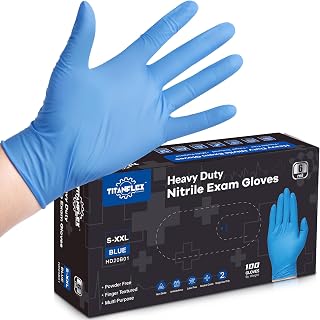 TitanFlex Nitrile Exam GlovesCheck price on Amazon
 TitanFlex Heavy Duty Industrial Nitrile Gloves with RaisedCheck price on Amazon
 Nitrile Gloves HEAVY DUTY 6Mil Disposable Black NitrileCheck price on Amazon
 MED PRIDE Nitrile Exam GlovesCheck price on Amazon
 Inspire Cobalt Blue Nitrile Disposable GlovesCheck price on Amazon
HiveKeeperGear earns a commission when you buy through links on this site, at no extra cost to you. As an Amazon Associate I earn from qualifying purchases. Affiliate disclosure.
Before choosing nitrile: how bee stings happen
Honey bees sting when they perceive a threat to their colony or when they are pinched during an inspection. A worker bee stinger is barbed and rigid, allowing it to penetrate human skin quickly upon contact. When a bee attempts to sting through rubber, the outcome depends on material thickness, how tightly the glove stretches against the skin, and whether the bee can gain leverage with its legs.
Traditional heavy leather gloves provide substantial barrier defense through material thickness, but that thickness comes at the expense of finger dexterity. Beekeepers wearing thick gloves often struggle to feel frame shoulders, leading to dropped equipment or crushed bees that release alarm pheromones. Nitrile gloves provide fingertip sensitivity so beekeepers can work calmly, feel hive components accurately, and avoid squeezing bees accidentally.
Can bees sting through nitrile gloves: thickness and protection compared
Disposable nitrile gloves are manufactured in various thickness grades, from thin medical exam gloves to heavy-duty industrial work gloves. While any nitrile glove can be punctured if a bee is compressed firmly against the skin, thicker industrial gloves provide more resistance during routine handling. The table below compares the thickness ratings, stated dimensions, and grip features across published nitrile listings.
| Thickness | Stated Metric Thickness | Stated Grip and Features | Reference Listing | Our Guide |
|---|---|---|---|---|
| 6-mil | 0.01 inches | Finger textured, exam grade | TitanFlex Blue Exam Gloves | Thick nitrile gloves |
| 8-mil | 0.2 millimeters | Raised diamond texture, waterproof | TitanFlex Heavy Duty Orange | Beekeeping gloves |
| 8-mil | 0.2 millimeters | Textured palm, puncture resistant claim | BEASTEK Nitrile Gloves | Gloves with wrist protection |
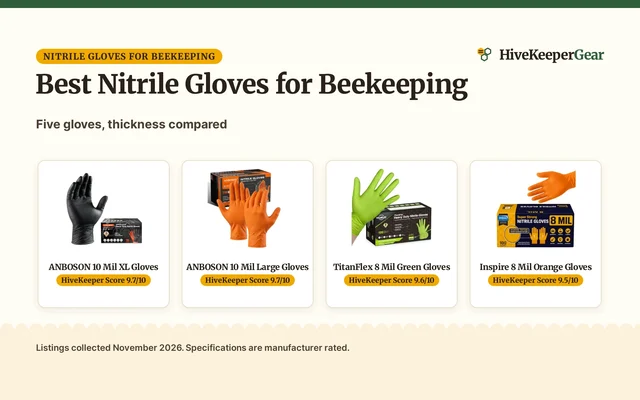
| 10 Mil | 0.25 millimeters | Diamond texture, ANSI ISEA Abrasion Level 4 | ANBOSON Black Heavy Duty | Goatskin gloves |
| 10 Mil | 0.25 millimeters | Raised diamond texture, high visibility orange | ANBOSON Orange Heavy Duty | Ventilated gloves |
All specs repeat what the manufacturer lists, not our own measurements. Listings demonstrate that nitrile gloves vary widely in material thickness, cuff coverage, and palm grip patterns.
1. Glove thickness and stinger penetration
Glove thickness is measured in mils, with higher ratings indicating a thicker barrier. Thinner exam-grade models in published listings, such as the 6-mil TitanFlex glove with a stated thickness of 0.01 inches, provide excellent tactile feel but minimal barrier defense. When a worker bee flexes its abdomen against 6-mil nitrile, the stinger can pass through the rubber into the skin, particularly if the material is stretched taut across the knuckles.
Heavier industrial gloves provide substantial physical protection. TitanFlex states its 8-mil gloves are 2 to 3 times thicker than standard disposable gloves, offering enhanced puncture resistance. BEASTEK and Inspire also list 8-mil disposable gloves with a stated thickness of 0.2 millimeters. For maximum barrier thickness in disposable gear, ANBOSON lists heavy-duty 10 Mil gloves with a stated thickness of 0.25 millimeters. Because a bee stinger can extend further than 0.25 millimeters, no disposable nitrile glove prevents stings if a bee is pinched tightly against the hand. However, 8-mil and 10 Mil nitrile make accidental penetration during incidental contact much less frequent than thin rubber.
2. Nitrile gloves versus traditional leather protective gear
Beekeepers have traditionally worn leather gloves made from goatskin or cowhide, paired with long canvas gauntlets that extend up the forearm. Leather provides dependable defense against stings, but heavy leather reduces tactile feedback, making delicate hive tasks awkward. When a beekeeper cannot feel bees under their fingers, they risk crushing workers against top bars, which prompts defensive stinging. In addition, leather absorbs honey, propolis, and alarm pheromones over time, and leather cannot be easily washed without stiffening.
Nitrile gloves solve many of these issues by maintaining fine motor control. Beekeepers can separate frames cleanly, handle a queen cage smoothly, and feel hive tool pressure with precision. In addition, nitrile does not absorb hive odors or sticky residues. When paired with a protective jacket or suit, nitrile gloves provide a practical compromise between sting prevention and dexterous handling.
3. Sizing, cuffs, and wrist coverage
Proper glove sizing directly influences how well nitrile performs in the apiary. If a glove is too small, the nitrile stretches tightly across the back of the hand and knuckles, thinning the material and making stinger penetration easier. If a glove is too large, excess material bunches at the fingertips, impairing grip on wooden frames and hive tools. A proper fit balances tactile sensitivity with relaxed material across the knuckles.
Manufacturers provide sizing charts based on hand measurements to help buyers choose an accurate fit. TitanFlex lists hand circumference ranges of 6.5 – 7 inches for Small, 9.5 – 10 inches for XL, and 10.5 – 11 inches for 2XL. ANBOSON specifies hand circumferences of 7.5 – 8 inches for Medium, 8.5 – 9 inches for Large, and 9.5 – 10 inches for X-Large. For hand width measurements, LOCCEF lists 3.2 inches for Small, 3.9 inches for XL, and 4.2 inches for 2XL, while Inspire lists 3.3 inches for Small, 3.7 inches for Medium, 4.1 inches for Large, and 4.5 inches for Extra Large.
Cuff length is another key consideration. Disposable nitrile gloves generally feature wrist-length cuffs rather than the elbow-length gauntlets found on leather bee gloves. For example, TitanFlex lists a cuff length and glove length of 9.5 inches, while GLOVEWORKS lists a glove length of 24 centimeters. Overlapping the elastic sleeve cuffs of a beekeeping suit or bee jacket over the glove cuff prevents bees from crawling onto exposed wrists.
4. Grip texture and handling apiary tools
Handling apiary equipment requires a firm grip on smooth wooden boxes, metal frames, and hive tools. Smooth nitrile gloves can become slick when coated with honey, nectar, or moisture. To address this, heavy-duty manufacturers incorporate textured grip patterns into their gloves.
TitanFlex features raised diamond texturing across the fingers and palm, stating the pattern provides up to 60% more gripping power than standard smooth gloves. ANBOSON similarly incorporates raised diamond textures on its 10 Mil gloves, listing a 60% stronger grip to prevent tools from slipping. GLOVEWORKS and TitanFlex also manufacture gloves in high-visibility orange, which helps beekeepers spot resting bees against dark comb before shifting frame grips.
5. Hive hygiene and propolis management
Honey bees gather tree resins to create propolis, a sticky sealant used to cement hive components together. During warm inspections, propolis transfers onto gloves and clothing. On traditional leather gloves, propolis accumulates and hardens, carrying alarm pheromones that draw bees to attack during future visits.
Nitrile provides an impervious surface that does not absorb resins or hive liquids. Beekeepers can wash sticky gloves during inspections or dispose of them after messy hive work. Care instructions vary: GLOVEWORKS, TitanFlex, and Inspire specify hand wash care, allowing heavy-duty gloves to be cleaned and reused, whereas BEASTEK and ANBOSON specify disposable care. Packaging options support regular replacements, with BEASTEK offering a 50 Count box and GLOVEWORKS, TitanFlex, ANBOSON, and Inspire offering 100 Count boxes.
Apiary inspection practices to reduce sting risks
Gloves are only one part of an effective defensive strategy in the apiary. How a beekeeper conducts an inspection often matters more than the gear worn on their hands. Honey bees react defensively to abrupt movements, vibration, and crushing. Applying cool smoke from a bee smoker masks alarm pheromones and encourages bees to feed on honey rather than defend the brood nest.
When working with nitrile gloves, move slowly and deliberately. Avoid grabbing frame side bars where nurse bees and guard bees cluster tightly; instead, hold frames by the wooden lugs. To increase barrier protection without sacrificing touch sensitivity, some beekeepers layer a pair of nitrile gloves over another pair. This layered rubber approach creates an additional barrier that discourages stings while keeping fingers agile enough to handle a hive tool cleanly.
Practical tips for wearing nitrile in the apiary
- Choose a properly sized fit that avoids overstretching across knuckles where thinned rubber allows a stinger through more easily.
- Layer a pair of nitrile gloves over another pair for added thickness while maintaining tactile control of hive frames.
- Pull suit or jacket wrist cuffs completely over glove edges to keep bees from crawling up sleeves.
- Keep a spare box of gloves in your apiary tool kit so sticky or torn gloves can be replaced immediately.
- Wash honey and propolis off gloves with water to prevent transferring sticky residue between hives.
Maintaining clean gear and working with calm, steady motions helps keep colonies settled throughout regular inspections.
What nitrile gloves do not protect against
Disposable nitrile gloves are designed for industrial, workshop, and sanitation tasks rather than heavy-duty apiary defense. They do not prevent stings when bees are compressed directly against the skin or when managing defensive colonies. For aggressive hives, autumn feeding periods, or major hive cutouts, thick leather gloves from our beekeeping gloves category provide superior mechanical protection. We do not provide health, medical, or treatment guidance regarding bee stings or venom reactions. Beekeepers with concerns about sting reactions should consult a qualified physician.
FAQs for beekeepers
Can honey bees sting through nitrile gloves?
Yes, honey bees can sting through nitrile gloves, particularly thin 6-mil disposable models or any glove pressed firmly against the skin. Heavy-duty 8-mil and 10 Mil nitrile gloves offer greater puncture resistance and substantially lower the chances of a sting during routine, gentle hive inspections.
What thickness of nitrile gloves is best for beekeeping?
Most beekeepers prefer 8-mil or 10 Mil gloves over thin 6-mil exam gloves. TitanFlex, Inspire, and BEASTEK list 8-mil gloves with a stated thickness of 0.2 millimeters, while ANBOSON provides 10 Mil gloves rated at 0.25 millimeters for heavier puncture protection.
Why do beekeepers wear nitrile instead of leather gloves?
Nitrile gloves provide superior fingertip sensitivity, allowing beekeepers to feel hive components and avoid clumsy movements that crush bees. Nitrile also resists propolis and honey absorption, making gloves easy to wash or discard between apiary visits.
Why do listings highlight bright glove colors?
Listings from GLOVEWORKS, TitanFlex, and ANBOSON emphasize high-visibility orange because bright colors improve hand visibility. In the apiary, high visual contrast against dark hive boxes and brood comb helps beekeepers notice worker bees resting on their fingers before adjusting their grip.
How do beekeepers protect their wrists when wearing nitrile gloves?
Disposable nitrile gloves typically feature wrist-length cuffs rather than extended gauntlets. For example, TitanFlex lists a cuff length of 9.5 inches and GLOVEWORKS lists a length of 24 centimeters. Beekeepers protect their wrists by overlapping the elastic sleeve cuffs of a protective suit or jacket over the glove openings.
More hive guides
See every beekeeping gloves guide and all protective gear guides, or see our safety disclaimer.
More guides: thick nitrile gloves, beekeeping gloves, beekeeping suits, and beekeeping jackets. New to beekeeping? Start with our beekeeping equipment list for beginners.