Celestron Outland X vs Bushnell PowerView: Which One Should You Buy?
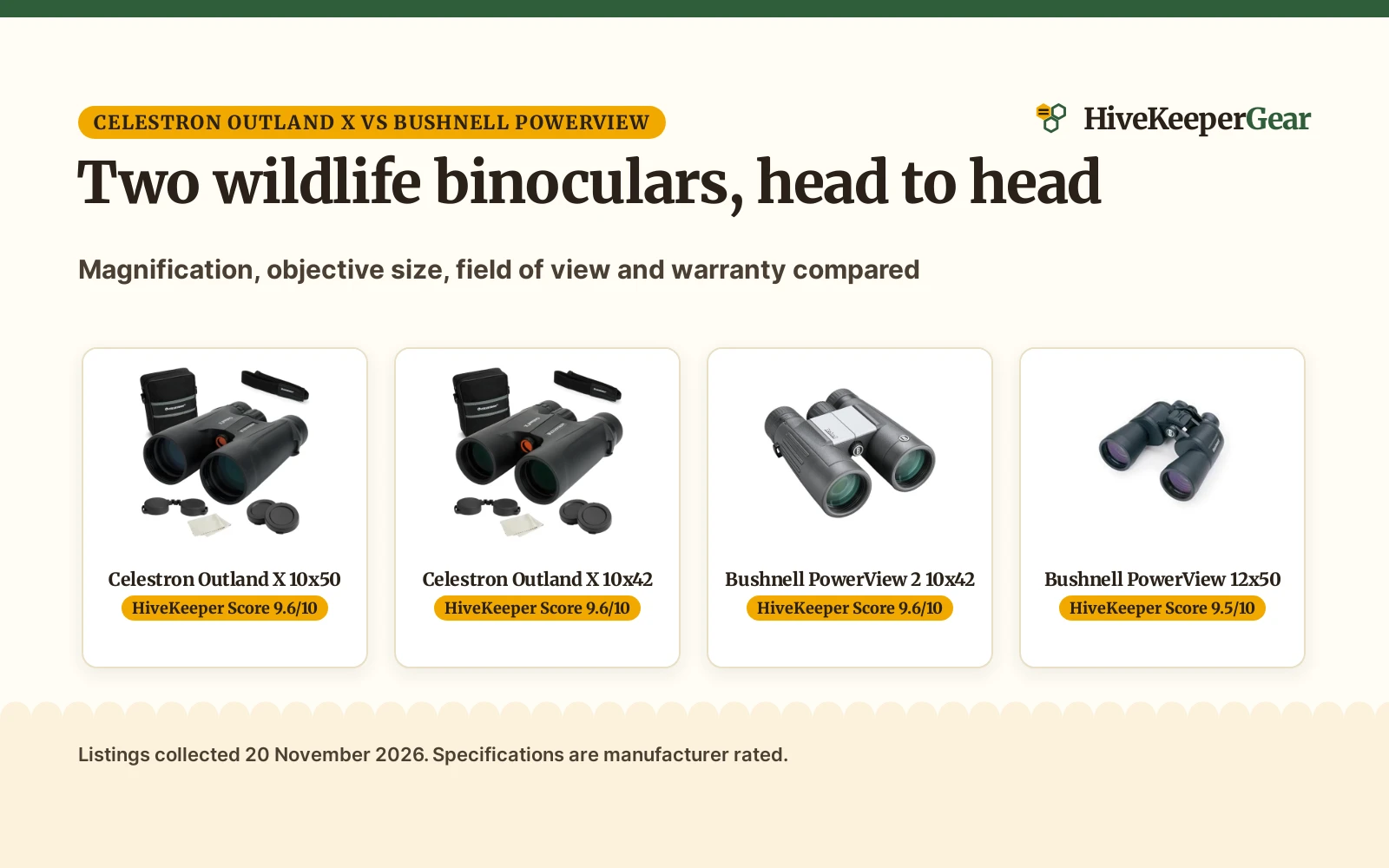
Celestron Outland X vs Bushnell PowerView, compared on 4 binoculars: magnification, objective size, prisms, field of view and warranty.

On this page
Top picks at a glance
As an Amazon Associate I earn from qualifying purchases.
- 1
 Celestron Outland X 10x509.6/10View on Amazon
- 2
 Celestron Outland X 10x429.6/10View on Amazon
- 3
 Bushnell PowerView 2 10x429.6/10View on Amazon
- 4
 Bushnell PowerView 12x509.5/10View on Amazon
A bird at the far hedge is easy to miss without glass, and the choice between wildlife binoculars comes down to what each listing actually states. Celestron Outland X vs Bushnell PowerView pits Celestron models against Bushnell models, all made for wildlife and birding.
HiveKeeperGear earns a commission when you buy through links on this page, at no extra cost to you. As an Amazon Associate I earn from qualifying purchases. Affiliate disclosure.
Quick verdict: choose the Celestron side for BaK-4 prisms, stated waterproofing and tripod threads on both models. Choose the Bushnell side for an alloy chassis on the 10×42 and the highest magnification on the 12×50.
Four examples
| # | Product | HiveKeeper Score | Buy |
|---|---|---|---|
| 1 | Celestron Outland X 10x50 | 9.6/10 | Buy on Amazon |
| 2 | Celestron Outland X 10x42 | 9.6/10 | Buy on Amazon |
| 3 | Bushnell PowerView 2 10x42 | 9.6/10 | Buy on Amazon |
| 4 | Bushnell PowerView 12x50 | 9.5/10 | Buy on Amazon |
Celestron Outland X 10x50
A 10x50 binocular with 50mm objectives for low-light views, BaK-4 prisms, multi-coated optics, a 5.6° field of view and waterproof nitrogen-purged housing.
Pros
- 50mm objectives with stated low-light performance
- BaK-4 prisms with multi-coated optics
- Waterproof and nitrogen-purged against fogging
- Tripod adapter threads for steady viewing
Cons
- Tripod adapter not included
- No fast-focus system is stated
- Polycarbonate housing, not an alloy chassis
- No close focus distance is stated
Celestron Outland X 10x42
A 10x42 binocular with BaK-4 prisms, multi-coated optics, a 5.5° field of view, waterproof nitrogen-purged housing and tripod adapter threads.
Pros
- BaK-4 prisms with multi-coated optics
- Waterproof and nitrogen-purged against fogging
- Tripod adapter threads for steady viewing
- 5.5° field of view for tracking wildlife
Cons
- Heaviest here at 2.0 lb
- Tripod adapter not included
- 42mm objectives, smaller than the 50mm models here
- Polycarbonate housing, not an alloy chassis
Bushnell PowerView 2 10x42
A 10x42 binocular with multi-coated optics, an aluminum alloy chassis, soft touch rubber and tripod compatibility.
Pros
- Aluminum alloy chassis without added bulk
- Multi-coated optics for low-light views
- Soft touch rubber with a confident grip
- Tripod compatible
Cons
- No prism type is stated
- No field of view figure is stated
- No waterproofing is stated
- Tripod compatible, with no adapter threads stated
Bushnell PowerView 12x50
A 12x50 Porro prism binocular with BK-7 prisms, multi-coated optics, InstaFocus and non-slip rubber armor.
Pros
- 12x magnification, the highest here
- 50mm objectives with BK-7 Porro prisms
- InstaFocus system for fast focusing
- Lightest here at 1.0 lb
Cons
- No waterproofing is stated
- No field of view figure is stated
- No tripod compatibility is stated
- BK-7 prisms rather than the BaK-4 glass on the Celestron side
As an Amazon Associate I earn from qualifying purchases.
Other hives and gear to compare
 Bushnell PowerView 10x50 Wide-Angle PermaFocus BinocularsCheck price on Amazon
 Bushnell PowerView 10x50 Porro Prism Instafocus BinocularsCheck price on Amazon
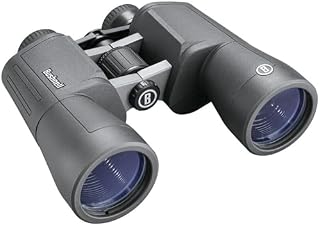 Bushnell PowerView 2 Binoculars_12x50_PWV1250 GreyCheck price on Amazon
 Bushnell PowerView 2 10x50 BinocularsCheck price on Amazon
 Bushnell Powerview 10x25 Compact BinocularsCheck price on Amazon
 Celestron Outland X 8x42 Binoculars for Birding & NatureCheck price on Amazon
Celestron Outland X vs Bushnell PowerView: side by side
| Spec | Celestron Outland X 10×42 | Celestron Outland X 10×50 | Bushnell PowerView 2 10×42 | Bushnell PowerView 12×50 |
|---|---|---|---|---|
| Magnification | 10x | 10x | 10x | 12x |
| Objective lens | 42mm | 50mm | 42mm | 50mm |
| Field of view | 5.5° | 5.6° | Not stated | Not stated |
| Prism | BaK-4 | BaK-4 | Not stated | BK-7 Porro |
| Waterproof | Yes | Yes | Not stated | Not stated |
| Tripod adaptable | Yes, threads | Yes, threads | Yes, compatible | Not stated |
| Weight | 2.0 lb | 1.68 lb | 1.39 lb | 1.0 lb |
| Warranty | Limited Lifetime US | Limited Lifetime US | Lifetime Ironclad | Limited lifetime |
Sizes, materials and capacities are the manufacturer’s ratings as each listing states them, collected 20 November 2026.
Magnification and objective size
Both Celestron models and the Bushnell PowerView 2 give 10x magnification, while the Bushnell PowerView 12×50 gives 12x. Objective size splits the same way: the 10×42 models on both sides use 42mm objectives, and the larger models use 50mm objectives. Celestron states low-light performance for the 10×50 only, and Bushnell states low-light images for the PowerView 2.
Field of view and prisms
Celestron states an angular field of view for both models, 5.5° on the 10×42 and 5.6° on the 10×50, while neither Bushnell listing states a field of view figure. Prism glass is stated on both Celestron models as BaK-4 and on the Bushnell 12×50 as BK-7 Porro, with the PowerView 2 stating no prism type.
Build and weatherproofing
Both Celestron models use rubber-armored polycarbonate housings, stated as waterproof and nitrogen-purged against fogging. The Bushnell PowerView 2 uses an aluminum alloy chassis with soft touch rubber, and the Bushnell 12×50 uses non-slip rubber armor, but neither Bushnell listing states waterproofing. Tripod threads are stated on both Celestron models and tripod compatibility on the PowerView 2, while the 12×50 states neither.
Weight and size
Stated weights run from 1.0 lb on the Bushnell 12×50 to 2.0 lb on the Celestron 10×42, with the Celestron 10×50 at 1.68 lb and the PowerView 2 at 1.39 lb.
Listing gaps to check
Neither Bushnell listing states waterproofing or a field of view figure, and the PowerView 2 states no prism type. The Bushnell 12×50 states no tripod compatibility. Ask the seller to confirm any figure that matters before ordering.
Which should you choose?
Choose Celestron Outland X if you want BaK-4 prisms, stated waterproofing and tripod threads on either model, and 50mm objectives on the 10×50 for low-light views. The best birding binoculars picks compare more models for the garden.
Choose Bushnell PowerView if you want an aluminum alloy chassis on the 10×42 or the 12x magnification of the 12×50. The 10×42 vs 12×50 binoculars guide compares the two sizes head to head.
Whichever you choose, check the stated field of view, prism glass and warranty before ordering, and read the guide on roof vs Porro prism binoculars to see how the two prism designs differ.
In the Bee Yard
- The Celestron models state waterproofing and nitrogen purging, so they suit damp mornings at the hives.
- Tripod adapter threads on both Celestron models take a tripod adapter for a standard tripod, with the adapter not included, for steady viewing at the garden.
- The Bushnell 12×50 is the lightest stated weight here at 1.0 lb.
- The PowerView 2 has soft touch rubber for a confident grip, even with one hand.
Inside the HiveKeeper Score
| Product | HiveKeeper Score | Perf. /35 | Build /25 | Value /25 | Safety /10 | Warranty /5 |
|---|---|---|---|---|---|---|
| Celestron Outland X 10×50 | 9.6 | 32 | 21 | 21 | 0 | 4 |
| Celestron Outland X 10×42 | 9.6 | 30 | 21 | 21 | 0 | 4 |
| Bushnell PowerView 2 10×42 | 9.6 | 29 | 21 | 21 | 0 | 4 |
| Bushnell PowerView 12×50 | 9.5 | 30 | 20 | 20 | 0 | 4 |
HiveKeeper Scores sit between 9.2 and 9.8, and a hive item’s weighted total lands on that range in proportion, so a higher total always gives a higher score.
The HiveKeeper Score weighs performance, build, value, safety and warranty. The Celestron 10×50 scores highest on performance for its 50mm objectives and stated low-light performance. No model earns safety points, as no listing states a safety certification or safety feature. Every model earns warranty points for a stated lifetime term.
FAQs for beekeepers
Which is better for low light, Celestron Outland X or Bushnell PowerView?
Celestron states low-light performance for the 10×50 with its 50mm objectives, and Bushnell states low-light images for the PowerView 2 with multi-coated optics. The 10×42 Celestron and the 12×50 state no low-light figure.
Are these binoculars waterproof?
Both Celestron models state waterproofing with nitrogen purging against fogging. Neither Bushnell listing states waterproofing, so check with the seller before using them in rain.
Can I mount these binoculars on a tripod?
Both Celestron models state built-in tripod adapter threads for a standard tripod, with the adapter not included. The PowerView 2 states tripod compatibility, while the 12×50 states no tripod compatibility.
What warranty do these binoculars carry?
Each of the 4 models states a lifetime term: limited lifetime US warranty on both Celestron models, lifetime ironclad warranty on the PowerView 2, and limited lifetime warranty on the PowerView 12×50.
More hive guides
Related: best birding binoculars, binoculars vs monocular for birding, roof vs Porro prism binoculars, and best spotting scope for bird watching.