Cellular Hive Scale vs Bluetooth Hive Scale: Which One Should You Buy?
Learn how cellular and bluetooth hive scales compare for remote monitoring, network coverage, battery upkeep, and tracking seasonal nectar flow in your yard.

On this page
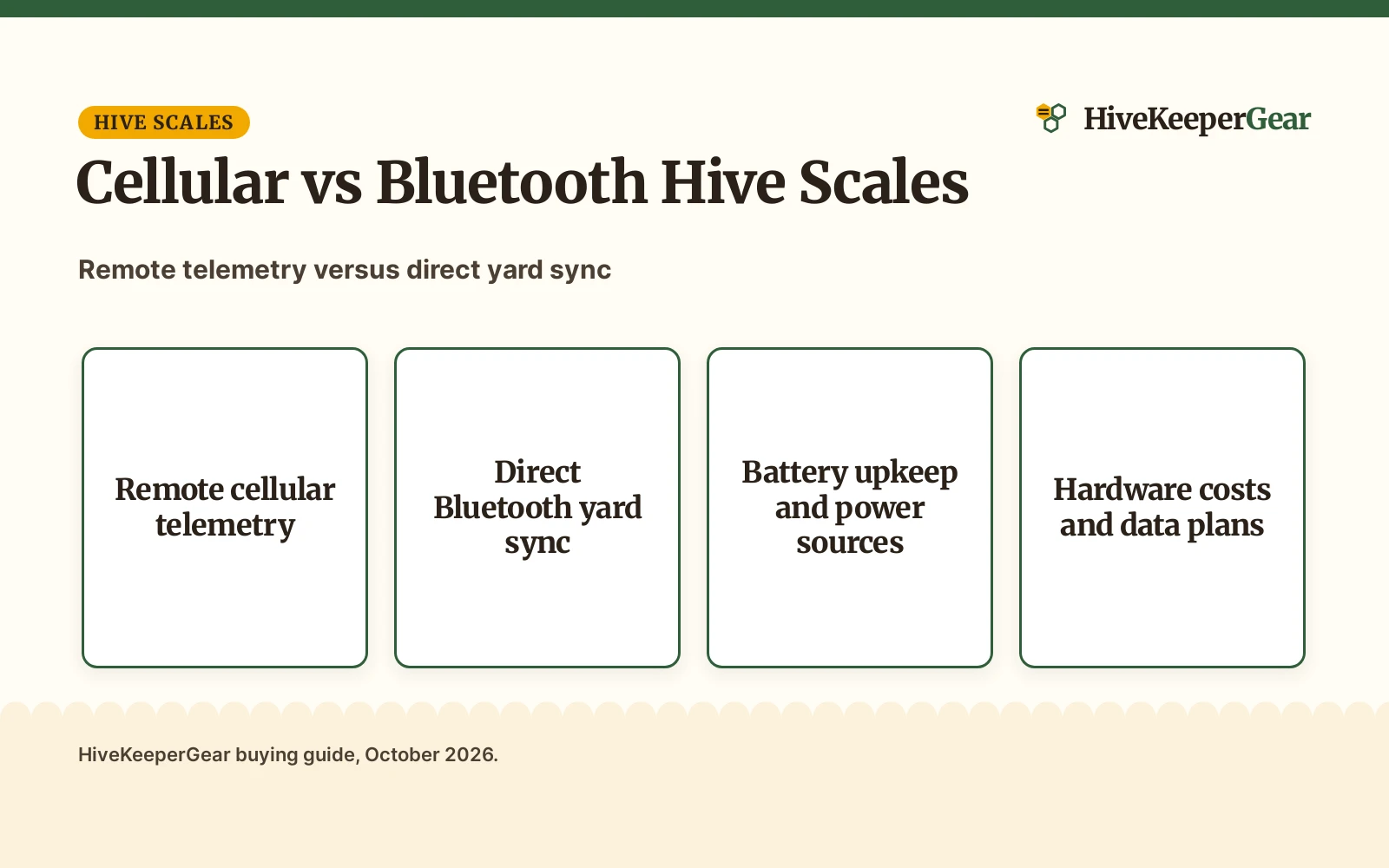
During the spring nectar flow or late winter buildup, tracking hive weight shows whether colonies are storing honey or consuming emergency stores without opening the brood box. Deciding between a cellular hive scale vs bluetooth hive scale comes down to where your apiary sits and how often you visit your bees. If your hives sit in distant outyards with mobile reception, choose a cellular hive scale for remote telemetry that uploads daily weights directly to your phone. If your colonies remain in your backyard within walking distance, choose a bluetooth hive scale to log accurate weight trends during routine yard visits without ongoing subscription fees. We compared both technologies across data transmission range, power upkeep, monthly expenses, and apiary management.
HiveKeeperGear earns a commission when you buy through links on this site, at no extra cost to you. As an Amazon Associate I earn from qualifying purchases. Affiliate disclosure.
Before you buy: check apiary location and cell reception
Before selecting a hive scale, evaluate where your colonies stand and whether reliable mobile reception reaches the bee yard. A cellular hive scale requires steady network coverage to transmit readings, so an outyard in a low valley with spotty mobile service will struggle to send data. If cellular signals do not reach your yard, a bluetooth model is the practical choice because it stores measurements internally until you visit the apiary and connect via mobile app. Conversely, if your hives are situated miles away on farm property, driving out simply to sync a bluetooth connection defeats the purpose of automated monitoring.
Consider also how your hives are arranged on their stands. A hive scale sits directly beneath the bottom board, taking the full load of brood boxes, honey supers, and winter covers. Pairing your setup with a sturdy Langstroth hive ensures even weight distribution across the scale platform.
Cellular hive scale vs bluetooth hive scale: feature comparison
| Feature | Cellular hive scale | Bluetooth hive scale | Recommended choice |
|---|---|---|---|
| Data transmission | Automated mobile network telemetry | Direct short-range wireless sync | Cellular for remote access |
| Monitoring range | Anywhere with mobile carrier coverage | Within local yard wireless range | Cellular for distant yards |
| Sync requirement | Automated upload without yard travel | Requires periodic visits to the apiary | Bluetooth for home apiaries |
| Ongoing costs | Monthly or annual data subscription | No recurring subscription fees | Bluetooth for cost savings |
| Power source | Rechargeable pack or solar assist | Replaceable internal dry batteries | Bluetooth for simple upkeep |
| Nectar flow tracking | Daily automated remote updates | Local sync during yard visits | Cellular for remote tracking |
1. Remote telemetry and cellular coverage
The defining strength of a cellular hive scale is automated remote telemetry. The scale records hive mass at scheduled intervals throughout the day and transmits those readings over mobile phone networks to a cloud dashboard or smartphone application. For beekeepers managing outyards, this remote feed transforms colony management. You can observe the exact day a spring nectar flow begins, watch daily honey gains accumulate, or spot sudden weight loss that indicates swarming or robbing, all from your home or office.
The trade-off is reliance on mobile infrastructure. If an outyard sits in a rural hollow with weak carrier signal, the internal modem may struggle to connect, leading to delayed uploads or drained batteries as the unit searches for a tower. When cellular reception is strong, however, remote telemetry provides peace of mind that local wireless cannot match.
2. Data syncing and yard inspections
A bluetooth hive scale operates on local wireless synchronization. The unit continuously measures hive weight and logs the data into internal memory, but it does not broadcast over the internet. To collect the data, you must walk into the apiary with your smartphone or tablet, open the companion application, and establish a short-range wireless link. Once connected, the app downloads the stored weight history for you to graph and inspect.
You do not need to suit up, light a smoker, or open the hive to collect data. Simply walking into the yard with your mobile device syncs stored records over wireless frequencies in moments, allowing you to monitor colony status without disturbing the bees. If you keep hives across multiple distant properties, however, having to travel on-site to view weight logs eliminates much of the convenience of electronic monitoring.
3. Battery management and power sources
Power consumption is a major point of divergence between the two scale architectures. Transmitting data across cellular frequencies demands significant electrical energy. To sustain daily transmissions through changing weather, cellular scales typically incorporate substantial rechargeable battery packs, often supplemented by a small solar panel positioned beside the apiary or attached to the hive stand. While solar charging allows indefinite runtime in sunny apiaries, shaded woodland yards or snowy winter conditions can reduce solar efficiency and require manual battery recharging.
Bluetooth hardware, by contrast, consumes minimal power because short-range wireless chips require tiny electrical pulses. Many bluetooth hive scales run for entire seasons on standard replaceable batteries without needing external solar panels or wiring. This modest power requirement allows bluetooth scales to operate entirely on internal batteries, keeping the scale footprint self-contained.
4. Ongoing data subscription fees
Financial commitment differs sharply between cellular and bluetooth monitoring systems. A cellular hive scale functions like an independent mobile device with an internal SIM card, requiring an active network connection. Manufacturers structure these connections as monthly or annual data subscription plans to cover network carrier access and cloud data hosting. Over several seasons of beekeeping, recurring data fees accumulate and represent a meaningful portion of your overall apiary operating budget.
A bluetooth hive scale carries no ongoing network fees. After the initial equipment purchase, local synchronization through the companion app remains free for the lifespan of the hardware. For hobbyists managing backyard colonies, avoiding recurring service fees makes bluetooth an exceptionally sensible long-term choice.
5. Physical hive balance and weather resistance
Both scale styles must withstand harsh outdoor apiary conditions while supporting substantial hive loads. A productive honey colony with full honey supers, a brood chamber, and woodenware creates heavy downward pressure on the load cells. High-quality hive scales use aluminum or stainless steel frames with sealed electronic sensors that resist rain, humidity, drifting snow, and hive debris. Whether choosing cellular or bluetooth, verify that the scale footprint fits standard Langstroth box dimensions and sits squarely beneath your Langstroth beehive kit.
Level placement beneath the bottom board is essential for accurate readings. If the ground settles unevenly under the hive stand, the scale may register false weight fluctuations. Keeping the base level and checking that weed growth does not contact the weighing surface ensures reliable measurement throughout the foraging year.
A seasonal monitoring timeline
Early spring buildup: Monitor winter weight decline as the queen expands the brood nest. Rapid weight loss signals that bees are consuming honey reserves quickly before spring blooms open, warning you to install an emergency feeder before starvation occurs.
Main summer nectar flow: Watch daily scale readings jump as foragers bring in nectar. Sudden surges indicate intense honey flows, telling you when to add fresh supers. A sharp midday weight drop during swarming season typically signals that a swarm has issued, allowing cellular scales to send timely alerts while bluetooth units preserve the data for your next visit.
Autumn feeding and harvest: Weigh the hive following honey extraction to confirm that remaining winter stores are sufficient. Tracking syrup uptake confirms whether colonies have taken down adequate feed before cold temperatures set in.
Winter dormancy: Track slow, steady weight decline during winter cluster without breaking the propolis seal or chilling the brood chamber. Periodic weight checks confirm that food reserves remain steady until warm spring flights resume.
Nice to have later
- An internal brood temperature sensor that detects queen brood rearing and cluster health.
- An ambient weather sensor to correlate local temperature and humidity with nectar foraging.
- A sturdy hive stand that elevates the scale platform above damp ground and creeping grass.
- A protective bee hive winter wrap to insulate hive boxes during cold months, taking care that the wrap does not touch the scale platform or bridge weight to the ground.
- An apiary inspection notebook to log physical brood frame observations alongside digital weight curves.
Combining automated weight data with thoughtful visual inspections gives you a complete view of colony progress while keeping hive disturbance to a minimum.
What is not on this list
Electronic hive scales provide valuable data on colony weight and foraging trends, but they do not replace physical hive inspections. Scales cannot detect queen health, brood laying patterns, or queen cell development. We also do not provide colony health, disease diagnosis, or pest treatment advice. For assistance with colony health and apiary regulations, consult your state apiary inspector or local agricultural extension office.
FAQs for beekeepers
Does a bluetooth hive scale require a monthly subscription?
No. A bluetooth hive scale connects directly to your mobile phone or tablet using local wireless signals, requiring no monthly subscription fees or carrier plans.
Can a cellular hive scale send alerts when bees swarm?
Yes. Cellular hive scales transmit regular weight updates, allowing accompanying software to detect sudden drops in hive weight caused by departing swarms and notify you promptly.
Will a cellular hive scale work in an outyard without internet access?
Yes, provided the location receives mobile network reception. Cellular scales contain an internal modem and SIM card that upload data directly over carrier towers without needing local Wi-Fi.
Do hive scales interfere with normal hive inspections?
No. The scale rests beneath the bottom board, allowing you to lift boxes, inspect frames with your hive tool, and harvest supers normally without moving the scale.
Which scale type is better for a backyard beekeeper?
A bluetooth hive scale is typically ideal for backyard beekeepers because your colonies are close at hand, making local phone synchronization effortless during routine yard walks while avoiding recurring data plan fees.
More hive guides
Browse every guide by category: beehives, protective gear, hive tools and honey harvesting.
More picks: hive tools, cleaning beekeeping tools, beekeeping tool kits, and bee smokers.