Honey Jar Sizes: Guide to Standard Weights and Volumes
A guide to honey jar sizes, explaining how honey net weight differs from liquid volume, standard jar capacities, and how to choose the right containers for your harvest.

On this page
Top picks at a glance
As an Amazon Associate I earn from qualifying purchases.
- 1
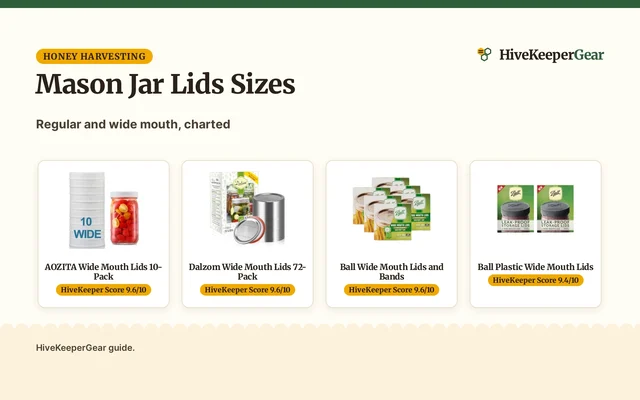
 AOZITA Wide Mouth Mason Jar Lids9.6/10View on Amazon
- 2
 Ball Wide Mouth Mason Jar Lids and Bands9.6/10View on Amazon
- 3
 Dalzom Wide Mouth Canning Lids for Ball and Kerr Jars9.6/10View on Amazon
Understanding honey jar sizes starts with knowing that honey containers are typically measured and labeled by net weight rather than fluid ounces. Because honey has a higher density than water, a container that holds a specific liquid volume holds substantially more honey by weight. Common container sizes range from 1.5 oz sample pots and 6 oz gift jars to popular 8 oz, 12 oz, 16 ounce, and 32 ounce containers. We compared published listing specifications across common glass and plastic containers to explain how honey weights match jar capacities.
HiveKeeperGear earns a commission when you buy through links on this site, at no extra cost to you. As an Amazon Associate I earn from qualifying purchases. Affiliate disclosure.
Before you bottle: weight versus liquid volume
The most common mistake for new beekeepers is confusing fluid ounces with net weight. Fluid ounces measure liquid volume, whereas net weight measures the actual heaviness of honey. Because honey has a higher density than water, a jar sized for a given volume of water holds a greater weight of honey.
Listing specifications show this density difference clearly. For example, Eccliy lists an 8 oz plastic honey bottle measuring approx. 2.13 x 4.9 inches with an approx. 1.41 inches lid diameter, stating it holds about 250 g or 8.8 oz of honey, but only about 180 ml or 6.1 oz of water. Because honey weighs more than water per volume, beekeepers must match container volume to expected net weight to ensure accurate labeling.
Standard honey jar sizes compared
Choosing a container depends on whether you need gift samples, table dispensers, or harvest storage. The comparison table below outlines common capacities, published volume equivalents, and container styles based on manufacturer specifications, along with recommended uses for each size.
| Listing Stated Size | Listing Volume or Measure | Common Container Style | Recommended Use |
|---|---|---|---|
| 1.5 oz | 45 ml (or 1.5 fluid ounces listed) | Hexagon glass favor jar with wooden dipper | Wedding favors and gift baskets |
| 6 oz | 170 ml (or 6 fluid ounces listed) | Hexagon glass jar with metal lid | Sample packs and farmers markets |
| 8 oz | Holds about 250 g (8.8 oz honey, 180 ml water) | Plastic squeeze bottle with flip-top cap | Everyday kitchen use and tabletop pouring |
| 9 oz | 255.15 g (1 cups volume listed) | Crystal glass honey pot with dipper | Countertop serving and breakfast tables |
| 12 oz | 350 ml | Round glass honey pot with dipper | Pantry storage and regular cooking |
| 16 ounce | 473 ml (or 16 fluid ounces listed) | Glass skep jar or plastic squeeze bottle | Retail sales and seasonal harvests |
| 32 ounce | Not stated | Glass skep jar with airtight lid | Bulk household storage and large harvests |
Sizes, materials and capacities are the manufacturer’s ratings as each listing states them.
1. Sample and gift jars
Small jars holding 1.5 oz are a popular choice for wedding favors, gift baskets, and sample sets. Makers such as Adabocute and Aliggbent produce mini hexagon glass containers designed for events. For example, Adabocute lists a 1.5 oz jar with dimensions of 1.96″L x 1.96″W x 1.96″H and a volume of 1.5 fluid ounces, while another pack from the maker lists dimensions of 2″L x 2″W x 2″H and a 45 ml capacity. Aliggbent also offers 1.5 oz glass jars paired with wood dippers. These compact jars allow beekeepers to share samples without committing substantial honey. Our guide to honey jars for wedding favors compares popular mini favor sets.
For slightly larger gifts, 6 oz jars provide a compact retail size suitable for farmers markets. Encheng lists a 6 oz clear hexagon glass jar with a capacity of 6 fluid ounces and an item volume of 170 ml, measuring 2.75″L x 2.75″W x 3.34″H. Hexagonal glass walls showcase honey color and clarity, though jars require airtight lids to keep honey from absorbing atmospheric moisture.
2. Squeeze bottles and small jars
Containers in the 8 oz to 9 oz range serve as convenient household dispensers for everyday kitchen use. Squeeze bottles made from food grade plastic help prevent drips and allow controlled pouring. Eccliy lists a plastic honey bottle holding about 250 g or 8.8 oz of honey, measuring approx. 2.13 x 4.9 inches, with a flip top cap that seals tightly.
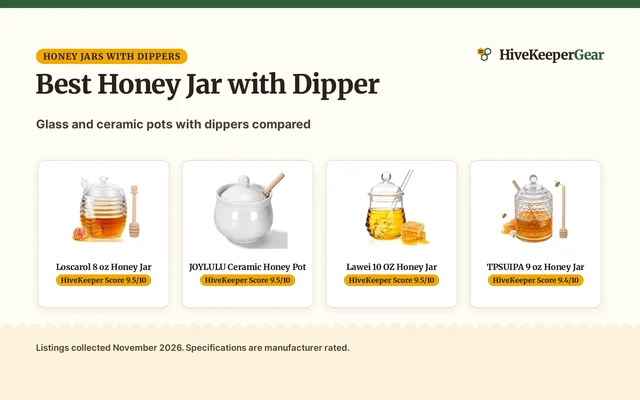
For countertop serving, glass pots with dippers offer an alternative. KANPURA lists a 9 oz crystal honey pot with a side opening for a dipper, specifying a capacity of 255.15 g, a volume of 1 cups, and dimensions of 4.6″L x 3.8″W x 3.6″H (approximate width 3.2 inches). Because the side opening is not airtight, this container is intended for table service rather than long-term storage.
3. Medium jars and table dispensers
Medium jars holding 12 oz represent a practical middle size between small gift jars and larger containers. SlZKADY lists a 12 oz clear glass jar with a capacity of 350 ml, supplied with a dipper and lid. Round jars in this capacity fit easily into pantry shelves while holding enough honey for regular culinary use.
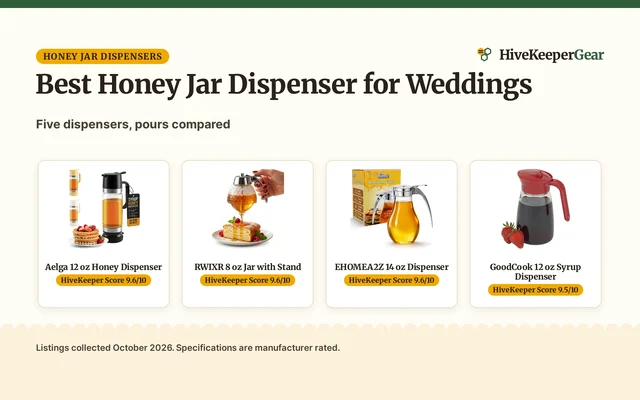
When selecting table servers, consider the closure. Screw top lids help maintain an airtight seal, while open pots prioritize quick access for tea or biscuits. Our review of the best honey jar dispenser models examines no-drip glass servers designed to keep counters clean.
4. Standard 16 ounce and 32 ounce jars
The 16 ounce container is a widely used size for backyard beekeepers selling or storing a harvest. Little Giant lists a 16 ounce glass skep jar with a volume of 473 ml, styled after a traditional beehive with label panels on both sides, though its spec table lists a capacity of 12 Ounces. In plastic, PPXHFV lists a 16 ounces squeeze bottle measuring approx. 5.9 x 2.9 inches with a flip top cap. PPXHFV notes a maximum temperature resistance of 122 degrees Fahrenheit for its bottle material, so avoid washing with hot water to prevent warping.
For larger yields, 32 ounce jars reduce capping and labeling time. Little Giant lists a 32 ounce size option in its skep jar line, offering greater capacity in a single container. Browse our comparison of the best honey jars to evaluate glass hexagon and canning styles.
5. Bulk containers and bottling equipment
Before honey flows into jars, it must be extracted and settled. After spinning frames in manual or electric honey extractors, run raw honey through a double sieve to remove wax cappings. Our guide to the best honey strainer covers filter setups, while our overview of uncapping tools details how to open honeycombs before extraction.
From the strainer, honey settles in a food grade bucket. Adding dedicated honey gate valves allows you to fill jars smoothly from the bottom with clean shutoff control. Letting honey settle in a warm room allows air bubbles to float out, ensuring clear jars.
A bottling workflow for backyard beekeepers
Extraction: uncap ripe frames and spin them in your extractor, straining raw honey into a bottling bucket. Settling: seal the bucket and let the honey rest undisturbed in a warm room so air bubbles and wax particles float to the surface. Jar inspection: inspect jars for chips and wash jars and lids in warm, soapy water, avoiding excessive water temperatures on heat-sensitive plastic bottles. Ensure every jar is completely dry, as residual moisture can raise water content and risk fermentation. Filling: place jars beneath the honey gate, open the valve smoothly, and close it crisply near the jar neck to avoid drips. Capping and cleaning: wipe any stray honey from jar rims with a damp cloth and tighten lids securely. Labeling: apply labels squarely, showing the net weight clearly in both ounces and grams.
Bottling tools and accessories to have ready
Having the right accessories ready keeps bottling day organized and tidy:
- A honey gate valve installed on your bottling pail for drip-free pouring.
- A specialized honey strainer for mason jar setup for small batch filtering.
- A digital scale to confirm that filled jars match the net weight on your label.
- Clean towels and warm water nearby to wipe rims and fingers between jars.
- Divided cardboard boxes or crates to hold glass jars safely during storage.
Preparing your bottling station in advance keeps honey off countertops and ensures clean containers.
Labeling rules and what to check
When packaging honey for sale or gifts, clear labeling is essential. Food labeling rules require containers to state the common name of the product, the apiary name and contact details, and the net weight of honey. By definition, net weight reflects the weight of the honey alone, excluding the container and lid.
Check local cottage food regulations, which govern sales at farm stands and markets. Never include medical claims or health promises on honey labels, as agricultural food rules prohibit unverified health statements. For local bottling and registration rules, contact your state apiary inspector or local extension office.
FAQs for beekeepers
Why are honey jar sizes measured by weight rather than volume?
Honey has a higher density than water, meaning a container holds more honey by weight than water by volume. For example, Eccliy notes that a container holding about 180 ml or 6.1 oz of water holds about 250 g or 8.8 oz of honey. Measuring by net weight ensures accurate labeling for consumers.
What is a popular honey jar size for seasonal sales?
A 16 ounce container is frequently chosen by backyard beekeepers for seasonal harvesting and local sales, providing a practical household quantity in classic skep or cylinder styles.
Can regular canning mason jars be used for honey?
Yes, standard canning jars work well for honey, provided they feature airtight lids to keep honey from absorbing moisture. Make sure jars and lids are completely dry before filling.
How does honey weight compare to water volume in a container?
Because honey is denser than water, a container holds more honey by weight than water by volume. Listing specifications from Eccliy illustrate this: a plastic bottle holding about 180 ml or 6.1 oz of water holds about 250 g or 8.8 oz of honey.
How should filled honey jars be stored?
Store sealed jars in a cool, dry pantry away from direct sunlight. For plastic containers, PPXHFV notes that its bottles have a maximum temperature resistance of 122 degrees Fahrenheit, so avoid radiators or hot appliances.
More hive guides
Browse every guide by category: honey harvesting, hive tools, beehives and protective gear.
More harvest guides: explore our picks for best honey jars, mini honey jars with dipper, and manual honey extractors. New to beekeeping? Start with our beekeeping equipment list for beginners.