How to Feed Bees Sugar Water Safely
A step-by-step guide to feeding bees sugar water with a jar feeder, entrance feeder or in-hive feeder, from mixing syrup to placing the feeder and checking it.

On this page
Top picks at a glance
As an Amazon Associate I earn from qualifying purchases.
- 1
 Foxhound Bee Company Front Entrance Honey Bee Feeder & LidView on Amazon
- 2
 AukBeeFun 8 Pack Bee Feeders for Hives Mason Jar Sugar WaterView on Amazon
- 3
 Minelife 4 Pack Entrance Feeder with LidsView on Amazon
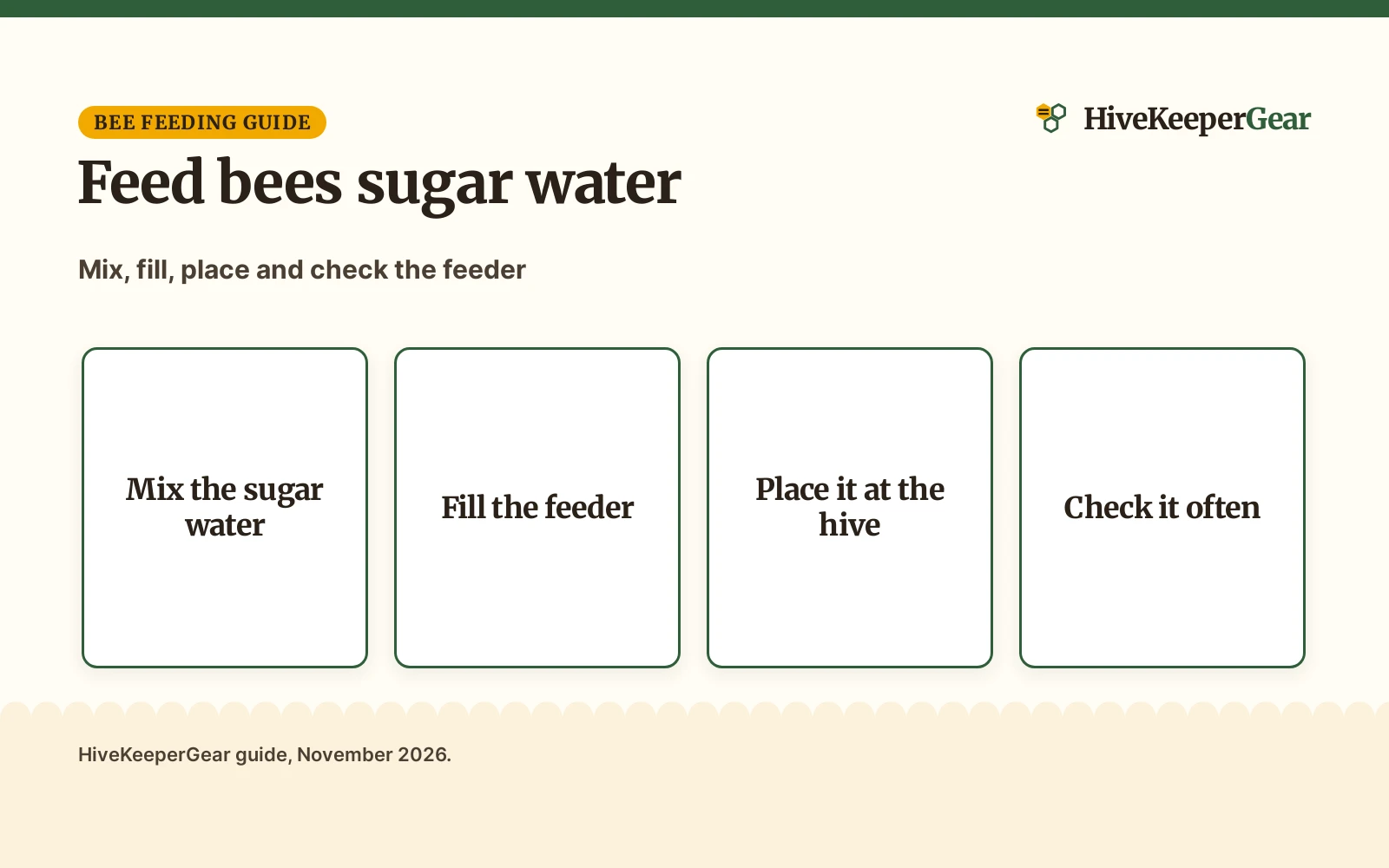
When a new colony is building comb, or when the flow stops and stores run low, the bees need syrup, and knowing how to feed bees sugar water keeps the colony going through the gap. Sugar water is sugar dissolved in water, offered in a feeder the bees can reach without drowning, and this guide walks through mixing it, filling a feeder, placing it at the hive and checking it, step by step.
Other hives and gear to compare
 Foxhound Bee Company Front Entrance Honey Bee Feeder & LidCheck price on Amazon
 AukBeeFun 8 Pack Bee Feeders for Hives Mason Jar Sugar WaterCheck price on Amazon
 Minelife 4 Pack Entrance Feeder with LidsCheck price on Amazon
HiveKeeperGear earns a commission when you buy through links on this site, at no extra cost to you. As an Amazon Associate I earn from qualifying purchases. Affiliate disclosure.
When to feed sugar water
Feed when the colony needs stores it cannot gather on its own. One in-hive feeder listing names the moments: early season spring buildup, fall feeding, emergency winter feeding, and feeding packages, nucs, splits and swarms so they build up. A new colony drawing comb has little stored honey to fall back on, and a colony coming out of winter may need help until the flow starts.
Know when not to feed, too. Stop when the bees have stores and forage to gather, and hold off during a honey flow, or while honey supers are on the hive, so syrup does not end up in honey meant for the table. In cold spells the bees may not leave the cluster to take liquid syrup, so a feeder set out then can sit untouched. For cold weather, the dry sugar vs sugar syrup comparison covers the alternative.
How to feed bees sugar water: mix the syrup
Use plain white sugar and clean water. For spring buildup and for stimulating a new colony, a thinner syrup is the usual choice: equal parts sugar and water by volume. For fall feeding, when the bees are storing for winter, a thicker syrup with more sugar than water is the usual choice. Stir the sugar into warm water until it dissolves, then let the syrup cool before it goes into the feeder. Warm water dissolves the sugar faster than cold water, and cooled syrup will not scald the bees. Mix only what the feeder will hold, and mix fresh syrup each time you refill.
Pick a feeder: jar, entrance or in-hive
Three styles cover most feeding: a mason jar feeder that sits at the hive front, an entrance feeder at the hive entrance, and an in-hive feeder that sits inside the hive. The jar feeder listings compared here are silicone caps for regular and wide-mouth mason jars, and the in-hive listing is a feeder that sits at the inner cover hole. A jar or entrance feeder is easy to see and refill from outside the hive, while an in-hive feeder keeps the syrup inside, where the bees feed in warmth. The table sets out what the listings state.
| Feeder style | Fits | What the listing states |
|---|---|---|
| Jar feeder, hexagonal grooves | Regular and wide-mouth mason jars | 2 pack, silicone, outlet smaller than bees |
| Jar feeder, honeycomb grooves | Regular and wide-mouth mason jars | 2 pack, about 6.3 x 0.8 in, silicone |
| In-hive feeder | Inner cover hole | 2 pack, 1-gallon capacity, self-draining, feeds 24 hours per day |
A frame feeder is another style that hangs inside the hive like a frame; the best beehive frame feeder picks compare them, and the frame feeder vs mason jar feeder comparison sets the styles side by side.
Fill the feeder
Fill the feeder away from the hive, so spilled syrup does not draw robbers to the entrance. For a jar feeder, attach the feeder base to a mason jar, fill the jar, and invert it so the syrup flows to the outlet: one jar feeder listing describes exactly that, attach to jar, fill, invert, and says the outlet is smaller than the bees, so they cannot crawl inside. For the in-hive feeder, fill the tank and set it in place; the listing gives its self-draining tank a 1-gallon capacity. Jars are not included with the jar feeders, so use a clean mason jar from the kitchen.
Place the feeder at the hive
Set a jar feeder at the hive front, where the bees can reach the grooves, and set an in-hive feeder at the inner cover hole, where the listing says bees feed 24 hours per day in warmth, regardless of temperature. The in-hive feeder keeps syrup inside the hive, close to the bees and out of the cold space above. The listing claims it reduces robbing, but robbing can still occur at the hive entrance, so keep watching it. A jar feeder at the front is easier to check and refill, but it sits outside, so check it often and take it in when the bees stop using it.
Check the feeder and watch for robbing
Look in on the feeder whenever you are at the hive, and refill before it runs dry: a colony building comb can empty a feeder fast, so do not let it sit empty. Watch the entrance while you are there. Bees fighting at the entrance, or bees crowding a feeder that is not theirs, mean robbing, and the feeder should come off until the robbing stops. Wipe up spills, since robbing can start at any style of feeder. If syrup sits untouched, check whether the feeder is placed where the bees can reach it, and whether the outlet is clear.
Common mistakes
- Feeding in the open: syrup left in an open container draws robbers and wasps to the yard, and drowns bees that fall in. Feed inside a feeder with grooves or a cover the bees can stand on.
- A feeder the bees cannot reach: syrup above a cold space, or a jar set too far from the cluster, may go untouched. The in-hive feeder sits at the inner cover hole, close to the bees.
- Forgetting the feeder: an empty feeder does not feed a colony, and syrup left standing goes stale. Check it whenever you are at the hive, and mix fresh syrup when you refill.
- Feeding wasps by accident: spilled syrup on the hive front or on the ground brings wasps as well as bees. Fill the feeder away from the hive and wipe up spills.
FAQs for beekeepers
When should I feed bees sugar water?
Feed when the colony needs stores it cannot gather: early season spring buildup, fall feeding, and emergency winter feeding, and for packages, nucs, splits and swarms building up. Those are the moments the in-hive feeder listing names. Stop when the bees have stores and forage to gather, and do not feed during a honey flow.
Can I feed bees with a mason jar?
Yes. The jar feeder listings fit regular and wide-mouth mason jars: attach the feeder base to the jar, fill it and invert it. Jars are not included, so use a clean mason jar. One listing describes an outer ring slot for wide-mouth jars and an inner ring slot for regular jars.
How much sugar water does a feeder hold?
The in-hive feeder listing states a 1-gallon capacity in a self-draining tank. A jar feeder holds what the jar holds, and jars are not included, so the capacity depends on the jar you use. Check the feeder often and refill before it runs dry.
Do bees feed at night?
The in-hive feeder listing says bees feed 24 hours per day at the inner cover hole in warmth, regardless of temperature.
How do I keep bees from drowning in the feeder?
Use a feeder with a place for the bees to stand. One jar feeder listing describes hexagonal grooves of moderate depth that give the bees a stable resting platform with no submerging, and an outlet smaller than the bees, so they cannot crawl inside. The in-hive feeder is listed with no drowning and no dead bees.
More hive guides
See every beekeeping tools guide and the bee feeders guides, and compare feeder styles in the frame feeder vs mason jar feeder and entrance feeder vs mason jar feeder comparisons. For cold weather feeding, see the best bee feeder for cold climates picks, and for new colonies, the best bee feeder for nucs picks.