Pneumatic vs Electric Honey Bottling Machine: Which One Should You Buy?
Compare pneumatic piston fillers and electric gear pump bottling machines to choose the right packaging equipment for your honey harvest volume and workshop setup.

On this page
Top picks at a glance
As an Amazon Associate I earn from qualifying purchases.
- 1
 VEVOR Manual Paste Liquid Filling Machine 5-100ml9.7/10View on Amazon
- 2
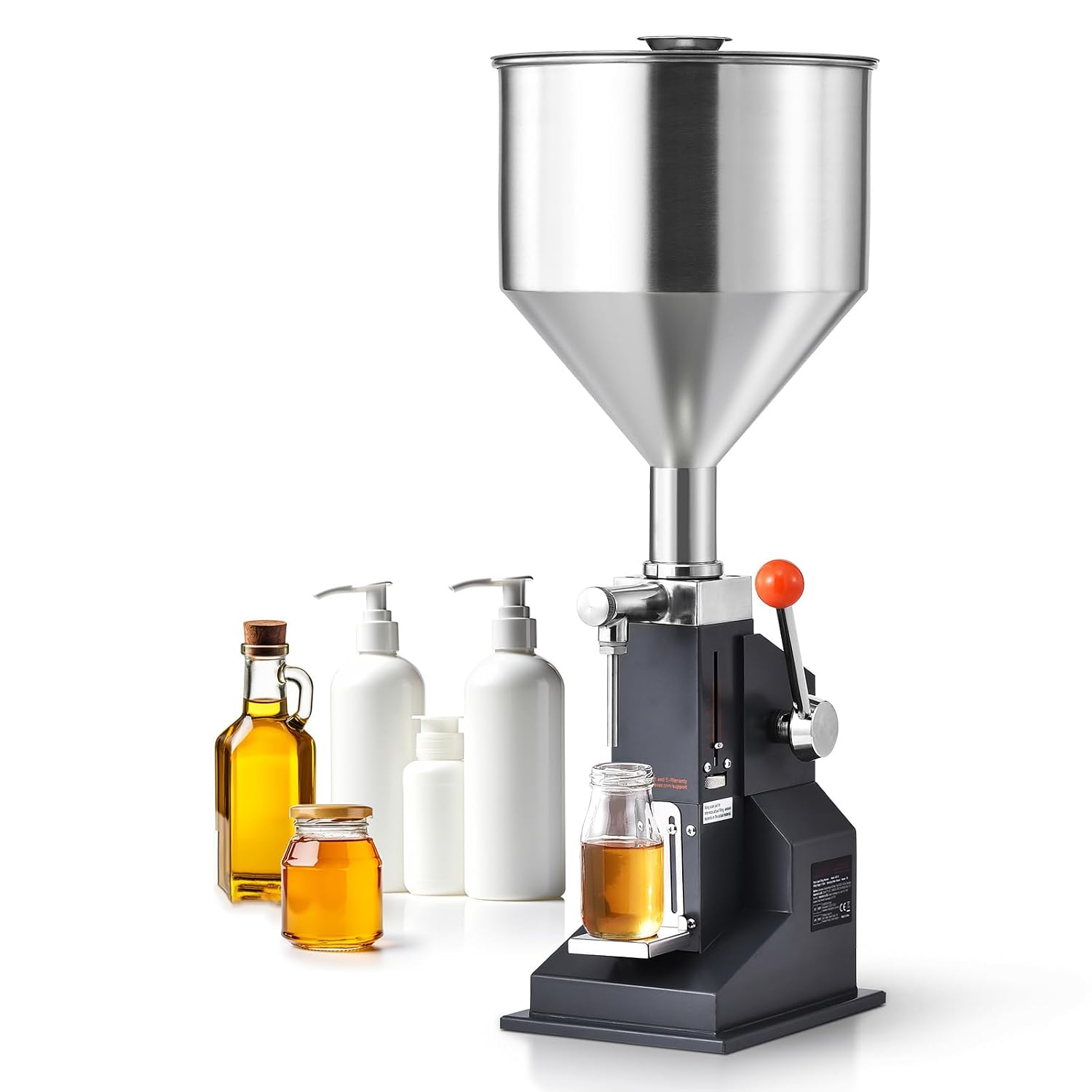 VEVOR Manual Paste Liquid Filling Machine 5-50ml9.6/10View on Amazon
- 3
 KIMTEM Manual Paste Liquid Filling Machine A039.5/10View on Amazon
When late summer honey extraction ends, choosing between a pneumatic vs electric honey bottling machine comes down to whether your workspace accommodates an air compressor. For high-volume bottling where rapid piston cycling maximizes output, pneumatic fillers provide steady mechanical power if you have shop space for compressed air. For backyard apiaries or kitchen workspaces where quiet operation and plug-in convenience matter most, an electric gear pump filler is the practical choice. We compared both styles across drive mechanisms, flow rates, and maintenance to help you choose.
HiveKeeperGear earns a commission when you buy through links on this site, at no extra cost to you. As an Amazon Associate I earn from qualifying purchases. Affiliate disclosure.
Before you choose: power source and workshop space
Before choosing packaging machinery, consider your utility supply and workspace layout. Pneumatic machines require an external air compressor, meaning you must factor compressor noise, power draw, and floor space alongside the filler itself. Electric machines run without a compressor on standard wall power or batteries, making them simple to place on kitchen countertops or pack away after harvest.
Noise also matters during long bottling runs. An air compressor cycling in an enclosed room creates noticeable noise, whereas electric gear pumps run with a quiet hum. If your apiary already maintains a shop compressor, pneumatic filling fits naturally. If you bottle in a home kitchen or shared room, a compact electric unit keeps your bench uncluttered.
Pneumatic vs electric honey bottling machine: side-by-side comparison
| Feature | Pneumatic Piston Filler | Electric Gear Pump Filler | Key Difference |
|---|---|---|---|
| Primary Drive Mechanism | Air cylinder with external compressor | Electric motor with internal gear pump | Pneumatic requires compressed air line |
| Power Requirements | Air line (select models require 110V connection for controls) | Standard AC 110-240V wall power or DC 12V battery | Electric offers plug-and-play mobility |
| Honey Feed Method | Top hopper on most models, or suction pipe | Suction hose drawn directly from settling tank or pail | Electric draws from tanks without overhead hoppers |
| Dispensing Action | Positive displacement piston stroke | Continuous rotary gear displacement | Piston fills by volume; gears by weight or time |
| Flow Adjustment | Piston stroke length and cylinder pressure | Digital weight presets, timer, or speed dial | Electric uses digital load cells or timers |
| Cleaning and Disassembly | Quick-release clamp fittings on cylinder | Detachable pump head and silicone hoses | Both offer tool-free teardown designs |
1. Drive mechanism and air supply
The primary distinction between these systems is how they drive thick honey through the dispensing nozzle. Pneumatic machines use compressed air to drive a cylinder and piston that draws honey into a chamber and expels it through an anti-drip valve. VEVOR notes that its compact 5-50ml pneumatic model can be powered by an external 500W air compressor, while larger horizontal fillers like Brunlix and WYDDDARY specify 0.4-0.9MPa air pressure, with WYDDDARY listing air consumption of ≥0.1 m³/min. Because compressed air performs the mechanical pushing, pneumatic pistons cycle reliably without motor strain.
Electric honey fillers rely on an internal motor driving a positive displacement gear pump. BOINES and witbee state their units operate on AC 110-240V mains power or DC 12V battery power, letting you run from a standard wall outlet or a field battery. Precision gears pull honey through a silicone inlet tube directly from a honey bucket with gate or settling tank, eliminating the need to lift heavy pails into an overhead hopper.
2. Viscosity handling and flow rates
Honey viscosity shifts with temperature and moisture. Electric fillers rate their pumps by density: Moonshan lists its gear pump at 1/2 gallon per minute for honey up to 44 baume degrees. BOINES and witbee state maximum flow rates up to 1.32 gallons per minute (rated 5L/min on BOINES) for honey up to 43° Baume or viscosities between 1000 and 180000 CP, though both note that thicker honey flows slower than maximum speed. Checking moisture with a honey refractometer verifies density before packaging.
Pneumatic pistons move dense liquid honey smoothly via air cylinder thrust. However, VEVOR notes its machine is not suitable for extremely thick pastes, and Brunlix specifies handling uncured liquid honey. Strained liquid honey flows well, but crystallized honey obstructs nozzles and must be liquefied first. For output rates, LEYSRIS lists 0-40 bottles per minute with 100-600ml capacity, Brunlix and BAIODNB list 15-35 bottles per minute across 100-1000ml, and WYDDDARY lists 1-25 cycles per minute for 10-100ml portions.
3. Fill accuracy and control methods
Electric and pneumatic fillers control portions differently. Electric models like Moonshan, BOINES, and witbee rely on digital scales, with Moonshan providing both weight and time modes. Moonshan states filling accuracy up to 1 gram, witbee lists ±2g error across a 30g-5000g range with 6 shortcut weight presets, and BOINES uses quantitative weighing with automatic tare and back-suction. You enter target weight on the panel, set a jar on the platform, and the pump stops when the load cell detects full weight.
Pneumatic fillers measure portions volumetrically by mechanical piston stroke. VEVOR specifies screw adjustment from 5ml to 50ml, Brunlix lists ±1% accuracy across 100-1000ml, WYDDDARY lists ±0.5% accuracy for 10-100ml, and LEYSRIS lists an accuracy rating of ±0.01. Once calibrated for a container size, volumetric filling provides fast, repeatable dispensing via foot pedal or automatic cycling.
4. Cleaning and food-contact teardown
Honey bottling machinery must be washed with warm water after every harvest session. Pneumatic fillers feature stainless steel hoppers, valves, and cylinders joined by quick clamps. Brunlix and Irlkavyot specify buckle clamp structures for tool-free disassembly, while VEVOR, Brunlix, and Irlkavyot feature 304 stainless steel construction. VEVOR lists heat tolerance up to 392℉ (200℃), allowing hot water washing.
Electric fillers use food-grade silicone hoses and compact pump bodies. witbee and BOINES state food-grade materials with heat tolerance up to 158℉ (70℃). The modular pump on witbee detaches without tools, letting you flush warm water through the pump cavity in a sink. Without a bulky hopper to wash, cleaning an electric pump unit is fast and compact.
5. Portability and operational footprint
Workspace footprint dictates equipment choice. Compact vertical pneumatic models like VEVOR list an item weight of 20.9 pounds (11 x 11 x 27.6 inches), similar to electric units like BOINES at 21 pounds (16 x 16 x 10 inches).
However, horizontal pneumatic fillers are heavier and need a dedicated bench. Brunlix lists 59.5 pounds, Irlkavyot lists 80 pounds, WYDDDARY lists 82.5 pounds, and LEYSRIS lists 35 kg with a 40L hopper. Combined with an air compressor, horizontal pneumatic fillers stay stationary. In contrast, electric gear pumps are easily portable, with Moonshan listing 10.03 pounds and witbee listing 5 pounds (17 x 17 x 9 inches).
A bottling day workflow
An orderly sequence keeps bottling day smooth. Allow harvested honey to settle so air bubbles rise, and ensure ambient warmth aids flow. Place empty jars on one side and leave clear room on the other for capped jars.
Set your target portion, running initial verification fills into a sample container. On a foot-pedal pneumatic machine, position the jar under the anti-drip nozzle and press the pedal. On an electric scale filler, set the jar on the sensor platform and let automatic detection start the fill. Cap jars immediately to protect aroma and seal out moisture, wipe rims with a damp cloth, and pack into storage cartons.
Accessories to pair with your bottling setup
- Spare food-grade silicone tubing and O-rings for intake ports and valves.
- A settling tank or pail with a tight honey gate for continuous feeding.
- Clean glass jars chosen with our guide to honey jar sizes.
- A digital scale for spot-checking filled container weights.
- Lint-free wiping cloths and a drip tray under the nozzle.
Equipment considerations to keep in mind
This comparison focuses on tabletop pneumatic piston and electric gear pump machines for small to mid-scale apiaries, excluding high-speed industrial conveyor lines and manual gates. Ensure replacement gaskets, seals, and valves are easily sourced before harvest begins.
FAQs for beekeepers
What is the main difference between pneumatic and electric honey bottling machines?
Pneumatics use external compressed air to drive a piston volumetrically, while electrics use an internal motor and gear pump to fill by weight or time.
Do pneumatic honey bottling machines include an air compressor?
No. Pneumatic fillers require an external air supply. VEVOR notes a 500W compressor for its compact unit, while Brunlix and WYDDDARY specify 0.4-0.9MPa pressure.
Can electric honey bottling machines handle thick honey?
Yes, if liquid and strained. Moonshan handles honey up to 44 baume degrees, while BOINES and witbee handle honey up to 43° Baume.
Which type of machine is easier to clean?
Electric gear pumps clean faster by flushing hoses from a bucket, though both styles feature clamp disassembly.
Can electric honey bottling machines run on batteries?
Yes. BOINES and witbee can run from a DC 12V battery or standard AC 110-240V wall power.
More hive guides
Browse every guide by category: honey harvesting, hive tools, beehives, and protective gear.
More harvest gear: explore our guides to honey extractors, honey strainers, honey jars, and honey buckets with gates.