Push in Queen Cage vs Roller Cage: Which One Should You Buy?
Compare push-in queen cages and roller cages to choose the right apiary tool for successful queen introduction or queen cell protection.

On this page
Top picks at a glance
As an Amazon Associate I earn from qualifying purchases.
- 1
 Walfront Queen Bee Rearing Kit9.5/10View on Amazon
- 2
 MODUODUO 4-Pc Bee Grafting Needles9.3/10View on Amazon
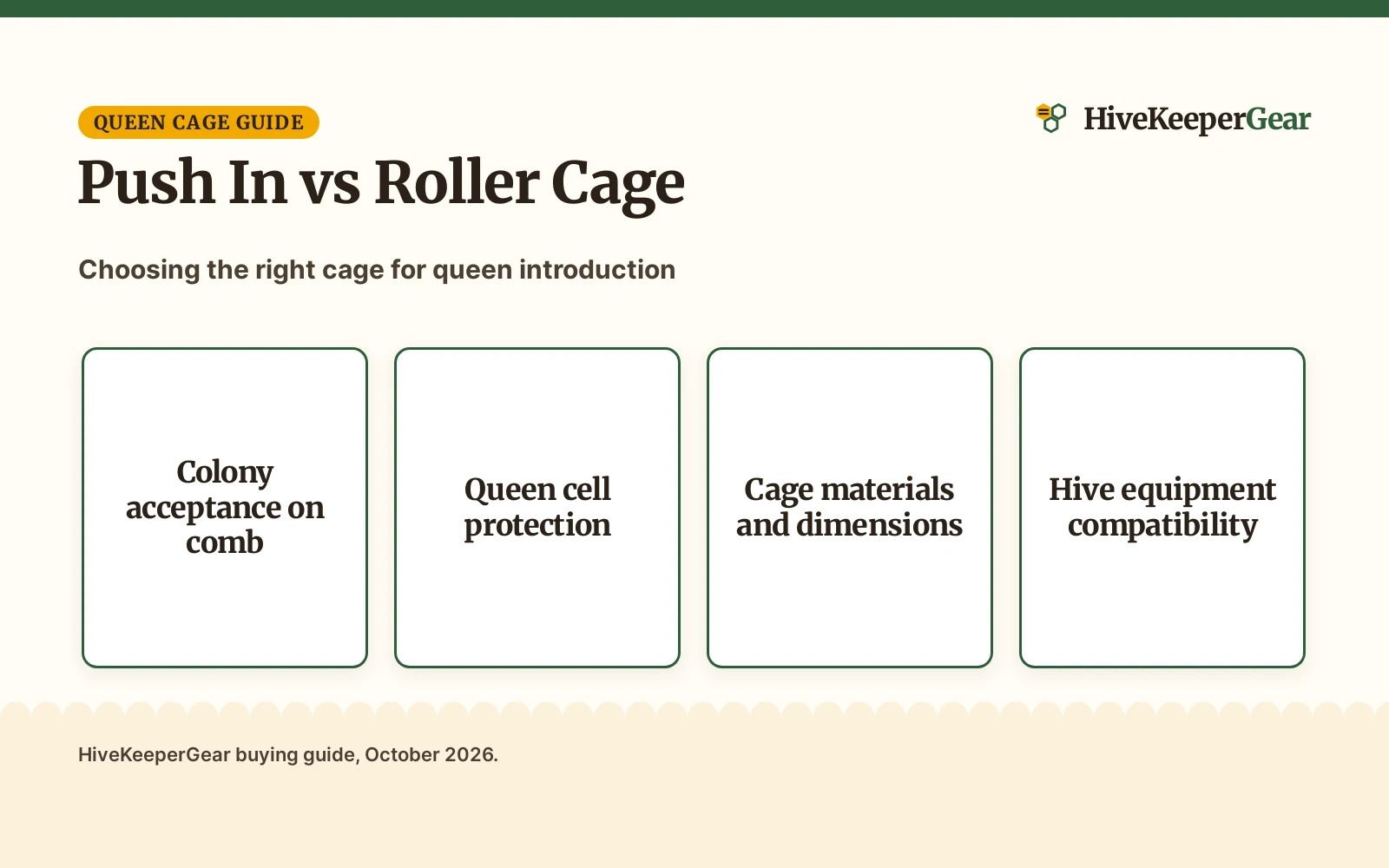
Deciding between a push in queen cage vs roller cage during an apiary inspection depends on whether your priority is colony acceptance or queen cell nursery protection. A push-in queen cage presses into drawn brood comb, allowing an introduced queen to walk on comb, receive feeding from emerging nurse bees, and lay eggs before release. A roller cage is a cylindrical plastic sleeve that slips over ripe queen cells without comb contact. For requeening established colonies, choose a push-in cage; for protecting emerging virgins in cell builders, choose a roller cage.
HiveKeeperGear earns a commission when you buy through links on this site, at no extra cost to you. As an Amazon Associate I earn from qualifying purchases. Affiliate disclosure.
Before you buy: queen management goals
Selecting the proper cage begins with understanding the biological conditions each design addresses. Introducing an adult mated queen requires careful pheromone management, because older field bees often attack unfamiliar queens. In contrast, queen rearing requires protecting ripe queen cells during emergence so multiple young queens can hatch safely in the same hive without fighting.
Colonies evaluate queens through scent. If a candy plug clears before the colony accepts an unfamiliar queen, workers may ball and kill her. Push-in cages provide protected territory on active brood comb. Emerging nurse bees hatch beneath the cage with no prior colony allegiance, immediately accepting the queen, grooming her, and feeding her royal jelly. This allows the queen to establish her brood nest scent naturally.
Queen rearers face a different hurdle. When grafting larvae into cell cups, multiple cells ripen simultaneously on a frame. The earliest virgin queen to emerge naturally destroys rival queen cells. Roller cages isolate each cell, providing a secure cylindrical chamber where virgins emerge safely until the beekeeper transfers them into mating nuclei or nursery colonies.
Push in queen cage vs roller cage: direct comparison
Comparing these tools highlights their distinct roles in the apiary. A push-in cage is an introduction tool designed for brood comb integration, whereas a roller cage is a holding tool built for frame bar suspension.
| Feature | Push-In Queen Cage | Roller Cage |
|---|---|---|
| Primary purpose | Queen introduction and colony acceptance | Queen cell protection and nursery holding |
| Comb contact | Pressed directly into drawn wax comb | Suspended between frames with no comb contact |
| Egg laying capability | Allows queen to lay in cells before release | No comb access, preventing egg laying |
| Worker interaction | Emerging nurse bees attend queen inside | Workers interact only through external mesh |
| Standard placement | Over emerging brood and open nectar cells | Mounted on cell bars or hanging between frames |
| Typical construction | Wire mesh screen or perforated disc with prongs | Cylindrical slotted plastic tube with end caps |
Hobbyists requeening established colonies, introducing valuable breeder queens, or managing splits with drawn brood comb rely on push-in cages, while beekeepers raising queens or collecting ripe queen cells depend on roller cages.
How a push-in queen cage works
A push-in queen cage consists of an open-faced wire mesh screen or perforated disc. During installation, the beekeeper selects dark brood comb containing open nectar, empty polished cells, and emerging worker brood to anchor the cage securely.
The beekeeper places the mated queen onto the selected comb and presses the cage into the wax until the rim reaches the midrib. Worker bees outside can touch antennae with her through the mesh without biting. Beneath the screen, emerging nurse bees recognize the enclosed queen as their mother, feeding her and cleaning cells.
Within days, the queen begins laying eggs in the polished cells. Once she is laying and surrounded by nurse bees, the colony accepts her, and the beekeeper removes the cage during a follow-up inspection. Beekeepers should distinguish between introduction cages and marking discs: introduction cages isolate the queen completely, while marking discs feature slots for worker passage. For example, the Nuqsx listing describes a pack of 6 push-in marking cages with an item weight of 2.2 pounds for marking on comb.
How a roller cage works
A roller cage uses a slotted cylindrical plastic body with removable end caps, engineered to slip over queen cell cups on cell bars to protect developing pupae before emergence.
Queen rearers place roller cages over capped cells before emergence. The plastic cylinder prevents worker bees from tearing down cell walls and stops the earliest hatching virgin from stinging rival queens. The top cap attaches to a cell cup holder, while the bottom cap holds a small sponge with honey so the virgin can feed upon emergence.
Roller cages also serve as temporary holding units in queen banks where caged queens hang between frames. External slots allow nurse bees to feed caged queens without fighting. Listing specifications reflect these proportions; for example, the alblinsy listing for plastic roller cages states a pack of 30, individual cage dimensions of 7.6 cm by 2.6 cm, package dimensions of 8.7 by 6.61 by 3.7 inches, and an item weight of 7.4 ounces.
Colony acceptance and queen safety
Queen acceptance is critical when introducing a mated queen. Mailing cages rely on candy plugs, risking rejection if candy clears prematurely. Push-in cages provide greater security because the queen begins laying under protected conditions.
When a queen lays eggs under mesh, her pheromone output increases and fresh brood pheromone permeates the comb. By release time, the colony treats her as an established mother. This makes push-in cages valuable for long-queenless colonies, aggressive hives, or late-season requeening.
While a roller cage can serve as a hanging release cage, it provides no comb contact or pre-release laying. Confined inside a tube, a queen cannot establish a brood nest. Roller cages excel at cell emergence and holding, whereas push-in cages provide the comb environment needed for laying and reliable acceptance.
Apiary workflow and equipment fit
Both cage designs require attention to frame spacing. A push-in cage adds height above the comb face. If frames are pressed together, adjacent comb can press against the mesh. Beekeepers using push-in cages in standard Langstroth boxes temporarily remove an outside frame or shift neighboring frames outward to create clearance.
Roller cages similarly require adjusted spacing between standard brood combs. On queen rearing frames, roller cages mount onto cell bars with open space. However, when suspended between brood combs, the 2.6 cm diameter of a roller cage (as listed by alblinsy) exceeds standard bee space, requiring beekeepers to spread frames apart to prevent comb damage.
Both cage styles are reusable. Plastic roller cages clean easily with warm water to dissolve honey and candy, while wire push-in cages can be scraped with a hive tool to remove propolis and wax.
Tools to pair with queen cages
Managing queens effectively requires a coordinated set of apiary tools to ensure gentle handling and minimize hive disruption.
- A sturdy hive tool for prying frames apart smoothly and scraping propolis.
- A transparent queen catcher for isolating the queen on comb before placing her beneath a push-in cage.
- Quality queen cell cups for raising queen cells ready for roller cage protection.
- A specialized queen grafting tool to transfer larvae during queen rearing.
- Durable beekeeping gloves that provide dependable protection while retaining tactile sensitivity.
- Straight beehive frames with drawn comb to provide the flat surface necessary for push-in cage placement.
- A dependable queen rearing kit to organize cell bars and nursery cages.
Keeping these tools organized in your field box ensures you can respond promptly whenever an inspection reveals queen issues.
What is not covered in this guide
This guide covers equipment selection, physical cage mechanics, and handling techniques for queen management in the apiary. We do not provide chemical treatment recommendations, veterinary instructions, or disease diagnostic guidance. For health concerns regarding brood pathology or regional apiary regulations, consult your state apiary inspector or local agricultural extension office.
FAQs for beekeepers
Can a queen lay eggs inside a roller cage?
No. A roller cage is a narrow cylindrical plastic sleeve without comb access, designed solely to protect queen cells and hold emerged virgins temporarily.
Why do beekeepers prefer push-in cages for expensive queens?
Push-in cages provide high acceptance rates because the queen walks on natural comb, receives care from emerging nurse bees, and begins laying eggs before release.
What type of comb works best under a push-in cage?
Dark drawn comb containing emerging worker pupae, open nectar cells, and polished empty cells provides the ideal environment for the queen to establish her brood nest.
What pack sizes are available for these cages?
Listing pack sizes depend on the manufacturer. For example, the alblinsy listing offers 30 roller cages, while push-in disc sets like the Nuqsx listing include a pack of 6 cages.
Do roller cages fit between standard hive frames without adjustments?
No. While roller cages mount easily on specialized cell bar frames, hanging them between drawn brood combs requires widening frame spacing or removing an outside frame, because the cylindrical cage body is wider than normal bee space.
More hive guides
Browse every guide by category: hive tools, protective gear, beehives and honey harvesting, or explore our complete beekeeping guides collection.