Queen Rearing Incubator vs Nursery Hive: Which One Should You Buy?
Compare queen rearing incubators with nursery hives to choose the right temperature control method for emerging queen cells in your backyard apiary or commercial setup.

On this page
Top picks at a glance
As an Amazon Associate I earn from qualifying purchases.
- 1
 Walfront Queen Bee Rearing Kit9.5/10View on Amazon
- 2
 Foxhound Bee Company Beetle Traps for Beekeeping9.6/10View on Amazon
- 3
 MODUODUO 4-Pc Bee Grafting Needles9.3/10View on Amazon
Choosing between a queen rearing incubator vs nursery hive comes down to batch volume, apiary scale, and whether you need electric climate control or natural colony incubation. For hobbyists and growing backyard beekeepers raising modest batches of queens, a nursery hive is generally the most practical choice because it uses nurse bees, colony warmth, and standard apiary equipment without adding specialized electrical gear. A dedicated queen rearing incubator becomes worthwhile for higher volume queen operations or unpredictable spring climates where beekeepers need dependable temperature stability without tying up strong colonies. This guide compares both approaches across climate stability, colony demands, cell capacity, and operational workflow.
HiveKeeperGear earns a commission when you buy through links on this site, at no extra cost to you. As an Amazon Associate I earn from qualifying purchases. Affiliate disclosure.
Before you decide: evaluate your apiary needs
Before investing in queen incubation equipment, beekeepers should assess how many queens they plan to raise each cycle and what colony assets they can spare. Raising queens successfully requires strong colonies with abundant young nurse bees, pollen stores, and incoming nectar. In smaller apiaries, using nurse bees to manage a nursery hive can reduce surplus honey storage and slow spring expansion. By contrast, an electric incubator requires dedicated indoor space, continuous electricity, and specialized racks. Evaluating the balance between colony labor and mechanical equipment helps you select the right method for your bee yard.
Queen rearing incubator vs nursery hive: comparison overview
The primary distinction between an incubator and a nursery hive is the source of environmental regulation. A nursery hive relies on living worker bees that cluster over caged cells, flexing flight muscles to generate heat and fanning wings to circulate air. An incubator uses an electric heating element, an electronic sensor thermostat, and water reservoirs to maintain atmospheric conditions inside an insulated enclosure.
| Feature | Queen Rearing Incubator | Nursery Hive | Practical Apiary Role |
|---|---|---|---|
| Heat source | Electric heating element with thermostat | Nurse bee clustering and muscular heat generation | Incubator runs without bees; nursery hive requires strong nurse population |
| Humidity regulation | Manual water reservoir trays | Nurse bees evaporating nectar and fanning air | Incubator requires manual monitoring; colony bees regulate humidity naturally |
| Colony resource demand | None after queen cells are sealed | Requires strong nurse bees, drawn comb, and stores | Incubator frees colonies for new grafts; nursery hive ties up colony assets |
| Power requirement | Continuous electrical power required | None; operates off-grid in any bee yard | Incubator depends on line power; nursery hive operates anywhere in the apiary |
| Emergence observation | Direct visual checks through viewing window | Requires opening hive boxes, smoking, and frame handling | Incubator permits fast inspection without disturbing colony clusters |
| Cell protection method | Roller cages on cell fixture bars | Roller cages on cell fixture bars | Both systems require individual cages to prevent emerging virgins fighting |
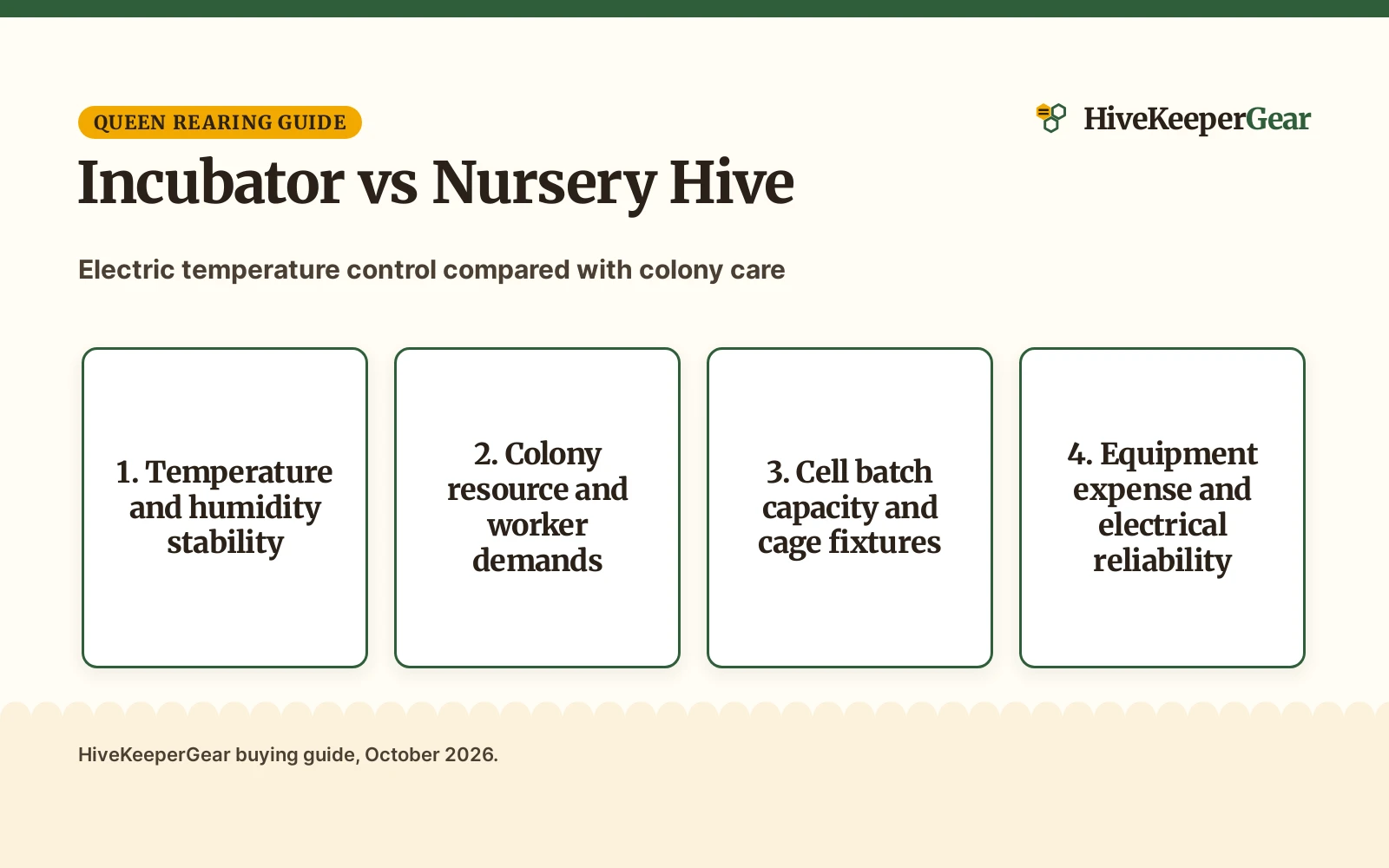
1. Temperature and humidity stability
Maintaining stable brood nest warmth is critical for developing queens during the pupal stage. Temperature drops can delay emergence or impair queen development. An incubator provides uniform warmth through an electric element and sensor circuit, protecting developing cells from chilly spring weather. Beekeepers can monitor internal climate through digital displays without exposing delicate cells to outdoor drafts. However, maintaining adequate humidity inside an incubator requires regular attention to water reservoirs, since dry conditions can cause emergence complications.
In a nursery hive, nurse bees regulate warmth and humidity with biological precision. Honey bees maintain brood warmth through dense clustering, adjusting humidity by fanning air and evaporating moisture. Listing data highlights how insulation supports temperature stability: HunterBee lists a mini mating nuc with three times the insulation performance of wood, illustrating how foam enclosures help shield bees from outdoor temperature shifts. While bees naturally maintain ideal conditions, sudden cold snaps can cause small clusters to contract, leaving perimeter cells vulnerable to chilling.
2. Colony resource and worker demands
The operational difference between these two systems centers on colony resources. A nursery hive requires a strong population of nurse bees, frames of drawn comb, and honey and pollen stores. Beekeepers often position nursery frames above a queen excluder on a queenright colony, or establish a dedicated queenless unit. Either setup diverts nurse bees away from field foraging and honey production during the spring nectar flow.
Using an incubator removes sealed queen cells from apiary colonies once worker bees have finished feeding and capping them. Because nurse bees no longer supply royal jelly after cells are capped with wax, sealed cells can complete development in an incubator without worker intervention. This allows the builder colony to receive another graft frame immediately or return to honey production.
Handling queen cells requires gentle care regardless of equipment. Always keep cell bars vertical and avoid sudden shocks, which can dislodge pupae inside delicate wax walls. Wearing protective gear such as beekeeping gloves ensures steady handling when transferring cell bars from busy hives.
3. Cell batch capacity and cage fixtures
Batch volume is a decisive factor when choosing queen rearing gear. In a nursery hive, capacity is limited by box dimensions and the number of cells nurse bees can cover evenly. Overcrowding cell bars in a hive can produce uneven warmth and poor airflow around individual cages. Reference listings demonstrate standard frame hardware capacities: HunterBee lists cell bars holding 50 cell cups on frame rails, as well as complete kits featuring 110 cell cups, 10 cell bar blocks, and 10 roller cages. Walfront similarly lists kits with 110 cell cups, 12 cell bar blocks, and 10 cages. In a hive, beekeepers typically run only one or two cell bars per colony to ensure complete cluster coverage.
An incubator handles substantially larger quantities across multiple interior shelves. Because internal fans distribute warmed air through the chamber, shelves hold multiple cell bars without crowding. In both systems, individual isolation cages are essential. Once emergence begins, the earliest virgin queen will seek out and destroy unhatched sister cells. Listing specifications show dedicated isolation hardware: HunterBee lists roller cages with an outer diameter of 26 mm and an inner diameter of 23 mm, while Lucky Farm lists cages measuring 0.4 by 0.4 by 0.4 inches in packs of 20. These cages fit over capped cells, protecting virgins until they are transferred into mating colonies.
4. Visual monitoring and emergence observation
Tracking queen emergence requires frequent observation. Virgin queens can emerge early if larvae were slightly older when grafted. An incubator with an insulated transparent viewing window lets beekeepers check cages at a glance. You can spot newly emerged virgins moving inside roller cages, assess vigor, and verify condition without disturbing remaining cells or altering chamber temperature.
Monitoring emergence in a nursery hive is considerably more disruptive. To verify emergence, the beekeeper must light a smoker, open the Langstroth hive, pry apart frames, and brush nurse bees off each cage. Each hive opening breaks the propolis seal and temporarily disrupts brood nest warmth. During cool or overcast weather, repeated inspections can chill adjacent cells and agitate the colony.
5. Equipment expense and electrical dependence
Simplicity and budget often favor the nursery hive for backyard beekeepers. A nursery hive uses equipment already present in the apiary: standard wooden boxes, frames, and bottom boards, supplemented only by inexpensive cell bars and cages. There are no electronic thermostats, heating elements, or wiring harnesses to maintain. Nursery hives operate completely off-grid in any remote bee yard.
An incubator requires an upfront equipment investment and introduces electrical dependence into the queen rearing workflow. Because developing queens cannot endure extended chilling, an incubator depends on continuous, uninterrupted line power. An electrical outage or disconnected cord can spoil an entire graft batch unless a backup generator or battery power supply is available.
A queen rearing emergence timeline
Understanding the queen rearing sequence illustrates where each method fits into apiary workflow:
Grafting and starting: beekeepers transfer tiny larvae into cell cups using a queen grafting tool, placing them into a queenless starter colony where nurse bees feed larvae royal jelly and draw vertical wax cell walls. Cell capping: worker bees seal the cell cups with wax once larvae pupate. Both incubators and nursery hives rely on nurse bees for this feeding stage. Caging and transfer: beekeepers place protective roller cages over individual capped cells on cell fixture bars, then move them into an incubator or a nursery hive above a queen excluder. Emergence: virgin queens emerge safely inside individual cages, separated from sister cells. Mating nuc introduction: beekeepers transfer emerged virgin queens or ripe capped cells into a nuc box or mini mating nuc so queens can take orientation and mating flights.
Nice to have queen rearing gear
- Cell bar frames and fixture blocks, which mount cell cups firmly inside standard hive boxes.
- A queen catcher clip or marking cage, which allows gentle restraint of queens during marking and inspection.
- Roller cages and candy compartments, which provide newly emerged virgins with sugar nourishment until collection.
- Polystyrene mini mating nucs with integrated feed troughs, which conserve worker bees during mating flights.
- An apiary record journal or notebook to log graft dates, line performance, and emergence rates.
Maintaining careful records during queen rearing cycles helps beekeepers evaluate queen vigor and establish dependable apiary stock over successive seasons.
What is not in this guide
Live honey bees, mated breeder queens, and semen supplies for instrumental insemination are obtained separately; this guide compares equipment options only. We also do not provide bee health, disease, or veterinary treatment advice. For questions regarding regional apiary regulations, bee health, or pest management, consult your state apiary inspector or local cooperative extension office.
FAQs for beekeepers
Can an incubator replace a cell builder colony?
No. An incubator cannot feed larvae royal jelly or construct wax cells. Nurse bees must feed larvae and cap the cells before an incubator can take over temperature duties.
Why must queen cells be placed inside roller cages?
The first virgin queen to emerge will instinctively seek out and sting unhatched sister cells. Enclosing each cell in a cage keeps emerging virgins isolated and safe.
How do nurse bees care for caged queens in a nursery hive?
Nurse bees cluster around the cages to maintain brood warmth and pass food to emerged virgin queens through the cage mesh until the beekeeper collects them.
What is the biggest operational risk of using an electric queen incubator?
Power interruptions pose the greatest hazard. A prolonged outage or disconnected plug will cause the chamber to cool, which can chill developing queens unless backup power is available.
When should capped cells be transferred into mating nucs?
Capped cells or newly emerged virgins are moved into mating nucs shortly before or after emergence, allowing young queens to mature and begin orientation flights.
More hive guides
Browse every guide by category: hive tools, beehives, protective gear, and honey harvesting.