Stainless Steel vs Glass Hummingbird Feeder: Which One Should You Buy?
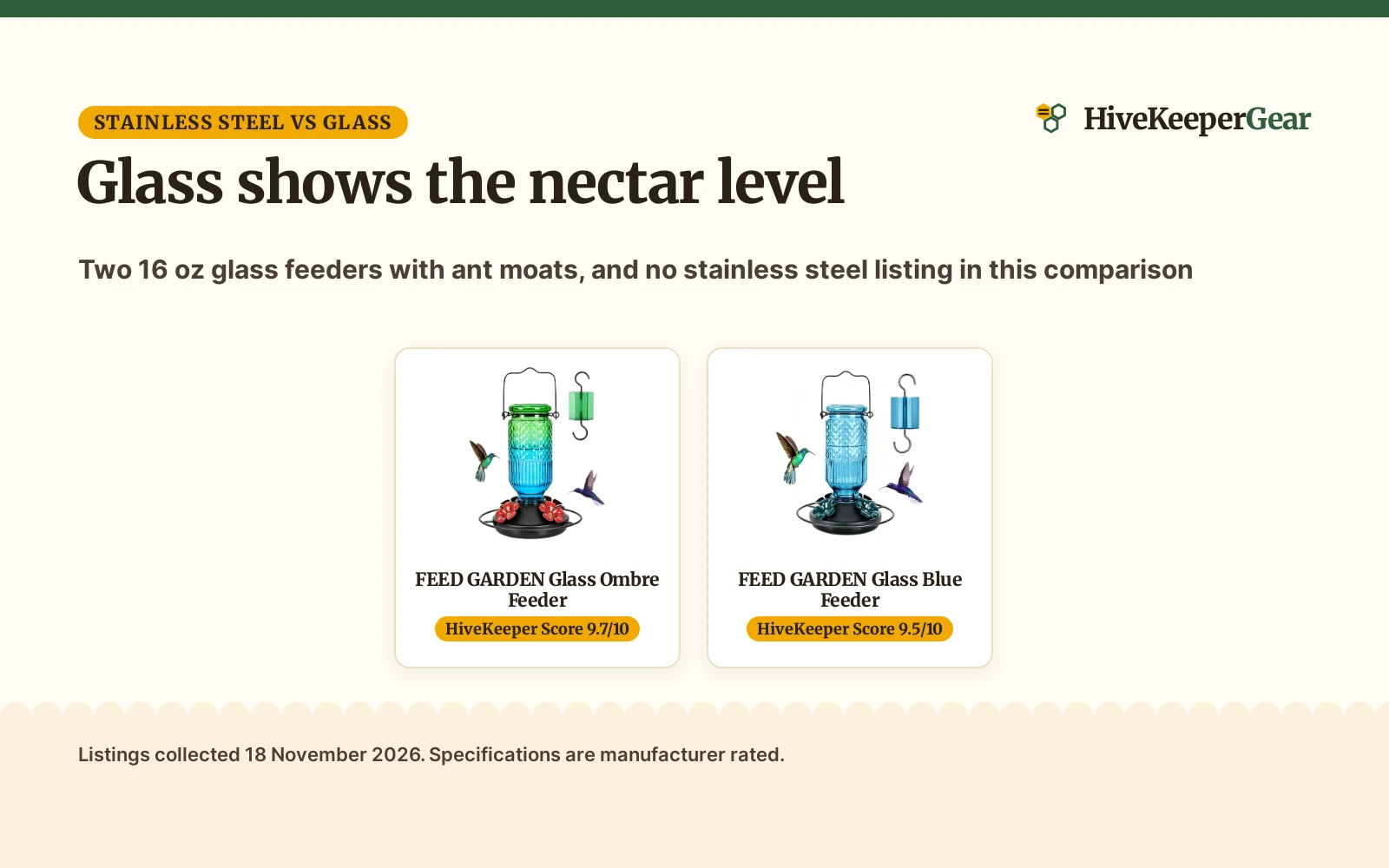
Stainless steel vs glass hummingbird feeder, compared on two glass FEED GARDEN examples, since no stainless steel feeder is listed here.

On this page
Top picks at a glance
As an Amazon Associate I earn from qualifying purchases.
- 1
 FEED GARDEN Glass Ombre Feeder9.7/10View on Amazon
- 2
 FEED GARDEN Glass Blue Feeder9.5/10View on Amazon
Stainless steel vs glass hummingbird feeder is the comparison this article sets out, but it has only glass examples to show: both feeders listed here are glass, and no stainless steel feeder is listed. The glass feeders here share the same shape, a glass bottle with metal flower ports, a built-in ant moat and 360 degree perches. Each holds 16 oz, with 4 metal flower ports and a 360 degree perch ring, and the green-blue model adds a 1-year warranty. What follows compares the two glass examples side by side and sets out what to check before choosing a stainless steel feeder instead.
HiveKeeperGear earns a commission when you buy through links on this page, at no extra cost to you. As an Amazon Associate I earn from qualifying purchases. Affiliate disclosure.
Quick verdict: choose glass if you want a wide-mouth bottle with bee guards and an ant moat. The blue feeder states its transparent glass shows the nectar level at a glance, and the green-blue feeder’s wide-mouth bottle takes a standard bottle brush. Choose stainless steel only after checking the capacity, port count, cleaning access and warranty term, since no stainless steel feeder is listed here to compare.
Two examples
FEED GARDEN Glass Ombre Feeder
A 16 oz glass hummingbird feeder with 4 metal flower ports, a built-in ant moat, a 360 degree perch ring and a 1-year warranty.
Pros
- 16 oz glass reservoir with a wide mouth for easy refills
- 4 metal flower ports with bee guards and a built-in ant moat
- Food-grade silicone gasket seals the bottle to the base
- 1-year warranty stated
Cons
- Hand wash only, not dishwasher safe
- Cleaning brush not included
- Metal ports can oxidize with prolonged outdoor exposure
- Maker advises hanging in shade or under an eave, not full sun and rain
FEED GARDEN Glass Blue Feeder
A 16 oz glass hummingbird feeder with 4 metal flower ports, a built-in ant moat and 360 degree metal perches.
Pros
- Transparent glass shows the nectar level at a glance
- 4 metal flower ports with bee guards and a built-in ant moat
- Wide-mouth glass bottle for cleaning and refilling
- Weather-resistant for year-round outdoor use
Cons
- No warranty term is stated
- Hand wash only
- Needs drying thoroughly after each wash
- 16 oz capacity needs frequent refills in a busy yard
As an Amazon Associate I earn from qualifying purchases.
Other hives and gear to compare
 LUJII Hummingbird FeederCheck price on Amazon
 Headak Life Charming Wind Chimes Hummingbird feeders forCheck price on Amazon
 Glass Hummingbird Feeders for Outdoors HangingCheck price on Amazon
 Set 3 Glass Hummingbird Feeders for Outdoors with 2 FlowerCheck price on Amazon
 More Birds Vintage Glass Hummingbird FeederCheck price on Amazon
 TOP XIAN Hummingbird Feeder Glass 20 OZ 2-Pack Round Ant&BeeCheck price on Amazon
Stainless steel vs glass hummingbird feeder: side by side
| Spec | FEED GARDEN Glass Blue Feeder | FEED GARDEN Glass Ombre Feeder | Stainless steel side |
|---|---|---|---|
| Capacity | 16 oz | 16 oz | Not stated |
| Feeding ports | 4 metal flower ports | 4 metal flower ports, 3.5 mm | Not stated |
| Ant moat | Built-in ant moat | Built-in ant moat | Not stated |
| Perch | 360 degree metal perches | 360 degree perch ring | Not stated |
| Nectar level visible | Yes, transparent glass | Not stated | Not stated |
| Cleaning | Wide-mouth bottle, hand wash only | Wide-mouth bottle, hand wash only, not dishwasher safe | Not stated |
| Base | BPA-free base | BPA-free plastic base | Not stated |
| Weight | 1.3 lb | 1.3 lb | Not stated |
| Dimensions | 4.0 x 4.0 x 8.0 in | 6.0 x 2.36 x 7.3 in | Not stated |
| Warranty | Not stated | 1-Year Warranty | Not stated |
Sizes, materials and capacities are the manufacturer’s ratings as each listing states them, collected 18 November 2026.
Seeing the nectar level
The blue feeder states that its transparent glass lets you monitor nectar levels at a glance. The green-blue feeder has a glass reservoir too, but the color finish sits on the outside of the glass, and the maker does not state whether the level shows through it. Both feeders have a wide-mouth bottle, and the green-blue maker says the bottle takes a standard bottle brush right down to the base. Both are hand wash only with mild soap and warm water, and both need drying thoroughly after washing. The green-blue maker adds that nectar needs changing every 3 to 7 days, and that the metal ports can oxidize with prolonged outdoor exposure, so drying the metal contact surfaces after every wash extends the feeder’s life.
What the two glass feeders share
Both feeders hold 16 oz, weigh 1.3 lb, and carry 4 metal flower ports with a built-in ant moat and 360 degree perches. Both have a BPA-free base and a glass bottle with a wide mouth, and both are hanging feeders with the ant moat built in. The shared shape means the choice between them turns on the details: the warranty, the gasket and the cleaning guidance, not the capacity or the port count.
Where the two glass feeders differ
The blue feeder measures 4.0 x 4.0 x 8.0 in, while the green-blue feeder measures 6.0 x 2.36 x 7.3 in. The green-blue feeder states a 1-year warranty and a food-grade silicone gasket, and its maker gives a nectar recipe of 1 part sugar to 4 parts water with no red dye. The blue feeder states no warranty term, and its maker describes a durable gasket instead. The blue feeder is described as weather-resistant for year-round outdoor use, while the green-blue maker advises hanging in shade or under an eave rather than in full sun and rain, and drying the metal contact surfaces after every wash. See can hummingbird feeders be in the sun for placement and shade.
What to check on a stainless steel feeder
No stainless steel feeder is listed here, so there is no stated capacity, port count or warranty to compare against the glass examples. Before buying a metal feeder, check the capacity in ounces, the number of feeding ports, whether it has an ant moat and bee guards, and how the bottle opens for cleaning. Ask how you will tell when the nectar runs low, since no stainless steel feeder is listed here to show whether its level is visible. Check the warranty term too: the green-blue glass feeder states 1 year, and the blue glass feeder states no term, so a stated term is worth looking for on any feeder.
Listing gaps to check
The green-blue feeder ships without a cleaning brush, and its maker warns that the metal ports can oxidize with prolonged outdoor exposure, showing first on the contact ring where the glass meets the base. The blue feeder states no warranty term. Both feeders are hand wash only, so a dishwasher is out, and both need drying thoroughly after washing. Check the warranty term and what cleaning gear comes in the box before ordering.
Which should you choose?
Choose glass if you want a wide-mouth bottle with bee guards and an ant moat. The blue feeder states its transparent glass shows the nectar level at a glance, and the green-blue feeder’s wide-mouth bottle takes a standard bottle brush. The best leak proof hummingbird feeder roundup compares more glass picks.
Choose stainless steel if you have checked the capacity, port count, ant moat, cleaning access and warranty term of a metal feeder, since no stainless steel feeder is listed here. The stainless steel vs plastic hummingbird feeder comparison covers a metal feeder against plastic.
The green-blue maker gives a nectar mix of 1 part sugar to 4 parts water with no red dye and says to change it every 3 to 7 days. Read the how to use a hummingbird feeder guide before hanging it.
Inside the HiveKeeper Score
| Product | HiveKeeper Score | Perf. /35 | Build /25 | Value /25 | Safety /10 | Warranty /5 |
|---|---|---|---|---|---|---|
| FEED GARDEN Glass Ombre Feeder | 9.7 | 30 | 21 | 20 | 7 | 3 |
| FEED GARDEN Glass Blue Feeder | 9.5 | 28 | 20 | 20 | 5 | 0 |
HiveKeeper Scores sit between 9.2 and 9.8, and a hive item’s weighted total lands on that range in proportion, so a higher total always gives a higher score.
The HiveKeeper Score weighs performance, build, value, safety and warranty. Safety here means the materials that touch the nectar: the BPA-free bases and the green-blue feeder’s food-grade silicone gasket. One of the two feeders states a warranty term. The green-blue feeder scores higher for its stated warranty, food-grade gasket and fuller cleaning guidance, and earns safety points for its BPA-free base and food-grade silicone gasket. The blue feeder earns safety points for its BPA-free base but no warranty points, because no term is stated.
FAQs for beekeepers
Can you see the nectar level in a glass hummingbird feeder?
On the blue feeder, yes: the transparent glass lets you monitor nectar levels at a glance. On the green-blue feeder, the color finish sits on the outside of the glass, and the maker does not state whether the level shows through it.
How often should you change hummingbird nectar?
The green-blue maker says nectar needs changing every 3 to 7 days to stay fresh. Clean the feeder with mild soap and warm water at the same time, and dry it thoroughly before refilling.
What nectar mix do hummingbird feeders use?
The green-blue maker gives a mix of 1 part sugar to 4 parts water and says to skip the red dye, since the feeder is what brings the birds in. The blue feeder’s maker gives no recipe.
Do glass hummingbird feeders keep ants and bees away?
Both feeders here have a built-in ant moat and 4 metal flower ports with bee guards. The green-blue maker says its built-in ant moat creates a water barrier to help block crawling ants, and the green-blue feeder’s ports sit above the nectar level.
Does a glass hummingbird feeder come with a warranty?
It depends on the model. The green-blue feeder states a 1-year warranty, while the blue feeder states no warranty term. Check the warranty before ordering any feeder.
More hive guides
Related: best leak proof hummingbird feeder, hummingbird feeder types, what is hummingbird nectar, and the hummingbird feeders hub.