Wired vs Wireless Weather Station: Which One Should You Buy?
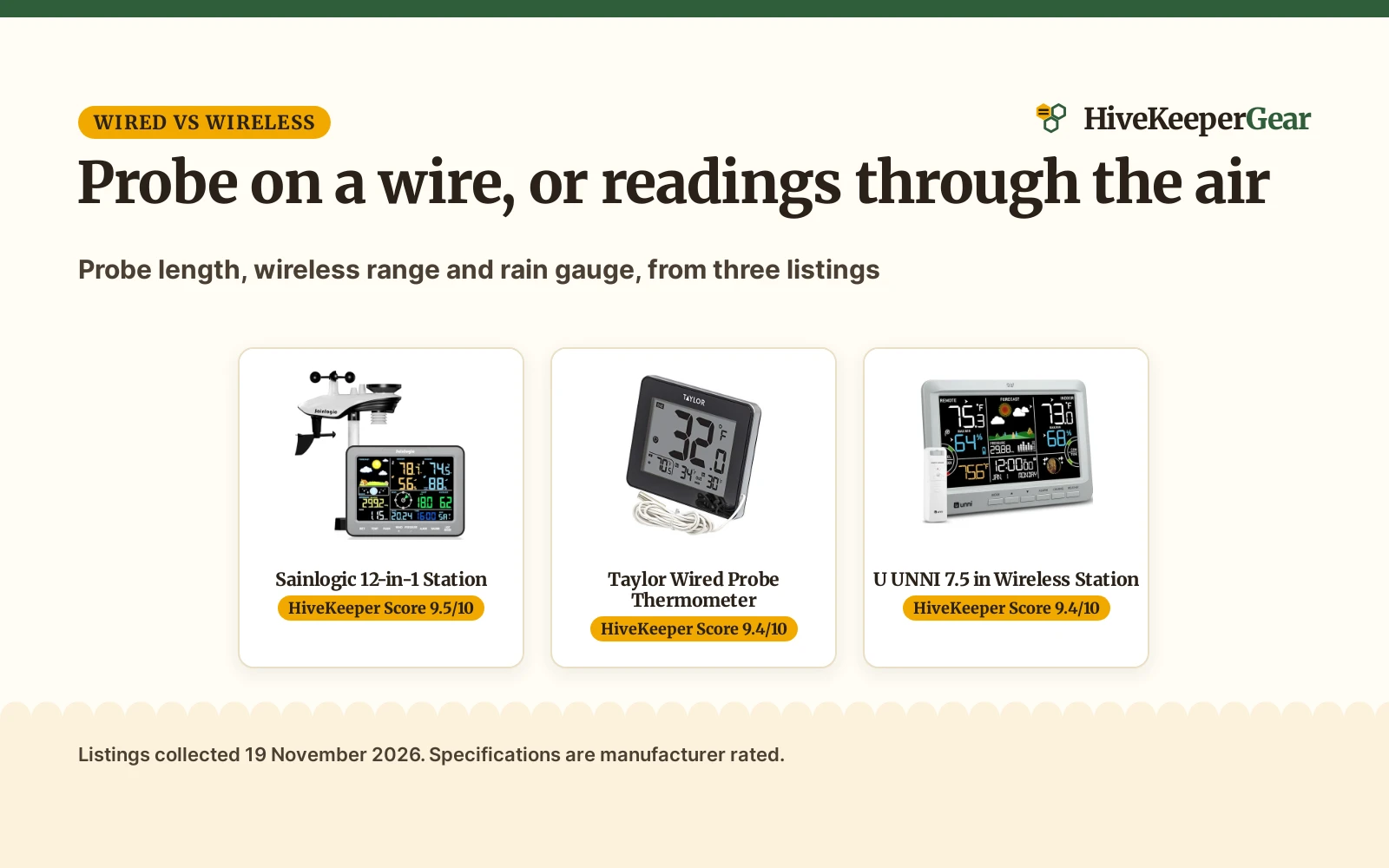
Wired vs wireless weather station, compared on three listings: probe length, wireless range, rain gauge, display size and who each one suits.

On this page
Top picks at a glance
As an Amazon Associate I earn from qualifying purchases.
- 1
 Sainlogic 12-in-1 Station9.5/10View on Amazon
- 2
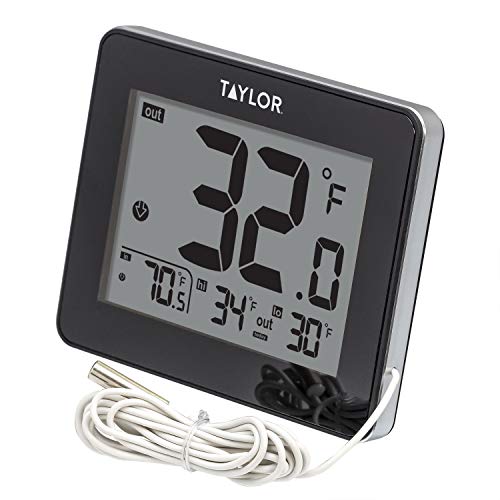 Taylor Wired Probe Thermometer9.4/10View on Amazon
- 3
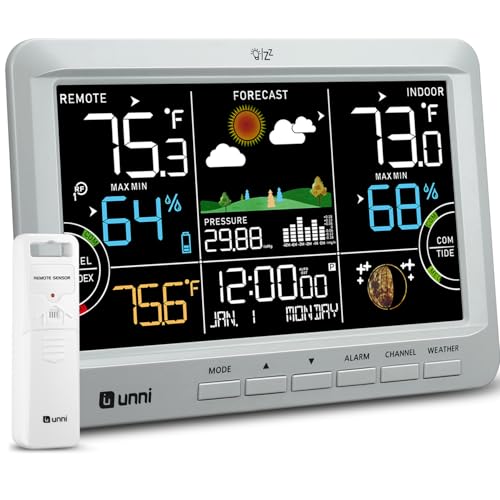 U UNNI 7.5 in Wireless Station9.4/10View on Amazon
A cool morning in the bee yard starts with a look at the sky and a check of the air before the hives are opened, and a wired vs wireless weather station turns that glance into a reading on the wall. The wired side runs a probe on a wire through a window or door frame, while the wireless side sends readings through the air from a sensor outside. This comparison covers a wired probe model and wireless stations on the other side, using only what each listing publishes.
HiveKeeperGear earns a commission when you buy through links on this page, at no extra cost to you. As an Amazon Associate I earn from qualifying purchases. Affiliate disclosure.
Quick verdict: choose the wired Taylor if you want a simple temperature and humidity read with a probe on a wire and no wireless link to set up. Choose a wireless station if you want the sensor away from the house: the U UNNI reaches up to 330 ft with an atomic clock, and the Sainlogic adds a rain gauge, wind readings and pressure to its 12-in-1 set. All three listings state indoor and outdoor temperature readings, so the real difference is the connection and how much weather each one measures.
The three picks
| # | Product | HiveKeeper Score | Buy |
|---|---|---|---|
| 1 | Sainlogic 12-in-1 Station | 9.5/10 | Buy on Amazon |
| 2 | Taylor Wired Probe Thermometer | 9.4/10 | Buy on Amazon |
| 3 | U UNNI 7.5 in Wireless Station | 9.4/10 | Buy on Amazon |
Sainlogic 12-in-1 Station
A 12-in-1 wireless station with a rain gauge, wind speed and direction, and an 8 in display, powered by solar energy with battery backup.
Pros
- Rain gauge with stated accuracy: error within 1 mm for light rain of 15 mm or less, within 7% for heavy rain from 15 to 9999 mm
- Measures wind speed and direction, pressure from 300 to 1100 hPa and humidity from 10% to 99%
- Solar power with battery backup for round-the-clock operation
- 8 in display with three-level adjustable backlighting
Cons
- Battery for backup is not included
- No warranty term is stated
- Outdoor temperature range is stated as -40 to 60 F, a narrow top end for warm climates
- Sensor mounts on poles or pillars, so placement needs a suitable mount
Taylor Wired Probe Thermometer
A wired thermometer and hygrometer with a 10 ft probe, indoor and outdoor temperature readings, an ice alert and a clock display.
Pros
- 10 ft wired probe for flexible outdoor sensor placement
- Reads indoor and outdoor temperatures at the same time
- Ice alert gives a visual warning when outdoor temperatures approach freezing
- Built-in hygrometer tracks indoor relative humidity
Cons
- No wireless sensor, so the probe wire must run to the outdoor sensor
- No rain, wind or pressure readings are stated
- No warranty term is stated
- Outdoor sensor placement is limited by the 10 ft probe wire
U UNNI 7.5 in Wireless Station
A wireless station with a 7.5 in always-on display, an atomic clock, dew point and heat index readings, and a sensor that sends data up to 330 ft every 30 seconds.
Pros
- Sensor sends temperature and humidity data up to 330 ft every 30 seconds
- Atomic clock receives the WWVB signal each day and adjusts for daylight saving time
- 7.5 in always-on display with adjustable brightness
- One-year warranty stated in the listing
Cons
- Battery for data backup is not included
- Display needs the power adapter for backlighting
- No rain gauge or wind readings are stated
- Temperature ranges are not stated
As an Amazon Associate I earn from qualifying purchases.
Other hives and gear to compare
 WiFi Weather Station with Rain Gauge and Wind Speed WirelessCheck price on Amazon
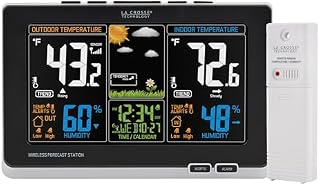 La Crosse Technology Advanced Weather Station with Full-ColorCheck price on Amazon
 AcuRite IrisCheck price on Amazon
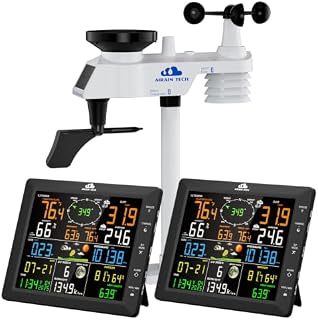 Wireless Weather Station with Dual DisplaysCheck price on Amazon
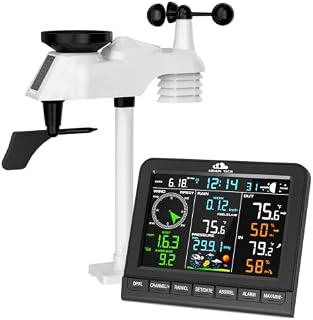 Wireless Weather StationCheck price on Amazon
 Weather Station Wireless Indoor Outdoor with 3 SensorCheck price on Amazon
Wired vs wireless weather station: side by side
| Spec | U UNNI 7.5 in Wireless Station | Sainlogic 12-in-1 Station | Taylor Wired Probe Thermometer |
|---|---|---|---|
| Connection | Wireless, up to 330 ft radius | Wireless, no wiring needed | Wired, 10 ft probe |
| Display | 7.5 in, always-on, adjustable brightness | 8 in, three-level backlight | Large LED display with clock |
| Temperature range | Indoor and outdoor, ranges not stated | Indoor 32 to 140 F, outdoor -40 to 60 F | Indoor 32 to 122 F, outdoor -40 to 158 F |
| Humidity | Indoor and outdoor, range not stated | 10% to 99% | Indoor relative humidity, range not stated |
| Rain gauge | Not stated | Yes, with stated accuracy | Not stated |
| Wind speed and direction | Not stated | Stated | Not stated |
| Barometric pressure | Barometer stated, range not stated | 300 to 1100 hPa | Not stated |
| Power | Power adapter included, battery for backup only, battery not included | Solar with battery backup, battery not included | Not stated |
| Item weight | 1.34 lb | 2.3 lb | 0.25 lb |
| Warranty | One-year warranty | Not stated | Not stated |
All specs repeat what the manufacturer lists, not our own measurements, read on 19 November 2026.
Connection and range
The Taylor is the wired pick: a 10 ft probe carries the outdoor sensor through a wall, window or door frame while the display stays indoors, and the listing states there is no wireless signal loss or dropped readings. The U UNNI sends temperature and humidity data from its wireless sensor up to 330 ft away, updating every 30 seconds. The Sainlogic also uses wireless transmission, and its listing states there are no wiring requirements.
What each one measures
The Taylor measures the least: indoor and outdoor temperature, plus indoor relative humidity, with an ice alert and a clock. Indoor temperature is stated as 32 to 122 F and outdoor temperature as -40 to 158 F. The U UNNI adds dew point, heat index, barometer, comfort, tide and moon phase to its indoor and outdoor temperature and humidity readings, though it states no temperature ranges. The Sainlogic lists the widest set: temperature indoors from 32 to 140 F and outdoors from -40 to 60 F, humidity from 10% to 99%, pressure from 300 to 1100 hPa, plus wind speed and direction, cumulative rainfall, dew point and perceived temperature. Only the Sainlogic states a rain gauge, and only the Sainlogic states wind readings.
Displays and power
The Taylor display is described as a large, easy-to-read LED display with a clock. The U UNNI display measures 7.5 in, stays on at all times, and offers adjustable brightness; it needs the included power adapter to keep its backlight on, while its battery only backs up data and is not included. The Sainlogic display measures 8 in, uses extra-large bold fonts and three-level adjustable backlighting, and the station runs on solar energy with battery backup, though the battery is not included.
Setup and space
Setting up the Taylor means running the 10 ft probe to the outdoor sensor and placing the display indoors. The U UNNI needs its power adapter at the display and its sensor within 330 ft, and its atomic clock receives the WWVB signal each day and adjusts for daylight saving time without a manual reset. The Sainlogic sensor assembles on poles or pillars at home, on a rooftop, back fence or yard, and on farms, ranches and orchards, while its indoor display uses clearly labeled buttons for settings, alerts and readings.
Listing gaps to check
Two listings state no warranty term: the Taylor and the Sainlogic. The U UNNI states a one-year warranty. The U UNNI also states no temperature ranges. The Sainlogic outdoor range tops out at 60 F in the listing, which is worth a look for warm climates. Both wireless listings need a battery that is not included.
How to choose the best wired vs wireless weather station
Choose a wired weather station if you want a simple temperature and humidity read, a probe that runs through a window or door frame, and no wireless link to set up. The Taylor covers that side with its 10 ft probe and ice alert.
Choose a wireless weather station if you want the sensor away from the house, a large always-on display, or rain and wind readings. The U UNNI suits a reader who wants reach and an atomic clock, while the Sainlogic suits a reader who wants rain, wind and pressure from one station. More wireless stations appear in the best wireless home weather station roundup, and the best home weather station roundup covers more stations of both kinds.
In the Bee Yard
- Run the Taylor probe through a window or door frame so the display stays indoors while the sensor reads the air outside.
- Set the U UNNI display where its power adapter reaches, since the adapter supplies power for the backlight.
- Keep the U UNNI sensor within 330 ft of the display so readings keep arriving every 30 seconds.
Inside the HiveKeeper Score
| Product | HiveKeeper Score | Perf. /35 | Build /25 | Value /25 | Safety /10 | Warranty /5 |
|---|---|---|---|---|---|---|
| Sainlogic 12-in-1 Station | 9.5 | 30 | 21 | 20 | 0 | 0 |
| Taylor Wired Probe Thermometer | 9.4 | 26 | 19 | 20 | 3 | 0 |
| U UNNI 7.5 in Wireless Station | 9.4 | 28 | 20 | 20 | 0 | 0 |
We map points onto a band running from 9.2 up to 9.8 in a straight line, so ranking by score is ranking by points.
The HiveKeeper Score weighs performance, build, value, safety and warranty, as explained on the how we pick page. The Sainlogic scores highest on performance for its rain gauge, wind readings and pressure range, while the U UNNI earns warranty points for its stated one-year warranty and the Taylor earns safety points for its stated ice alert.
FAQs for beekeepers
How far can a wireless weather station sensor sit from its display?
The U UNNI listing states a radius of up to 330 ft, with updates every 30 seconds. The Sainlogic listing states wireless transmission with no wiring requirements but gives no range figure.
What does the wired station need for its outdoor reading?
The Taylor uses a 10 ft wired probe that runs through a wall, window or door frame while the display stays indoors. The listing states the wired link avoids wireless signal loss and dropped readings.
Which station in this comparison measures rainfall?
Only the Sainlogic, a 12-in-1 station with a rain gauge. The listing states an error within 1 mm for light rain of 15 mm or less, and within 7% for heavy rain from 15 to 9999 mm. The other two listings state no rain gauge.
Do these stations state a warranty?
One does: the U UNNI listing states a one-year warranty. The Taylor and Sainlogic listings state no warranty term, so ask the seller before ordering if a warranty matters.
More hive guides
Related: best home weather station, best professional weather station, best barometer, and anemometer vs weather station.