Best Honey Strainer for Small Batches (2026): 4 Picks Compared
Stainless double sieves and nylon filter nets for small honey batches, compared by mesh size, bowl size, bucket fit and cleaning.

On this page
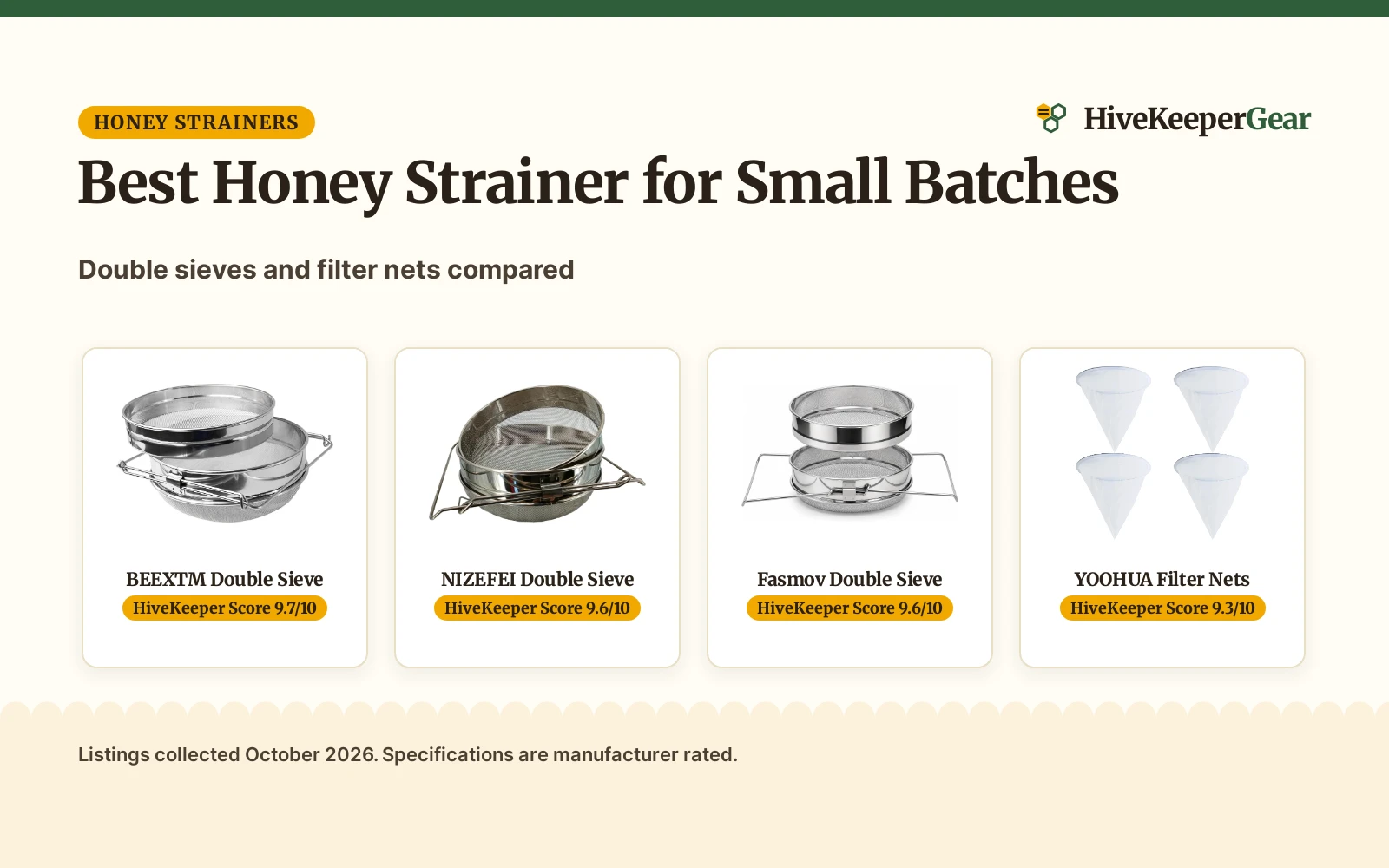
Top picks at a glance
As an Amazon Associate I earn from qualifying purchases.
- 1
 Best for a Single JarYOOHUA Filter Nets9.3/10View on Amazon
- 2
 Best OverallBEEXTM Double Sieve9.7/10View on Amazon
- 3
 Best Adjustable ArmsNIZEFEI Double Sieve9.6/10View on Amazon
- 4
 Best Cold-Water RinseFasmov Double Sieve9.6/10View on Amazon
At harvest time, when frames come off the hive and only a little honey needs clearing of wax, the best honey strainer for small batches keeps debris out of the jar. This guide compares double sieves in stainless steel and a pack of nylon filter nets, using only what each listing states.
HiveKeeperGear earns a commission when you buy through links on this page, at no extra cost to you. As an Amazon Associate I earn from qualifying purchases. Affiliate disclosure.
Quick picks
- Best for a Single Jar YOOHUA Filter Nets: Pack of 4 nylon nets that fit over a jar or bucket. Check price on Amazon
- Best Overall BEEXTM Double Sieve: Widest bowl here at 9.8 inches, with 1875 and 650 micron mesh. Check price on Amazon
- Best Adjustable Arms NIZEFEI Double Sieve: Arms expand from 10 to 16.5 inches for 5-gallon buckets. Check price on Amazon
- Best Cold-Water Rinse Fasmov Double Sieve: Cold-water rinse for wax, with 1875 and 650 micron mesh. Check price on Amazon
Picks for the bee yard
| # | Product | HiveKeeper Score | Buy |
|---|---|---|---|
| 1 | BEEXTM Double Sieve | 9.7/10 | Buy on Amazon |
| 2 | NIZEFEI Double Sieve | 9.6/10 | Buy on Amazon |
| 3 | Fasmov Double Sieve | 9.6/10 | Buy on Amazon |
| 4 | YOOHUA Filter Nets | 9.3/10 | Buy on Amazon |
BEEXTM Double Sieve
A food-grade 304 stainless double sieve with 1875 and 650 micron meshes, a 9.8 in bowl and arms that extend from 9 to 16 in.
Pros
- Food-grade 304 stainless steel stated
- Largest bowl here at 9.8 in wide and 4.3 in deep
- Arms adjust from 9 to 16 in
- Coarse and fine meshes in one pass
Cons
- No warranty term is stated
- 650 micron is coarser than a cloth bag
- Wax clogs the fine mesh on big batches
- Listing also pitches kitchen uses
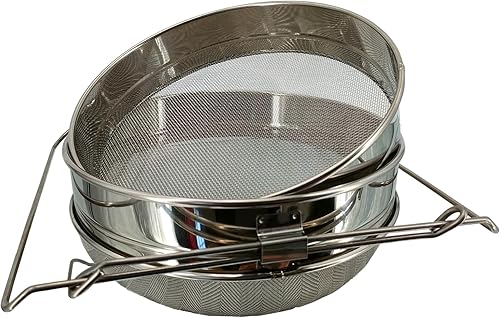
NIZEFEI Double Sieve
Double sieve strainer in food-grade 304 stainless steel with 1875 and 650 micron mesh, a 9-inch bowl and arms from 10 to 16.5 inches for 5-gallon buckets.
Pros
- 1875-micron and 650-micron mesh screens in one double sieve
- Arms expand from 10 to 16.5 inches for 5-gallon buckets
- Food-grade 304 stainless steel mesh and frame
- 9-inch diameter gives a wide filtration surface
Cons
- No warranty term is stated
- Size is given as a 9-inch diameter in one place and 10.24 inches elsewhere
- No cleaning steps are stated in the listing
- Pack holds 1 strainer, with no spare screen stated

Fasmov Double Sieve
A 9 x 4 in double sieve with 1875 and 650 micron stainless mesh and arms that reach 15.5 in.
Pros
- 1875 and 650 micron meshes
- Food-grade material stated
- Arms reach 15.5 in
- Rinses clean with cold water
Cons
- No warranty term is stated
- Stainless grade is not named
- Table lists mesh as 18 count, a different measure from the bullets
- Smaller bowl than the BEEXTM

YOOHUA Filter Nets
Pack of 4 nylon filter nets, about 13.8 x 15.75 inches, for straining honey over a jar or bucket.
Pros
- 4 filter nets in the pack for rotation between batches
- Nylon nets wash and hang dry for reuse
- Fits over a jar or bucket, per the bullets
- 13.8 x 15.75 inch size for wide jar and bucket mouths
Cons
- No mesh micron size is stated
- No warranty term is stated
- Size is given as 13.8 x 15.75 inches in one place and 13.8 inches square elsewhere
- Filter bags need a jar or bucket to hang from, unlike the arm-supported sieves
As an Amazon Associate I earn from qualifying purchases.
Other hives and gear to compare
 5 Pcs Premium Ultra Fine Mesh Strainer Bags with StainlessCheck price on Amazon
 Fine Mesh Strainer Set of 3Check price on Amazon
 Fine Mesh StrainerCheck price on Amazon
 Flexzion 304 Stainless Steel Honey StrainerCheck price on Amazon
Head to head
| Strainer | HiveKeeper Score | Mesh | Bowl | Arms | Material |
|---|---|---|---|---|---|
| BEEXTM Double Sieve | 9.7/10 | 1875 and 650 micron | 9.8 inches wide, 4.3 inches deep | 9 to 16 inches | 304 stainless steel |
| NIZEFEI Double Sieve | 9.6/10 | 1875 and 650 micron | 9 inches diameter | 10 to 16.5 inches | 304 stainless steel |
| Fasmov Double Sieve | 9.6/10 | 1875 and 650 micron | 9 inches diameter, 4 inches deep | 15.5 inches max | Stainless steel |
| YOOHUA Filter Nets | 9.3/10 | Not stated | 13.8 x 15.75 inches | Not stated | Nylon |
We quote the beekeeping gear makers’ rated specs from each listing (as of 21 October 2026).
How to choose the best honey strainer for small batches
Start with the vessel: jar or bucket
For a small harvest, the vessel matters as much as the mesh. The YOOHUA nets fit over a jar or bucket, so they suit a small batch poured into a jar, and the pack holds 4 nets for rotation between batches. The stainless double sieves are built around buckets and honey pans, which makes them a better match once a harvest outgrows a jar. Keep a spare net or a second sieve handy for back-to-back batches, since a clogged screen slows the pour.
Mesh sizes: coarse and fine
Two mesh stages do different jobs: a coarse screen catches wax chunks and large debris, while a fine screen catches tiny particles for smooth honey. The stainless sieves here all pair 1875-micron coarse mesh with 650-micron fine mesh. The nylon nets state no micron size, so a keeper who needs a stated fine mesh should pick a sieve.
| Strainer | Coarse mesh | Fine mesh | Bowl |
|---|---|---|---|
| BEEXTM Double Sieve | 1875 micron | 650 micron | 9.8 inches wide |
| NIZEFEI Double Sieve | 1875 micron | 650 micron | 9 inches diameter |
| Fasmov Double Sieve | 1875 micron | 650 micron | 9 inches diameter |
| YOOHUA Filter Nets | Not stated | Not stated | 13.8 x 15.75 inches |
Bucket fit and adjustable arms
Arms decide whether a sieve sits steady over the bucket or pan below it. The BEEXTM arms adjust from 9 to 16 inches, the NIZEFEI arms from 10 to 16.5 inches, and the Fasmov arms reach a stated max of 15.5 inches, all for 5-gallon buckets and honey pans. Measure the bucket or pan rim before buying, since the listings state arm ranges rather than one fixed width. See our honey strainer for 5 gallon bucket guide and our honey strainer for mason jar guide.
Materials and cleaning
Stainless sieves and nylon nets clean differently. The stainless listings state rust resistance, and the Fasmov listing names a cold-water rinse for beeswax residue. The BEEXTM listing says the sieve rinses under running water. The nylon nets wash with warm water and hang dry for reuse. Food-grade wording matters for honey contact: the BEEXTM, NIZEFEI and Fasmov listings state food-grade materials, while the YOOHUA listing says the nets can filter food safely but names only nylon as the material.
In the Bee Yard
- Double sieves with arms from 9 to 16.5 inches sit over 5-gallon buckets and honey pans.
- Filter nets fit over a jar or bucket and wash for reuse between batches.
- The Fasmov sieve rinses with cold water for wax removal, per its listing.
- Store nets hung dry after washing, ready for the next harvest.
Inside the HiveKeeper Score
The HiveKeeper Score weighs performance, build, value, safety and warranty. For strainers, safety means stated food-grade materials for honey contact. None of the listings state a warranty. The nylon nets score lower mainly because their listing gives no mesh size and no food-grade wording, not because a jar-sized net is a poor fit for a small harvest. How we pick explains the weights.
| Product | HiveKeeper Score | Perf. /35 | Build /25 | Value /25 | Safety /10 | Warranty /5 |
|---|---|---|---|---|---|---|
| NIZEFEI Double Sieve | 9.6 | 30 | 21 | 20 | 7 | 0 |
| YOOHUA Filter Nets | 9.3 | 23 | 18 | 21 | 0 | 0 |
Each item’s weighted total is converted onto a scale that starts at 9.2 and ends at 9.8, linearly and in the same order.
FAQs for beekeepers
What mesh size should a honey strainer have?
The stainless sieves here pair 1875-micron coarse mesh with 650-micron fine mesh. The nylon nets state no micron size.
Do honey strainers fit 5-gallon buckets?
The sieves here are made for 5-gallon buckets: the BEEXTM arms adjust from 9 to 16 inches, the NIZEFEI arms from 10 to 16.5 inches, and the Fasmov arms reach 15.5 inches. The nylon nets fit over a jar or bucket, without arms.
How do you clean a honey strainer?
The Fasmov listing states a cold-water rinse for beeswax residue, and the BEEXTM listing states a rinse under running water. The YOOHUA nets wash with warm water and hang dry for reuse.
Why strain honey in two stages?
Two stages split the work: the coarse screen catches wax chunks and large debris, while the fine screen catches tiny particles. The stainless sieves here all use 1875-micron coarse mesh above 650-micron fine mesh.
More hive guides
See every honey strainer guide and all honey harvesting guides. Also see our honey strainer for 5 gallon bucket. Also see our honey strainer for mason jar. Also see our honey strainer mesh size.
More picks: honey extractors, uncapping knives, and beehive feeders. New to beekeeping? Start with our beekeeping equipment list for beginners.