Honey Strainer Mesh Size: Micron Ratings and Setup Guide
Learn the right honey strainer mesh size for your harvest, comparing coarse 1875 micron screens, fine 650 micron sieves, and 400-micron filter bags.

On this page
Top picks at a glance
As an Amazon Associate I earn from qualifying purchases.
- 1
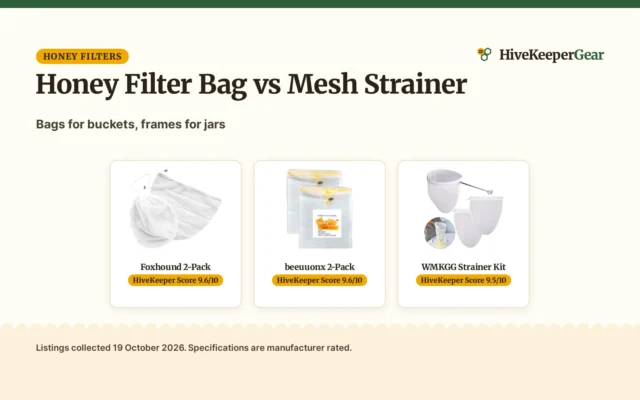
 Foxhound 2-Pack Honey Filter9.6/10View on Amazon
- 2
 beeuuonx 2-Pack Honey Filter9.6/10View on Amazon
- 3
 WMKGG Strainer Kit9.5/10View on Amazon
- 4
 Fine Mesh StrainerView on Amazon
- 5
 4 Pcs Ultra Fine Mesh Strainer Bags with Stainless SteelView on Amazon
- 6
 GDFYMI 2 Pack Ultra-Fine Nylon Mesh StrainerView on Amazon
- 7
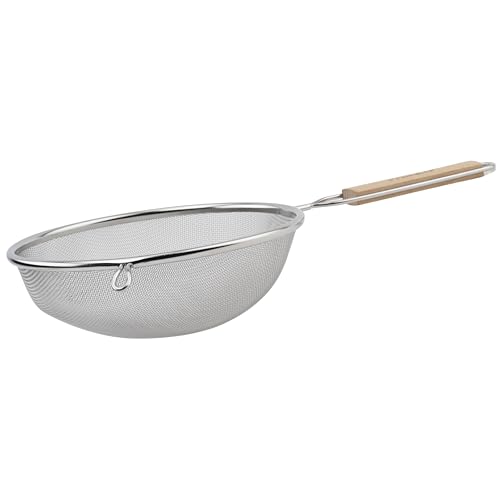 Winco Strainer with Single Fine MeshView on Amazon
- 8
 Esuduky 5 Pcs Premium Ultra Fine Mesh Strainer Bags withView on Amazon
- 9
 HIC Kitchen Ultra-Fine Mesh StrainersView on Amazon
Choosing the right honey strainer mesh size is essential for separating wax cappings, comb debris, and hive matter from freshly extracted honey while preserving raw quality. For backyard beekeepers, standard harvesting relies on a two-stage stainless steel double sieve featuring a coarse upper mesh to catch large comb fragments and a fine lower mesh to capture smaller wax particles without clogging. Reference listings from makers such as BEEKNOWS and NIZEFEI specify an 1875 micron coarse upper screen paired with a 650 micron fine lower screen, while BEEKNOWS also offers a 400-micron nylon filter bag for optional extra clarity. Because honey is viscous, mesh openings smaller than recommended will clog quickly and stall extraction.
Other hives and gear to compare
 Fine Mesh StrainerCheck price on Amazon
 4 Pcs Ultra Fine Mesh Strainer Bags with Stainless SteelCheck price on Amazon
 GDFYMI 2 Pack Ultra-Fine Nylon Mesh StrainerCheck price on Amazon
 Winco Strainer with Single Fine MeshCheck price on Amazon
 Esuduky 5 Pcs Premium Ultra Fine Mesh Strainer Bags withCheck price on Amazon
 HIC Kitchen Ultra-Fine Mesh StrainersCheck price on Amazon
HiveKeeperGear earns a commission when you buy through links on this site, at no extra cost to you. As an Amazon Associate I earn from qualifying purchases. Affiliate disclosure.
Understanding microns and mesh counts in honey filtration
Honey strainers are measured using microns or mesh counts. A micron measures the physical opening between wires: a larger micron figure means a wider opening. Mesh count indicates the number of wire strands per linear inch: a higher mesh number means smaller openings. Understanding both scales prevents choosing screens that either let debris pass through or blind immediately during extraction.
Manufacturer listings often cite both scales. BEEKNOWS lists an 1875 micron coarse upper mesh alongside a 650 micron fine lower mesh, with its specification table listing an opening size of 1.88 millimeters. ZHUITU classifies its stainless steel bucket insert using a 60 mesh rating for 5 gallon containers. Listing specifications can also introduce confusion and contradictions: Golden Palace describes a double sieve with a 16 mesh upper screen claiming 100 microns, followed by a 40 mesh lower screen described as 240 microns, while its specification table lists a mesh opening size of 500 microns. On standard wire scales, 16 mesh features substantially wider openings than 40 mesh, yet the listing numbers reverse this relationship by assigning 100 microns to the top screen and 240 microns to the bottom. Understanding physical micron ratings helps beekeepers identify listing errors and select appropriate filtration gear.
Honey strainer mesh size recommendations for backyard harvesting
The goal of honey straining is removing hive debris while allowing liquid honey and natural pollen to pass into your collection bucket. The table below compares common mesh counts and micron ratings found in beekeeping hardware and utility filters.
| Equipment Type | Filter Stage | Stated Rating | Target Debris | Example Listing |
|---|---|---|---|---|
| Double Sieve Upper Basket | Coarse pre-filter | 1875 microns (1.88 millimeters) | Wax cappings, comb chunks, large debris | BEEKNOWS, NIZEFEI |
| Double Sieve Lower Bowl | Fine clarifying filter | 650 microns | Fine wax flakes, small particulate | BEEKNOWS, NIZEFEI |
| Nylon Filter Bag | Ultra-fine finishing pass | 400-micron | Minute wax crystals, fine residue | BEEKNOWS (pack of 6) |
| Bucket Insert Strainer | Utility bucket filter | 60 mesh | General residue, paint, honey debris | ZHUITU (5 gallon bucket) |
| Alternative Double Sieve | Tiered screens | 16 mesh top (100 microns listed), 40 mesh bottom (240 microns listed) | Comb debris and wax particles | Golden Palace (500 microns in spec table) |
Coarse upper sieves: pre-filtering large debris
When honey drains from a honey extractor or uncapping tank after frames are uncapped with an uncapping knife, it carries large wax cappings, comb pieces, and propolis. Straining directly through a fine screen causes immediate clogs because wax forms an impermeable layer over fine openings. A coarse upper sieve acts as the primary barrier, catching bulky debris while honey drains through freely.
Makers such as BEEKNOWS and NIZEFEI specify an 1875 micron coarse upper screen for this initial stage. At 1875 microns (corresponding to an opening width of roughly 1.88 millimeters in the BEEKNOWS specification table), openings stop wax chunks without slowing the pour. As cappings accumulate in the upper basket, you can lift the top bowl and scoop out collected wax, keeping the drainage path clear.
Fine lower sieves: clarifying raw honey
The second stage of standard honey filtration sits directly below the coarse basket. Rather than relying on a single screen, double sieves pair the coarse top with a fine lower barrier to catch smaller floating wax flakes, comb crumbs, and hive particles that pass through the upper mesh.
In double sieve designs from brands like BEEKNOWS and NIZEFEI, the lower screen features a 650 micron mesh. A 650 micron opening provides an effective balance for backyard beekeepers: it clarifies honey cleanly for bottling while allowing microscopic pollen grains to pass through, preserving raw honey character. Frame dimensions provide adequate flow area; for example, Honey Lake lists a double sieve measuring 9 inches in diameter by 4 inches in height, while BEEKNOWS lists a 9.4 inches diameter by 4 inches depth bowl, and NIZEFEI specifies a 9-inch diameter processing area.
Filter bags and cloth strainers: ultra-fine finishing
Some beekeepers prefer an extra filtration step beyond stainless steel screens. BEEKNOWS offers reusable food-grade nylon filter bags rated at 400-micron mesh, supplied in packs of 6. These fabric filter bags stretch over a standard 5 gallon bucket rim with an elastic cord, catching fine wax crystals that pass through a 650 micron screen.
Alternative cloth netting, such as the YOOHUA nylon filter net measuring 13.8 by 15.75 inches, provides similar flexibility for hanging over buckets. However, pouring raw honey straight into a 400-micron fabric bag will quickly blind the weave with wax. Cloth filter bags work best as a secondary clarifying pass after honey has cleared a coarse and fine stainless double sieve.
Bucket sizing, adjustable arms, and harvest hardware
Backyard honey processing commonly centers on standard 5 gallon food-grade buckets. To strain honey steadily, a double sieve must rest securely on the bucket rim without slipping under the weight of accumulated honey. Beekeeping strainers feature sliding arms that expand across various container widths.
Listing specifications show varying arm spans across brands. NIZEFEI includes adjustable support arms that expand from 10 to 16.5 inches, with another NIZEFEI listing citing a range of 10.1 to 16.7 inches. BEEKNOWS lists extendable arms reaching up to 16 inches, while Golden Palace lists arms extendable to 17 inches across a 10.23 inches diameter frame. SunVara provides a double strainer unit measuring 10.7 by 10.1 by 4.7 inches for 5-gallon containers, though its listing notes a contradiction between stainless steel in bullets and plastic in its specification table. Sturdy 304 stainless steel arms keep compatible sieves balanced over your pail during extraction.
Gravity straining workflow and temperature management
Honey straining relies on gravity rather than mechanical pressure. Honey viscosity depends on temperature: honey flows quickly when warm, but thickens in cool air. Straining honey in a cold space causes honey to pool on fine screens, slowing extraction.
Never boil or overheat honey to speed up filtration, as heat harms natural enzymes and alters flavor. Straining honey immediately after extraction, while comb warmth remains, or working in a comfortably warm room provides ideal flow. If wax accumulates in the upper coarse basket, use a clean silicone spatula to gently lift away cappings. Avoid scraping wax down against the lower fine screen, which forces soft wax particles through the wire openings.
Settling versus excessive filtration for raw honey
Beginners sometimes assume they should filter honey until every microscopic speck is removed. However, over-filtering with industrial-grade micro-filters strips away natural pollen and requires commercial pumps that are unnecessary for backyard apiaries. Pairing a double sieve with simple gravity settling produces clear honey while maintaining natural raw qualities.
After honey drains through your sieves into a 5 gallon bucket, seal the bucket lid and allow it to rest in a warm space. Over time, air bubbles and microscopic wax dust rise to the surface, forming a thin white foam layer that you can skim away with a clean spoon. Dispensing honey from the bottom through a honey gate for 5 gallon bucket valve yields clear honey ready for bottling. Review our guide to the best honey jars to select storage glassware for your harvest.
FAQs for beekeepers
What is the recommended honey strainer mesh size for beginners?
Most beginners start with a two-stage stainless steel double sieve featuring a coarse upper screen and a fine lower screen. Reference models from brands like BEEKNOWS and NIZEFEI pair an 1875 micron coarse top mesh with a 650 micron fine bottom mesh to strain comb debris smoothly into a 5 gallon bucket.
What happens if your honey strainer mesh size is too small?
Mesh openings that are too fine clog rapidly when processing raw honey containing comb wax. Dense honey pools on the screen, stalling flow and requiring repeated cleaning to clear compacted wax from wire gaps.
Does a 650 micron honey strainer remove natural pollen?
No. A 650 micron screen allows natural microscopic pollen grains to pass through into your bucket, preserving genuine raw honey character while capturing visible wax particles and hive debris.
Can I use a 60 mesh utility strainer for honey?
Some beekeepers use a 60 mesh stainless bucket strainer like those from ZHUITU for rough filtering, but a dedicated double sieve with coarse and fine screens separates wax far more effectively without blinding.
How do you clean wax out of a stainless steel honey strainer?
Rinse the strainer with cool water first so wax does not melt into wire intersections. After removing loose debris, wash the screens with warm water and mild soap, then dry thoroughly before storing.
More hive guides
See every honey strainers guide and all honey harvesting guides.
More picks: compare top rated models in our best honey strainer review, find a dedicated honey strainer for 5 gallon bucket setups, pair your system with the best honey extractor, or learn how to use a honey extractor step by step. New to beekeeping? Start with our beekeeping equipment list for beginners.