Boardman Feeder vs Top Feeder: Which One Should You Buy?
Compare Boardman entrance feeders with hive top feeders to understand capacity, robbing risks, colony temperature management, and seasonal syrup feeding.

On this page
Top picks at a glance
As an Amazon Associate I earn from qualifying purchases.
- 1
 AOIT Rapid Round Hive Top Feeder for 8 or 10 Frame Beehives9.7/10View on Amazon
- 2
 Lehman's Stoney Acres Beekeeping Top Feeder with Floats9.7/10View on Amazon
- 3
 MayBee 6.5L Bee Pro Feeder9.7/10View on Amazon
- 4
 2 Pack Bee Entry FeedersView on Amazon
- 5
 AOIT 6 Pack Front Bee Feeders for Hives BeehiveView on Amazon
- 6
 Bee FeederView on Amazon
- 7
 Upgraded Rapid Bee Top Feeder with Anti-Drowning Sponge RingsView on Amazon
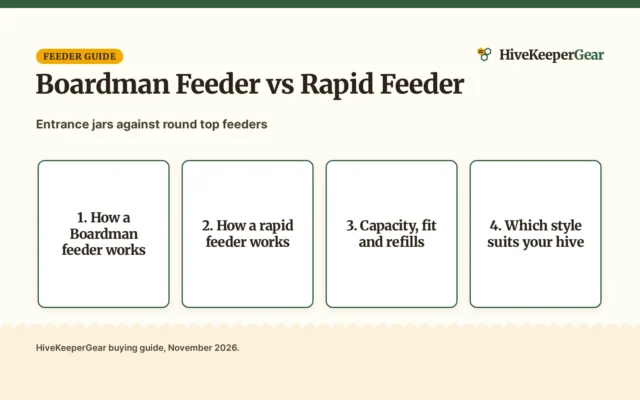
When evaluating a boardman feeder vs top feeder, the top feeder is generally the superior choice for delivering sugar syrup because its large internal reservoir minimizes robbing risks and sits directly above the warm cluster, while a Boardman entrance feeder is best reserved for supplying water or offering supplemental syrup to strong colonies when robbing pressure is low. Choosing between internal and external feeding shapes how effectively bees take syrup, how easily robber insects detect food odors, and whether your colony can reach liquid nutrition during chilly weather. This guide compares both styles across capacity, robbing defense, thermal performance, and inspection routines to help you select the right feeder for your apiary.
Other hives and gear to compare
 2 Pack Bee Entry FeedersCheck price on Amazon
 AOIT 6 Pack Front Bee Feeders for Hives BeehiveCheck price on Amazon
 Bee FeederCheck price on Amazon
 Upgraded Rapid Bee Top Feeder with Anti-Drowning Sponge RingsCheck price on Amazon
HiveKeeperGear earns a commission when you buy through links on this site, at no extra cost to you. As an Amazon Associate I earn from qualifying purchases. Affiliate disclosure.
Before you choose: internal versus external syrup feeding
Honey bees consume sugar syrup to build wax comb, rear brood during spring buildup, and store reserves before winter. How you deliver that syrup matters as much as the syrup itself. Feeders divide into primary categories: external entrance feeders that sit at the front opening of the bottom board, and internal feeders that sit inside the hive perimeter beneath the outer telescoping cover.
External feeders expose syrup aroma directly to the outside air, making them visible to foraging insects and neighboring colonies. Internal feeders keep syrup sealed inside the hive envelope, relying on colony warmth and protecting stores behind the hive defense perimeter. Understanding this distinction clarifies why experienced beekeepers select different feeding equipment depending on the season and colony strength.
Boardman feeder vs top feeder: comparison overview
| Feature | Boardman Feeder | Top Feeder | Practical Apiary Impact |
|---|---|---|---|
| Placement | Hive entrance on bottom board | Top hive body under outer cover | Internal placement keeps syrup warm and safe |
| Syrup capacity | Small jar capacity | Large reservoir volume | Top feeders allow bulk feeding with fewer refills |
| Robbing risk | High risk at front entrance | Low risk enclosed under roof | Weak colonies can struggle to defend entrance feeders |
| Cold weather access | Poor access during cool days | Direct access above warm cluster | Bees cannot break cluster to reach bottom entrances |
| Hive disturbance | Refill without opening boxes | Lift outer cover to refill | Boardman allows quick exterior monitoring |
| Best seasonal use | Summer water and warm-weather supplemental feeding | Spring buildup, autumn provisioning, and dearth feeding | Top feeders support bulk feeding whenever colonies need substantial stores |
1. Capacity and refill frequency
Syrup capacity represents a major operational difference between these designs. A Boardman feeder utilizes an inverted jar seated in an exterior base. Dimensions and capacities vary by maker; for instance, the Minelife entrance feeder listing specifies tray dimensions of 5.5 by 3.15 by 1.18 inches and a 16-ounce capacity, while the PUERDEAN entrance feeder listing provides a base designed for 2.75-inch jars. While a compact jar allows beekeepers to check liquid levels at a glance from outside the hive, an active colony can empty that volume quickly during a nectar dearth. Maintaining continuous feed with an entrance unit requires frequent visits to replace or refill jars.
In contrast, a hive top feeder spans the entire upper rim of the hive box, holding substantial reservoirs of syrup. This volume allows beekeepers to pour large quantities of feed in a visit. For fall feeding, when colonies must store significant reserves before winter temperatures set in, top feeders supply the required bulk quickly without daily refills. To explore other feeder shapes, read our guide to bee feeder types.
2. Robbing risk and apiary defense
Robbing presents a severe hazard associated with entrance feeding. Because a Boardman feeder positions sweet syrup directly at the front entrance, scent disperses into the flight path. Foraging yellowjackets, wasps, and scout bees from neighboring colonies quickly detect the sugar source. If the host colony is small or recovering, robber insects can overwhelm the guard bees at the entrance. Beekeepers using entrance devices often install a best hive entrance reducer to shrink the opening, yet the proximity of syrup to the outdoors remains an inherent vulnerability.
A top feeder substantially reduces robbing hazards by enclosing the syrup reservoir within the hive walls beneath the outer cover. Bees access the liquid through the inner cover opening or an internal access chimney. Stray foragers investigating the hive exterior detect minimal aroma and encounter no exposed syrup pans. While beekeepers must still ensure outer covers fit snugly to prevent opportunistic scouts from entering upper seams, this enclosed placement makes top feeders far safer than entrance units in crowded yards or during late-summer nectar droughts.
3. Cold weather performance and cluster access
Colony thermal dynamics dictate how bees access stored nutrition. As autumn temperatures fall, honey bees contract into a tight winter cluster to generate and conserve heat. Bees within a cluster cannot separate or travel across cold comb without chilling and perishing.
Because a Boardman feeder sits at the drafty bottom entrance, bees are reluctant to leave the warm brood nest during cool weather. Liquid syrup in an exterior jar chills rapidly, and bees will not break cluster to take it. A top feeder, by comparison, sits directly above the brood nest where rising cluster heat helps keep the syrup chamber accessible, allowing colonies to take feed during brisk spring or autumn days.
4. Hive disturbance and inspection convenience
The primary advantage of a Boardman feeder lies in convenience. You can monitor consumption and swap empty jars from outside the hive without cracking open boxes or smoking the colony. This makes entrance units popular for observation hives or backyards where beekeepers want quick verification of liquid intake.
Refilling a top feeder requires removing the outer telescoping cover. However, quality top feeder trays incorporate internal screened chimneys or floating baffles. These safety barriers keep bees confined beneath the screen while the beekeeper pours fresh syrup into the reservoir pans. You can replenish fresh syrup in moments without releasing bees into the apiary or crushing workers along frame rests. For comparisons with frame-mounted alternatives, see our analysis of entrance feeder vs frame feeder setups.
Seasonal strategy: when to deploy each feeder
Experienced beekeepers match feeding equipment to seasonal goals and colony development:
- Early spring stimulation: When temperatures begin to rise and colonies require light syrup to stimulate brood production, a top feeder delivers syrup without chilling the hive. If using an entrance feeder for early stimulation, restrict it to strong colonies with reduced entrances to avoid tempting robber bees.
- Late summer nectar dearth: When field nectar dries up and robbing instincts surge, remove entrance feeders immediately. Deploy protective internal top feeders or explore options in our best beehive feeder review.
- Autumn preparation: Fall requires rapid delivery of heavy syrup so bees can ripen and seal stores before freezing weather arrives. Top feeders excel here, taking bulk feed efficiently above the cluster.
- Summer apiary water station: Boardman feeders filled with fresh water rather than sugar syrup provide an excellent drinking source at the hive entrance, keeping bees from seeking moisture in neighborhood swimming pools.
Feeder safety: preventing leaks and drowning
Spilled syrup creates serious apiary hazards. An inverted jar feeder relies on an airtight vacuum seal within the container. If an entrance jar lid develops hairline cracks or sits unlevel in the base tray, the vacuum fails and syrup flows across the bottom board and out the front entrance, triggering frantic robbing. Check lid perforations and inspect jar rims before installation.
Top feeders require equal vigilance regarding bee drowning. Bees attempting to drink from open, deep syrup pools can lose footing on smooth plastic surfaces. Ensure your top feeder includes textured climbing ladders, protective corner screens, or wooden floats that give bees steady footing while feeding.
FAQs for beekeepers
Can a Boardman feeder trigger hive robbing?
Yes. Placing sugar syrup at the exterior entrance exposes food odors directly to scout bees from neighboring colonies and wasps. A weak colony can be quickly overwhelmed by robber insects attracted to the entrance jar.
Can bees take syrup from a Boardman feeder in cold weather?
Generally no. When ambient temperatures drop, honey bees gather into a tight cluster to conserve warmth. Bees avoid breaking cluster to travel down to a drafty hive entrance, leaving cold syrup untouched until weather warms.
Do honey bees drown in top feeders?
Drowning is rare when the feeder includes safety screens or floating rafts. Quality top feeders feature screened center chimneys or grooved access steps that prevent bees from falling into the open liquid reservoir.
Is a Boardman feeder suitable for package bees?
Most experienced beekeepers advise against using an entrance feeder on new packages. Newly installed packages lack sufficient guard bees to defend an exterior syrup source, making an enclosed top feeder a safer choice to prevent robbing.
Can you feed water through a Boardman feeder?
Yes. Filling an entrance jar with clean water provides bees with a dependable water source right at the bottom board without attracting robber bees, which is especially helpful during hot summer weather.
More hive guides
Browse every guide in our bee feeders section and all beekeeping tools guides.
More picks: compare our entrance feeder vs frame feeder breakdown, find the best beehive feeder for your setup, explore bee feeder types, or review our beekeeping supplies for beginners checklist.