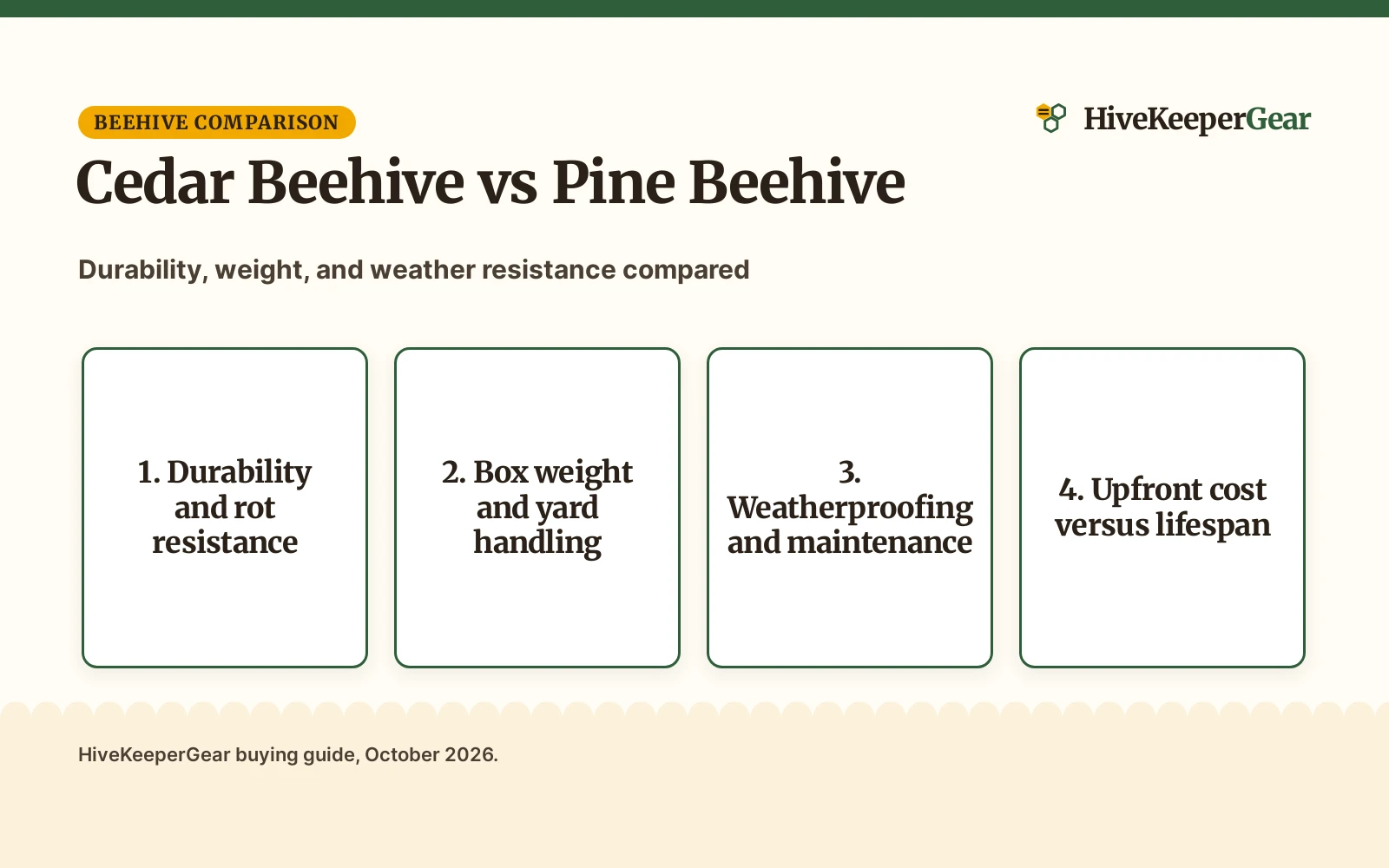
Cedar Beehive vs Pine Beehive: Which One Should You Buy?
A side-by-side comparison of cedar and pine beehives, weighing natural rot resistance, box weight, finish requirements, and long-term apiary durability.

On this page
Top picks at a glance
As an Amazon Associate I earn from qualifying purchases.
- 1
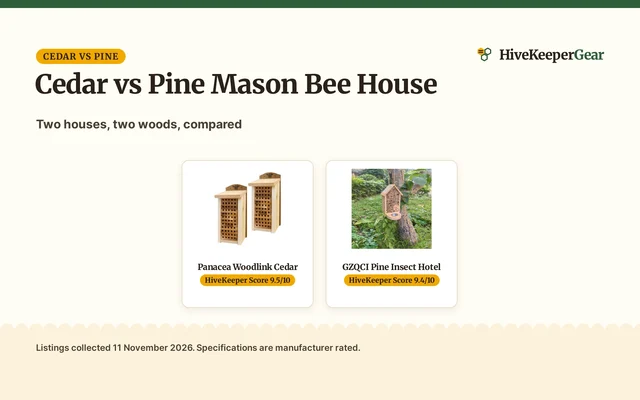
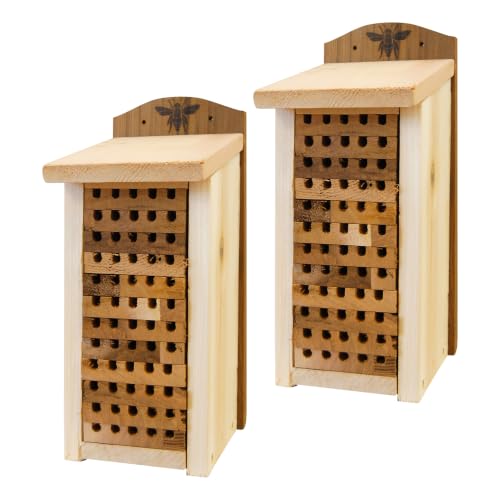 Woodlink Heavy Duty Cedar Mason Bee House9.5/10View on Amazon
- 2
 Wooden Insect Hotel9.4/10View on Amazon
- 3
 4Pcs Beehive Screened Bottom Board 10 Frame Thickened 100%View on Amazon
- 4
 3 Pcs Beehive Candy Board for Langstroth 10 Frame Bee HivesView on Amazon
In the debate of a cedar beehive vs pine beehive, cedar is the superior wood for weather resistance, natural rot protection, and lighter box weight, while pine is the economical, widely available choice that requires regular painting or wax dipping to endure outdoor conditions. Beekeepers must balance upfront cost against long-term box maintenance. For beekeepers seeking maximum durability with minimal upkeep, cedar excels without chemical sealants. For those setting up multiple colonies on a starter budget, pine offers dependable performance when protected by exterior paint or beeswax. Explaining how each timber handles moisture, seasonal temperature shifts, yard handling, and long-term apiary wear helps determine which option fits your yard.
Other hives and gear to compare
 4Pcs Beehive Screened Bottom Board 10 Frame Thickened 100%Check price on Amazon
 3 Pcs Beehive Candy Board for Langstroth 10 Frame Bee HivesCheck price on Amazon
HiveKeeperGear earns a commission when you buy through links on this site, at no extra cost to you. As an Amazon Associate I earn from qualifying purchases. Affiliate disclosure.
Before you buy: apiary climate and yard conditions
Before ordering hive components, consider your yard location and seasonal climate. Damp ground, high humidity, and winter snow subject wooden boxes to persistent moisture that challenges corner joints. Placing colonies on an elevated stand in full sun helps keep bottom boards dry regardless of wood species, while local beekeeping clubs can share how bare and painted boxes endure regional weather.
Cedar beehive vs pine beehive, compared side by side
| Evaluation factor | Cedar beehive | Pine beehive | Relevant guide |
|---|---|---|---|
| Durability and rot resistance | Natural oils repel insects and resist decay without chemical treatments | Softwood prone to fungal rot when exposed to damp ground and rain | 10-frame kits |
| Box weight and handling | Lighter timber reduces physical strain during colony inspections | Denser, heavier wood to lift when honey supers are full | Beginner hives |
| Exterior finishing | Can remain bare, weather naturally, or receive a natural beeswax dip | Requires primer and exterior paint or thorough wax dipping to prevent rot | Complete hive kits |
| Thermal properties | Natural wood grain provides modest thermal buffering across seasons | Standard softwood density providing baseline wooden hive insulation | Insulated vs wooden hives |
| Initial cost and availability | Higher upfront purchase price, reflecting premium timber availability | Widely produced standard with a lower entry purchase cost | Starter beehives |
| Component compatibility | Manufactured to standard Langstroth dimensions for interchangeable parts | Standard commercial dimensions compatible with all hive accessories | Beehive frames |
1. Durability and natural rot resistance
Durability in the bee yard depends on how well wood fibers resist moisture, fungal decay, and insects. Western red cedar produces natural organic thujaplicins and resins that shield heartwood from rot without chemical preservatives. In manufacturer specifications, ACORNS constructs its beehives from hand-selected, kiln-dried Western red cedar with precision dovetail joints, providing a 10-year warranty on its Flow Frame components and rating the cedar build for plant hardiness zones 3 through 10.
Pine timber, by contrast, lacks these protective compounds. Untreated pine absorbs moisture from persistent rain or ground contact, causing end grain to soften and joints to weaken. Without an intact barrier of exterior paint or beeswax, pine boards can cup and rot within several wet seasons. For damp apiaries, cedar provides built-in insurance against structural decay.
2. Box weight and yard handling
Routine inspections require lifting brood boxes and honey supers to examine brood comb and food stores. Cedar has a lower physical density than pine, resulting in lighter woodenware. Stated specifications reflect how box counts affect equipment weight: MayBee lists a package weight of 60.19 pounds for its three-box cedar kit with two deep boxes and one medium box, while TRINFREE lists an item weight of 65 pounds for its three-layer 10-frame cedar kit holding two deep boxes, one medium box, and 30 solid pine frames. ThxBees lists an item weight of 44 pounds for a smaller two-box kit with one deep box and one medium box.
Because drawn combs filled with honey and brood become heavy during a summer nectar flow, stacking lighter cedar supers reduces physical fatigue. Standard deep hive body dimensions show that with uniform box sizing, cedar’s lower wood density offers practical yard advantages.
3. Exterior finishing and weatherproofing
Exterior finish determines your maintenance workload. Because cedar naturally resists rot, beekeepers can leave cedar boxes unpainted, weathering over seasons into a silver-gray patina. Alternatively, cedar can be finished with oil or natural beeswax. Cedar manufacturers, including MayBee, TRINFREE, and MEDEHOO, submerge complete hive bodies in boiling natural beeswax, creating an even water-repellent shell that protects the grain.
Pine beehives cannot remain bare outdoors. Untreated pine absorbs rainwater, causing box corners to warp and fasteners to loosen. Pine requires exterior primer and light-colored latex paint, or complete hot wax dipping. Beekeepers using painted pine must inspect boxes annually for flaking and touch up exposed corners to stop moisture from penetrating the wood.
4. Thermal insulation and hive moisture
Honey bees regulate brood nest temperatures through seasonal clustering and fanning. In product listings, ACORNS states that its kiln-dried Western red cedar provides superior insulation compared to pine hives across plant hardiness zones 3 through 10. While both woods provide shelter, cedar’s grain structure offers mild thermal buffering against rapid outdoor shifts between daytime sun and cool nights.
Moisture management is equally critical. Because bees coat inner hive walls with propolis, and wax dipping seals wood pores, internal vapor does not escape through timber walls. Apiary ventilation governs humidity: choosing a screened vs solid bottom board allows airflow adjustments. MayBee specifies screened bottom boards are preferred for summer to maintain cooling air circulation, while solid boards or closed inserts help prevent chilling drafts in cold weather.
5. Upfront purchase cost versus longevity
Commercial operations rely heavily on pine equipment due to cost efficiency and manufacturing volume. Pine is economical to mill, making unassembled box kits substantially less expensive at checkout. When starting multiple colonies in a single season, choosing pine keeps startup expenses manageable while acquiring necessary tools and protective gear.
However, calculating total equipment cost extends beyond the initial purchase. Pine requires periodic investments of primer, paint, and labor to prevent decay. Cedar demands higher upfront capital, but its natural resilience allows boxes to endure outdoors with minimal upkeep. When ordering replacement equipment from our guide to the best bee hive box, hobbyists often find cedar’s longevity justifies its price.
A seasonal maintenance timeline
Early spring: scrape propolis and burr comb from rebates with a clean hive tool. Check painted pine for peeling paint around dovetails, touching up exposed wood once warm weather arrives. Late spring and summer: monitor hive ventilation as temperatures rise. Keep bottom board screens clear of debris so air circulates freely. Fall: prepare equipment for autumn rains and freezing conditions. Tilt hive stands forward so rainwater entering the entrance drains out rather than pooling on the bottom board. Winter: leave hives undisturbed during cold weather. Use workshop hours to assemble new boxes, paint spare pine supers, and prepare clean frames for spring buildup.
Nice to have in the bee yard
- An elevated metal hive stand, like the stand supplied with MEDEHOO cedar kits, keeping bottom boards off damp soil.
- A telescoping outer cover with a galvanized metal cap, featured on TRINFREE and ThxBees kits, shielding joints from rain.
- A reversible wooden entrance reducer to restrict cold drafts and assist defensive guarding.
- A screened bottom board, as on MayBee kits, for summer ventilation and debris monitoring.
- Spare frames with beeswax-coated foundation, like 10-frame deep and medium sizes, ready for spring swarms.
Pairing wooden boxes with dependable hardware ensures both cedar and pine provide reliable seasonal service.
What does not change between wood types
Choosing between cedar and pine changes durability and weight, but standard Langstroth box dimensions remain uniform. Manufacturer specifications from ThxBees list standard dimensions of 16-1/4 by 19-7/8 by 9-5/8 inches for deep boxes and 16-1/4 by 19-7/8 by 6-5/8 inches for medium supers. Because dimensions are standardized, cedar and pine components interchange seamlessly.
Beekeepers can place pine supers atop cedar brood bodies, sharing covers, excluders, and feeders. Makers like TRINFREE combine woods directly, supplying cedar box walls paired with 30 solid pine frames inside. Both timbers also use precision dovetail joints that lock together securely during assembly.
FAQs for beekeepers
Do cedar beehives need to be painted?
No. Cedar contains natural oils that resist rot and insects. Boxes can weather to a natural gray patina, or be purchased dipped in natural beeswax like MEDEHOO kits crafted from 100% natural cedarwood.
Why do pine beehives require paint or wax dipping?
Pine lacks natural rot-resistant resins and absorbs moisture rapidly. Without exterior primer and paint or hot beeswax dipping, pine panels can warp and decay outdoors.
Can I mix cedar boxes and pine boxes on the same hive?
Yes. Both woods share standard Langstroth dimensions, such as 16-1/4 by 19-7/8 inches for 10-frame equipment, allowing boxes and covers to interchange flush.
Is a cedar beehive lighter than a pine beehive?
Yes. Cedar has a lower density than pine, making boxes lighter to lift during routine inspections.
How long do cedar beehives last compared to pine?
Cedar hives endure for many seasons outdoors due to natural decay resistance. ACORNS notes its kiln-dried cedar is built for decades of use alongside a 10-year warranty on Flow Frame components, whereas pine requires regular repainting to match that lifespan.
More hive guides
Browse every guide by category: beehives, protective gear, hive tools and honey harvesting.
More picks: explore our guides to the best Langstroth beehive kit, best 8-frame beehive, and best beekeeping starter kit. New to beekeeping? Start with our checklist of beekeeping supplies for beginners.