Cordless vs Corded Bee Vacuum: Which One Should You Buy?
Compare cordless and corded bee vacuums across mobility, continuous runtime, suction control, and hive management to choose the right tool for your apiary.

On this page
Top picks at a glance
As an Amazon Associate I earn from qualifying purchases.
- 1
 VIVO Large Beekeeping Jacket with Zip-Off Veil Hood9.6/10View on Amazon
- 2
 Visidge Bee Watering Station9.6/10View on Amazon
- 3
 Aetwhy Beeswax Sheets9.6/10View on Amazon
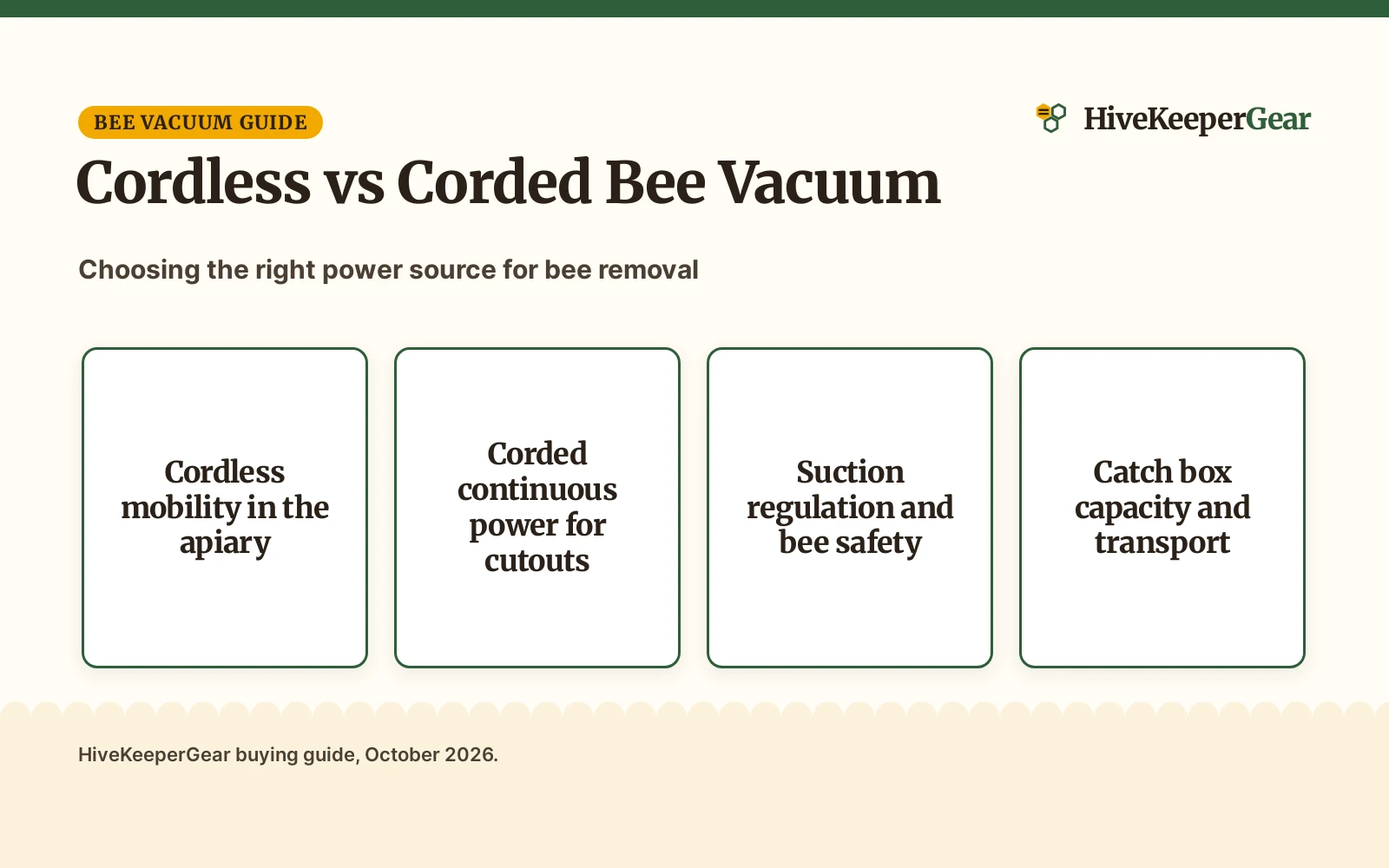
During spring swarm season or when answering a call for a colony trapped inside a structure, choosing between a cordless vs corded bee vacuum comes down to where you collect the bees and how long you need continuous suction. If you are catching swarms in high branches, across open fields, or in remote outyards without electrical outlets, a cordless bee vacuum is the practical choice because it gives you complete mobility. If you are performing long cutouts from house walls, soffits, or sheds with accessible power, a corded bee vacuum provides uninterrupted suction without worrying about depleted batteries. Each design serves distinct removal situations, and understanding how power delivery affects airflow, bee safety, and yard workflow helps you select the right setup.
HiveKeeperGear earns a commission when you buy through links on this site, at no extra cost to you. As an Amazon Associate I earn from qualifying purchases. Affiliate disclosure.
Before you buy: understand bee vacuum basics
A bee vacuum is not an ordinary workshop vacuum. Standard utility vacuums pull debris directly through high-speed impellers, which kills honey bees instantly. A dedicated bee vacuum routes incoming airflow through a bypass chamber or directly into a ventilated collection box before the vacuum motor. This arrangement creates gentle suction that draws worker bees, drones, and queens safely into a holding chamber without physical trauma.
Whether you choose a battery system or a plug-in unit, the primary goal remains identical: capturing live colonies safely so they can be relocated into a permanent hive. Suction strength must be strong enough to lift bees from comb or wall cavities, yet gentle enough to prevent them from slamming against walls or each other. Every vacuum setup relies on balance between airflow volume, collection chamber ventilation, and smooth internal hose surfaces.
The cordless vs corded bee vacuum comparison: at a glance
Choosing between cordless and corded power involves trade-offs between unrestricted movement and continuous operating time. The table below compares how both systems perform across key field conditions.
| Feature | Cordless bee vacuum | Corded bee vacuum | Which to choose |
|---|---|---|---|
| Power source | Rechargeable lithium battery pack | Standard electrical outlet or generator | Cordless for field work, corded for home structures |
| Mobility and reach | Unlimited range across apiaries, orchards, and ladders | Restricted by extension cord length and outlet location | Cordless whenever you must climb or walk far from power |
| Operating runtime | Finite duration per battery charge | Continuous runtime without interruptions | Corded for extended, multi-hour structural cutouts |
| Suction consistency | Airflow may taper slightly as battery voltage drops | Constant, steady suction throughout the extraction | Corded for predictable, steady airflow |
| Weight and balance | Heavier hand unit due to onboard battery mass | Lighter collection wand with stationary motor housing | Corded for reduced arm fatigue during prolonged work |
| Setup convenience | Rapid deployment with charged batteries and collection box | Requires running heavy-duty outdoor extension cords | Cordless for immediate response during sudden swarms |
Power source and operating runtime
The most fundamental difference between these systems is how they sustain electrical power during a job. Corded bee vacuums draw power from standard household outlets, making them the standard choice for structural removals where an outlet is readily accessible. When working inside an attic, garage, or crawlspace, a corded unit runs indefinitely without interruption. You can leave the motor running while you slowly expose comb, scrape propolis with your hive tools, and capture clustered bees at your own pace.
Cordless bee vacuums rely entirely on rechargeable battery packs. Operating runtime depends on motor draw and battery charge status. While modern lithium packs deliver substantial energy, suction motors consume significant power. When using a cordless system, carry spare fully charged batteries to avoid running out of power midway through an extraction. When planning to vacuum large swarms or complex colonies, managing battery swaps without disturbing the catch chamber requires careful preparation.
Mobility and apiary access
Mobility is where cordless bee vacuums excel. Honey bee swarms rarely settle in convenient locations next to electrical outlets. They land on tree limbs, fence posts, pasture brush, and outyard hives where running electrical cords is impractical or impossible. A cordless vacuum allows you to walk straight into an orchard or climb a ladder without managing cord weight or tripping hazards.
Corded vacuums, by contrast, tether the operator to an electrical source. In a residential yard, you may need linked extension cords to reach a back fence or garden shed. Long cords introduce voltage drops that can strain vacuum motors, and dragging cords through brush can snag equipment or agitate nearby hives. When operating in remote apiaries without grid power, a corded vacuum requires bringing a portable generator or a heavy power inverter, adding bulk and engine noise to what should be a calm capture process.
Suction control and bee safety
Regulating suction is vital to bee survival regardless of power source. Honey bees are delicate insects; excessive air velocity causes internal injuries or fatal impacts against the catch box mesh. Both corded and cordless designs should feature adjustable airflow valves, commonly called blast gates or bleeder vents, that allow the operator to bleed off excess vacuum pressure.
Corded vacuums typically generate higher peak suction than cordless models. While extra suction helps pull stubborn bees from deep crevices, it also increases the risk of bee mortality if the bleeder valve is closed too tightly. Cordless models generally operate at moderate airflow levels that are gentler on bees, though you must monitor suction as battery charge depletes. A drop in battery power can cause suction to fall below the threshold needed to dislodge clinging bees, leading to clogged vacuum hoses.
Catch box design and hive transfer
The vacuum power head is only part of the system; the catch box where bees collect is equally critical. Quality bee vacuums deposit bees directly into a ventilated wooden box or a modified hive body fitted with wire screen. Quality collection boxes allow ample airflow so bees do not overheat, as trapped bees generate substantial metabolic heat when agitated.
Certain systems allow you to vacuum bees directly into a standard nucleus hive box or a dedicated transport chamber. Once the vacuuming is complete, you simply remove the vacuum lid, insert standard Langstroth hive kits frames or top covers, and allow the colony to settle. Generic shop-vacuum conversion buckets often require pouring bees out into a hive, which can disorient the colony and damage the queen. Choose a vacuum configuration that minimizes post-capture bee handling.
Weight, handling, and operator fatigue
Holding a vacuum wand while perched on a ladder or working inside a tight wall cavity quickly reveals the ergonomic differences between setups. With corded vacuums, the heavy motor and collection chamber usually sit on the ground or a stable platform, connected to your hand via a flexible hose. Your hand supports only the lightweight wand, reducing arm fatigue during extended cutouts.
Cordless designs vary in weight distribution. Some models mount the motor and battery directly onto the collection box, allowing stationary floor placement similar to corded units. Other styles integrate the battery and motor into a handheld wand assembly. Handheld cordless units offer superb agility for reaching awkward angles, but the combined weight of the battery pack, motor, and collection cylinder can strain your wrist and shoulder during prolonged removal sessions.
Step-by-step bee removal workflow
Executing a successful live bee removal with either vacuum type follows a methodical sequence that protects both the operator and the bees:
- Gear up and inspect the site: Put on protective equipment including protective bee suits and durable beekeeping gloves before approaching the colony. Have your smoker lit and standby tools ready.
- Check your power supply: Verify that battery packs are fully charged for a cordless vacuum, or ensure heavy-duty outdoor extension cords are securely connected to a grounded outlet for a corded unit.
- Calibrate suction airflow: Turn on the vacuum and open the bleeder valve fully. Place your hand near the nozzle and slowly adjust the valve until suction is just strong enough to pull bees gently from a surface without snapping them against the hose.
- Vacuum clusters systematically: Work from the outer edges of the cluster toward the center. Vacuuming bees in calm, steady sweeps prevents panic and reduces defensive stinging behavior. Use a soft bee brush to sweep loose bees toward the suction nozzle when working on delicate surfaces.
- Locate and secure the queen: Watch carefully for the queen as the cluster thins. If spotted, guide her gently into the vacuum nozzle or capture her separately in a queen clip to ensure her safety.
- Provide shade and ventilation: Once capture is complete, shut down power immediately. Keep the ventilated catch box in a shaded, well-ventilated area to prevent heat buildup during transport to the apiary.
Essential accessories for your bee vacuum kit
A bee vacuum works best as part of an integrated removal kit. Complement your vacuum with gear designed to support colony recovery and hive installation:
- Catch box shade cloth: A breathable canvas wrap or light towel protects captured bees from direct sunlight and wind chill during transit.
- Swarm attractants: Setting out nearby bait boxes with swarm lures helps draw in foraging bees that return to the removal site after the main cluster is vacuumed.
- Smoker and fuel: A cool puff of smoke from reliable bee smokers helps steer bees toward the vacuum nozzle and masks alarm pheromones.
- Tool maintenance supplies: Propolis and honey residue accumulate rapidly inside hoses and catch boxes; review how to clean beekeeping tools to keep valves and screens clear after every removal.
What a bee vacuum cannot replace
While a bee vacuum is an invaluable tool for swarm collection and structural cutouts, it does not replace core beekeeping skills or foundational equipment. Vacuuming removes the adult bees, but in a structural cutout, you must still physically cut out wax combs, remove honey stores, and salvage brood comb to prevent future pest infestations and hive rot.
Furthermore, captured bees must be hived promptly into functional apiary equipment. You will need ready hive bodies, bottom boards, frames, and feeders to give the vacuumed colony the resources it needs to rebuild. Keepers should ensure they have their fundamental gear assembled from our beekeeping supplies for beginners checklist before undertaking live removals.
FAQs for beekeepers
Does a bee vacuum hurt or kill the bees?
A properly designed bee vacuum does not harm bees because airflow is moderated through a bleeder valve and bees land in a screened catch box before reaching the motor. Standard shop vacuums without bypass boxes will kill bees due to high impeller speed and violent impact.
How long does a cordless bee vacuum battery last during a removal?
Runtime varies depending on motor suction demand and battery capacity, but battery power eventually depletes during continuous use. Experienced operators always keep spare charged replacement battery packs on hand to swap out without pausing work.
Can I run a corded bee vacuum using a portable generator in an apiary?
A portable generator can power a corded bee vacuum in remote yards where wall outlets are unavailable. However, the generator adds significant noise, exhaust, and heavy transport equipment compared to a lightweight cordless setup.
What should I do with bees immediately after vacuuming them?
Move the ventilated catch box into a shaded, cool spot right away to prevent heat stress and suffocation. Transfer the bees into a prepared hive with comb and feed as soon as possible so they can reorganize.
Can I build my own bee vacuum catch box for a shop vacuum?
Many beekeepers build custom wooden catch boxes that sit between a shop vacuum hose and a collection chamber with an adjustable bleeder valve. The key requirement is ensuring the vacuum suction draws air through the box rather than pulling bees through the vacuum motor itself.
More hive guides
Browse every guide by category: hive tools, protective gear, beehives and honey harvesting.
More guides: Compare hive tools, review bee smokers, or read our beekeeping supplies for beginners checklist.