Deep vs Medium Hive Boxes: Which One Should You Buy?
A comparison of deep vs medium hive boxes for brood rearing and honey storage, covering box depths, frame sizing, lifting weight, and apiary standardization.

On this page
Top picks at a glance
As an Amazon Associate I earn from qualifying purchases.
- 1
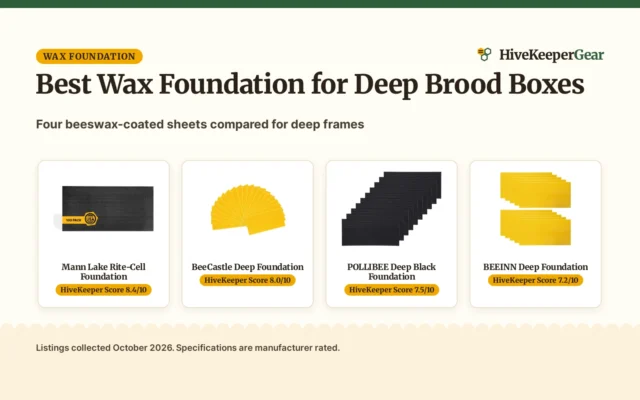
 BeeCastle Heavy Wax Coated Langstroth Unassembled Deep/Brood9.6/10View on Amazon
- 2
 POLLIBEE 10 Frame Beehive BoxView on Amazon
- 3
 Honey Lake 8 Frame Beehive Deep Brood BoxView on Amazon
- 4
 LANGNSTROTH DEEP Box Size for 10 Frame Standar LANGSTROTHView on Amazon
- 5
 10 Frame Deep Brood Beehive Box Wax Coated Bee Hives IncludesView on Amazon
- 6
 8 Frame Deep Brood Bee Hive BoxView on Amazon
- 7
 10 Frame Deep Brood Box Langstroth Bee Hive Box Dipped inView on Amazon
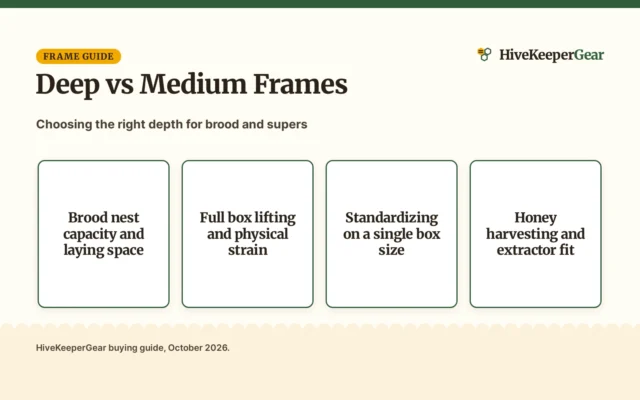
During spring inspections when colonies expand across the brood nest, choosing between deep vs medium hive boxes comes down to lifting weight versus frame interchangeability: buy deep boxes if you want a traditional two-deep brood chamber with maximum unbroken laying space for the queen, or choose medium boxes if you need lighter lifting during inspections or want one frame size across your entire apiary.
Other hives and gear to compare
 POLLIBEE 10 Frame Beehive BoxCheck price on Amazon
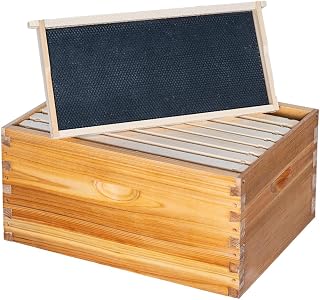 Honey Lake 8 Frame Beehive Deep Brood BoxCheck price on Amazon
 LANGNSTROTH DEEP Box Size for 10 Frame Standar LANGSTROTHCheck price on Amazon
 10 Frame Deep Brood Beehive Box Wax Coated Bee Hives IncludesCheck price on Amazon
 8 Frame Deep Brood Bee Hive BoxCheck price on Amazon
 10 Frame Deep Brood Box Langstroth Bee Hive Box Dipped inCheck price on Amazon
HiveKeeperGear earns a commission when you buy through links on this site, at no extra cost to you. As an Amazon Associate I earn from qualifying purchases. Affiliate disclosure.
Before you choose: understanding hive box depths
Every Langstroth beehive is built from modular wooden boxes that stack vertically on top of a bottom board. In a standard setup, beekeepers separate the hive into two functional zones: the lower boxes form the brood chamber where the queen lays eggs and workers raise young bees, while the upper boxes serve as honey supers where colonies store surplus honey. The dimensions of these boxes dictate both colony management and the physical effort required during yard visits.
While hive equipment shares the same standard outer footprint for a given width, box depth varies significantly. A deep box provides the largest single volume in the Langstroth system, making it the standard choice for brood rearing. A medium box, originally designed as an intermediate honey super, offers a shallower profile that holds less weight when filled. Understanding how these two depths function in the yard helps you choose equipment that matches your physical capabilities and management goals.
Understanding deep vs medium hive boxes: specifications and sizing
| Specification | Deep Hive Box | Medium Hive Box | Our guide |
|---|---|---|---|
| 10-frame box dimensions | 19-7/8 by 16 by 9-5/8 inches | 19-7/8 by 16 by 6-5/8 inches | 10-frame hive dimensions |
| 8-frame box dimensions | 14 by 19-7/8 by 9-5/8 inches | 14 by 19-7/8 by 6-5/8 inches | 8-frame hive dimensions |
| Primary apiary role | Brood nest chamber | Honey super or all-medium brood | Medium frames guide |
| Empty box weight | POLLIBEE lists 16.96 pounds | Lighter box weight (not stated) | Hive box guide |
| Frame capacity options | 10 frames or 8 frames | 10 frames or 8 frames | Deep frames guide |
1. Box dimensions and frame capacity
Langstroth hive boxes are manufactured to precise outer dimensions so that components from different makers align on the hive stand. Manufacturer listings reflect these standard dimensions clearly. For 10-frame equipment, POLLIBEE lists deep brood boxes measuring 19-7/8 by 16 by 9-5/8 inches, and BeeCastle lists a deep brood box measuring 16-1/4 by 19-7/8 by 9-5/8 inches. Walsport also lists a 10-frame deep box measuring 19-7/8 by 16 by 9-5/8 inches. In contrast, medium super boxes measure 19-7/8 by 16 by 6-5/8 inches in POLLIBEE specifications, creating a noticeably shallower box.
For narrower 8-frame equipment, MayBee lists deep brood boxes measuring 14 by 19-7/8 by 9-5/8 inches and medium super boxes measuring 14 by 19-7/8 by 6-5/8 inches. Honey Lake lists an 8-frame deep box measuring 19.88 by 14 by 9.56 inches. Frame capacity corresponds directly to box width: 10-frame boxes hold 10 frames, while 8-frame boxes hold 8 frames. For internal comb space, BeeCastle lists deep wooden frames measuring 9-1/8 by 19 by 1-3/8 inches with plastic foundation sheets measuring 8-1/2 by 16-3/4 by 3/16 inches. Complete starter bundles reflect these ratios: POLLIBEE supplies 20 deep frames and 20 medium frames with its 4 layer kit, while MayBee provides 16 deep frames and 16 medium frames for its 8-frame setup. Learn more about complete kits in our 10-frame Langstroth kits and 8-frame beehive kits guides.
2. Lifting weight and apiary ergonomics
The single most important practical factor when comparing deep and medium boxes is lifting weight. Hive inspections require beekeepers to lift upper boxes off the stack to examine the brood nest below. Even empty equipment carries noticeable mass. Listing specifications show that an empty POLLIBEE 10-frame cedar deep box with wooden frames and waxed foundation weighs 16.96 pounds. Walsport lists a single 10-frame cedar deep box at 16.65 pounds, while Honey Lake lists an empty 8-frame deep box at 13.9 pounds. Complete unassembled multi-box sets demonstrate the overall timber weight: MayBee lists a kit containing 1 deep box and 1 medium box at 45.3 pounds, a kit containing 2 deep boxes and 1 medium box at 60.19 pounds, and an 8-frame kit with 2 deep boxes and 2 medium boxes at 49 pounds.
When boxes are filled with drawn comb, honey, pollen, and brood, the weight increases dramatically. Although manufacturers do not publish full honey weights in their listings, the physical depth difference dictates the total mass. Because a deep box is 9-5/8 inches tall compared to 6-5/8 inches for a medium box, a deep box holds significantly more comb volume and honey. Lifting a fully loaded deep box off a hive puts severe leverage on the lower back and forearms. For beekeepers managing hives alone or those seeking to protect their backs, medium boxes offer a noticeably lighter lift during routine yard work.
3. Brood nest management and wintering
Brood rearing patterns differ between deep and medium equipment. The traditional North American hive configuration uses 2 deep boxes for the brood nest. A deep frame provides an expansive, contiguous sheet of wax foundation. Queen bees prefer laying in broad, circular patterns, and the generous vertical span of a deep frame allows the queen to lay hundreds of eggs without interruption. Beekeepers inspecting a two-deep brood chamber need to handle fewer total frames to evaluate laying patterns, queen health, and brood viability.
Managing a brood nest in medium boxes requires a different approach. Because medium boxes are shallower, a colony typically requires additional vertical volume, where beekeepers stack multiple medium boxes to equal the brood comb area of 2 deep boxes. This configuration introduces wooden top bars, bottom bars, and bee space gaps across multiple levels, creating horizontal breaks in the comb. During cold winter months, bees cluster tightly together and move upward toward honey stores. In some climates, large breaks between boxes can influence cluster movement, whereas deep frames offer uninterrupted comb. Beekeepers interested in alternative frame configurations can read our guide to types of bee hive frames.
4. Standardizing on a single frame size
One of the strongest arguments for choosing medium boxes is equipment standardization. In a mixed apiary that uses deep boxes for brood and medium boxes for honey supers, frames are not interchangeable. A deep frame cannot fit inside a medium super, and placing a medium frame in a deep box results in bees drawing unwanted comb beneath the bottom bar. Beekeepers must purchase, assemble, and store distinct sizes of wooden frames and foundation sheets.
In an all-medium apiary, every box and every frame across all your hives shares the exact same 6-5/8 inch depth. This interchangeability simplifies hive management immensely. If a colony needs emergency feed in early spring, you can move a frame of capped honey from a honey super directly into the brood nest. When making colony splits or managing swarms, any frame fits into any box. Furthermore, honey extractors and uncapping tanks only need to accommodate a single frame height, reducing equipment complexity in the honey house.
5. Honey supers and harvesting
While deep boxes excel at providing large brood comb, they are rarely used as honey supers in modern apiaries. Honey is dense, and a deep box packed with capped honey becomes unwieldy to lift down from chest height. Stacking deep supers several boxes high on top of a vigorous colony creates an unstable, heavy tower that is difficult to manipulate during summer flows.
Medium boxes represent the industry standard for honey supers. They sit above queen excluders, allowing worker bees to store clean surplus honey away from the brood nest. Their 6-5/8 inch height makes them far easier to carry from the apiary to the honey house for extraction. For beekeepers comparing honey storage options, our article on honey super vs medium boxes and our review of medium frames for honey supers cover frame choices in detail.
A seasonal management timeline
Spring buildup: Inspect the lower boxes as soon as temperatures permit. In a two-deep brood setup, inspect brood patterns across the 2 boxes and reverse box positions if the colony has clustered exclusively in the upper box. In an all-medium setup, inspect across the brood boxes and ensure the queen has room to lay.
Summer nectar flow: Add medium supers above a queen excluder as the colony fills frames with nectar. Monitor supers weekly and add additional medium boxes on top before existing comb is completely filled and capped.
Fall preparation: Assess food stores before cold weather arrives. Ensure colonies have sufficient capped honey in the brood boxes. Remove empty supers, consolidate boxes, and install entrance reducers to protect against cold winds.
Winter clustering: Leave the hive closed during cold periods to conserve warmth. The winter cluster moves slowly across the comb, consuming honey stores. Avoid breaking box seals with hive tools on cold days.
Nice to have in the bee yard
- A sturdy hive stand to keep bottom boards off damp ground and level your box stack.
- A frame perch or frame rest that hangs on the outside of a box to hold frames safely during inspections.
- Spare medium boxes and assembled frames ready on short notice for spring splits or swarm catching.
- A queen excluder to keep brood out of upper honey supers.
- An apiary notebook to record queen laying patterns, box configurations, and seasonal colony progress.
Keeping clear notes during every inspection helps you track colony growth and determine whether your box configurations are meeting your physical needs in the bee yard.
What this comparison does not cover
This guide compares standard Langstroth box depths and wooden hive dimensions. We do not provide health, medical, or colony treatment advice, nor do we advise on treatments for hive pests or diseases. For questions regarding colony health or seasonal disease management, consult your local beekeeping association or state apiary inspection office.
FAQs for beekeepers
Can you mix deep and medium boxes on the same hive?
Yes. The most common Langstroth setup combines 2 deep boxes for the brood nest with medium boxes stacked above as honey supers. As long as the box width matches, such as 10-frame or 8-frame, deep and medium boxes stack together securely.
Can I use medium boxes for the brood chamber?
Yes. Many beekeepers run an all-medium apiary where 3 medium boxes serve as the brood nest. This system keeps individual box lifting weights manageable and allows complete frame interchangeability across all hive components.
How tall are deep and medium hive boxes?
Manufacturer specifications show that a standard 10-frame deep box measures 9-5/8 inches in height, while a medium box measures 6-5/8 inches in height. For 8-frame equipment, MayBee lists deep boxes at 9-5/8 inches tall and medium boxes at 6-5/8 inches tall.
Why are deep boxes rarely used for honey supers?
Honey is dense and heavy, making a deep box full of capped honey difficult to lift down from a tall hive stack. Medium boxes hold less honey volume per box, making harvesting and transport significantly easier on the beekeeper.
How much do empty hive boxes weigh?
Empty box weight varies by maker and timber. POLLIBEE lists an empty 10-frame cedar deep box with frames at 16.96 pounds, while walsport lists a cedar deep box at 16.65 pounds, and Honey Lake lists an 8-frame cedar deep box at 13.9 pounds.
More hive guides
Browse every guide by category: beehives, protective gear, hive tools and honey harvesting.
More hive guides: explore our 10-frame Langstroth kits, 8-frame beehive kits, and deep brood frames. New to beekeeping? Start with our beekeeping supplies for beginners checklist.