Deerhide vs Goatskin Beekeeping Gloves: Which One Should You Buy?
How deerhide and goatskin beekeeping gloves differ in feel, dexterity and protection, plus what sleeves, fit and care to look for.

On this page
Top picks at a glance
As an Amazon Associate I earn from qualifying purchases.
- 1
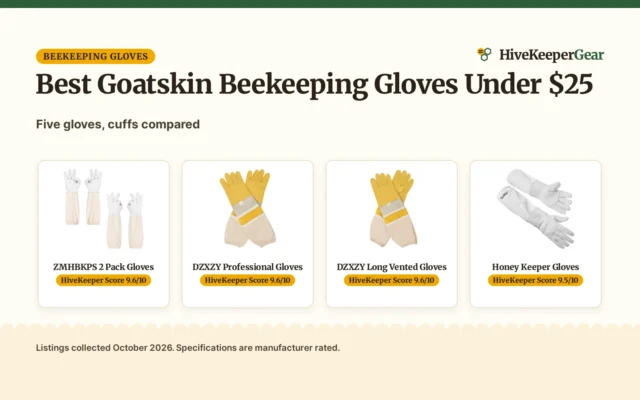
 DZXZY Professional Beekeeping Gloves Hornets Premium Goatskin9.6/10View on Amazon
- 2
 DZXZY Goatskin Beekeeping Gloves with Long Canvas Vented9.6/10View on Amazon
- 3
 Honey Keeper Beekeeping Gloves9.5/10View on Amazon
- 4
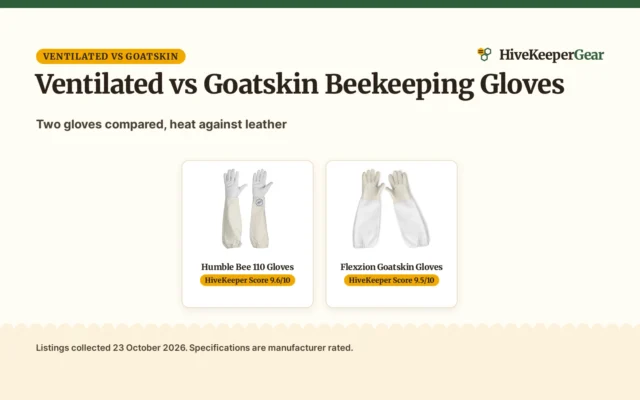
 Humble Bee 110 Goatskin Beekeeping Gloves with ExtendedView on Amazon
- 5
 Heavy Duty Beekeeping GlovesView on Amazon
- 6Honey Keeper Beekeeping GlovesView on Amazon
- 7
 Goatskin Beekeeping GlovesView on Amazon
- 8
 Beekeeping Gloves with Goat Skin Leather Palm and 3-LayerView on Amazon
- 9
 Goatskin Leather Bee Gloves for Men & Women with Vented MeshView on Amazon
On a spring inspection, prying the first frames of the season, the gloves on your hands decide whether you feel the frame or fight it. Deerhide vs goatskin beekeeping gloves is really a question of feel against availability: goatskin is the standard leather in beekeeping gloves, thin and pliable with good dexterity, while deerhide is softer and stretchier but rare in bee-specific gloves. Either way, most beekeeping gloves pair leather hands with long canvas sleeves and elastic cuffs.
Other hives and gear to compare
 Humble Bee 110 Goatskin Beekeeping Gloves with ExtendedCheck price on Amazon
 Heavy Duty Beekeeping GlovesCheck price on Amazon
 Honey Keeper Beekeeping GlovesCheck price on Amazon
 Goatskin Beekeeping GlovesCheck price on Amazon
 Beekeeping Gloves with Goat Skin Leather Palm and 3-LayerCheck price on Amazon
 Goatskin Leather Bee Gloves for Men & Women with Vented MeshCheck price on Amazon
HiveKeeperGear earns a commission when you buy through links on this site, at no extra cost to you. As an Amazon Associate I earn from qualifying purchases. Affiliate disclosure.
Deerhide vs goatskin beekeeping gloves at a glance
| Aspect | Deerhide | Goatskin |
|---|---|---|
| Feel | Soft and stretchy | Thin and pliable |
| Dexterity | Good, where bee-specific pairs exist | Good; the standard for frame work |
| Availability in bee gloves | Rare | Common |
| Typical pairing | Long sleeves (assumed; no deerhide bee listings to cite) | Long canvas sleeves and elastic cuffs |
| Care | Hand wash (typical for leather) | Hand wash, per the listings |
The practical upshot: most keepers choose between goatskin gloves, because deerhide bee gloves are hard to find. The differences that matter day to day are in the cut, the sleeve and the fit, not the hide.
The leather: feel and dexterity
Goatskin is the leather you will meet most often in beekeeping gloves: thin, pliable and close-fitting enough to lift frames without fumbling. Deerhide is softer and stretchier to the touch, which sounds ideal for delicate work, but it is rare in gloves made for bee work, so finding a bee-specific deerhide pair takes more hunting. If dexterity is your priority, look at the glove’s cut and palm rather than the hide name: a slim, close-fitting goatskin glove is likelier to handle frames better than a roomy deerhide one.
Sleeves, cuffs and coverage
Whichever leather covers the hands, the sleeve does the forearm work. Look for long canvas sleeves with elastic or extended cuffs that keep the glove sealed at the wrist; most goatskin listings pair leather hands with this layout. For a concrete sense of length, the Honey Keeper listing gives item dimensions of 0.25 x 0.25 x 19 inches, and the Apis Tactical listing describes a 3/4 sleeve. The Honey Keeper gloves’ ventilated canvas sleeve is the listings’ summer-heat option.
Fit: how to read the size
Gloves that swim on your hands make frame work clumsy. The Apis Tactical listing publishes a hand-width chart: X-Small fits 7 to 7.3 inches, Small 7.3 to 7.5, Medium 7.8 to 8, Large 8.3 to 8.5, XL 8.8 to 9, XXL 9.3 to 9.5 and 3XL 9.8. Measure across your knuckles and match the chart where a listing gives one. Where no chart is given, the listed size still helps: the Forest Beekeeping Supply gloves come in XS and XXS, the Humble Bee 110 in Small and the Honey Keeper in X-Large. Ambidextrous hands, stated on several listings, mean either glove fits either hand.
Care and wear
Leather bee gloves are hand wash only, per the care instructions on the listings, and they are not water resistant. Let them dry away from direct heat. Propolis and hive grime stain the leather over time; that is cosmetic and does not change the fit. Check the elastic cuffs each season, since a stretched cuff can let bees in at the wrist.
Buying by the numbers: weight, warranty and fit
When the leather choice is settled, the numbers separate the listings. Start with weight: the Honey Keeper states 5.28 ounces, the Humble Bee 110 states 6.4 ounces, and the Forest 2X-Small lists 0.1 kg. The gap between the lightest and heaviest stated pair here is about an ounce, which does not sound like much until the third hive of the afternoon. When two gloves look alike, the stated weight is a fair tiebreaker.
Next, warranty. Only two listings state a term: the Humble Bee 110 with a 2 Year Manufacturer warranty and the Honey Keeper with a 90 Day Limited Manufacturer Warranty. The rest point to the manufacturer for warranty information or state nothing at all. Gloves are consumables: propolis, sweat and sun wear them out. A stated term is a small but real point in a listing’s favor, and its absence is a reason to check the seller’s policy before ordering.
Fit type matters as much as size. The listings show regular (Forest XS, Humble Bee 110, Honey Keeper), slim (Forest XXS, Apis Tactical) and a children’s fit (the Forest children’s glove in Large). Slim suits close work, regular suits most hands, and the children’s fit is cut for young beekeepers rather than simply scaled down. Most listings also state ambidextrous hands, meaning either glove fits either hand, which stretches a pair’s life when one side wears first.
Finally, closures and bundles. Closure types in the listings are elastic (Forest), pull-on (Humble Bee 110, Honey Keeper) and snap (the HunterBee set). Elastic and pull-on seal the wrist without hardware, while a snap closure adds adjustability. The HunterBee listing bundles a bee hat with net and XL gloves in one set, which is worth knowing if the veil needs replacing at the same time as the gloves.
FAQs for beekeepers
Which leather is better for a beginner?
Goatskin, because it is what most beekeeping gloves are made of: thin, pliable and easy to find in long-sleeve bee-specific designs. Start with a standard goatskin pair and judge feel from there. Our best goatskin beekeeping gloves for beginners compares first pairs.
Do beekeeping gloves stop stings?
No glove stops every sting. Leather hands with long sleeves and snug cuffs reduce how often bees reach skin, but calm, slow movements matter as much as the glove.
How should beekeeping gloves fit?
Snug at the fingers with room to close your hand around a frame. The Apis Tactical listing’s hand-width chart runs from 7 to 7.3 inches for X-Small up to 9.8 for 3XL; measure across your knuckles and match it. For delicate work, see best goatskin beekeeping gloves for dexterity.
How do I clean them?
Hand wash only, per the care instructions on the listings, and let them dry away from direct heat. The listings also state the gloves are not water resistant.
What warranties do listings state?
The Humble Bee 110 listing states a 2 Year Manufacturer warranty and the Honey Keeper listing states a 90 Day Limited Manufacturer Warranty. Other listings point to the manufacturer for warranty information.
More hive guides
For the other leather debates, read goatskin vs sheepskin beekeeping gloves and leather vs nitrile beekeeping gloves. For hot-weather picks, see best ventilated beekeeping gloves for summer.