How to Clean Hummingbird Feeder
Empty the old nectar, scrub the bottle and the ports with a brush that fits, rinse well, and let every part dry before refilling the feeder.

On this page
Top picks at a glance
As an Amazon Associate I earn from qualifying purchases.
- 1
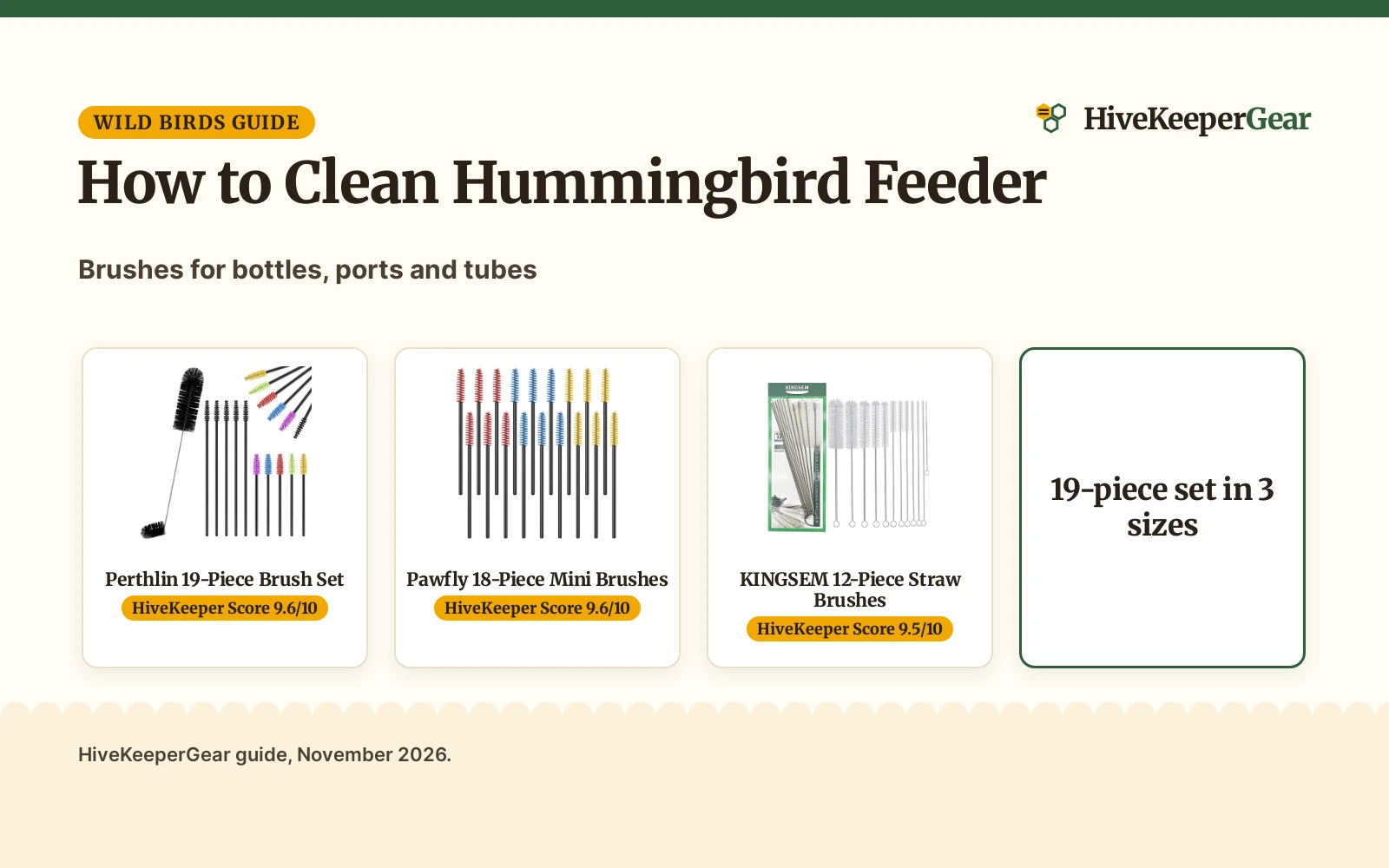
 Perthlin 19-Piece Brush Set9.6/10View on Amazon
- 2
 Pawfly 18-Piece Mini Brushes9.6/10View on Amazon
- 3
 KINGSEM 12-Piece Straw Brushes9.5/10View on Amazon
This guide covers how to clean hummingbird feeder. How to clean a hummingbird feeder starts with a feeder that has gone cloudy or shows dark specks in the ports: empty the old nectar, scrub the bottle and the ports, rinse well, and let every part dry before refilling. The brushes in this guide reach into bottles, ports and tubes that a cloth cannot reach, and each one handles a different part of the job.
HiveKeeperGear earns a commission when you buy through links on this site, at no extra cost to you. As an Amazon Associate I earn from qualifying purchases. Affiliate disclosure.
| # | Product | HiveKeeper Score | Buy |
|---|---|---|---|
| 1 | Perthlin 19-Piece Brush Set | 9.6/10 | Buy on Amazon |
| 2 | Pawfly 18-Piece Mini Brushes | 9.6/10 | Buy on Amazon |
| 3 | KINGSEM 12-Piece Straw Brushes | 9.5/10 | Buy on Amazon |
Perthlin 19-Piece Brush Set
A 19-piece set of nylon hummingbird feeder cleaning brushes in 3 sizes, with a double-headed large brush and stainless steel and plastic handles.
Pros
- 19 pieces in 3 sizes: 7.8, 6.7 and 3.9 inch brushes
- Large brush is double-headed, with a head for the bottle and a smaller head for the holder
- Nylon bristles, with a stainless steel handle on the large brush
- Reaches small corners that are hard to reach, plus water cups and bottles
Cons
- No warranty term is stated
- Small and medium brush handles are plastic, not stainless steel
- No brush head diameter is stated
- Black color only; no other color is stated
Pawfly 18-Piece Mini Brushes
An 18-piece set of mini nylon hummingbird feeder brushes in 3 colors, with a 0.3 inch brush head for narrow nectar ports.
Pros
- 0.3 inch brush head slips into narrow nectar ports and tight feeding slots
- Flexible wire core bends through curved feeder parts
- Nylon bristles handle tough stains without shedding
- 18 brushes in 3 colors keep cleaning tasks color-coded
Cons
- No warranty term is stated
- One size only: 3.9 inch length, with no larger brush stated
- No handle material is stated apart from the flexible wire core
- No brush count per color is stated
KINGSEM 12-Piece Straw Brushes
A 12-piece straw cleaner brush kit in food grade 304 stainless steel and nylon, with bristle diameters from 2 mm to 25 mm for tubes, straws and feeder parts.
Pros
- Food grade 304 stainless steel and nylon bristles
- Bristle diameters from 2 mm to 25 mm cover straws and narrow tubes
- Bristle lengths of 6.5, 9.5 and 10 inches reach long tubes
- Detachable hanging ring for storage
Cons
- No warranty term is stated
- Made for straws first; hummingbird feeders are a secondary use
- No count per bristle length is stated
- No feeder-specific head shape is stated; the brushes are straw brushes
As an Amazon Associate I earn from qualifying purchases.
How to clean a hummingbird feeder: the short answer
Empty the feeder and take it apart, then scrub the bottle with a large brush and the ports with a small one. The Perthlin set covers the bottle and the holder with a double-headed large brush, while the Pawfly mini brushes (on Amazon) fit the narrow ports. Rinse every part under running water, let the feeder dry, and refill with fresh nectar. The KINGSEM straw brushes (on Amazon) reach long tubes and narrow feeder parts that the shorter brushes cannot reach.
Brushes for the job: how to clean hummingbird feeder
Scrubbing the bottle, the ports and the tubes takes a brush that fits each part, so here are the 3 brush sets from the listings, ranked by HiveKeeper Score.
Brush sets compared
The sets differ in piece count, sizes and handles, so match the brush to the part that needs scrubbing.
| Brush set | Pieces | Sizes | Handles |
|---|---|---|---|
| Perthlin 19-Piece Brush Set | 19 | 7.8, 6.7 and 3.9 in | Stainless steel and plastic |
| Pawfly 18-Piece Mini Brushes | 18 | 3.9 in, 0.3 in head | Flexible wire core |
| KINGSEM 12-Piece Straw Brushes | 12 | 2 to 25 mm, 6.5 to 10 in | 304 stainless steel |
Step 1: empty and take the feeder apart
Pour out the old nectar and take the feeder apart so every part can be scrubbed on its own. Hold the bottle up to the light and look inside the ports for residue that needs a brush. A feeder that comes apart gives the brushes room to reach the base, the ports and the tube.
Step 2: scrub the bottle, ports and tubes
Scrub the bottle with the large brush and the ports with a small one. The Perthlin large brush is double-headed, with one head for the nectar bottle and a smaller head for the nectar bottle holder, and its 6 medium brushes at 6.7 inches and 12 small brushes at 3.9 inches cover the rest of the feeder. The Pawfly mini brushes, at 3.9 inches with a 0.3 inch head, slip into narrow nectar ports and tight feeding slots, and the flexible wire core bends through curved feeder parts. The KINGSEM straw brushes, with bristle diameters from 2 mm to 25 mm and lengths of 6.5, 9.5 and 10 inches, reach long tubes and narrow feeder parts.
Step 3: rinse and dry
Rinse every part under running water and let the feeder dry before refilling. The Pawfly brushes rinse clean under running water, and their smooth, non-porous surface keeps residue from building up on the bristles. The KINGSEM brushes wash clean after use, per the listing. Dry parts keep stale nectar and residue from sitting in the feeder.
Step 4: refill and hang
Refill the feeder with fresh nectar and hang it where it can be watched. A clean feeder with fresh nectar draws hummingbirds back, and a feeder that stays clean between refills needs less scrubbing at the next cleaning. Keep spare brushes on hand: the Perthlin set holds 19 pieces and the Pawfly set holds 18, so a worn brush can be replaced from the pack.
FAQs for beekeepers
What brush size fits a hummingbird feeder port?
The Pawfly mini brushes fit narrow nectar ports, at 3.9 inches long with a 0.3 inch brush head. The Perthlin small brushes are also 3.9 inches long, but no brush head diameter is stated for them. Match the brush head to the port: a head that is too wide cannot enter the port.
Can one brush clean the bottle and the ports?
The Perthlin large brush is double-headed, with one head for the nectar bottle and a smaller head for the nectar bottle holder. For the ports, use a Pawfly mini brush. A brush that fits the bottle rarely fits the ports, since the bottle and the ports need different head sizes.
Do these brushes work on straws and bottles too?
The KINGSEM set is made for straws and tubes, with bristle diameters from 2 mm to 25 mm, and the Perthlin brushes also clean water cups and bottles. The Pawfly brushes suit detail work on jewelry, watches and craft supplies, per their listings.
How do I clean the brushes after use?
Rinse the Pawfly brushes under running water; their smooth, non-porous surface keeps residue from building up. The KINGSEM brushes wash clean after use, per the listing. Let the brushes dry before storing them, and replace a worn brush from the pack.
What are the brushes made of?
The bristles are nylon on all 3 sets. The Perthlin large brush handle is stainless steel, and its small and medium brush handles are plastic. The KINGSEM brushes use food grade 304 stainless steel with nylon bristles, and the Pawfly brushes have a flexible wire core.
More hive guides
Browse every guide by category: beekeeping tools and hummingbird feeders, or see our how to clean a wooden honey dipper guide.