Langstroth Hive Alternative: Which One Should You Buy?
Explore practical Langstroth hive alternative choices, including horizontal top bar hives, Warre hives, and lighter 8-frame setups for your apiary.

On this page
Top picks at a glance
As an Amazon Associate I earn from qualifying purchases.
- 1
 BeeCastle 10 Frame Langstroth Bee Hive Coated with Beeswax9.7/10View on Amazon
- 2
 BeeCastle 8 Frame Langstroth Bee Hive Coated with Beeswax9.6/10View on Amazon
- 3
 BobbleT Winter Bee Hive Insulation Wrap9.6/10View on Amazon
During a midsummer hive inspection when lifting heavy boxes strains your back, finding a practical langstroth hive alternative is a natural next step. Popular alternatives to a standard 10-frame Langstroth hive include the horizontal top bar hive, the compact Warre hive, and the lighter 8-frame Langstroth hive. While horizontal designs eliminate lifting stacked boxes entirely, modular alternatives like 8-frame Langstroth and compact Warre hives reduce the weight of individual boxes. This guide explains each hive style step by step to help you decide which setup fits your backyard apiary.
HiveKeeperGear earns a commission when you buy through links on this site, at no extra cost to you. As an Amazon Associate I earn from qualifying purchases. Affiliate disclosure.
Before you choose: check apiary goals
Before switching hive styles, consider your physical preferences and beekeeping goals. Keepers seeking gentle comb handling without heavy lifting often prefer horizontal hives. Those who want high honey output and interchangeable gear usually stay with standard frame dimensions. Local bee clubs also share equipment such as extractors, which work primarily with standard frames. Remember that 8-frame and 10-frame boxes have different outer dimensions and do not interchange, though both use standard frame lengths. Assessing your lifting comfort and apiary goals helps clarify which design fits your routine.
Every practical langstroth hive alternative, compared
| Option | Hive style | Main advantage | Our guide |
|---|---|---|---|
| 1 | Horizontal Top Bar Hive | Single-level trough with no heavy lifting | Top bar bee hive |
| 2 | Warre Hive | Vertical cavity expansion with natural comb | Beehives |
| 3 | 8-Frame Langstroth Hive | Lighter box weight using standard frames | 8-frame beehive kits |
| 4 | Long Langstroth Hive | Horizontal layout accepting conventional frames | Langstroth hives |
| 5 | Standard 10-Frame Langstroth Hive | Maximum compatibility and wide gear selection | Langstroth beehive kits |
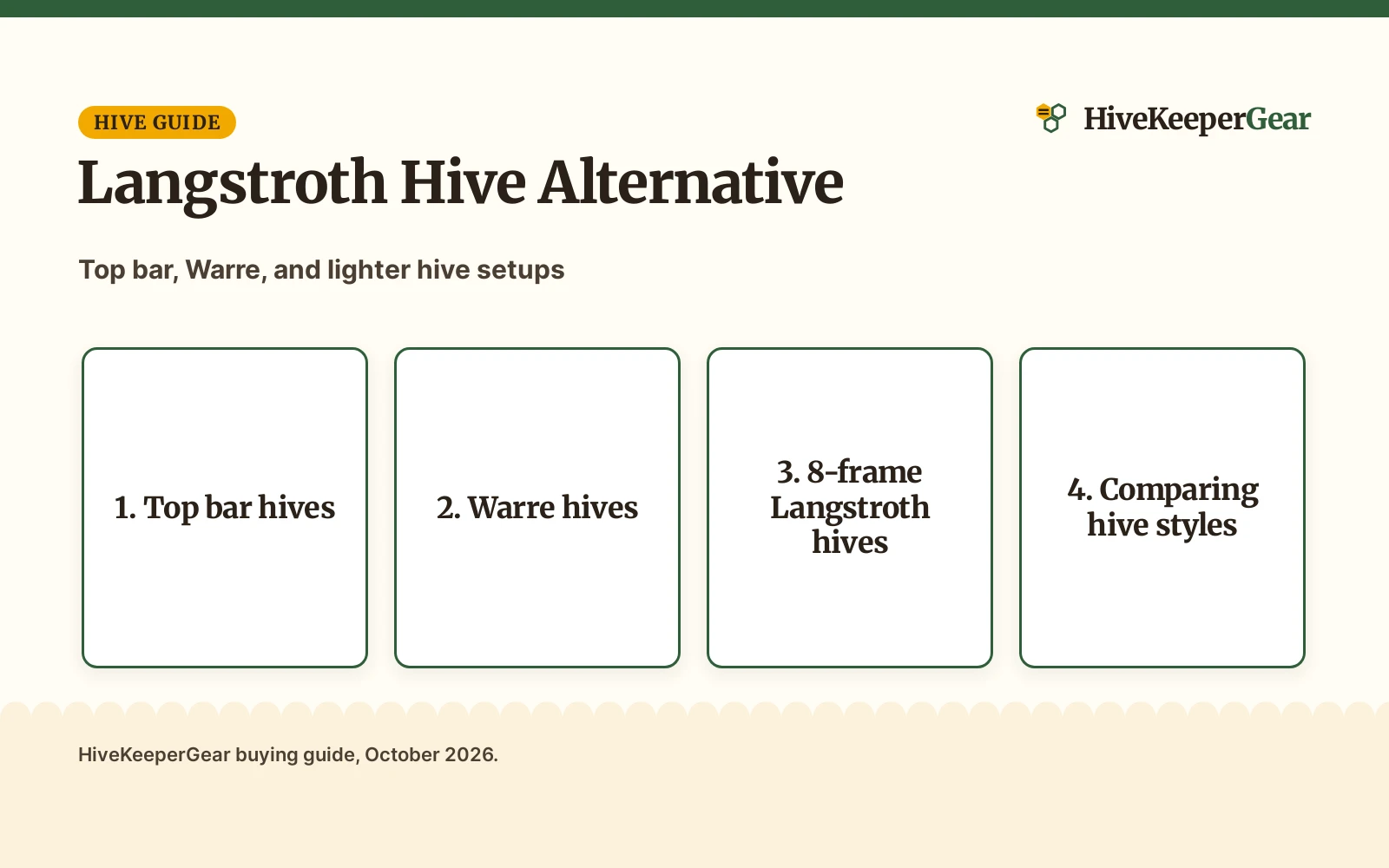
1. Horizontal top bar hives
The horizontal top bar hive houses bees inside a single long wooden trough rather than stacked boxes. Wooden bars rest across the top rim, and bees build comb downward without plastic or wax foundation sheets. A movable follower board adjusts the active interior cavity as the colony grows.
Inspecting a top bar hive involves moving individual bars at a time, eliminating the need to lift heavy honey supers. Because the trough remains covered by neighboring bars, inspections disturb fewer bees. Standard hive tools separate propolis seals, and bee smokers calm the colony. However, foundationless comb requires careful handling along its vertical plane so comb does not break under warm weather.
2. Warre hives and vertical natural comb
The Warre hive uses a vertical stack of compact square boxes where bees build natural comb down from top bars without foundation. Conventionally, beekeepers place empty boxes beneath the active brood nest. This nadiring method supports natural downward comb expansion while an insulated top quilt box manages moisture during cold weather.
Warre hives appeal to keepers who prefer minimal intervention. Beekeepers who want to monitor comb without lifting boxes often choose a hive with an observation pane, such as a langstroth hive with window or a Warre observation hive. Unlike a modular langstroth hive plastic or wax foundation setup where comb is guided by rigid sheets, Warre comb requires gentle handling during harvests. While Warre boxes are smaller and lighter than standard Langstroth boxes, nadiring still requires lifting the active upper boxes to place an empty box underneath.
3. 8-frame Langstroth hives for reduced weight
For beekeepers who want standard frames and conventional management with less lifting, an 8-frame Langstroth hive is an effective alternative. Narrower boxes hold fewer frames, substantially reducing box weight during inspections while keeping full compatibility with commercial beehive frames.
To understand equipment weight, examine a concrete manufacturer example. The Hiveaura 10-frame beehive kit listing states package dimensions of 25 by 22 by 14 inches and a shipping package weight of 59 pounds for unassembled components, which include 2 deep boxes, 1 medium box, and 30 frames. When those 2 deep brood boxes and 1 medium honey super are fully drawn and filled with honey, brood, and bees, lifting individual 10-frame boxes requires considerable effort. Switching to an 8-frame width noticeably reduces the weight of each full box while keeping familiar management routines.
4. Long Langstroth horizontal hives
A Long Langstroth hive combines the single-box layout of a top bar hive with standard Langstroth frames. Built as a horizontal wooden chest on legs, it holds deep or medium frames side by side along a single horizontal plane. While a standard Langstroth hive with frames relies on rectangular frames lifted vertically out of stacked boxes, a Long Langstroth keeps all frames accessible at waist height.
This design eliminates super lifting while maintaining frame durability. You can harvest honey with extractors, use pre-assembled frames, and insert internal beehive feeders. The main trade-off is bulk: stationary long hives cannot be broken down into compact boxes for transport.
5. Honey harvesting across hive styles
Honey harvesting varies across hive styles. In standard and 8-frame Langstroth hives, frames with foundation spin inside a centrifugal extractor, preserving comb for bees to reuse. You can learn how to use a honey extractor to harvest honey efficiently across seasons.
In contrast, traditional top bar and Warre hives produce foundationless comb that lacks rigid outer framing, making conventional centrifugal extraction impractical without specialized baskets. Keepers harvest honey through the crush-and-strain method, slicing comb from bars, crushing it in a food-grade bucket, and filtering it through a fine mesh strainer. Crush-and-strain yields fresh beeswax along with honey, but bees must draw new comb from scratch during future flows.
A seasonal management comparison
Spring buildup: bees expand brood rearing as early pollen arrives. In horizontal hives, expand cavity space by sliding the follower board. In Warre hives, place an empty box beneath the brood nest, while in Langstroth hives you add boxes on top. Summer nectar flow: bees collect nectar and fill comb. Inspect comb carefully without tilting soft foundationless comb horizontally. Fall preparation: confirm adequate honey stores near the cluster area and reduce entrance openings. Winter cluster: bees form a tight winter cluster for warmth. Leave hives closed during cold weather until spring foraging begins.
Nice to have later
- A follower board to adjust internal volume inside horizontal troughs.
- A comb perch to support bars securely during hive inspections.
- A hive tool with a curved hook for freeing propolis seals cleanly.
- An observation window, such as a langstroth hive with window or Warre viewing pane, to check comb progress.
- A notebook to log colony temperament and comb development at each visit.
Recording simple notes during each yard visit helps track colony development across seasons without added cost.
What is not on this list
Bees themselves, purchased as packages, nucleus colonies, or swarms, are sourced separately from apiaries; this guide covers hive hardware and housing design only. We also do not provide colony health, disease, or treatment advice. For colony health questions, consult your state apiary inspector or local extension office.
FAQs for beekeepers
What is the most popular Langstroth hive alternative?
The horizontal top bar hive is the most widely adopted alternative for backyard beekeepers seeking to avoid heavy lifting. It houses bees in a single long trough where comb hangs from removable wooden bars.
Can you use Langstroth frames in an alternative hive?
Long Langstroth hives accept standard Langstroth frames in a horizontal layout, allowing you to use conventional frames without lifting stacked boxes. Top bar hives use frameless bars and Warre hives use compact bars.
Is an 8-frame hive a true Langstroth alternative?
An 8-frame hive uses the same vertical modular design as a standard 10-frame setup but with narrower boxes holding fewer frames. It reduces box weight while using standard Langstroth frame dimensions, though 8-frame boxes and covers do not interchange with 10-frame hardware.
What does an unassembled hive kit weigh?
As an example of kit weight, the Hiveaura 10-frame beehive kit listing states an unassembled shipping package weight of 59 pounds for its set of 2 deep boxes, 1 medium box, and 30 frames. Once assembled and populated with bees and honey, individual 10-frame boxes require significant physical effort to lift.
Do alternative hives require a honey extractor?
Top bar and Warre hives rely primarily on the crush-and-strain method for harvesting honey, so an extractor is unnecessary. Langstroth hives, including 8-frame and horizontal Long Langstroth models, hold comb in frames that spin in an extractor.
More hive guides
Browse every guide by category: beehives, protective gear, hive tools and honey harvesting.
More picks: explore our guide to the top bar bee hive, lighter 8-frame beehive kits, and standard Langstroth beehive kits. New to beekeeping? Start with our guide to types of bee hive frames.