Langstroth vs Warre Hive: Which One Should You Buy?
Langstroth vs Warre hive compared on frame management, comb building, box handling, honey harvest methods and which design suits your backyard beekeeping goals.

On this page
Top picks at a glance
As an Amazon Associate I earn from qualifying purchases.
- 1
 VEVOR 10 Frame Beehive9.5/10View on Amazon
- 2
 BeeCastle 10-Frame Beehive9.5/10View on Amazon
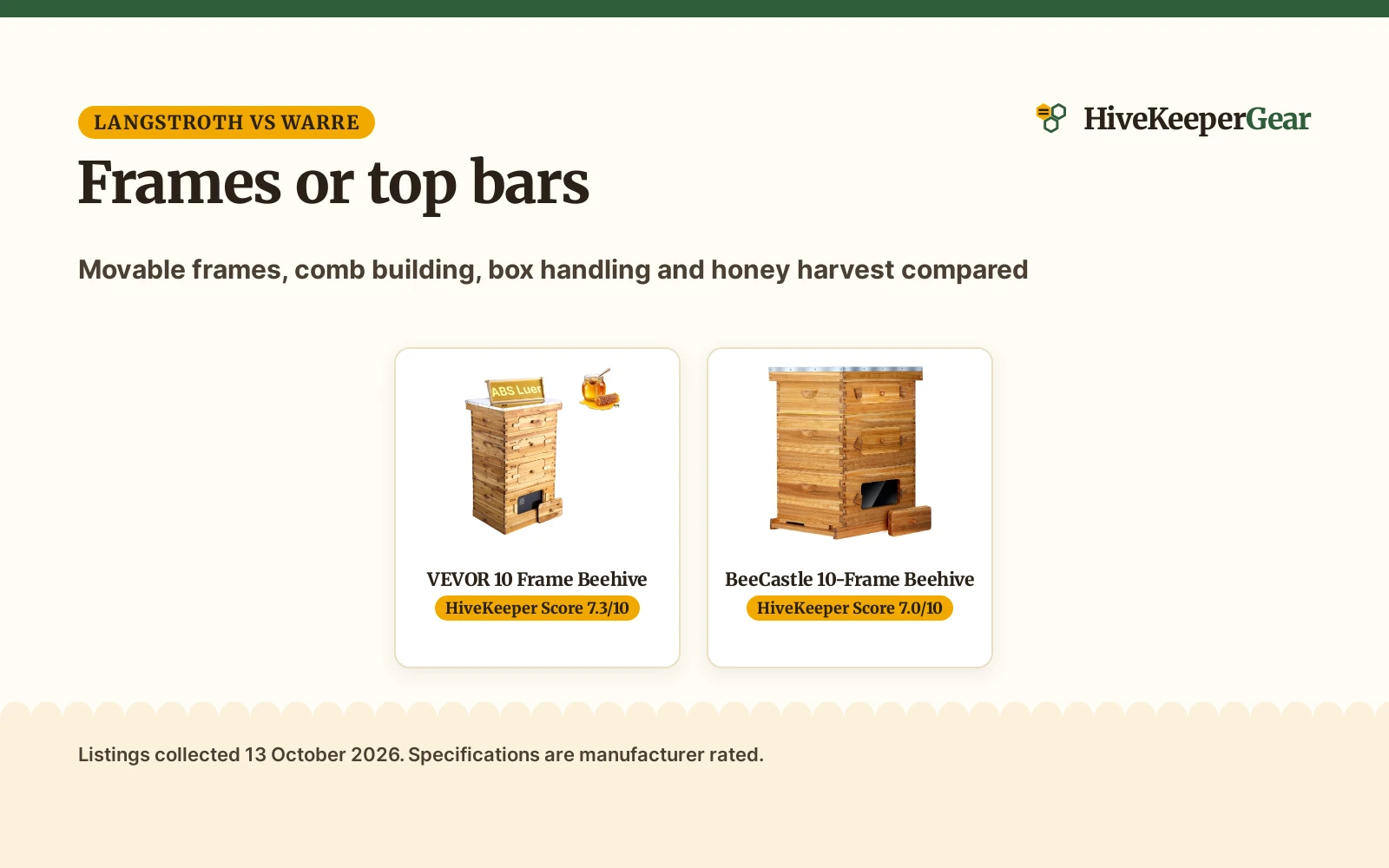
During spring hive setup as you prepare your bee yard for incoming packages or nucs, choosing between a langstroth vs warre hive determines how you will manage colony space, handle comb, and harvest honey. A Langstroth setup relies on standardized movable frames with wax or plastic foundation, whereas a Warre hive uses top bars that encourage bees to build natural comb downward with minimal intrusion. We compared the design philosophy of both hive styles alongside two 10-frame Langstroth starter kits from VEVOR and BeeCastle, evaluating their materials, box configurations, and yard management using only published listing specifications.
HiveKeeperGear earns a commission when you buy through links on this page, at no extra cost to you. As an Amazon Associate I earn from qualifying purchases. Affiliate disclosure.
Quick verdict: choose a Langstroth hive if you want interchangeable movable frames, easy frame-by-frame inspections, high honey production, and compatibility with standard honey extractors. Choose a Warre hive if you prefer a low-intervention approach focused on natural comb building, minimal colony disturbance, and simple crush-and-strain honey harvesting. If you decide on a Langstroth setup, the VEVOR kit offers a four-box setup with acrylic observation windows, while the BeeCastle kit delivers rot-resistant cedar construction with pre-drilled assembly holes.
Two examples
VEVOR 10 Frame Beehive
A 10-frame Langstroth hive kit in 0.74-inch fir wood with 2 deep boxes, 2 medium boxes, 40 beeswax-coated frames and acrylic observation windows.
Pros
- Includes 2 deep brood boxes and 2 medium supers with 40 frames
- Coated exterior with beeswax over 0.74 in thick fir wood
- Acrylic observation windows allow hive checks without opening boxes
- Dovetail joints provide tight corners during assembly
Cons
- Listing calls medium frames lure frames and brood boxes deep frames
- Heavier assembled stack at 70.6 lb to lift and position
- ABS plastic frame material rather than wooden frames
- No warranty term is stated

BeeCastle 10-Frame Beehive
A 10-frame Langstroth hive kit in cedar wood with 2 deep boxes, 1 medium box, 30 pinewood frames and removable plexiglass observation windows.
Pros
- Cedarwood hive body offers solid, rot-resistant wood construction
- Pre-drilled holes and pre-cut dovetails speed up box assembly
- Two removable acrylic plexiglass windows for colony observation
- Includes 30 pinewood frames with beeswax-coated foundations
Cons
- Includes 3 boxes rather than a 4-box setup
- No warranty term is stated
As an Amazon Associate I earn from qualifying purchases.
Other hives and gear to compare
 BeeCastle 10 Frame Langstroth Bee Hive Coated with BeeswaxCheck price on Amazon
 BeeCastle 8 Frame Langstroth Bee Hive Coated with BeeswaxCheck price on Amazon
 BeeCastle 10 Frame Langstroth Bee Hive Coated with 100%Check price on Amazon
 BeeCastle 10 Frame Deep Bee Hive BoxCheck price on Amazon
 BeeCastle 10 Frame Medium Bee Hive BoxCheck price on Amazon
 Honey Lake 10 Frame Langstroth Deep Brood Bee Hive Box DippedCheck price on Amazon
Langstroth vs warre hive: side by side
| Hive | HiveKeeper Score | Boxes | Frames | Material | Weight |
|---|---|---|---|---|---|
| VEVOR 10 Frame Beehive | 9.5/10 | 2 deep, 2 medium | 40 frames | Fir wood | 70.6 lb |
| BeeCastle 10-Frame Beehive | 9.5/10 | 2 deep, 1 medium | 30 frames | Cedar wood | 58.9 lb |
All specs repeat what the manufacturer lists, not our own measurements, read on 13 October 2026.
Comb building and frame management
The primary structural contrast between these two hive styles centers on how bees build comb and how keepers manipulate it. A Langstroth hive uses rectangular wooden or plastic frames that enclose foundation sheets. This keeps the comb aligned within four sturdy borders, making frames straightforward to remove, inspect, uncap, and spin in an extractor without structural breakage. The VEVOR example provides 40 ABS plastic frames coated with beeswax, while the BeeCastle example includes 30 pinewood frames with waxed foundations.
By contrast, a Warre hive relies on top bars resting across the upper rim of each hive body without side or bottom bars. The bees build natural comb downward from wax starter strips on the underside of each bar. Because the comb is completely foundationless and unattached along the bottom, it can adhere to the inner box walls and requires gentle handling on warm yard visits to prevent breakage.
Box manipulation and colony expansion
Managing colony expansion follows opposing directions in these two systems. Langstroth beekeeping expands upward through supering, where you place empty medium or shallow boxes on top of the brood nest as the seasonal nectar flow begins. This approach separates surplus honey storage from the lower brood boxes and allows you to add or harvest upper boxes without disturbing the brood nest below.
Warre beekeeping expands downward through nadiring, where empty boxes are added beneath the active brood chambers at the base of the stack. This downward expansion mirrors how wild honeybees build comb in natural tree hollows, keeping brood warmth rising into the upper comb. However, nadiring requires lifting the entire occupied hive stack to position an empty box at the bottom, which requires physical effort unless you use a specialized hive lift or work with an apiary partner.
Honey harvesting methods
Harvesting honey from a Langstroth hive is non-destructive because supported frames withstand centrifugal spinning. Beekeepers slice away wax cappings with an uncapping knife and spin the frames inside a honey extractor, throwing honey out against the drum wall while leaving the comb cells intact. The intact comb is then returned to the hive supers, saving the bees the considerable nectar resources required to secrete new beeswax.
Because Warre comb lacks supporting frames and wire reinforcement, it cannot survive centrifugal extraction. Warre honey is harvested by removing the uppermost box, cutting the comb free from the top bars, and crushing the comb in a bucket before pouring it through a fine strainer. While crush and strain yields pure beeswax alongside raw honey, the colony must expend nectar and energy building fresh wax comb from scratch during the next spring flow.
Hive inspections and observation
Langstroth management encourages routine frame-by-frame inspections, where the keeper lifts individual frames to monitor egg laying, check the queen, and watch for swarm cells. Both featured Langstroth kits include acrylic observation windows that permit visual checks without cracking propolis seals or cooling the hive. The VEVOR example features transparent acrylic windows with ventilation ports, while the BeeCastle example provides two removable acrylic plexiglass windows.
Warre hives are intentionally managed for low intervention, aiming to preserve the nest cavity temperature, humidity, and colony scent. Rather than pulling individual combs, Warre keepers judge colony growth and winter stores by viewing comb through box windows or observing entrance activity and hive weight.
Listing gaps to check
Neither manufacturer states a warranty term in its listing specifications. In addition, the BeeCastle listing contains notable catalog errors in its spec table: it lists hive height as 6.62 inches, which represents only a single medium box rather than the assembled three-box stack, and it includes an errant pet classification. The VEVOR listing describes its medium frames as lure hive frames and deep boxes as brood boxes, though the spec table confirms four hive bodies and 40 frames total. Confirm exact packaging and dimensions with the seller before ordering.
Which should you choose?
Choose a Langstroth hive if you want standardized interchangeable equipment, easy frame-by-frame inspections, maximum honey yields, and the ability to extract honey without destroying comb. Our best Langstroth hive guide and best Langstroth beehive kit roundup compare more wooden starter setups.
Choose a Warre hive if you want a sustainable, low-intervention approach that lets bees draw natural comb downward, requires no honey extractor, and focuses on colony self-sufficiency rather than high harvest volume. Our Langstroth hive alternative guide explores more non-traditional hive styles.
Whichever hive design you choose for your apiary, assemble your boxes well ahead of the spring buildup and protect your hands during inspections with a pair of best beekeeping gloves.
In the Bee Yard
- Box handling: At 70.6 pounds for the four-box VEVOR setup and 58.9 pounds for the three-box BeeCastle stack, assemble and position hive bodies box by box on your hive stand rather than trying to lift a fully stacked hive into place.
- Observation windows: Use the transparent acrylic windows on both models for quick visual checks of comb building and bee cluster movement on cool mornings without removing top covers or breaking hive seals.
- Frame fit: The VEVOR kit supplies 40 ABS plastic frames while BeeCastle provides 30 pinewood frames, both sized for 10-frame Langstroth bodies and coated in beeswax to help bees accept and draw out the foundations.
- Assembly preparation: The BeeCastle kit provides pre-drilled screw holes to align the dovetail joints, whereas the 0.74-inch fir wood on the VEVOR boxes requires careful corner tapping to seat joints flush before fastening.
Inside the HiveKeeper Score
| Product | HiveKeeper Score | Perf. /35 | Build /25 | Value /25 | Safety /10 | Warranty /5 |
|---|---|---|---|---|---|---|
| VEVOR 10 Frame Beehive | 9.5 | 30 | 21 | 21 | 0 | 0 |
| BeeCastle 10-Frame Beehive | 9.5 | 28 | 22 | 20 | 0 | 0 |
We map points onto a band running from 9.2 up to 9.8 in a straight line, so ranking by score is ranking by points.
The HiveKeeper Score weighs performance, build, value, safety and warranty, as explained on our how we pick page. The VEVOR kit scores higher on performance and value because it provides a complete four-box setup with 40 frames and foundations straight from the box. The BeeCastle kit earns strong marks for build quality due to its solid cedarwood construction and pre-drilled assembly holes. Neither listing earns warranty points because neither manufacturer states a warranty term.
FAQs for beekeepers
What is the main difference between a Langstroth and a Warre hive?
A Langstroth hive uses standardized movable frames with wax or plastic foundations where supers are added on top, allowing frame-by-frame inspections and centrifugal honey extraction. A Warre hive uses top bars without side frames, encouraging bees to build natural comb downward while new boxes are added underneath with minimal disturbance.
Can you extract honey from a Warre hive with a honey extractor?
No, honey extractors spin rigid wooden or plastic frames like the 40 frames included with the VEVOR Langstroth kit or the 30 frames in the BeeCastle kit. Because Warre top-bar comb has no surrounding frame or wire support, spinning it in an extractor drum would tear the comb apart, requiring you to harvest honey by crushing and straining.
How heavy is a complete Langstroth beehive kit?
Weight depends on the number of wooden boxes and frame count. The four-box VEVOR 10-frame kit with two deep and two medium boxes lists an item weight of 70.6 pounds, while the three-box BeeCastle kit with two deep boxes and one medium super lists an item weight of 58.9 pounds.
Is a Langstroth or a Warre hive better for beginner beekeepers?
Most beginners choose a Langstroth hive because standardized dimensions, replacement parts, and local mentoring align with movable frame management. Starter setups like the VEVOR and BeeCastle kits also feature acrylic observation windows, allowing beginners to watch colony progress without opening the hive.
More hive guides
Related: best Langstroth hive, best Langstroth beehive kit, Langstroth hive alternative, and 10 frame beehive dimensions.