Layens Hive vs Warre Hive: Which One Should You Buy?
A practical comparison of Layens and Warre hives, contrasting horizontal deep frames and vertical top bars for brood space, wintering, and low-intervention beekeeping.

On this page
Top picks at a glance
As an Amazon Associate I earn from qualifying purchases.
- 1
 BeeCastle 10 Frame Langstroth Bee Hive Coated with Beeswax9.7/10View on Amazon
- 2
 witbee Winter Bee Hive Wrap for 8 and 10 Frame Beehives9.6/10View on Amazon
- 3
 HiveSweet 2Pcs Bee Hive Winter Quilt Box9.6/10View on Amazon
When preparing your apiary before spring buildup, deciding between a layens hive vs warre hive comes down to choosing between a horizontal box with deep frames or a vertical stack of compact boxes on natural comb. Layens hives suit keepers wanting high honey capacity and waist-height inspections without lifting heavy boxes. Warre hives suit keepers seeking low-intervention beekeeping and natural comb building. This guide compares both designs across frame architecture, colony expansion, inspections, wintering, and harvesting to help you choose.
HiveKeeperGear earns a commission when you buy through links on this site, at no extra cost to you. As an Amazon Associate I earn from qualifying purchases. Affiliate disclosure.
Before you buy: matching hive styles to your apiary
Before choosing equipment, consider how your physical preferences, climate, and management philosophy align with hive geometry. While conventional beekeeping relies on vertical modular boxes, alternative hives offer distinct advantages. A horizontal hive minimizes lifting by keeping inspections at waist height without unstacking boxes. A vertical top-bar stack allows bees to build comb downward with minimal colony disturbance. For a broader look at hive formats, read our guide to horizontal vs vertical bee hives before buying.
The layens hive vs warre hive comparison, feature by feature
| Feature | Layens Hive | Warre Hive | Langstroth Reference |
|---|---|---|---|
| Design axis | Horizontal trough | Vertical stack | Vertical tiered stack |
| Frame style | Enclosed deep frames | Top bars without foundation | Removable rectangular frames |
| Colony expansion | Lateral by moving divider board | Downward nadiring underneath nest | Upward supering above brood nest |
| Comb inspection | Individual frame removal from above | Box lifting or underside viewing | Frame removal box by box |
| Lifting requirement | Single frame at a time | Upper boxes lifted to nadir | Stacked boxes lifted for inspection |
| Honey harvesting | Frame extraction or comb cutting | Crush and strain comb | Centrifugal honey extractor |
| Winter cluster space | Continuous deep comb | Vertical chimney through boxes | Across stacked box seams |
1. Hive architecture and frame design
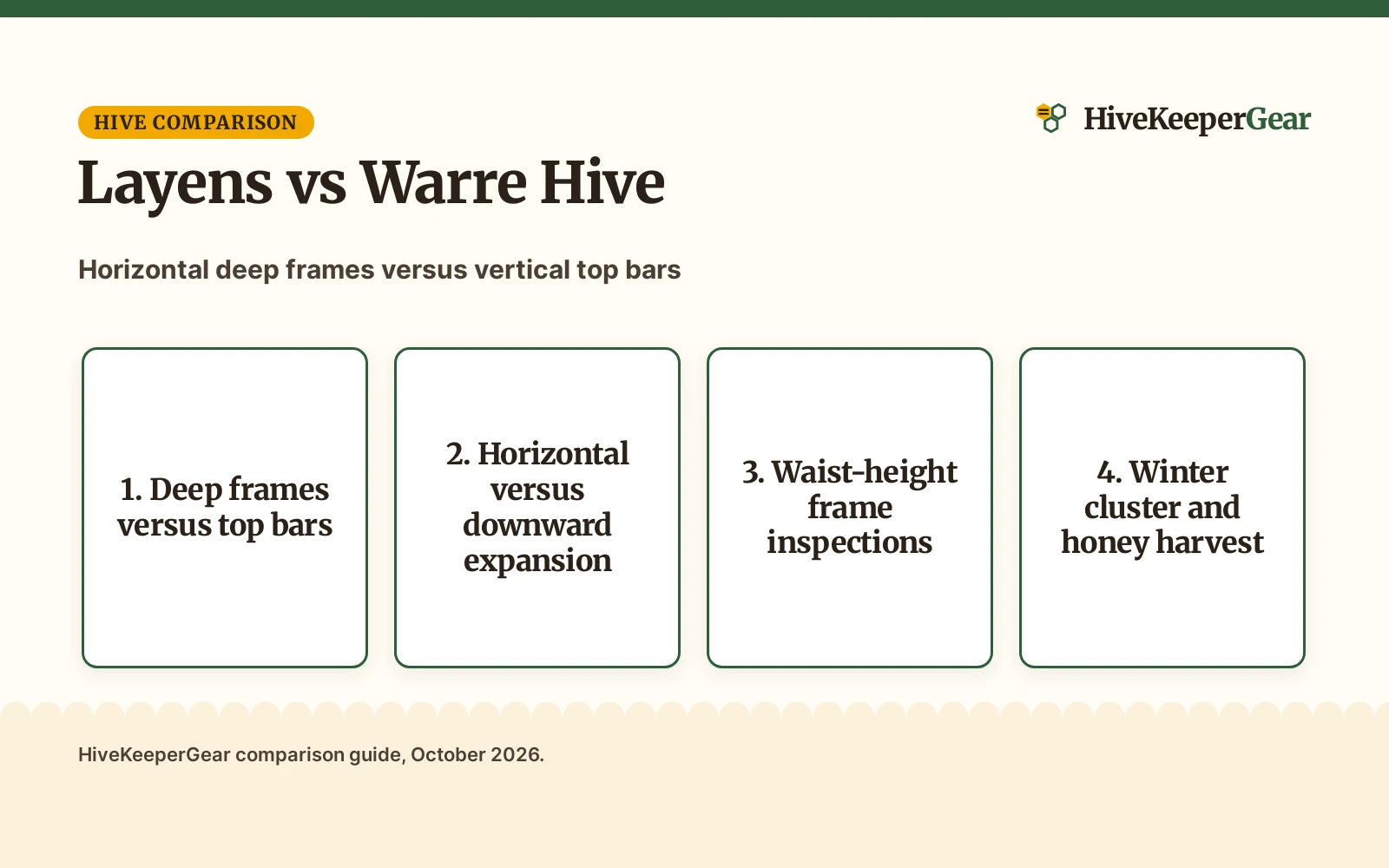
The primary difference between both hives lies in frame structure and box layout. The horizontal hive popularized by Georges de Layens houses the colony in a single long wooden chest with deep frames. Each Layens frame features a wide top bar that touches adjacent bars, forming an unbroken ceiling that seals heat inside when the outer lid opens. For keepers evaluating horizontal alternatives, our Layens hive vs top bar hive guide explores how deep frames differ from sloping troughs.
By contrast, the Warre hive, designed by Emile Warre, uses small square boxes stacked vertically. Instead of four-sided frames with foundation, a Warre hive uses wooden top bars where bees build unsupported natural comb. Modular vertical gear provides a sizing reference: manufacturer data for a MayBee deep brood box lists dimensions of 9.63 inches deep by 19.88 inches wide by 9.63 inches high with capacity for 10 frames, while Mann Lake lists its deep frames at 9 1/8 inches deep. Layens frames extend far deeper than such modular deep frames, providing continuous comb for brood and honey storage.
2. Comb building and colony expansion
Comb building reflects two distinct philosophies. In a Layens hive, four-sided wooden frames support the comb during handling. Lateral expansion happens along the horizontal trough: as the colony grows in spring, the keeper slides a follower board sideways and adds empty deep frames next to the brood nest, adjusting hive volume to colony size.
In a Warre hive, bees build natural comb downward from top bars without foundation sheets. Colony expansion requires nadiring: placing empty boxes beneath the active brood nest rather than supering above. This encourages the queen to move downward as fresh comb is drawn, leaving upper boxes for surplus honey. For more on natural comb, see our top bar vs Warre hive guide. While both hives traditionally use a solid floor to retain warmth, you can compare base options in our screened vs solid bottom board guide.
3. Hive inspections and ergonomics
Physical strain during inspections is where these hives diverge. In tiered hives, inspecting the brood area requires unstacking heavy boxes. As an example of stacked woodenware, the 4 layer TRINFREE hive kit has a listed weight of 68 pounds empty, and full supers add significant weight. A Layens hive eliminates box lifting during routine inspections. Positioned on a stand at waist height, you lift the roof, slide the divider board, and remove a single frame at a time.
A Warre hive uses lighter boxes than standard 10-frame hives, but nadiring still requires lifting the active upper stack to slide a fresh box underneath. Because Warre combs attach to box walls, pulling combs risks tearing wax, so keepers inspect from the bottom of boxes or through windows. When inspecting either hive, protect yourself with a quality hive tool, a dependable bee smoker, durable beekeeping gloves, and a breathable bee suit.
4. Winter survival and thermal regulation
Winter cluster mechanics showcase the thermal strengths of both designs. Honey bees cluster together in cold weather, consuming honey to generate heat. In a Layens hive, deep continuous frames let the cluster form at the bottom of the comb and advance upward along unbroken honey reserves, avoiding the cold frame seams that separate stacked box tiers. Thick walls and closed top bars preserve warmth throughout harsh winters.
The Warre hive provides thermal efficiency through its compact vertical chimney, matching the narrow profile of hollow trees so warm air rises directly through the cluster. Above the top bars, a Warre quilt box filled with wood shavings absorbs moisture while retaining heat. For moisture management tips, consult our inner cover vs quilt box guide, and prepare syrup with a beehive feeder if fall stores run low.
5. Honey harvesting and wax processing
Harvesting methods depend on frame design. In a Layens hive, surplus honey gathers in outer frames away from the entrance. Supported by sturdy wooden borders, these combs can be uncapped with an uncapping knife and extracted in a specialized centrifugal extractor, or harvested as cut comb. Extracting leaves the drawn comb intact for reuse, saving bees wax-building energy.
In a Warre hive, honey is harvested by removing the top box once the brood nest has moved down. Because unsupported natural comb risks breaking in a centrifugal spinner, Warre keepers typically cut the comb from top bars and use the crush-and-strain method, filtering honey through a honey strainer into buckets. Compare processing options in our honey press vs honey extractor guide.
A seasonal management timeline
Late winter: check entrance airflow and verify that quilt boxes or top insulation remain dry. Spring buildup: expand hive capacity as brood rearing begins. In a Layens hive, slide the follower board sideways to add deep frames; in a Warre hive, nadir an empty box beneath the stack. Summer nectar flow: monitor honey storage. Layens bees store surplus laterally toward the far side, while Warre colonies fill upper boxes as the brood shifts downward. Fall preparation: confirm adequate capped stores near the cluster, reduce entrances against robbing, and add mouse guards. Winter: leave the cluster quiet, preserve top moisture protection, and avoid unneeded openings until warm spring weather arrives.
Nice to have later
- An elevated hive stand to raise entrances off damp ground and keep horizontal inspections at waist height.
- Extra follower boards to adjust cavity volume during spring expansion or winter prep.
- A honey press or double sieve strainer to process natural comb harvested from top bars.
- A spare veil and gloves for apiary visitors.
- An inspection log to track comb building, laying patterns, and winter store reserves.
A simple written log of comb progress and honey stores helps you anticipate colony needs without opening the hive unnecessarily.
What is not on this list
Honey bees, acquired as packages, nucleus colonies, or swarms, are purchased separately from woodenware; we compare equipment and management styles only. We do not provide bee disease diagnosis, chemical mite treatments, or veterinary advice. For local apiary regulations and health guidelines, contact your state apiary inspector or county extension office.
FAQs for beekeepers
Which hive is easier to inspect, a Layens or a Warre?
A Layens hive is easier to inspect frame by frame because you lift individual deep frames from waist height without moving boxes. Warre hives use top bars where comb attaches to box walls, so inspections typically happen from the bottom of boxes.
Can you extract honey from a Warre hive using a honey extractor?
Centrifugal extractors require reinforced frames that withstand spinning forces. Because Warre bees build unsupported natural comb from top bars, keepers harvest by crushing comb and filtering it through a strainer.
How do bees build comb differently in Layens and Warre hives?
In a Layens hive, bees build comb inside enclosed wooden frames, expanding laterally along the horizontal trough. In a Warre hive, bees build downward in a vertical column from top bars into empty boxes added underneath.
Is a Layens hive or Warre hive better for cold winter climates?
Both designs winter well compared to multi-box vertical hives. Layens hives provide continuous honey on deep frames above the cluster, while Warre hives use compact vertical chambers and an absorbent quilt box to manage moisture.
Which hive is better for beekeepers who want to avoid heavy lifting?
The Layens hive is superior for avoiding heavy lifting. While stacked modular setups can be heavy, such as the TRINFREE 4 layer kit listed at 68 pounds empty, a Layens hive allows seasonal inspections by lifting individual frames from waist height.
More hive guides
Browse every guide by category: beehives, protective gear, hive tools and honey harvesting.