Horizontal vs Vertical Bee Hives: Which One Should You Buy?
Compare horizontal vs vertical bee hives by lifting weight, frame compatibility, seasonal management, and honey harvest to choose the right hive design for your apiary.

On this page
Top picks at a glance
As an Amazon Associate I earn from qualifying purchases.
- 1
 Mondazie Adjustable Metal Bee Hive Stand9.7/10View on Amazon
- 2
 Blythewood Bee Company Swarm Commander Super Lure with9.6/10View on Amazon
- 3
 Aukbeefun Bee Feeders for HivesView on Amazon
- 4
 4 PCS Bee Feeders for Hives Rapid Round Bee Feeder BeehiveView on Amazon
- 5
 AukBeeFun 8 Pack Bee Feeders for Hives Mason Jar Sugar WaterView on Amazon
- 6
 Bee Feeder for HivesView on Amazon
- 7
 Hoover Hives 10-Frame Wax-Coated Solid Bottom BoardView on Amazon
- 8
 AOIT 6 Pack Front Bee Feeders for Hives BeehiveView on Amazon
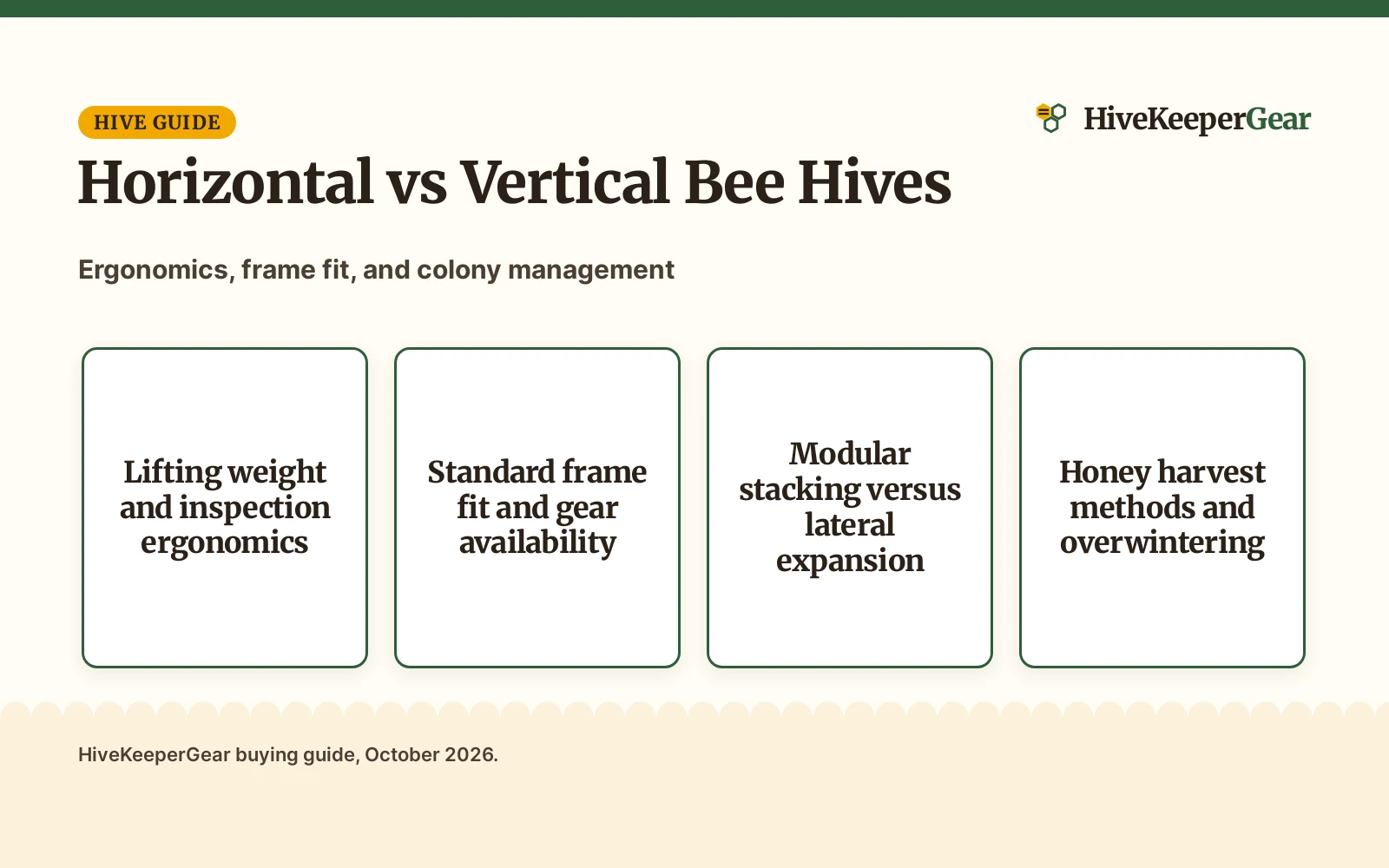
When spring nectar flows begin and colonies expand rapidly, deciding between horizontal vs vertical bee hives comes down to how much lifting your back can tolerate and how you prefer to manage honey supers. Vertical hives suit beekeepers prioritizing high honey yields, modular expansion, and universally available commercial parts, while horizontal hives are better for keepers seeking waist-height inspections without lifting heavy boxes. This guide compares both hive styles across ergonomics, frame compatibility, seasonal management, and equipment investment. We examine how each system functions in the bee yard so you can choose the right setup before ordering your bees and woodenware.
Other hives and gear to compare
 Aukbeefun Bee Feeders for HivesCheck price on Amazon
 4 PCS Bee Feeders for Hives Rapid Round Bee Feeder BeehiveCheck price on Amazon
 AukBeeFun 8 Pack Bee Feeders for Hives Mason Jar Sugar WaterCheck price on Amazon
 Bee Feeder for HivesCheck price on Amazon
 Hoover Hives 10-Frame Wax-Coated Solid Bottom BoardCheck price on Amazon
 AOIT 6 Pack Front Bee Feeders for Hives BeehiveCheck price on Amazon
HiveKeeperGear earns a commission when you buy through links on this site, at no extra cost to you. As an Amazon Associate I earn from qualifying purchases. Affiliate disclosure.
Before you choose: physical limits and apiary goals
Every hive style creates a distinct working rhythm in the bee yard. Vertical hives stack modular wooden boxes upward, demanding regular lifting whenever you inspect brood frames located in the lower chambers. For beekeepers with physical limitations, back strain, or joint stiffness, shifting heavy boxes during routine summer visits quickly becomes difficult. Horizontal hives solve this ergonomic challenge by spreading frames along a single waist-level trough, allowing inspections without unstacking boxes. Before selecting a system, evaluate your physical comfort, available backyard footprint, and whether your primary goal is surplus honey production or calm colony stewardship.
Horizontal vs vertical bee hives: core design differences
| Feature | Vertical Langstroth Hive | Horizontal Hive | Our guide |
|---|---|---|---|
| Expansion direction | Vertical modular stacking with added boxes | Lateral horizontal expansion along one long box | Langstroth hives |
| Heavy box lifting | Required to inspect lower brood boxes | None; frames inspected individually at waist height | Long Langstroth vs top bar |
| Frame standardization | Standard deep and medium Langstroth frames | Standard deep frames in Long Langstroth, top bars in Kenyan style | Deep brood frames |
| Honey harvest method | Removable supers extracted in centrifugal extractors | Individual frames or crushed comb depending on style | Honey extractors |
| Equipment availability | Available in complete starter kits from major suppliers | Specialty niche suppliers or custom woodwork | Hive alternatives |
1. Lifting requirements and inspection ergonomics
The primary operational difference between these two hive styles is the physical effort required during routine hive checks. In a vertical setup, honey supers rest directly above the brood chamber. Evaluating queen performance, egg laying, or swarm cells requires smoking the colony, unsealing propolis joints, lifting each upper box, and resting it aside. Full boxes become quite heavy when loaded with bees, comb, and honey. For example, MayBee lists its packaged 10-frame kit containing 1 deep box, 1 medium box, and frames at an unassembled shipping weight of 45.3 pounds with package dimensions of 22.8 by 19.2 by 12.1 inches before adding any comb, nectar, or bees. Once boxes are assembled and filled with brood, bees, and capped honey, lifting an individual box during routine checks requires significant physical exertion.
In contrast, a horizontal hive remains entirely on 1 level at standing height. To inspect the brood nest, you simply open the hinged roof, slide back canvas cloths or individual wooden top slats, and lift 1 frame at a time. The hive body never moves, and no heavy upper boxes need removal. This single-level access makes horizontal hives ideal for solo beekeepers and anyone wishing to avoid heavy lifting.
2. Frame compatibility and equipment availability
Vertical Langstroth hives follow broadly standardized dimensions across the industry, though individual manufacturers show slight variations in exterior cuts. For example, POLLIBEE lists its 10-frame deep brood boxes at 19-7/8 by 16 by 9-5/8 inches and medium supers at 19-7/8 by 16 by 6-5/8 inches, while Honey Lake lists its 10-frame deep brood boxes at 19.88 by 16.25 by 9.56 inches and medium supers at 19.88 by 16.25 by 6.6 inches. Both designs accommodate standard Langstroth frames internally, even though minor exterior measurement differences mean mixing boxes from different makers can occasionally leave small ledges. Kit configurations also vary by brand: the POLLIBEE 4-layer bundle includes 20 deep frames and 20 medium frames across 2 deep boxes and 2 medium boxes, while Honey Lake supplies 30 frames across 2 deep brood boxes and 1 medium box.
If you choose a horizontal hive, frame compatibility depends entirely on the design. A Long Langstroth hive uses standard Langstroth deep frames, meaning you can buy standard frames and foundation from our 10-frame Langstroth hive kit guide and interchange them with vertical deep boxes. Conversely, top bar hives use custom wooden bars without outer rectangular frames, as explored in our top bar bee hive guide. Top bar comb cannot be swapped into standard Langstroth equipment.
3. Honey production and extraction methods
Vertical hives excel at maximizing surplus honey harvest. When a heavy nectar flow begins in early summer, beekeepers place a queen excluder above the brood nest and stack additional medium supers overhead. The bees store surplus honey above the brood chamber without running out of room. When harvesting, beekeepers remove entire supers and spin frames in centrifugal extractors, returning intact combs for refilling. Explore our medium frames for honey supers and honey extractors guides to see standard harvesting equipment.
Horizontal hives manage surplus honey differently. Because boxes cannot be stacked overhead, the colony expands sideways along the trough. The brood nest remains near the entrance, and bees deposit honey toward the rear behind a vertical excluder or follower board. Because total volume is fixed by the length of the box, beekeepers must harvest honey frames periodically throughout the season rather than waiting for 1 massive late-summer pull.
4. Colony expansion and swarm management
Managing colony expansion requires different techniques in each format. In vertical hives, beekeepers add boxes as the colony fills existing frames, or split strong colonies into separate boxes to prevent swarming. For instance, the BEEINN 5-frame nuc measures 19.9 by 9 by 9.5 inches and holds 5 deep frames, providing a dedicated compact box for holding a colony split or rearing a new queen.
In a horizontal hive, cavity volume is adjusted internally rather than externally. Beekeepers use movable wooden follower boards to contract the hive in early spring, expanding the active space frame by frame as the colony grows. Swarm prevention requires actively rotating empty frames into the brood area or pulling frames of brood to start a nucleus colony elsewhere.
5. Wintering and temperature regulation
Winter cluster behavior naturally aligns with vertical cavity design. In cold weather, honey bees form a tight cluster and move upward through honey stores, utilizing rising heat from the cluster below. Vertical hives require adequate upper ventilation to let moisture escape while keeping the lower hive free of drafts. While screened bottom boards like the one on the MayBee kit are preferred by makers for summer air circulation to keep bees cool, wintering in cold climates typically requires sliding in a closure board or using a solid bottom board to prevent chilling drafts under the cluster.
Horizontal hives require careful winter preparation because the cluster must travel horizontally across frames rather than upward. Beekeepers position winter honey frames directly alongside the brood cluster and insert an insulated follower board to partition off unused sections of the trough, packing the empty space with insulation. When properly configured, a horizontal hive offers reliable thermal stability throughout winter.
A seasonal management timeline
Late winter and early spring: check food stores. In vertical hives, lift the outer cover to assess cluster position near upper honey frames; in horizontal hives, slide back the top cloth to confirm honey frames remain adjacent to the cluster. Provide sugar syrup using an internal feeder if stores run low. Spring buildup: monitor brood expansion. Add supers above the brood nest in vertical hives, or move the follower board laterally in horizontal hives to supply empty frames for egg laying. Summer flow and honey harvest: add medium supers on vertical stacks as nectar pours in; in horizontal hives, inspect rear frames weekly and pull capped honey combs to maintain space. Fall preparation: verify adequate winter honey stores, install entrance reducers to deter robbing, and guard against hive drafts. Winter: minimize disturbance, leaving hives closed on cold days while checking that upper ventilation openings remain dry and unobstructed.
Practical accessories for both hive styles
- A sturdy stainless steel hive tool with a J hook to pry propolis-glued frames apart cleanly, compared in our hive tool guide.
- A stainless steel bee smoker with a protective wire heat shield to keep bees calm during hive visits, detailed in our bee smoker guide.
- A dedicated frame rest to hang inspected frames safely beside the hive without resting comb on the ground.
- Movable wooden follower boards to adjust internal volume to match colony strength through changing seasons.
- An internal feeder, such as a frame or top feeder, to supply sugar syrup during early spring buildup, covered in our beehive feeder guide.
Keeping thorough notes in an apiary notebook after each visit helps track brood patterns, honey stores, and queen temperament across seasons regardless of which hive style you choose.
What this comparison does not cover
This comparison focuses strictly on hive hardware and woodenware architecture. We do not sell live honey bees, which must be ordered separately as packaged bees, nucleus colonies, or caught swarms from reputable local apiaries. Furthermore, we do not provide bee health, disease, or medical treatment advice. For regional guidance on colony health, pests, and local apiary ordinances, contact your state apiary inspector or local beekeeping association.
FAQs for beekeepers
Which hive produces more honey, horizontal or vertical?
Vertical Langstroth hives typically yield more surplus honey because beekeepers can stack additional medium supers as long as the nectar flow continues. Horizontal hives have a fixed internal volume, requiring beekeepers to harvest honey frames more frequently throughout the summer.
Can I use standard Langstroth frames in a horizontal hive?
Yes, Long Langstroth hives are built specifically to hold standard deep Langstroth frames, allowing them to share frames with vertical deep brood boxes. Top bar hives, however, use frameless wooden bars that cannot fit into standard Langstroth boxes or extractors.
Is a horizontal hive better for beginners with physical limitations?
A horizontal hive is ideal for anyone seeking to avoid heavy lifting because all frame inspections happen at comfortable waist height without unstacking heavy boxes. However, vertical hives offer greater availability of replacement parts and beginner mentoring support.
How do bees move in a horizontal hive during winter?
In a horizontal hive, the winter cluster travels sideways from frame to frame toward stored honey rather than moving upward. Beekeepers use insulated follower boards to partition the trough and prevent drafts in unoccupied sections.
Can I harvest honey from a horizontal hive using a centrifugal extractor?
If your horizontal hive uses standard framed combs, such as in a Long Langstroth setup, those deep frames can be extracted in centrifugal extractors designed to hold deep frames. Comb harvested from top bar hives lacks outer wooden frames and is processed using the crush-and-strain method instead.
More hive guides
Browse every guide by category: beehives, protective gear, hive tools, and honey harvesting.
More picks: explore our reviews in 10-frame Langstroth hive kits, Long Langstroth vs top bar hives, and top bar bee hives. New to beekeeping? Check out our complete beekeeping supplies for beginners checklist.