Honey Press vs Honey Extractor: Which One Should You Buy?
A comparison of honey presses and extractors: how comb preservation, honey yields, equipment setup, and wax harvesting differ for backyard beekeepers.

On this page
Top picks at a glance
As an Amazon Associate I earn from qualifying purchases.
- 1
 4oz Glass Mason Jars with Airtight Lids9.7/10View on Amazon
- 2
 MayBee 2 Pack Honey Gate Valve for ExtractorView on Amazon
- 3
 2Pcs Honey Gate Valve for ExtractorView on Amazon
As the summer nectar flow slows and supers grow heavy with capped comb, deciding between a honey press vs honey extractor determines how you bring in your harvest. For beekeepers running standard Langstroth frames who want to preserve drawn comb for the next flow, a centrifugal honey extractor is the right choice, while a manual honey press suits top-bar keepers, foundationless comb, or anyone wanting pure beeswax alongside their honey. We compared the mechanical operation, comb preservation, honey yields, and equipment requirements of both methods to help you choose the right tool for your apiary.
Other hives and gear to compare
 MayBee 2 Pack Honey Gate Valve for ExtractorCheck price on Amazon
 2Pcs Honey Gate Valve for ExtractorCheck price on Amazon
HiveKeeperGear earns a commission when you buy through links on this site, at no extra cost to you. As an Amazon Associate I earn from qualifying purchases. Affiliate disclosure.
Before you buy: assess your comb and hives
Before purchasing harvest equipment, look closely at your hive style and how your bees build comb. Standard Langstroth hives use wooden or plastic frames where bees draw comb supported by sheets of foundation or guide wires. These rigid frames are designed specifically for centrifugal extraction, allowing you to uncap cells and spin honey out while keeping delicate wax comb intact.
In contrast, top-bar hives, Warre hives, and foundationless Langstroth frames produce free-hanging comb without internal foundation support. Spinning unsupported comb in an extractor can cause fragile wax to collapse under centrifugal force. For beekeepers managing foundationless hives or harvesting wild comb from removals, a honey press is often the most practical extraction method because it does not require intact structural comb. Knowing your frame style before buying equipment prevents frustrating comb blowouts during harvest.
Honey press vs honey extractor: method comparison
| Harvest Feature | Honey Press | Honey Extractor | Related Equipment |
|---|---|---|---|
| Comb preservation | Crushes comb completely | Preserves drawn comb intact | Honey extractors |
| Hive compatibility | Any hive style, including top-bar | Framed hives, primarily Langstroth | Manual extractors |
| Wax production | High yield of clean comb wax | Cappings wax only | Uncapping tools |
| Extraction speed | Batch pressing of comb | Fast batch spinning of frames | Extractor guide |
| Straining method | Direct mesh bag filtration | Double sieve into settling bucket | Honey strainers |
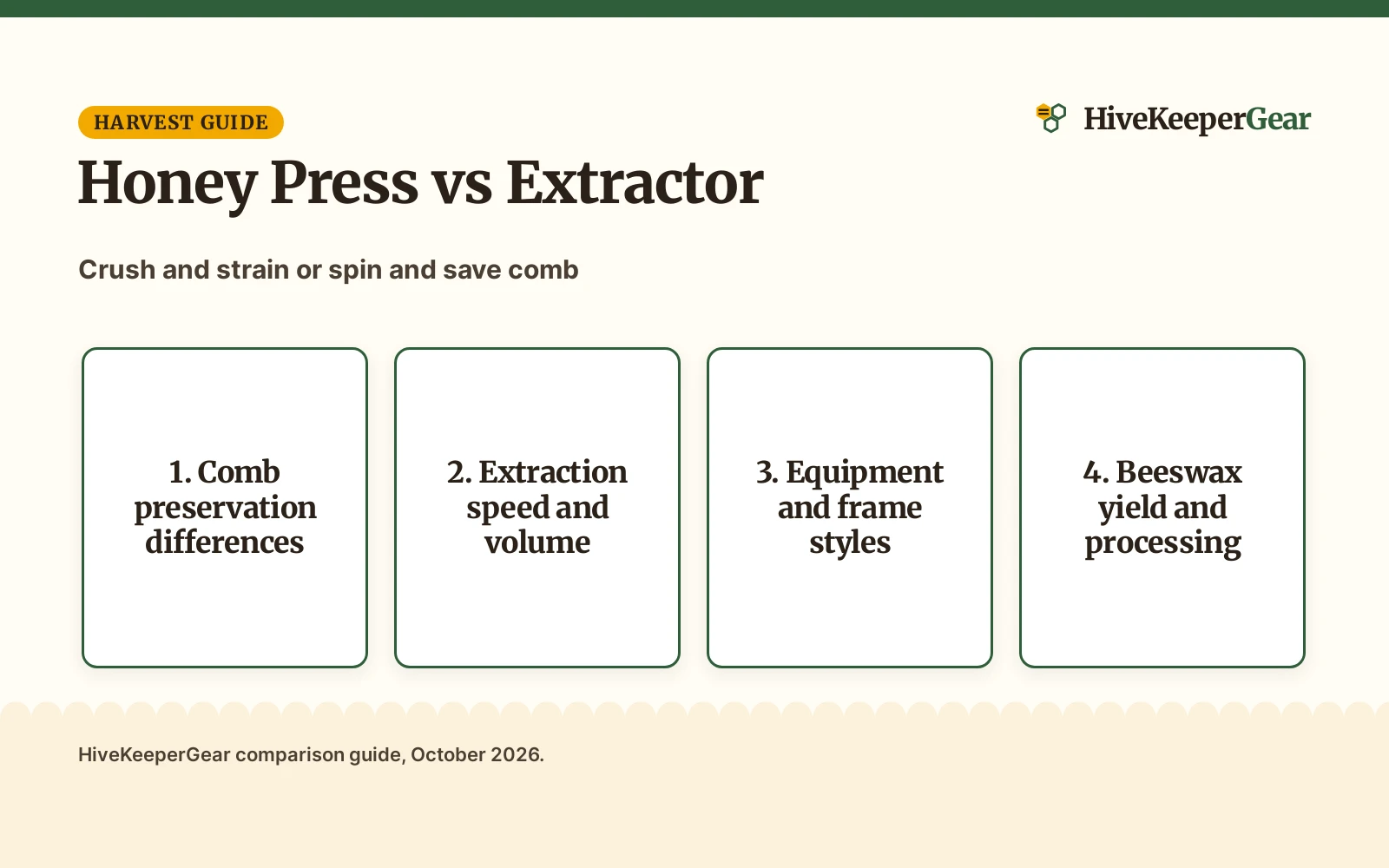
1. Comb preservation and colony resources
The greatest difference between these two harvesting tools is what happens to your drawn beeswax comb. When you harvest with a centrifugal extractor, you use an uncapping knife or fork to slice off the thin wax cappings covering the honey cells. The frame is then loaded into the extractor basket, where spinning pulls honey out against the drum walls while leaving comb structure intact. Returning extracted wet frames to the hive gives your colony a massive advantage, because bees can immediately clean, refill, and cap existing cells without consuming valuable nectar to rebuild wax comb.
A honey press, by contrast, uses mechanical pressure to crush comb completely. You slice comb away from the wooden top bar or frame, place the chunks into a filter bag, and turn a screw handle to squeeze honey out through mesh. Once pressed, that comb cannot be returned to the hive. While bees naturally produce new comb during strong nectar flows, forcing a colony to draw out fresh comb every season requires substantial energy and nectar that would otherwise become surplus honey in your jars.
2. Honey yield and extraction efficiency
Extraction efficiency depends on how thoroughly you recover honey from the comb and how quickly you process supers. A honey extractor uses centrifugal motion to fling liquid honey outward against the stainless steel drum, where it drains downward toward the honey gate. Because cells remain open and rigid, spinning empties comb thoroughly with minimal residual honey left behind. Beekeepers with multiple honey supers can uncap, spin, and empty frames rapidly in an afternoon.
Pressing honey is slower and operates in discrete batches. You load comb into a perforated basket or filter bag, position the pressure plate, and turn the screw handle to apply downforce. While heavy pressure extracts most liquid honey, the compacted wax cake inside the bag retains some honey residue. For beekeepers with a modest harvest from a backyard hive, pressing offers a simple workflow, but larger apiaries find batch loading and pressing far more labor intensive than spinning frames.
3. Beeswax harvest and processing
While extractors win on comb preservation, honey presses excel at beeswax harvesting. When using an extractor, your wax harvest comes only from cappings sliced off before spinning. Cappings wax is exceptionally pure and light in color, but it represents only a small portion of the wax present in a honey super. If your goal is crafting beeswax candles, salves, lip balms, or furniture polish, extracting leaves you with relatively little wax to melt down.
With a honey press, the entire comb is crushed, yielding substantial cakes of clean beeswax alongside your honey. Because comb is pressed through a fine mesh filter bag, the resulting wax cake is free of large debris. Once pressing is finished, you remove the compacted wax disc from the bag, rinse away residual honey in cool water, and melt it down in a solar wax melter or dedicated melting pot. Beekeepers who value wax production as much as honey often keep a press specifically for processing burr comb, brace comb, or foundationless honey bars.
4. Frame styles and equipment capacity
Choosing between a press and an extractor also shapes your equipment choices in the bee yard. Honey extractors rely on framed comb, ideally supported by foundation or guide wires to withstand spinning forces without blowing out. Extractors come in manual hand-crank and motorized formats designed to hold frames arranged radially or tangentially within the drum basket.
Manual honey presses, on the other hand, are standalone benchtop appliances that do not hold frames directly. Specifications from manufacturer listings illustrate the typical capacities available for backyard use. The HCTOOL honey press lists a 4.2-gallon capacity holding 2.64 gallons of honey at once, constructed from 304 stainless steel with an outer bucket wall thickness of 2.8mm and an overall weight of 20 pounds. HCTOOL also lists a smaller 2.6-gallon capacity model made from 201 stainless steel weighing 18 pounds. Generic lists a 3.17-gallon capacity model weighing 12.81 pounds with a food grade stainless steel build. For apiaries needing compact tools, BOZHENYULEI lists a 10-liter pressing capacity, while Pcmursal lists a lightweight food-grade unit at 10.73 pounds and PreAsion lists a 19.41-pound model. Because presses accept raw cut comb, they accommodate comb from top-bar hives, Warre boxes, or irregular cut comb that cannot fit into an extractor basket.
5. Cleaning and seasonal storage
Post-harvest cleanup is an unavoidable part of beekeeping, and both tools require proper care to maintain food safety and equipment longevity. A honey extractor has a large surface area comprising the drum walls, central spindle, frame baskets, and bottom cone. Cleaning an extractor involves rinsing the stainless steel drum with cool water to wash away residual honey without melting wax onto the metal, wiping down frame baskets, and opening the honey gate to let rinse water drain into a bucket. Storing an extractor requires a dedicated corner in a garage or shed, covered with a clean sheet or plastic wrap to keep dust and pests out until the next harvest.
A manual honey press has a smaller footprint but several moving parts that come into direct contact with honey and wax. The pressure plate, screw shaft, pressing chamber, and any filter bags used must all be thoroughly cleaned after each session. Rinsing with cool water dissolves honey readily without softening wax into the mesh or screw threads. Once clean and completely dry, a compact press fits easily on a workshop shelf.
A harvest decision timeline
Spring buildup: evaluate your hive styles and frame types. If you install packaged bees onto new foundation or run foundationless frames, expect colonies to invest nectar into drawing wax rather than producing a large surplus honey crop. Midsummer flow: monitor honey supers as flowers bloom. If supers fill rapidly and you run drawn comb on standard Langstroth frames, arrange for an extractor before capping finishes. Late summer harvest: inspect supers and remove frames that are fully or mostly capped with ripe honey. If you have foundationless comb or top-bar bars, cut the comb into a honey press lined with nylon filter mesh. For standard frames, slice cappings and spin frames in an extractor, then return wet supers to the hive for bees to clean. Fall prep: leave sufficient honey stores in brood boxes for winter survival. Clean all harvest equipment thoroughly with cool water to dissolve honey without melting wax, let parts dry completely, and store them securely away from mice and insects.
Additional harvest gear you need
Regardless of whether you choose a press or an extractor, harvesting honey requires several supporting tools to handle, filter, and bottle your crop:
- An uncapping knife or uncapping fork to remove wax cappings from frames before spinning in an extractor.
- A food-grade honey bucket with gate for collecting, settling, and dispensing liquid honey into jars.
- A stainless steel honey strainer or filter bag to remove wax particles, bee parts, and hive debris from freshly extracted honey.
- A honey refractometer to check moisture content before bottling and ensure honey will not ferment in storage.
- Clean glass or plastic jars with airtight lids for long-term storage and labeling.
Having your settling buckets, filters, and jars ready before you pull supers from the hive prevents sticky bottlenecks in your kitchen or honey house.
What is not covered in this guide
This comparison focuses strictly on mechanical honey presses and centrifugal honey extractors for backyard apiaries. We do not cover commercial radial extractors driven by multi-horsepower motors or large uncapping machines used by commercial honey producers. We also do not provide colony health, disease diagnosis, or pest treatment advice. For questions regarding hive health or regional apiary management, consult your local extension office or state apiary inspector.
FAQs for beekeepers
Can you use a honey extractor for crushed comb?
An extractor relies on centrifugal force spinning unbroken frames inside a basket, so loose crushed comb cannot be spun without making a mess and clogging the mechanism. Crushed comb from top-bar hives or cut comb must be strained through mesh or pressed in a honey press.
Does pressing honey ruin the beeswax?
Pressing crushes the comb structure into a compact cake of wax, but the beeswax itself remains intact and pure. Many beekeepers prefer pressing because it separates honey from the comb and leaves clean beeswax ready for melting into blocks.
Which method is faster for harvesting honey?
A centrifugal honey extractor processes supers much faster because spinning takes only minutes per batch and leaves frames ready to return to the bees. A manual press requires cutting comb, loading nylon filter bags, and turning the handle for each batch.
What capacity do manual honey presses offer?
Manual honey presses in manufacturer listings vary from small units to larger models. For instance, HCTOOL lists a 4.2-gallon capacity model that holds 2.64 gallons of honey at once, alongside a 2.6-gallon model, while BOZHENYULEI lists a 10-liter batch capacity.
Do I need to uncap frames before using a honey press?
No uncapping is needed for a honey press because you cut the comb entirely from the top bar or frame and crush it directly inside a filter bag. Uncapping knives and forks are only required when loading intact frames into a centrifugal honey extractor.
More hive guides
Browse every guide by category: honey harvesting, honey extractors, honey strainers and uncapping tools.
More harvest guides: Explore our honey extractor picks, read our manual extractor guide, compare honey strainers, or learn how to use a honey extractor. New to beekeeping? Start with our beekeeping supplies for beginners checklist.