Top Bar vs Warre Hive: Which One Should You Buy?
A direct comparison of top bar and Warre hives, examining horizontal management, vertical nadiring, comb inspection, honey harvesting, and winter colony survival.

On this page
Top picks at a glance
As an Amazon Associate I earn from qualifying purchases.
- 1
 Build Your Own Beekeeping Equipment: How to Construct 8- &9.2/10View on Amazon
- 2
 witbee Winter Bee Hive Wrap for 8 and 10 Frame Beehives9.6/10View on Amazon
- 3
 Balanced Beekeeping II: Managing the Top Bar Hive by PhilipView on Amazon
- 4
 BackYardHive DVD: Alternative Beekeeping Using the Top BarView on Amazon
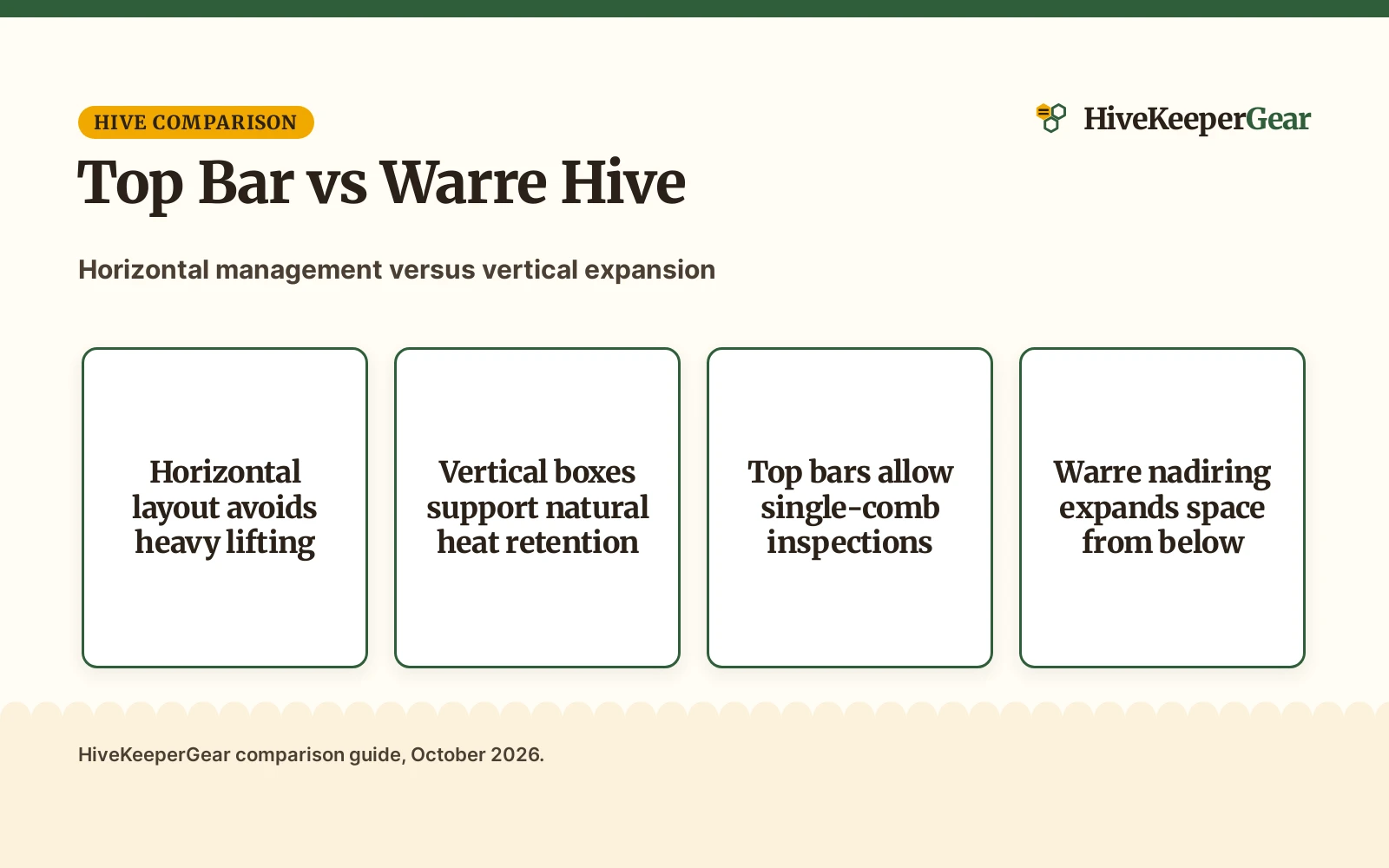
When preparing the apiary for spring colony arrivals, choosing between a top bar vs warre hive comes down to how you prefer to inspect comb and manage brood space. A top bar hive suits beekeepers who want waist-height inspections without lifting heavy boxes, while a Warre hive serves those who prefer a compact vertical footprint that mirrors a natural tree hollow and conserves winter warmth. Both styles use foundationless wooden bars where bees build natural comb, but they differ fundamentally in expansion direction, harvesting technique, and seasonal handling. This guide compares how each hive operates across the active season to help you select the right setup.
Other hives and gear to compare
 Balanced Beekeeping II: Managing the Top Bar Hive by PhilipCheck price on Amazon
 BackYardHive DVD: Alternative Beekeeping Using the Top BarCheck price on Amazon
HiveKeeperGear earns a commission when you buy through links on this site, at no extra cost to you. As an Amazon Associate I earn from qualifying purchases. Affiliate disclosure.
Natural comb beekeeping principles
Conventional beekeeping relies heavily on rectangular wooden frames with embossed plastic foundation sheets that dictate comb cell size. In contrast, top bar and Warre hives belong to the natural comb tradition. In these hives, honeybees build comb entirely from their own wax glands, drawing worker brood cells, drone comb, and honey storage cells according to colony needs. Because comb is not bound inside enclosed wooden frames, bees produce virgin wax free from artificial plastics.
Managing foundationless comb requires calm handling. Without foundation, fresh comb is pliable, especially during warm summer nectar flows. Beekeepers drawn to these styles prioritize bee-centric biology, reduced equipment clutter, and simple wax processing over commercial honey volume.
Top bar vs warre hive: core differences compared
While both designs use foundationless top bars, their physical architecture leads to opposite seasonal workflows. The table below outlines how hive mechanics, inspection requirements, and colony management differ across both styles.
| Feature | Top Bar Hive | Warre Hive |
|---|---|---|
| Hive layout | Horizontal trough | Vertical stacked boxes |
| Comb support | Top bars without frames | Top bars without frames |
| Expansion direction | Sideways along the trough | Downward by nadiring boxes |
| Heavy box lifting | None required during inspection | Required when adding lower boxes |
| Comb inspection | Individual comb examination | Box-level or limited comb checks |
| Harvesting method | Cut-comb or crush-and-strain | Crush-and-strain by whole box |
| Winter heat retention | Horizontal heat loss along ceiling | Vertical chimney retains warmth |
| Apiary footprint | Wide horizontal space required | Compact vertical stack |
How the top bar hive works
The top bar hive, often built with sloping sides in the Kenyan style, consists of a long trough resting horizontally on legs at comfortable standing height. Wooden bars rest across the upper rim, fitting tightly against each other edge to edge to form a continuous wooden roof over the colony. When you lift a bar, only a narrow opening into the cavity is exposed, keeping the brood nest dark and calm.
Colony space inside a top bar hive is regulated using a movable wooden divider called a follower board. During early spring buildup, the follower board is positioned close to the entrance to maintain brood nest warmth. As nectar flows strengthen, the beekeeper slides the board down the trough, adding empty bars where bees draw fresh comb. Compare complete setups in our top bar bee hive guide.
How the Warre hive works
The Warre hive uses a vertical stack of compact, interchangeable square wooden boxes. Rather than resting comb on full frames, each box supports a row of wooden top bars across its upper rebate. The hive is topped with a canvas cloth, a ventilated quilt box packed with wood shavings to absorb moisture and retain heat, and an angled roof. The quilt box design is contrasted with standard covers in our inner cover vs quilt box guide.
The defining management technique of the Warre hive is nadiring. Instead of adding empty honey supers above the brood nest, the keeper lifts existing boxes and places fresh, empty boxes underneath. Honeybees naturally build comb downward as the brood nest descends, storing honey overhead. This mimics wild bees nesting in hollow trees, keeping the colony on freshly drawn wax while leaving mature honey stores undisturbed above.
Inspections and physical management
Physical strain during routine inspections represents a significant contrast between these designs. Top bar beekeeping eliminates the back strain of lifting heavy supers. The hive sits permanently on a stand at waist height, allowing you to inspect comb by comb without lifting boxes. You simply remove the outer lid, apply light smoke, and lift each bar individually. This makes top bar beekeeping an attractive option for keepers with physical lifting limitations.
Handling foundationless top bar combs requires care. Because comb hangs freely from the bar without side rails, gravity can snap soft wax if a bar is tilted flat. Keepers must keep the comb perpendicular to the ground, pivoting the bar smoothly to examine both sides.
In contrast, Warre beekeeping emphasizes minimal colony disturbance, meaning keepers rarely pull individual bars apart to search for the queen. Expansion is assessed by viewing comb upward from beneath tilted boxes. However, nadiring and harvesting require lifting the entire stack of heavy, bee-filled boxes to insert fresh equipment at the bottom.
Honey harvesting and wax yield
Harvesting honey from natural comb hives differs from conventional extraction. In framed hives, keepers uncap frames and spin them inside a centrifuge to extract liquid honey without damaging wax comb. In top bar and Warre hives, foundationless comb lacks the rigidity to survive spinning forces, requiring cut-comb or crush-and-strain processing.
Top bar keepers harvest selectively by removing bars filled with capped honey from the rear of the trough. The comb is sliced away from the bar, leaving a thin wax starter strip so bees can rebuild. Comb can be consumed as raw honeycomb or crushed inside a filter bag. Warre keepers harvest by the entire box, removing the top capped box in late summer. Many Warre keepers use a dedicated honey press rather than bucket strainers, as detailed in our honey press vs honey extractor guide.
Both systems yield abundant clean beeswax alongside honey. Because bees draw new comb for future storage, natural comb harvesting provides a regular supply of pure wax for candles and balms.
Wintering performance and climate fit
Winter survival highlights the thermodynamic differences between these shapes. Honeybees do not warm the entire hive cavity; they form a tight cluster that generates warmth through shivering flight muscles. As winter progresses, the cluster moves into honey stores, consuming fuel while generating rising heat and moisture.
The Warre hive excels in cold winter climates because its vertical column matches wild nesting geometry. As warmth rises, it softens capped honey directly above the cluster, allowing bees to ascend smoothly into food stores. Above the top bars, the quilt box lets moisture vent away without condensing into chilling droplets, keeping the cluster dry through northern winters.
Top bar hives present greater thermal challenges in freezing regions. Because the cavity stretches horizontally, rising heat gathers along the ceiling rather than concentrating over the bees. To reach stores, the cluster must move sideways along the trough. During prolonged cold spells, bees cannot break cluster to cross cold comb, risking starvation within reach of honey. Top bar hives perform most reliably in temperate or southern regions with mild winters.
Top bar vs warre hive: which hive should you choose?
Selecting between these systems depends on your physical lifting comfort, regional climate, and preferred inspection routine.
Choose a top bar hive if:
- You want to avoid lifting heavy boxes due to physical or back strain.
- You enjoy detailed comb inspections and observing brood development bar by bar.
- You keep bees in a temperate region with relatively mild winters.
- You prefer harvesting small amounts of comb honey throughout the season.
- You have horizontal space in your yard for a long hive body.
Choose a Warre hive if:
- You want a compact vertical footprint for a small yard or garden.
- You live in a cold-winter climate where vertical heat retention is critical.
- You prefer a low-intervention management approach with minimal brood disturbance.
- You have the physical strength to lift stacked boxes when nadiring or harvesting.
- You want whole-box honey harvesting and generous yields of clean beeswax.
FAQs for beekeepers
Can you extract honey from a top bar or Warre hive using a centrifuge?
Centrifugal extractors require rigid framed comb that spins under force without breaking. Because both top bar and Warre hives use foundationless comb, spinning tears the wax, making crush-and-strain or cut-comb the primary harvesting methods.
Which hive requires less heavy lifting during inspections?
The top bar hive requires significantly less lifting because you inspect individual wooden bars horizontally while standing upright. A Warre hive requires lifting entire honey-filled upper boxes to place empty boxes underneath the brood nest.
How do bees move during winter in a top bar versus a Warre hive?
In a Warre hive, the winter cluster follows its vertical tendency by moving upward into warm honey stores. In a top bar hive, the cluster must travel horizontally along the trough, which can leave distant honey out of reach during severe freezes.
Do top bar and Warre hives use standard Langstroth frames?
Neither design uses standard rectangular frames or plastic foundation. Both systems rely on simple wooden bars where the colony builds natural comb downward without outer wooden borders.
Can you add foundation to top bar or Warre hive bars?
Both hive styles are designed for natural foundationless beekeeping. Keepers use wooden comb guides or melted beeswax strips along each bar to guide straight comb construction rather than installing full foundation sheets.
More hive guides
Explore our guides by category: browse all beehives, honey harvesting equipment, and essential hive tools.
Compare alternative hive setups: read our guides on Langstroth vs Warre hive, horizontal vs vertical bee hives, and long Langstroth hive vs top bar. Setting up your yard? Review our checklist of beekeeping supplies for beginners.