Manual vs Electric Honey Extractor: Which One Should You Buy?
Manual vs electric honey extractor, compared on two VEVOR machines: frame capacity, effort, motor speed, lid safety and who each one suits.

On this page
Top picks at a glance
As an Amazon Associate I earn from qualifying purchases.
- 1
 VEVOR 4/8 Frame Electric Extractor9.5/10View on Amazon
- 2
 VEVOR 3 Frame Manual Extractor9.4/10View on Amazon
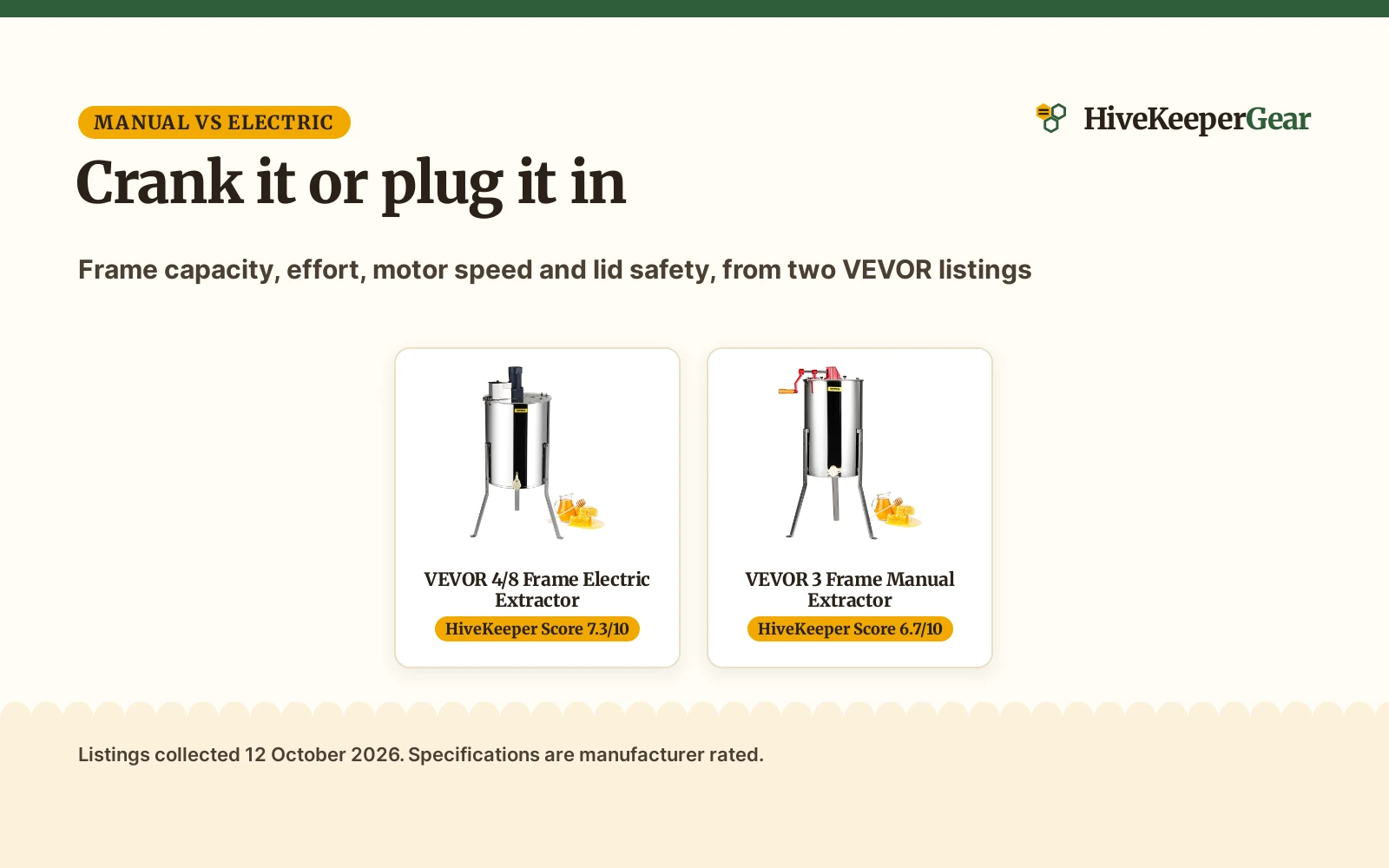
The manual vs electric honey extractor choice comes down to how many frames you spin at harvest and whether you have power where you extract. A hand crank model suits a beekeeper with a few hives and a few supers; an electric model suits someone spinning more frames, or anyone who wants to save their arms. We compared two stainless steel extractors from the same maker, a 3 frame manual model and a 4/8 frame electric model, using only what each Amazon listing publishes.
HiveKeeperGear earns a commission when you buy through links on this page, at no extra cost to you. As an Amazon Associate I earn from qualifying purchases. Affiliate disclosure.
Quick verdict: choose the manual extractor if you run a small apiary, want no cords and do not mind cranking each load. Choose the electric extractor if you spin more frames per harvest, want the speed control of a motor and have an outlet nearby. Both machines share the same stainless drum style, clear lid and adjustable stand, so the real difference is the drive and the capacity.
Two examples

VEVOR 4/8 Frame Electric Extractor
A 140W electric extractor in stainless steel with adjustable speed up to 1300 rpm, a clear lid that stops the spinner when opened and a 1.8 in honey gate.
Pros
- 140W motor with adjustable speed up to 1300 rpm
- Spinner stops automatically if the lid is opened
- 1.8 in honey gate for draining into containers
- Stand adjusts from 39.3 to 42.5 in
Cons
- Frame count is unclear: title says 4/8, bullets say 4 deep and 4 medium or shallow
- No warranty term is stated
- Needs a power outlet where you extract

VEVOR 3 Frame Manual Extractor
A 3 frame hand crank extractor in stainless steel with a clear lid and a stand that adjusts from 39.3 to 42.5 in and can be bolted to plywood.
Pros
- Holds up to 3 deep, medium or shallow frames
- No power needed, works anywhere you can crank
- Clear lid to watch the frames spin
- Legs can be bolted to a plywood base
Cons
- Every frame is spun by hand
- Honey gate size is not stated
- No warranty term is stated
As an Amazon Associate I earn from qualifying purchases.
Other hives and gear to compare
 GOODLAND BEE SUPPLY Hardin Professional 2 Frame Manual HoneyCheck price on Amazon
 Little Giant® 2-Frame Honey Extractor for BeekeepingCheck price on Amazon
 MayBee 2 Pack Honey Gate Valve for ExtractorCheck price on Amazon
 2Pcs Honey Gate Valve for ExtractorCheck price on Amazon
 Manual Paste Liquid Filling MachineCheck price on Amazon
Manual vs electric honey extractor: side by side
| Spec | VEVOR 3 Frame Manual Extractor | VEVOR 4/8 Frame Electric Extractor |
|---|---|---|
| Drive | Hand crank | 140W motor, adjustable speed |
| Top speed | Not stated | Up to 1300 rpm |
| Frame capacity | Up to 3 deep, medium or shallow frames | 4 deep frames, or 8 medium or shallow (title); bullets say 4 deep and 4 medium or shallow |
| Frame sizes listed | Deep 18.9 x 9 in, medium 18.9 x 6.3 in | Deep 18.9 x 9 in, medium 18.9 x 6.3 in |
| Material | Stainless steel | Stainless steel |
| Lid | Clear lid | Clear lid, spinner stops if opened |
| Honey gate | Not stated | 1.8 in |
| Stand height | 39.3 to 42.5 in, adjustable | 39.3 to 42.5 in, adjustable |
| Item weight | 25.8 lb | 21.4 lb |
| Item dimensions | 28 x 16 x 16 in | 33 x 19 x 19 in |
| Warranty | Not stated | Not stated |
We quote the beekeeping gear makers’ rated specs from each listing (as of 12 October 2026).
Effort and speed
A manual extractor is spun with a hand crank, so every load takes your arm. The VEVOR manual listing describes an ergonomic handle meant to make cranking easier, but it gives no speed figure. The electric VEVOR lists a 140W motor with adjustable speed up to 1300 rpm, which takes the cranking off your hands. Adjustable speed also lets you choose how fast the basket spins for each load.
Frame capacity
The manual model holds up to 3 deep, medium or shallow frames per load. The electric model is sold as a 4/8 frame extractor, described as an 8 frame rack or 4 deep frames, though one bullet says 4 deep and 4 medium or shallow. Either way, the electric one spins more frames per load than the manual one. Both listings give the same frame sizes: deep 18.9 x 9 in and medium 18.9 x 6.3 in, so check your frames against those numbers.
Lid safety and draining
Both machines have a clear lid so you can watch the honey move. Only the electric listing describes a safety feature: the spinner stops automatically if the lid is opened during extraction. That matters on a motorized machine, where the basket keeps turning on its own. The electric model also lists a 1.8 in honey gate for draining into containers; the manual listing does not state a gate size. Pair either one with a honey strainer and a honey bucket with gate for bottling.
Setup and space
Both stands adjust from 39.3 to 42.5 in, and the listings say the legs can be bolted to a piece of plywood to keep the barrel steady and off the floor. The manual model lists 25.8 lb and 28 x 16 x 16 in; the electric model lists 21.4 lb and 33 x 19 x 19 in. The electric one needs an outlet at your extraction spot, which can rule out a barn or outbuilding without power.
Listing gaps to check
Neither listing states a warranty term. Both spec tables list more than one extractor and manual in the box, 3 for the manual model and 2 for the electric one, which reads as a listing error for a single machine. The electric listing also contradicts itself on frame count. Ask the seller to confirm what ships before you order.
Which should you choose?
Choose a manual honey extractor if you keep a few hives, spin a few supers a season, want a machine that works anywhere without power and are happy to crank each load. Our manual honey extractor picks compare more hand crank models.
Choose an electric honey extractor if you spin more frames per harvest, want adjustable speed and a lid stop, and have an outlet where you extract. Our best honey extractor roundup covers more machines of both kinds.
Whichever you choose, uncap the frames first with an uncapping knife, and read our guide on how to use a honey extractor before the first harvest.
Inside the HiveKeeper Score
| Product | HiveKeeper Score | Perf. /35 | Build /25 | Value /25 | Safety /10 | Warranty /5 |
|---|---|---|---|---|---|---|
| VEVOR 4/8 Frame Electric Extractor | 9.5 | 29 | 20 | 20 | 4 | 0 |
| VEVOR 3 Frame Manual Extractor | 9.4 | 26 | 19 | 22 | 0 | 0 |
Each item’s weighted total is converted onto a scale that starts at 9.2 and ends at 9.8, linearly and in the same order.
The HiveKeeper Score weighs performance, build, value, safety and warranty, as explained on our how we pick page. The electric model scores higher on performance for its motor and speed control and earns safety points for its stated lid stop. The manual model scores better on value for a small apiary. Neither earns warranty points because neither listing states a warranty term.
FAQs for beekeepers
Is an electric honey extractor worth it for a hobby beekeeper?
It depends on how many frames you spin. The electric VEVOR holds more frames per load than the 3 frame manual model and replaces the hand crank with a 140W motor and adjustable speed up to 1300 rpm. With only a few supers a season, a manual extractor may be all you need.
How many frames should a honey extractor hold?
Match it to your harvest. The manual model in this comparison holds up to 3 deep, medium or shallow frames per load. The electric model is sold as 4/8 frame, described as 8 frames or 4 deep frames. More frames per load means fewer loads at harvest, so larger apiaries benefit from the bigger machine.
Is a manual honey extractor hard to use?
It takes effort, since you crank every load by hand. The VEVOR manual listing describes an ergonomic handle and a stand that adjusts from 39.3 to 42.5 in, so you can set a comfortable working height, and its legs can be bolted to plywood to keep the barrel steady while you crank.
Do electric honey extractors stop when the lid opens?
Some do. The electric VEVOR listing states that the spinner stops automatically if the lid is opened during extraction. Not every listing states this, so check for a lid stop before you buy any electric extractor, because the basket keeps spinning on its own once the motor is running.
More hive guides
Related: best honey extractor, manual honey extractor, how to use a honey extractor, and best honey refractometer.