Telescoping Cover vs Migratory Cover: Which One Should You Buy?
Compare telescoping and migratory hive covers to understand weather protection, apiary space, inner cover use, and transport needs before you buy.

On this page
Top picks at a glance
As an Amazon Associate I earn from qualifying purchases.
- 1
 Colingmill Bee Hive Telescoping Cover for 10 Frame Hive9.5/10View on Amazon
- 2
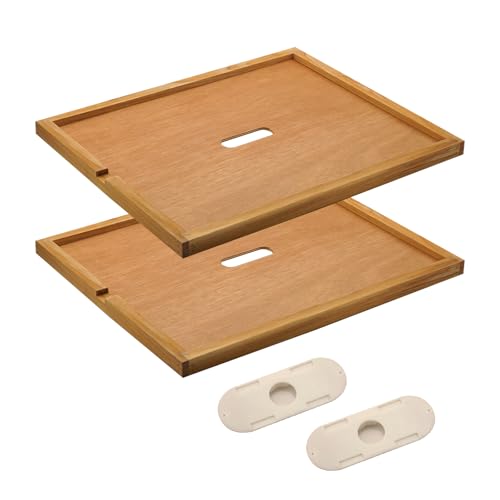 ENGAMEGURI Cedar Beehive Inner Cover with 2 Bee Escapes9.7/10View on Amazon
- 3
 Colingmill Bee Hive Telescoping Cover for 10 Frame Hive9.4/10View on Amazon
- 4
 Mann Lake Garden Hivery CoverView on Amazon
- 5
 Telescoping Cover Wax Dipped 8 Frame Used for Beehive DurableView on Amazon
As autumn flows end and apiary work turns to winter preparation, choosing the right lid to shield your colony from rain, snow, and cold becomes a central decision. When comparing a telescoping cover vs migratory cover, the right choice depends on your apiary priorities: beekeepers wanting maximum weather protection, rain runoff, and upper insulation space generally choose a telescoping cover, while those prioritizing hive portability, flush spacing on pallets, and rapid inspections prefer a migratory cover. This guide breaks down each design feature step by step.
Other hives and gear to compare
 Mann Lake Garden Hivery CoverCheck price on Amazon
 Telescoping Cover Wax Dipped 8 Frame Used for Beehive DurableCheck price on Amazon
 Colingmill 1 Pcs Bee Hive Cover 10 Frame Telescoping TopCheck price on Amazon
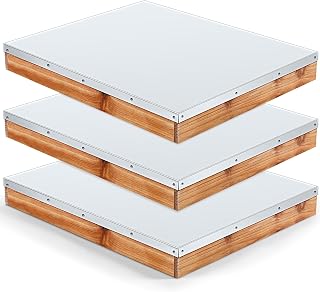 Colingmill 3 Pcs Bee Hive Cover 10 Frame Telescoping TopCheck price on Amazon
HiveKeeperGear earns a commission when you buy through links on this site, at no extra cost to you. As an Amazon Associate I earn from qualifying purchases. Affiliate disclosure.
Before you choose: hive cover fundamentals
A beehive cover does far more than keep rain off frames. The roof governs internal moisture, wind resistance, and accessibility during inspections. In North American beekeeping, Langstroth hives rely on either a telescoping cover or a migratory cover. Both rest atop the upper box, but they approach weather protection, apiary footprint, and equipment assembly in distinct ways. Understanding these differences before ordering woodenware prevents mismatched parts.
Telescoping cover vs migratory cover
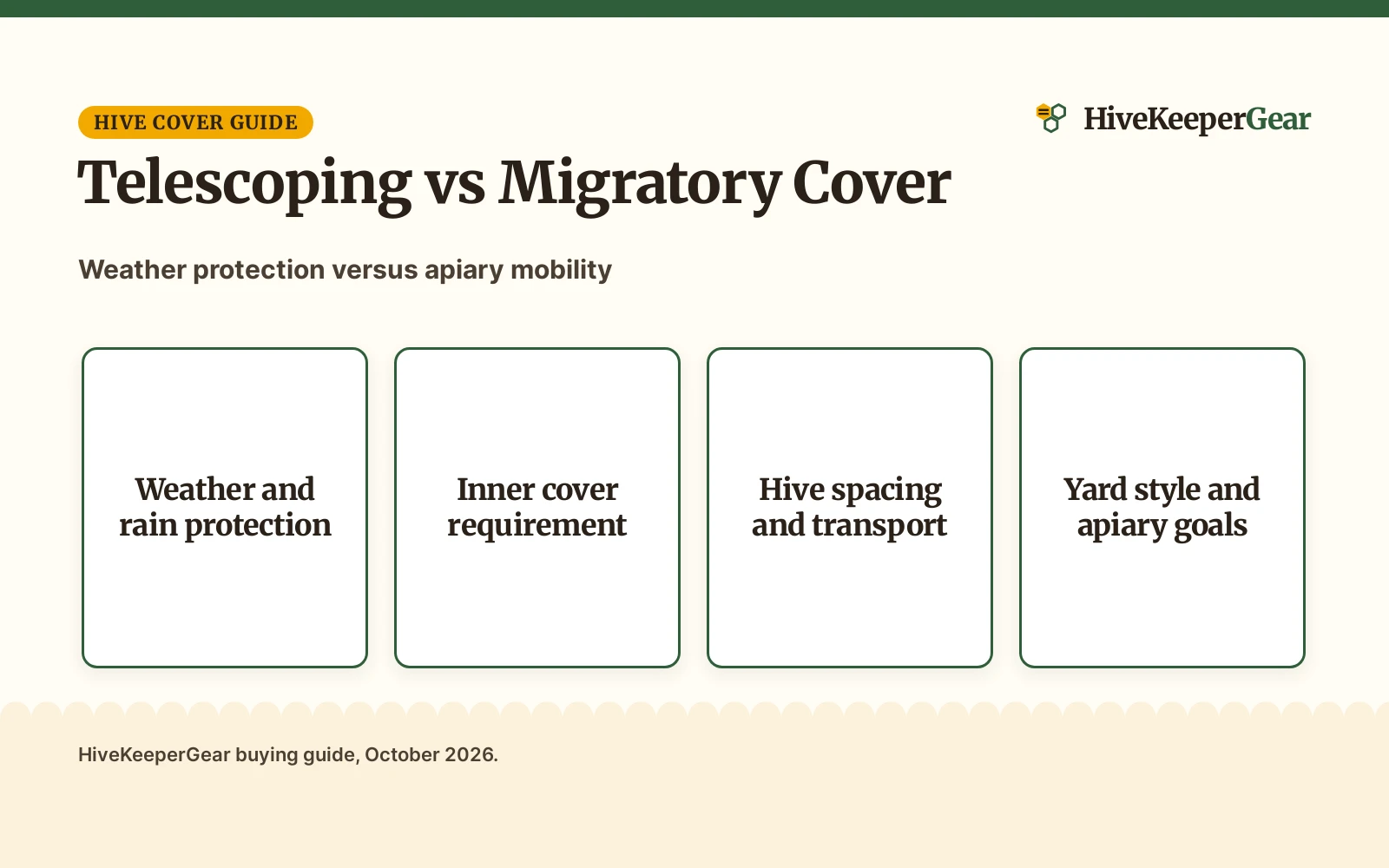
The main mechanical difference between these covers lies in their perimeter. A telescoping cover features a rim that drops around the top box edges, whereas a migratory cover sits flush on the sides and uses wooden cleats on the front and back. The comparison table below outlines their practical differences in daily apiary use.
| Feature | Telescoping Cover | Migratory Cover | Practical Impact |
|---|---|---|---|
| Side profile | Overhanging rim extends down around box edges | Flush sides aligned with hive walls | Telescoping sheds rain; migratory packs tightly on pallets |
| Inner cover | Paired underneath for bee space and removal | Omitted; rests on top box rim | Telescoping adds parts; migratory simplifies the hive stack |
| Cleats | Internal perimeter frame forms drop rim | External wooden cleats on front and back | Migratory cleats prevent front-to-back shifting in transit |
| Weather barrier | Outer metal cap over wood frame | Painted exterior plywood or solid lumber | Telescoping resists standing water and sun degradation |
| Apiary spacing | Requires clearance between adjacent hives | Hives can touch side by side on pallets | Migratory maximizes colony density on trucks and stands |
| Overhead cavity | Recessed space over inner cover holds thin insulation or feed | Flat underside leaves no cavity above frames | Telescoping simplifies feeding and condensation control |
1. Overhang and weather protection
The signature feature of a telescoping cover is the protective lip telescoping over the uppermost box. For a standard 10-frame hive, Colingmill lists outer dimensions of 21.85 by 17.83 inches with a rim depth of 2.56 inches. This overhang directs rain, snow, and ice away from the seam between roof and hive box, preventing water from pooling inside.
A migratory cover has no side overhang. Its flat board sits flush with hive body side walls, secured by front and back cleats. While a flat migratory cover sheds water forward when tilted slightly on its stand, driving rain can strike flush side seams directly. In damp climates, an overhanging rim provides stronger weather defense.
2. Inner cover requirement
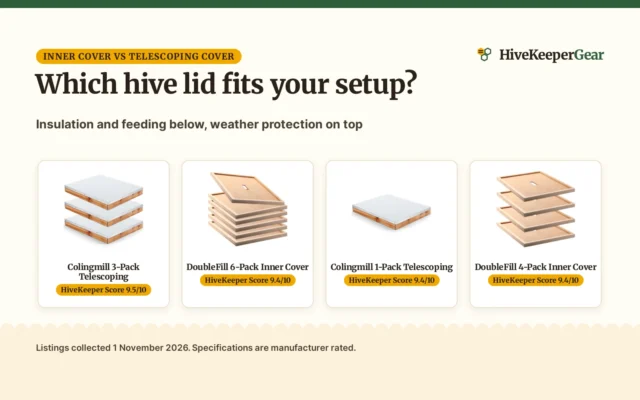
A telescoping cover is designed to pair with an inner cover underneath. Maker Colingmill pairs its 10-frame telescoping cover with an inner cover measuring 19.88 by 16.34 by 0.98 inches. The inner cover provides bee space over top bars, prevents bees from gluing the outer lid down with propolis, and creates an insulating dead-air pocket. Without an inner cover, bees would propolize the lid underside directly to the box rim. Because the telescoping rim hangs down over the outside, inserting a hive tool into that glued seam becomes nearly impossible.
Migratory covers are used without an inner cover. The flat underside rests directly on the hive box rim. Bees seal this joint with propolis, but the exposed outer edge gives beekeepers a direct prying ledge for a hive tool. Eliminating the inner cover cuts equipment cost and removes an extra piece to handle at inspections.
3. Hive spacing and transport
Transport efficiency is why migratory covers exist. Commercial beekeepers move colonies for pollination and honey flows, loading hives onto pallets and trucks. Because migratory covers have flush sides, hives can pack tightly with side walls touching, saving bed space and preventing shifting during transit. Cleats on the front and back also give tie-down straps a secure anchor ledge.
Telescoping covers are poorly suited for moves or palletized setups. Because rims extend beyond hive walls, adjacent hives cannot sit flush. Rims bump together, creating wasted gaps and trailer instability. In a stationary yard where hives sit spaced on dedicated stands, overhanging rims present no drawback.
4. Materials and weight
Most telescoping covers feature a metal skin over a wooden frame, though all-metal models exist. Maker Colingmill uses fir wood framed with galvanized iron or galvanized steel, listing an item weight of 8.68 pounds bundled with an inner cover. Other makers use decorative metals; Mann Lake lists an anodized copper-colored aluminum cover for 10-frame hives at an item weight of 8.6 pounds. The metal sheath ensures rainwater cannot soak through or rot underlying wood.
Migratory covers are built for simplicity, typically made from exterior plywood or pine with hardwood cleats across each end. Omitting metal capping makes migratory lids lighter to lift during apiary work. However, exposed wood surfaces require regular painting to prevent warping or delamination from sun and rain.
5. Inspection speed and propolis
Opening a hive with a telescoping cover requires separate steps: lifting the outer cover, then using a hive tool to pry loose the inner cover. While this takes only a moment, it adds up across many hives. On the upside, the inner cover keeps bees calm, preventing an immediate rush of flying bees when you remove the outer roof.
With a migratory cover, opening the hive is swift. You insert your hive tool into the flush side seam between the lid and the top box rim, pop the propolis seal, and lift the cover off. This speed is helpful when working through many colonies in an afternoon. Backyard keepers should note that breaking this seal exposes the entire top of the colony immediately, making calm smoker use essential.
Seasonal management in the bee yard
Throughout the season, your cover choice shapes your apiary routine. During spring buildup and honey flows, migratory covers let you stack supers rapidly without rim clearances or extra inner covers. In peak summer heat, sliding a migratory cover slightly forward so the back cleat rests atop the rear box wall creates a narrow upper ventilation gap to help colonies vent heat.
As fall turns toward winter, telescoping covers offer distinct advantages. The cavity beneath a telescoping cover accommodates sugar patties or fondant boards placed over the inner cover hole. In cold climates, keepers can place an insulation board or moisture pad over the inner cover beneath the lid to prevent winter condensation. When wrapping colonies with a bee hive winter wrap, the telescoping rim slides down over the wrap to prevent rain from running behind the insulation.
Nice to have later
- A brick or patio paver placed atop either cover to prevent wind from lifting the roof.
- A ratcheting strap to bind the bottom board, boxes, and cover together during storms or moves.
- A moisture quilt box or insulated shim to manage condensation in freezing weather.
- An entrance reducer to coordinate upper ventilation with restricted lower hive openings.
- A spare outer cover kept in yard storage for emergency replacements or swarm catches.
Having a spare lid and bricks on hand ensures you are prepared when storms blow through or unexpected apiary tasks arise.
What is not on this list
Package bees, nucleus colonies, and queens are sourced separately from gear suppliers; this guide evaluates hive covers only. We do not provide colony health, disease, or medical advice. For colony health questions, consult your local beekeeping association or state apiary inspector.
FAQs for beekeepers
Can you use an inner cover with a migratory cover?
Migratory covers are designed to rest directly on the hive body without an inner cover. Adding an inner cover under a migratory lid leaves the side seams exposed to rain and prevents cleats from seating properly on the box.
Why do commercial beekeepers prefer migratory covers?
Commercial beekeepers move colonies on pallets and trucks for pollination contracts. Flush side edges let hive boxes sit touching without wasted space, while cleats secure lids against shifting during transport.
Do telescoping covers require a brick or hive strap?
While telescoping covers have noticeable weight, such as the Mann Lake aluminum model listed at 8.6 pounds, wind can catch an overhanging rim. Placing a brick on top or strapping the hive provides security during storms.
Which hive cover is better for winter weather?
A telescoping cover provides superior winter protection because its rim hangs down past the top box joint to block driving snow and rain. It also accommodates an inner cover and supplemental feeding or moisture boards.
What dimensions does a 10-frame telescoping cover typically have?
Dimensions vary by maker, but as a reference, Colingmill lists a 10-frame telescoping cover at 21.85 by 17.83 by 2.56 inches over an inner cover measuring 19.88 by 16.34 by 0.98 inches. These figures ensure adequate rim drop around the hive walls.
More hive guides
Browse every guide by category: beehives, protective gear, hive tools and honey harvesting.
More picks: Compare Langstroth hive kits, see our guide on an inner cover vs quilt box, or weigh a screened vs solid bottom board. New to beekeeping? Check our guide to beekeeping supplies for beginners.