Ventilated vs Cotton Bee Jacket: Which One Should You Buy?
A comparison of ventilated and cotton bee jackets, looking at airflow, sting protection, fabric weight, veil options, and apiary durability to help you choose.

On this page
Top picks at a glance
As an Amazon Associate I earn from qualifying purchases.
- 1
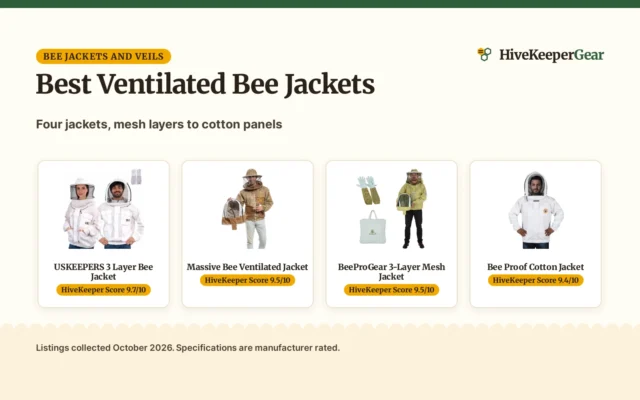
 3 Layer Ventilated Sting Proof Bee Jacket for Men & Women9.7/10View on Amazon
- 2
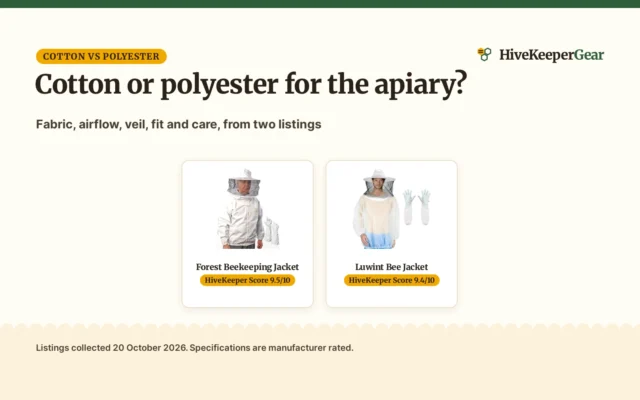
 Luwint Bee Jacket9.4/10View on Amazon
- 3
 Forest Beekeeping Jacket9.5/10View on Amazon
- 4
 Ventilated Beekeeping JacketView on Amazon
- 5
 Beekeeping Three Layer Mesh ventilated Jacket Fencing Veil inView on Amazon
- 6
 Brutul Bee 3 Layer Beekeeping Ultralight Ventilated JacketView on Amazon
- 7
 Humble Bee 330 Ventilated Beekeeping Jacket with Round VeilView on Amazon
- 8
 Humble Bee 331 Ventilated Beekeeping Jacket with Fencing VeilView on Amazon
- 9
 3 Layer Ventilated Bee Suit for Men & WomenView on Amazon
When midsummer hive inspections bring high heat and defensive colonies, deciding between a ventilated vs cotton bee jacket comes down to cooling airflow versus snag-resistant fabric durability. If you work in hot weather, buy a ventilated jacket because open mesh lets breezes through while creating fabric depth that helps keep bee stingers away from skin. If you inspect in mild weather, work around thorny brush, or want a lighter garment that cleans easily, a cotton bee jacket is the practical choice. We compared both styles across airflow, sting protection, fabric weight, veil options, and durability to help you choose.
Other hives and gear to compare
 Ventilated Beekeeping JacketCheck price on Amazon
 Beekeeping Three Layer Mesh ventilated Jacket Fencing Veil inCheck price on Amazon
 Brutul Bee 3 Layer Beekeeping Ultralight Ventilated JacketCheck price on Amazon
 Humble Bee 330 Ventilated Beekeeping Jacket with Round VeilCheck price on Amazon
 Humble Bee 331 Ventilated Beekeeping Jacket with Fencing VeilCheck price on Amazon
 3 Layer Ventilated Bee Suit for Men & WomenCheck price on Amazon
HiveKeeperGear earns a commission when you buy through links on this site, at no extra cost to you. As an Amazon Associate I earn from qualifying purchases. Affiliate disclosure.
Before you choose: climate and apiary conditions
Apiary location, seasonal weather, and yard vegetation shape clothing needs. Beekeepers managing hives in sunny yards during summer flows face intense heat buildup inside protective gear. When heat causes fatigue, inspections become rushed. In contrast, yards bordered by blackberry thickets or rough fences present sharp hazards that catch loose threads. Assessing yard conditions ensures you select a garment that protects without hindering hive work.
Ventilated vs cotton bee jacket: how they compare
While both garments protect your upper body during hive checks, they operate on different defensive principles. Ventilated jackets rely on fabric depth to help prevent stingers from reaching skin, whereas cotton jackets depend on tight canvas weaves. The comparison table below summarizes the practical differences between both styles.
| Feature | Ventilated Bee Jacket | Cotton Bee Jacket |
|---|---|---|
| Fabric design | Multi-layer mesh or polycotton open weave | Woven cotton canvas or twill |
| Cooling airflow | Allows wind to blow directly through layers | Restricts direct wind, retaining more body heat |
| Sting defense | Fabric depth creates physical barrier | Dense weave resists stinger penetration |
| Garment weight | Heavier due to layered mesh construction | Lighter garment weight when dry |
| Sweat handling | Perspiration evaporates quickly through mesh | Fabric absorbs moisture and holds dampness |
| Snag resistance | Outer mesh can catch on thorns and splinters | Smooth surface glides past rough branches |
| Laundering | Gentle wash cycle recommended; veil detached | Durable machine washable jacket body |
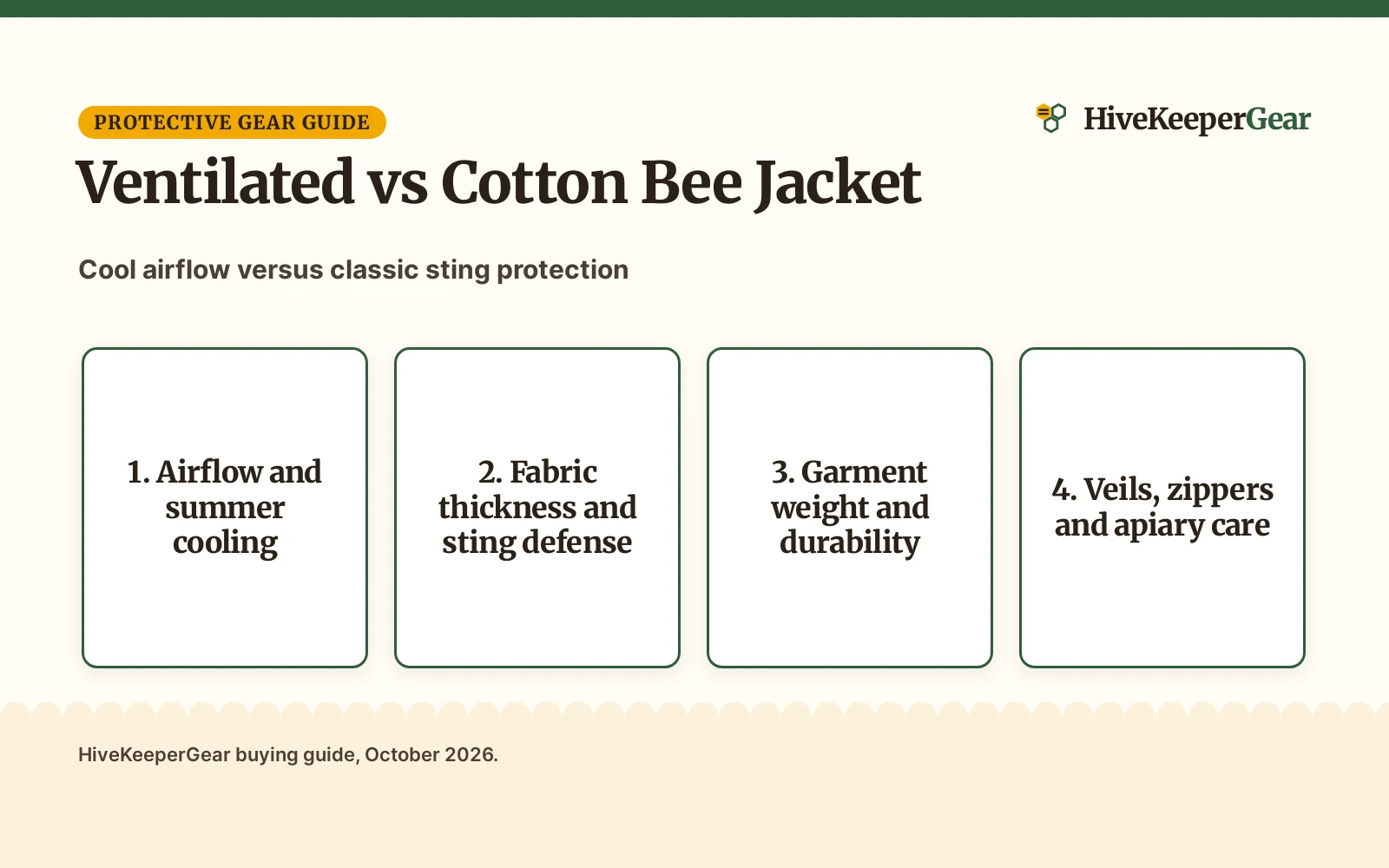
1. Airflow and summer ventilation
The primary advantage of a ventilated bee jacket is thermal comfort. Working multiple hives under bright sunshine generates considerable warmth. Ventilated jackets incorporate raised open mesh that permits ambient air to circulate across your chest, arms, and back. As wind moves through mesh, perspiration evaporates quickly, cooling skin naturally. Makers such as BeeProGear use an 80% polyester and 20% cotton mesh blend to balance ventilation with fabric structure.
Cotton jackets use closely woven canvas or twill. Cotton provides natural breathability, but blocks direct wind currents, retaining body heat in warm weather. For cool spring checks, this heat retention feels comfortable. During high summer inspections, however, cotton jackets cause heavy sweating that leaves cloth clinging to skin. If you work during hot afternoons, our best bee jacket for hot weather guide highlights models designed for maximum ventilation.
2. Fabric thickness and sting protection
Protection against honey bee stings relies on distinct structural methods in each garment. Ventilated jackets commonly use three-layer construction, placing an open middle spacer mesh between inner and outer linings. This configuration creates a physical barrier that helps keep stingers from reaching skin. Makers including USKEEPERS, FOREST BEEKEEPING SUPPLY, and GAIACOLMEIA rely on this three-layer barrier as their central sting defense mechanism. However, if mesh is pressed firmly against skin, such as when bending an elbow or leaning against hive boxes, compressed layers can still allow a stinger to reach skin.
A cotton bee jacket protects through fabric density rather than layered thickness. Heavy cotton canvas features a tight weave that resists stinger penetration. Because a cotton jacket consists of unlayered cloth, however, any point where the garment pulls taut against your body creates potential vulnerability. When fabric presses flush against skin, a bee stinger can pass through the weave. To maintain safety, cotton jackets must fit loosely to preserve an air cushion between fabric and skin. When considering whether a jacket or full coverall suits your apiary routine, our comparison of bee suit vs bee jacket options explains coverage differences.
3. Garment weight and fabric durability
Fabric construction influences jacket weight and durability. Because ventilated jackets feature multiple layers of mesh and spacer material, they carry greater heft than cotton apparel. Reference listings show a FOREST BEEKEEPING SUPPLY ventilated jacket weighs 3.09 pounds in size Medium, an OZ ARMOUR ventilated jacket weighs 3.84 pounds in size Large, and GAIACOLMEIA lists an item weight of 3.45 pounds in size Large and 3.85 pounds in size 4XL. Although this weight rests comfortably on shoulders, the garment feels heavier when handled than a cotton jacket.
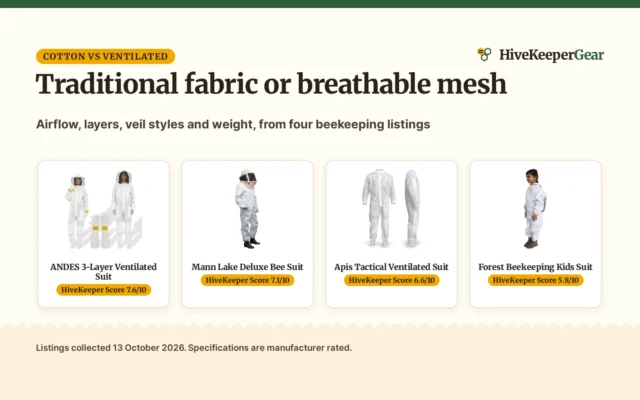
Durability in the bee yard also reflects material design. Smooth cotton canvas resists abrasive contact with rough hive bodies and thorny brush. If you work near blackberry brambles, cotton canvas slides past obstacles without snagging. Ventilated jackets feature synthetic netting that can catch on thorns or exposed nails, causing localized runs. Beekeepers working around wild vegetation must navigate carefully to avoid tearing outer layers. For full-length alternatives, our cotton vs ventilated bee suit guide reviews these material characteristics across one-piece garments.
4. Veils, zippers, and pocket storage
Both jacket styles feature detachable hoods secured with perimeter zippers and Velcro overlap covers that close throat gaps. Certain ventilated listings provide multiple veil styles in the package; for example, OZ ARMOUR, USKEEPERS, and GAIACOLMEIA each include 2 detachable hoods featuring both a fencing veil and a round brim hat. Fencing veils feature rigid inserts that keep mesh off the face and unzip from the front, while round veils provide 360-degree mesh clearance around the head for wide peripheral vision. Our fencing veil vs round veil guide explains the sightlines of each shape.
Hardware construction determines durability across seasons. Reference listings from FOREST BEEKEEPING SUPPLY and USKEEPERS feature YKK brass metal zippers, while OZ ARMOUR highlights smooth synthetic YKK zippers with protective flaps. Storage options also vary. USKEEPERS includes 6 pockets with Velcro closures on its jacket, while FOREST BEEKEEPING SUPPLY provides 3 utility pockets. Cotton jackets feature patch pockets stitched directly to canvas, whereas ventilated jackets use reinforced fabric patches to secure pocket seams over mesh. For focused recommendations, explore our best beekeeping jacket review.
5. Washing and long-term apiary care
Regular maintenance removes sweat, dirt, and honey bee alarm pheromones deposited during inspections. Laundering gear neutralizes these chemical markers and keeps equipment fresh.
Cotton bee jackets offer simple washing. Once the veil is detached, the cotton body can be washed in a machine on a standard cycle with mild detergent, then hung to air dry or tumble dried on low heat. Ventilated jackets require more gentle laundering. Strong agitation or high dryer heat can distort internal spacer mesh. Makers like USKEEPERS specify cool machine washing and air drying to preserve layer thickness. Most beekeepers hand wash veils in cool water to protect wire brims and mesh screens, while the jacket body can be machine washed on a gentle or cool cycle as recommended by makers like USKEEPERS.
A seasonal decision guide
Choosing the right jacket depends on your climate, inspection schedule, and apiary environment.
Choose a ventilated bee jacket if:
- You inspect colonies in warm summer climates where high humidity causes heavy sweating.
- You manage multiple hives in a single session under direct sunshine.
- You want dependable physical separation between bee stingers and skin without wearing thick clothing underneath.
- You value listings that provide interchangeable veils to switch between fencing and round hat designs.
Choose a cotton bee jacket if:
- Your apiary routine takes place primarily during mild spring weather, cool mornings, or northern climates.
- You maintain hives near thick briars or brushy terrain where mesh might snag.
- You prefer lighter apparel that packs easily and cleans in normal household laundry.
- You want durable canvas construction that withstands abrasive contact with hive equipment.
Beekeepers seeking dedicated mesh options can browse our best ventilated bee jacket picks for detailed comparisons.
Features worth looking for
When evaluating any beekeeping jacket, check for these practical design details:
- Elastic thumb loops sewn into sleeve cuffs to prevent fabric from sliding up when putting on beekeeping gloves.
- Overlapping Velcro closures situated over the neck zipper junction to eliminate entry gaps.
- Reinforced pocket seams capable of supporting a stainless steel hive tool without tearing.
- A rigid veil insert that keeps netting safely away from your face during breezy inspections.
- A wide elastic waistband that sits snugly against trousers to block bees from crawling beneath the hem.
What these jackets will not do
A beekeeping jacket protects the upper torso, neck, arms, and head, but leaves your lower body dependent on work pants. While jackets are convenient for quick inspections, adding feed, or checking supers, bees can crawl beneath a loose waist hem or sting through thin denim. For complete coverage when moving colonies or splitting hives, a full coverall suit from our best beekeeping suit guide provides protection down to the ankles.
Furthermore, protective clothing cannot replace calm apiary technique. Defensive bees can still exploit unsealed cuff gaps or loose zippers. Always pair protective gear with deliberate hive handling, proper smoker technique from our best bee smoker guide, and routine gear checks to verify every closure remains secure before opening a hive.
FAQs for beekeepers
Can bees sting through a ventilated bee jacket?
Ventilated jackets use layered mesh to create fabric depth that helps keep stingers away from skin. While bees cannot reach skin through uncompressed mesh, stings can occur if fabric pulls tight against skin or if bees enter through unsealed gaps at cuffs, zippers, or the waist hem.
Is a cotton bee jacket too hot for summer beekeeping?
Cotton canvas restricts direct airflow and holds heat inside during summer hive checks, causing heavy sweating. Ventilated jackets allow breezes to evaporate perspiration through open mesh layers, providing superior cooling.
How much heavier is a ventilated jacket than a cotton jacket?
Because it incorporates layered mesh, a ventilated jacket weighs more than a cotton jacket. Reference listings show a Medium FOREST BEEKEEPING SUPPLY ventilated jacket weighs 3.09 pounds, while an OZ ARMOUR jacket weighs 3.84 pounds in Large, and GAIACOLMEIA lists 3.45 pounds for Large and 3.85 pounds for 4XL.
Can you machine wash a ventilated bee jacket?
You can wash the jacket body on a gentle or cool machine cycle after removing the veil, as specified by makers like USKEEPERS. Most beekeepers wash veils by hand in cool water to protect support wires and mesh netting.
Which veil style is better on a bee jacket?
Fencing veils feature rigid inserts that keep netting off the face and unzip at the front, while round veils provide 360-degree panoramic sightlines. Our what is veil in beekeeping guide details the benefits of each style.
More hive guides
See every bee jackets guide and all protective gear guides, or browse our guides for beehives, hive tools, and honey harvesting.
More picks: Compare full suits in our cotton vs ventilated bee suit guide, examine coverage differences in bee suit vs bee jacket, or explore mesh models in best ventilated bee jacket. For beginner supplies, see our beekeeping supplies for beginners checklist.