Where Do Bumble Bees Make Their Nests
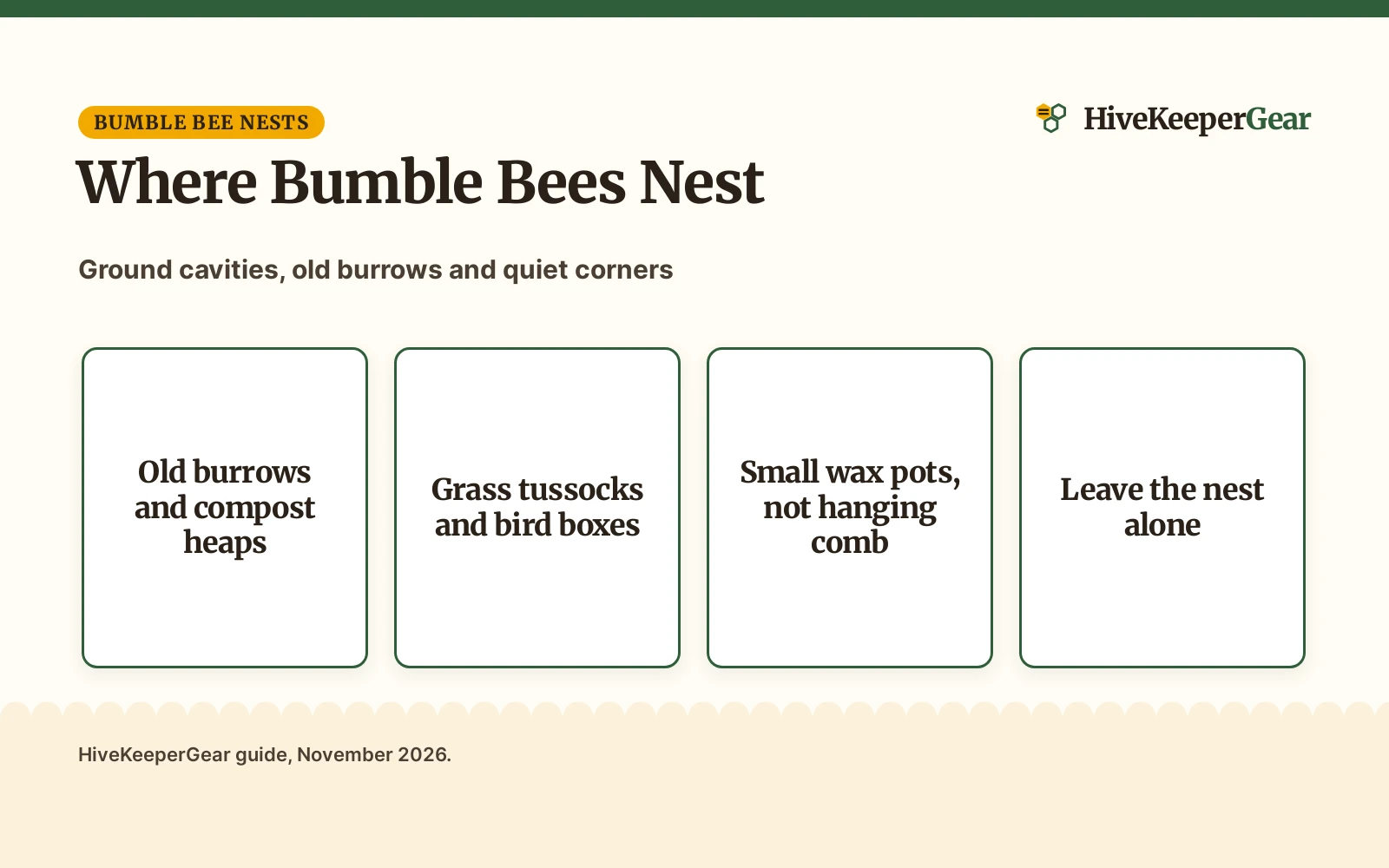
Bumble bees nest in sheltered cavities near the ground, from old burrows and compost heaps to grass tussocks and bird boxes, and this guide shows how to spot a nest and leave it alone.

On this page
Top picks at a glance
As an Amazon Associate I earn from qualifying purchases.
- 1
 BBB Seed Honey Source Wildflower Seeds Mix for Honey Bees9.5/10View on Amazon
- 2
 Organo Republic 16 Perennial Wildflower Seeds Mix9.6/10View on Amazon
- 3
 Created By Nature Bee and Butterfly Wildflower Seed Mix9.6/10View on Amazon
In spring, when the first queens appear over the lawn, the question comes up at the bee yard gate: where do bumble bees make their nests? The short answer is a sheltered cavity that is already there, usually at or just below ground level: an old burrow, a hollow under a shed, a compost heap, or a thick grass tussock. A queen does not build a hive the way honey bees do; she moves into a ready-made shelter and raises her colony inside it.
HiveKeeperGear earns a commission when you buy through links on this site, at no extra cost to you. As an Amazon Associate I earn from qualifying purchases. Affiliate disclosure.
Where Do Bumble Bees Make Their Nests: The Usual Places
Most nests sit at or just below ground level, in a dry, shaded spot with a small entrance and room for the colony to grow. The queen looks for insulation around the nest chamber, often moss, dry grass or old bedding left by the animal that dug the burrow. She also needs flowers nearby, since the colony feeds on nectar and pollen through the season.
| Place | What to look for | Notes |
|---|---|---|
| Old rodent burrow | A small hole in a bank or lawn edge, with bees coming and going | The most common nest site |
| Compost heap | Bees entering a gap in the heap | Warm and sheltered, leave it alone |
| Grass tussock | A low dome of dry grass with a hidden entrance | Easy to miss when mowing |
| Under a shed or deck | Bees using a gap under boards | Dry and shaded |
| Bird box | Bees in an old nest box | A box with old nesting material suits a queen |
| Wall cavity | Bees at a gap in brick or siding | Leave it and watch from a distance |
If you find a nest, watch it from a distance before deciding anything. A colony at the entrance, with workers flying in and out through the day, is a settled nest. See our can bumble bee sting guide for a calm look at stings.
How a Queen Chooses a Nest
A queen emerges in spring and spends her early days feeding and searching, flying low over banks, hedges and compost heaps while she looks for a cavity. She prefers a dry chamber with soft, dry material to line it, and an entrance she can defend. A nest that floods in rain or sits in full sun through the afternoon is a poor choice, so queens favor shade and drainage. Once she settles, she builds wax pots, lays her first eggs, and raises the workers that take over foraging.
What a Bumble Bee Nest Looks Like
A bumble bee nest is a loose cluster of wax pots on the ground, not the hanging combs of a honey bee hive. The queen builds small wax cups for nectar and pollen, and the brood sits in wax cells nearby. From the outside, the only sign is often the entrance hole and the steady traffic of workers. A hive box built for honey bees looks very different: Walsport lists its deep brood box at 19-7/8 by 16 by 9-5/8 inches, with a medium super at 19-7/8 by 16 by 6-5/8 inches, and frames that hang in a row of 10.
Bumble Bees and Honey Bees Nest Differently
Honey bees live in managed boxes that a beekeeper stacks and inspects, with frames the bees fill with comb. Bumble bees keep only small stores in wax pots and build no tall comb; their colony lives for a season in a cavity the queen found, then ends when the new queens leave to mate and rest through winter. That is why a bumble bee nest needs no hive, no frames and no beekeeper: the colony is wild, small and short-lived, and the colony is gone by winter.
A Bee House Is Not a Bumble Bee Nest
Garden bee houses suit solitary bees, not bumble bees. The BalterFF bee house (on Amazon), at 7.5 by 5.1 by 5.7 inches, has pre-drilled holes that suit leafcutter and carpenter bees, which nest alone in narrow tunnels. A bumble bee queen needs a larger cavity with room for a colony, so a small drilled block will not draw her. For the difference, see our beehive vs bee hotel guide and are bee houses a good idea guide.
If You Find a Nest
Leave the nest alone when you can. Mark the spot so mowing and foot traffic stay clear, and watch from a distance. Bumble bees are not aggressive away from the nest, and a colony in a quiet corner will finish its season and leave. If the nest sits where people must pass, ask your local beekeeping club or extension office for advice before moving anything. Do not block the entrance or pour anything into the nest.
FAQs for beekeepers
Do bumble bees live underground?
Often, yes. Many nests sit in old burrows or hollows just below the surface, though some sit at ground level in grass tussocks, compost heaps or under sheds. The nest is always in a sheltered cavity, not out in the open.
What does a bumble bee nest look like?
A loose cluster of wax pots on the ground, with brood cells nearby and no hanging comb. From outside, the entrance hole and the traffic of workers are the clearest signs.
Do bumble bees build nests?
A queen builds wax pots and cells inside a cavity she finds, but she does not build the cavity itself or hang comb the way honey bees do. She reuses a burrow, hollow or shelter that is already there.
How long does a bumble bee nest last?
A season. The colony grows through spring and summer, raises new queens, and ends as the year cools. The nest is not reused the next year, and the new queens rest elsewhere through winter.
Will bumble bees nest in a bee house?
No. Bee houses with drilled holes suit solitary bees such as leafcutter and carpenter bees. A bumble bee queen needs a larger cavity with room for a colony, so a small bee house will not draw her.
What should I do if I find a bumble bee nest?
Leave it alone when you can, mark the spot, and keep mowing and foot traffic clear. If the nest sits where people must pass, ask your local beekeeping club or extension office for advice.
More hive guides
Browse every guide by category: beehives, or see our Langstroth beehive kit and beehive frames guides, and our where to put a bee house guide.