Bee Balm Seeds vs Coneflower Seeds: Which One Should You Buy?
Bee balm and coneflower seeds compared on bloom color, height, zones, sowing needs and what each listing leaves unstated.

On this page
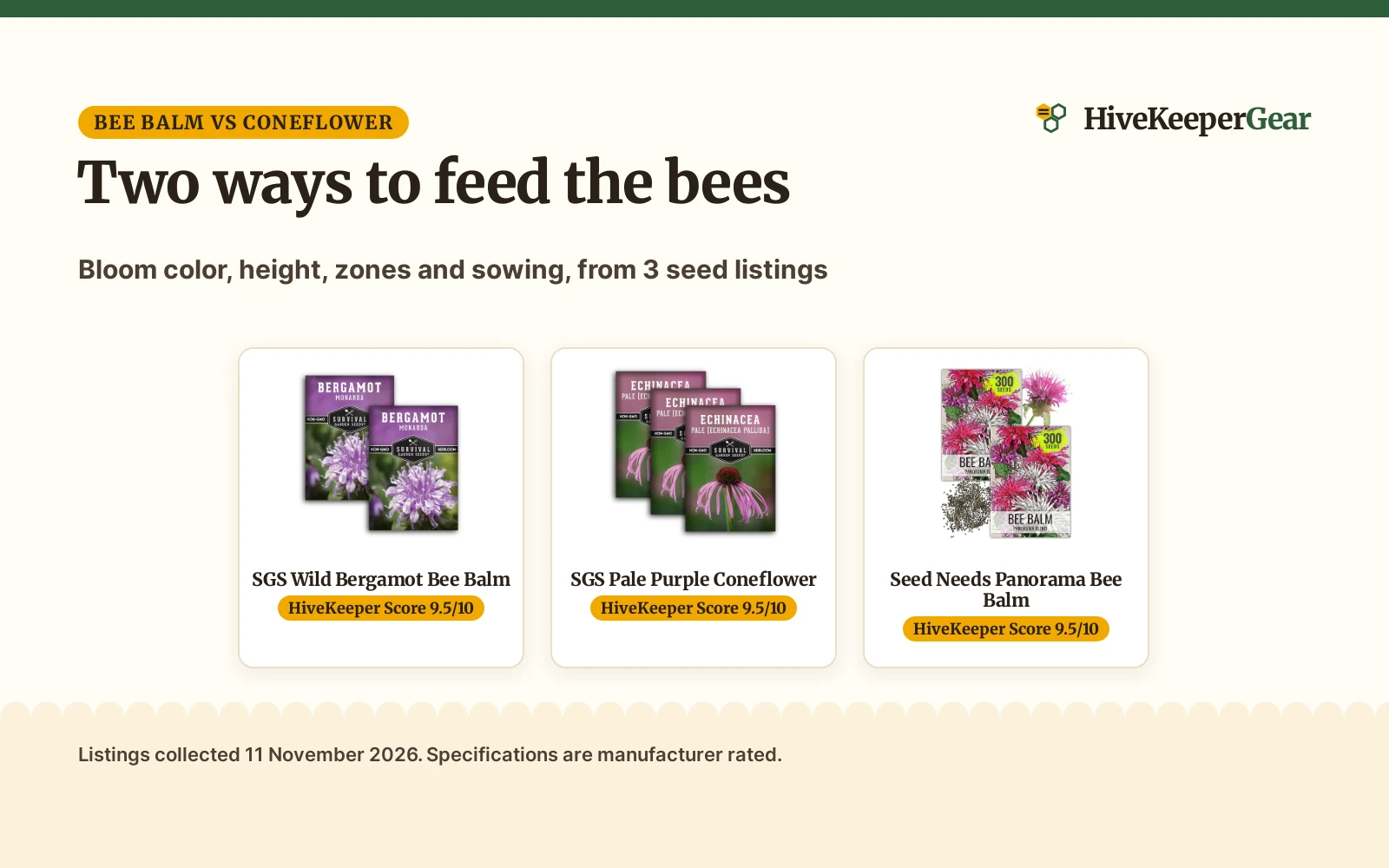
Top picks at a glance
As an Amazon Associate I earn from qualifying purchases.
- 1
 SGS Wild Bergamot Bee Balm9.5/10View on Amazon
- 2
 SGS Pale Purple Coneflower9.5/10View on Amazon
- 3
 Seed Needs Panorama Bee Balm9.5/10View on Amazon
Spring buildup fills the bee yard with new forage decisions, and the bee balm seeds vs coneflower seeds choice decides what blooms beside the hives. Bee balm promises fragrant flowers that return each year, while coneflower offers pale purple blooms on tall stems. We compared seed listings for both sides, using only what each listing publishes, to show where they differ and where the listings leave it unclear.
HiveKeeperGear earns a commission when you buy through links on this page, at no extra cost to you. As an Amazon Associate I earn from qualifying purchases. Affiliate disclosure.
Quick verdict: choose bee balm seeds if you want flowers that return each year with little fuss, and choose coneflower seeds if you want pale purple blooms and are willing to cold stratify the seed and accept that blooms may come only in the second year. Both sides are perennials that draw bees and butterflies, and the bee balm listings also name hummingbirds, so the real difference is patience at sowing time and what the listing actually states.
Three examples
| # | Product | HiveKeeper Score | Buy |
|---|---|---|---|
| 1 | SGS Wild Bergamot Bee Balm | 9.5/10 | Buy on Amazon |
| 2 | SGS Pale Purple Coneflower | 9.5/10 | Buy on Amazon |
| 3 | Seed Needs Panorama Bee Balm | 9.5/10 | Buy on Amazon |
SGS Wild Bergamot Bee Balm
Wild bergamot bee balm in 2 packs, a perennial native with lavender blooms that draws bees, butterflies and hummingbirds, sown indoors or directly outdoors in full sun.
Pros
- Perennial native that returns each year
- Draws bees, butterflies and hummingbirds
- Tolerates drought once established and spreads naturally
- Untreated, open-pollinated, non-GMO seed
Cons
- No height figure stated
- No zones stated
- No warranty term stated
SGS Pale Purple Coneflower
Pale purple coneflower in 3 packs, a perennial native with drooping petals around spiky centers, grown from seed that needs cold stratification before sowing.
Pros
- 3 packs, the most here
- Nectar-rich blooms attract bees and butterflies
- Perennial that returns year after year
- Untreated, open-pollinated, non-GMO seed
Cons
- Needs cold stratification before sowing
- May not bloom until the second year
- No height figure stated
- No warranty term stated
Seed Needs Panorama Bee Balm
A Panorama Mix of bee balm in 2 packs, with pink, white and scarlet blooms, a minty fragrance and a stated height up to 30 inches, for zones 3 to 9.
Pros
- Three bloom colors: pink, white and scarlet
- Grows up to 30 inches tall, the only height stated
- Thrives in zones 3 to 9, the only zone range stated
- Mildew resistant, per the listing
Cons
- No seed count per packet stated
- No untreated claim stated
- No warranty term stated
- Needs well-drained, moist soil, per the listing
As an Amazon Associate I earn from qualifying purchases.
Other hives and gear to compare
 Seed Needs Bee Balm Seeds to Plant Panorama Mix PerennialCheck price on Amazon
 Seed Needs Wild Bee Balm Seeds to Plant Bergamot PerennialCheck price on Amazon
 Seed Needs Spotted Bee Balm Seeds to Plant HorsemintCheck price on Amazon
 LOSEEDSOO Wild Bergamot Seeds for PlantingCheck price on Amazon
 Outsidepride Scarlet Bee Balm SeedsCheck price on Amazon
 American Wildflower Seeds for PlantingCheck price on Amazon
Bee balm seeds vs coneflower seeds: side by side
| Spec | SGS Wild Bergamot Bee Balm | SGS Pale Purple Coneflower | Seed Needs Panorama Bee Balm |
|---|---|---|---|
| Side | Bee balm seeds | Coneflower seeds | Bee balm seeds |
| Packs | 2 | 3 | 2 |
| Bloom color | Lavender, per bullets; Pink, per spec table | Pale purple | Pink, white and scarlet |
| Height | Not stated | Not stated | Up to 30 inches |
| Zones | Not stated | Not stated | 3 to 9 |
| Sun | Full sun | Full sun to partial shade | Full sun to part shade |
| Sowing | Indoors or directly outdoors | Cold stratify, then sow | Indoors or directly outdoors |
| First bloom | Not stated | May bloom in the second year | Not stated |
| Seed | Open-pollinated, untreated, non-GMO | Open-pollinated, untreated, non-GMO | Non-GMO; most seeds open-pollinated, heirloom |
| Warranty | Not stated | Not stated | Not stated |
Sizes, materials and capacities are the manufacturer’s ratings as each listing states them, collected 11 November 2026.
Bloom color and height
Bloom color is where the two sides part ways. The Wild Bergamot bee balm listing describes lavender blooms, though its spec table lists the color as Pink, while the Panorama Mix offers pink, white and scarlet blooms with a minty fragrance. The coneflower listing is steadier: pale purple blooms with drooping petals around spiky centers. Height is harder to compare, since only the Panorama Mix states one, up to 30 inches tall. The other 2 listings describe tall stems without a figure, so no side wins on height; the listings leave it unclear.
Where each one grows
Both sides are perennials that return each year, and both list full sun. The coneflower and the Panorama Mix add partial shade, while the Wild Bergamot listing says full sun only. Only the Panorama Mix states a zone range, 3 to 9. The Wild Bergamot listing says it tolerates drought once established and spreads naturally with little maintenance, and the Panorama Mix listing says it resists mildew. The coneflower listing asks for well-drained soil, as does the Panorama Mix, which also wants moist soil.
Starting from seed
Sowing is the sharpest difference between the sides. Both bee balm listings say to sow indoors or directly outdoors, with no extra step. The coneflower listing asks for cold stratification before sowing, then planting in well-drained soil, and warns that seedlings take time to establish strong roots and may bloom in the second year. The Panorama Mix packets measure 3.25 in wide by 4.50 in tall and carry sowing information on the reverse side. The SGS spec tables list product dimensions of 8.0 by 6.0 by 0.12 in for the bee balm and 8.0 by 6.0 by 0.18 in for the coneflower, not packet sizes.
What the listings leave out
No listing states a seed count per packet, a germination rate or a warranty term, so none of those can be compared. No listing states a height except the Panorama Mix, and no listing states a zone range except the Panorama Mix. Only the Panorama Mix listing states a packet size, 3.25 in wide by 4.50 in tall. What the listings do state is consistent on one point: all 3 are non-GMO, the 2 SGS listings state open-pollinated and untreated seed, and the Seed Needs listing says most of its seeds are open-pollinated and heirloom, with a few hybrids as exceptions.
Which should you choose?
Choose bee balm seeds if you want fragrant flowers that return each year and sow indoors or directly outdoors; the Panorama Mix adds pink, white and scarlet blooms. Our best bee balm seeds for gardens picks compare more bee balm packs.
Choose coneflower seeds if you want pale purple blooms with drooping petals, and you are willing to cold stratify before sowing and accept that blooms may come only in the second year. Our best coneflower seeds roundup covers more coneflower packs.
In the Bee Yard
- Store seed packets dry: the Seed Needs listing says its packets are moisture resistant and its seeds are stored in a facility free of significant amounts of moisture.
- Sow bee balm indoors or directly outdoors in full sun; the coneflower listing asks for cold stratification first.
- Keep packets where their sowing notes stay readable: the Seed Needs packets carry sowing information on the reverse side.
- Plant in well-drained soil with full sun to partial shade, as the coneflower and Panorama Mix listings state.
Inside the HiveKeeper Score
| Product | HiveKeeper Score | Perf. /35 | Build /25 | Value /25 | Safety /10 | Warranty /5 |
|---|---|---|---|---|---|---|
| SGS Wild Bergamot Bee Balm | 9.5 | 29 | 21 | 20 | 3 | 0 |
| SGS Pale Purple Coneflower | 9.5 | 28 | 20 | 21 | 3 | 0 |
| Seed Needs Panorama Bee Balm | 9.5 | 30 | 21 | 20 | 0 | 0 |
HiveKeeper Scores sit between 9.2 and 9.8, and a hive item’s weighted total lands on that range in proportion, so a higher total always gives a higher score.
The HiveKeeper Score weighs performance, build, value, safety and warranty, as explained on our how we pick page. The 2 SGS listings earn safety points for stating untreated seed, while the Seed Needs listing states no untreated claim. None of the 3 listings states a warranty term, so none earns warranty points. The coneflower listing scores lower on performance because it needs cold stratification and may not bloom until the second year.
FAQs for beekeepers
Can bee balm and coneflower grow together?
The listings do not say they cannot share a bed: both are perennials, and both list full sun. The coneflower needs cold stratification first, and the Wild Bergamot listing says it spreads naturally, so give each its own space.
Do bee balm seeds need cold stratification?
Not stated. Both bee balm listings say to sow indoors or directly outdoors, with no stratification step. The coneflower listing is the one that asks for cold stratification before sowing.
How tall does bee balm grow?
Only the Panorama Mix listing states a height: up to 30 inches tall. The other bee balm listing describes tall stems without a figure.
Will coneflower bloom in the first year?
The listing says seedlings may bloom in the second year, so a first-year bloom is not promised. Seedlings take time to establish strong roots, per the listing.
Are these seeds non-GMO?
All 3 listings state non-GMO seed. The 2 SGS listings add untreated and open-pollinated. The Seed Needs listing says most of its seeds are open-pollinated and heirloom, with a few hybrids as exceptions.
More hive guides
Related: best bee balm seeds for gardens, best coneflower seeds, best pollinator seed mix for apiaries, and how to attract mason bees.
More picks: lemon balm seeds vs bee balm seeds, borage seeds vs bee balm seeds and bee balm seeds vs pollinator seed mix.