Borage Seeds vs Bee Balm Seeds: Which One Should You Buy?
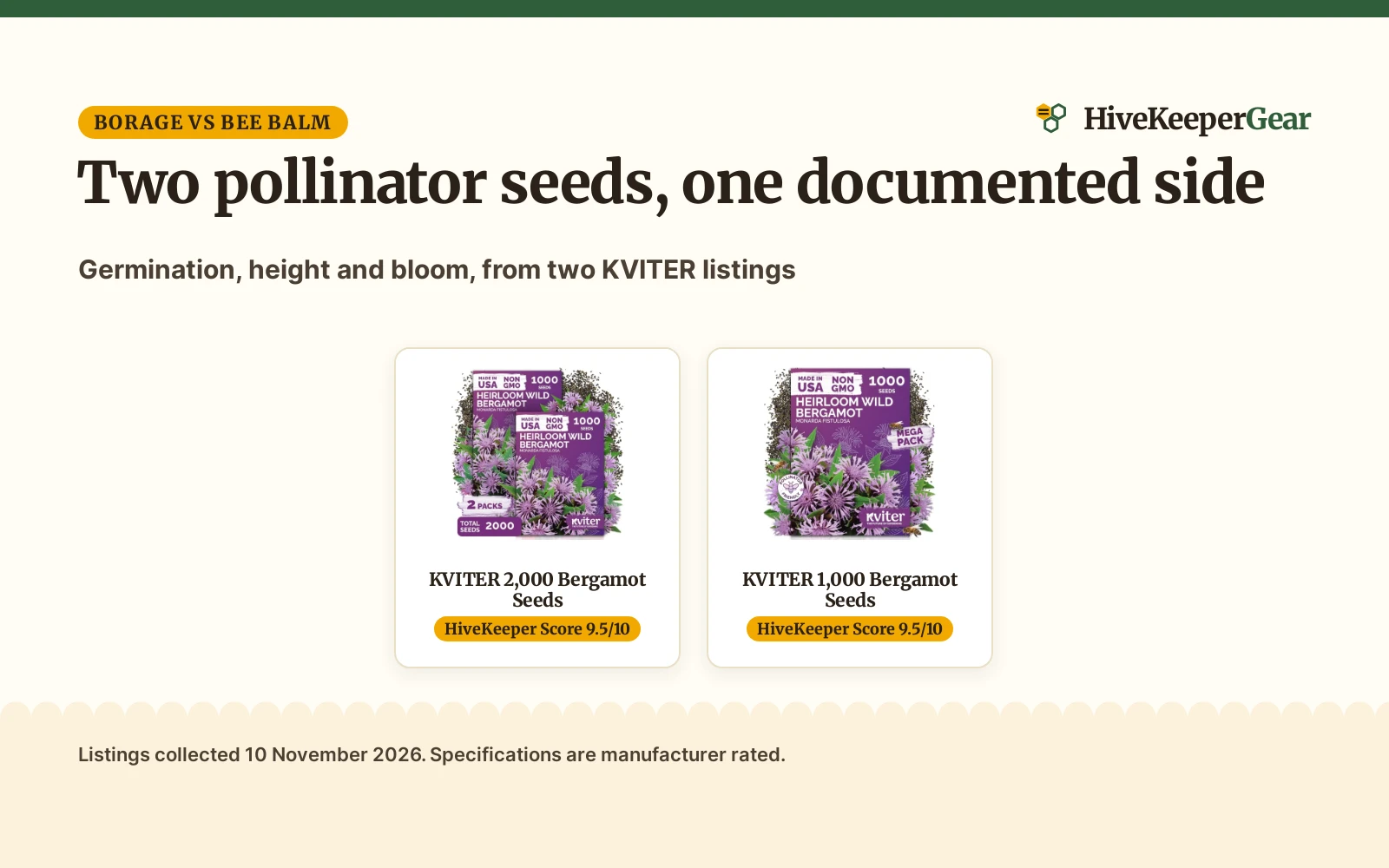
Two KVITER wild bergamot bee balm listings carry this borage vs bee balm comparison, since no borage listing was included in the data.

On this page
Top picks at a glance
As an Amazon Associate I earn from qualifying purchases.
- 1
 KVITER 2,000 Bergamot Seeds9.5/10View on Amazon
- 2
 KVITER 1,000 Bergamot Seeds9.5/10View on Amazon
Borage seeds vs bee balm seeds is the choice between two flower seeds for a pollinator bed. We compared the two listings in this article’s data, both wild bergamot bee balm from KVITER, using only what each listing publishes. No borage listing was included in the data, so the borage side has no listing figures here, and the bee balm side carries the whole comparison.
HiveKeeperGear earns a commission when you buy through links on this page, at no extra cost to you. As an Amazon Associate I earn from qualifying purchases. Affiliate disclosure.
Quick verdict: choose the bee balm listings if you want the documented perennial here: both KVITER packs state the same germination, height and bloom figures, and the 2,000-seed pack lists more seeds for a large bed. Choose borage only after checking a borage listing’s own figures, since this article’s data states none for that side.
Two examples
KVITER 2,000 Bergamot Seeds
A 2,000-seed pack of wild bergamot bee balm, heirloom, that sprouts in 10-20 days at 60-70 °F and grows up to 2-4 ft.
Pros
- 2,000 seeds per pack
- Sprouts in 10-20 days at 60-70 °F
- Drought tolerant, deer and mildew resistant
- Perennial, self-seeding rhizomes form mats
Cons
- No size stated in the spec table
- No warranty term is stated
- No germination rate is stated
- Same listing text as the 1,000-seed pack
KVITER 1,000 Bergamot Seeds
A 1,000-seed pack of wild bergamot bee balm, heirloom, non-GMO and USA packed, that sprouts in 10-20 days at 60-70 °F and grows up to 2-4 ft.
Pros
- 1,000 seeds per pack
- Sprouts in 10-20 days at 60-70 °F
- Drought tolerant, deer and mildew resistant
- Heirloom, non-GMO, USA packed
Cons
- Fewer seeds than the 2,000-seed pack
- No warranty term is stated
- No germination rate is stated
- Same listing text as the 2,000-seed pack
As an Amazon Associate I earn from qualifying purchases.
Other hives and gear to compare
 700 Lemon Balm Heirloom Herb Seeds for PlantingCheck price on Amazon
 Bee Balm Seeds for PlantingCheck price on Amazon
 Sow Right SeedsCheck price on Amazon
 Seed Needs Bee Balm Seeds to Plant Panorama Mix PerennialCheck price on Amazon
 Outsidepride Scarlet Bee Balm SeedsCheck price on Amazon
 LOSEEDSOO Wild Bergamot Seeds for PlantingCheck price on Amazon
Borage seeds vs bee balm seeds: side by side
| Spec | KVITER 2,000 Bergamot Seeds | KVITER 1,000 Bergamot Seeds | |
|---|---|---|---|
| Seeds per pack | 2,000 | 1,000 | |
| Germination | 10-20 days at 60-70 °F | 10-20 days at 60-70 °F | |
| Height | Up to 2-4 ft | Up to 2-4 ft | |
| Zones | USDA 2-9 | USDA 2-9 | |
| Color | Pink | Pink | |
| Pack size | Not stated | 1 Pack | |
| Warranty | Not stated | Not stated |
We quote the beekeeping gear makers’ rated specs from each listing (as of 10 November 2026).
Germination and growing
Both KVITER listings state the same germination figures: the seeds sprout in 10-20 days at 60-70 °F when surface-sown and kept moist, and suit USDA zones 2-9 in flower beds and containers. Nothing in the data states germination figures for borage, so the two sides cannot be compared on sprouting time from these listings. The listings also state the plants are drought tolerant once rooted and need rare drinks after that, which is a growing claim for the bee balm side only.
Height and spread
Both listings state the plants grow up to 2-4 ft, with 4 ft stems for fresh bouquets, and that self-seeding rhizomes form wildflower mats. The listings also state to divide bee balm every 2-3 years to renew blooms. No height or spread figure is stated for borage in the data, so the comparison cannot rank the sides on size from these listings.
Pollinators and bloom
The bee balm listings state pink-purple blooms in midsummer to early fall, attracting hummingbirds, butterflies and bees, and that the leaves lend citrus notes to herbal tea, potpourri and dried-herb mixes, with edible petals for home gardens. The listings also state the plants resist deer and mildew and scent herb gardens with a citrus aroma. No bloom or pollinator figure is stated for borage in the data, so the borage side has no matching claim here.
Listing gaps to check
The largest gap is the missing side: both listings in the data are bee balm, and no borage listing was included, so every borage figure is unstated here. The two KVITER listings also share the same bullet text, so the stated differences between them are the seed count, 2,000 against 1,000, the pack size, which the 1,000-seed listing states as 1 Pack and the 2,000-seed listing leaves unstated, and USA Packed and Non-GMO, which the 1,000-seed title states and the 2,000-seed title does not. Neither listing states a warranty term or a germination rate, and the 4 ft stems the listings mention for bouquets sit at the top of the stated 2-4 ft height range. Check a borage listing’s own figures before choosing that side.
Which should you choose?
Choose the bee balm listings if you want the documented perennial here, with stated germination, height and bloom figures, and a pack size that fits your bed. Our best bee balm seeds for gardens picks compare more bee balm listings.
Choose borage if you want the other side of this comparison, and check the borage listing’s own germination, height and bloom figures first, since this article’s data states none. Our best borage seeds picks compare more borage listings.
Inside the HiveKeeper Score
| Product | HiveKeeper Score | Perf. /35 | Build /25 | Value /25 | Safety /10 | Warranty /5 |
|---|---|---|---|---|---|---|
| KVITER 2,000 Bergamot Seeds | 9.5 | 29 | 21 | 21 | 0 | 0 |
| KVITER 1,000 Bergamot Seeds | 9.5 | 29 | 21 | 20 | 0 | 0 |
Each item’s weighted total is converted onto a scale that starts at 9.2 and ends at 9.8, linearly and in the same order.
The HiveKeeper Score weighs performance, build, value, safety and warranty. The 2,000-seed pack scores higher on value because it lists more seeds, while the 1,000-seed pack scores lower there. Neither listing states a safety feature or a warranty term, so neither earns safety or warranty points. How we pick explains the weights.
FAQs for beekeepers
Can I plant bee balm seeds in containers?
Yes. The KVITER listings state the seeds suit USDA zones 2-9 in flower beds and containers, when surface-sown and kept moist.
How long do bee balm seeds take to sprout?
The KVITER listings state the seeds sprout in 10-20 days at 60-70 °F when surface-sown and kept moist.
How tall does wild bergamot bee balm grow?
The KVITER listings state the plants grow up to 2-4 ft, with 4 ft stems for fresh bouquets.
Does bee balm come back every year?
The KVITER listings state bee balm is a perennial, that self-seeding rhizomes form wildflower mats, and that you divide bee balm every 2-3 years to renew blooms.
What pollinators does bee balm attract?
The KVITER listings state the pink-purple blooms attract hummingbirds, butterflies and bees in midsummer to early fall.
Do I need to check borage figures separately?
Yes. No borage listing was included in this article’s data, so check the borage listing’s own germination, height and bloom figures before you buy.
More hive guides
Related: best borage seeds, best bee balm seeds for gardens, best pollinator seed mix for beekeepers, and bee balm seeds vs pollinator seed mix.