Bee Balm Seeds vs Yarrow Seeds: Which One Should You Buy?
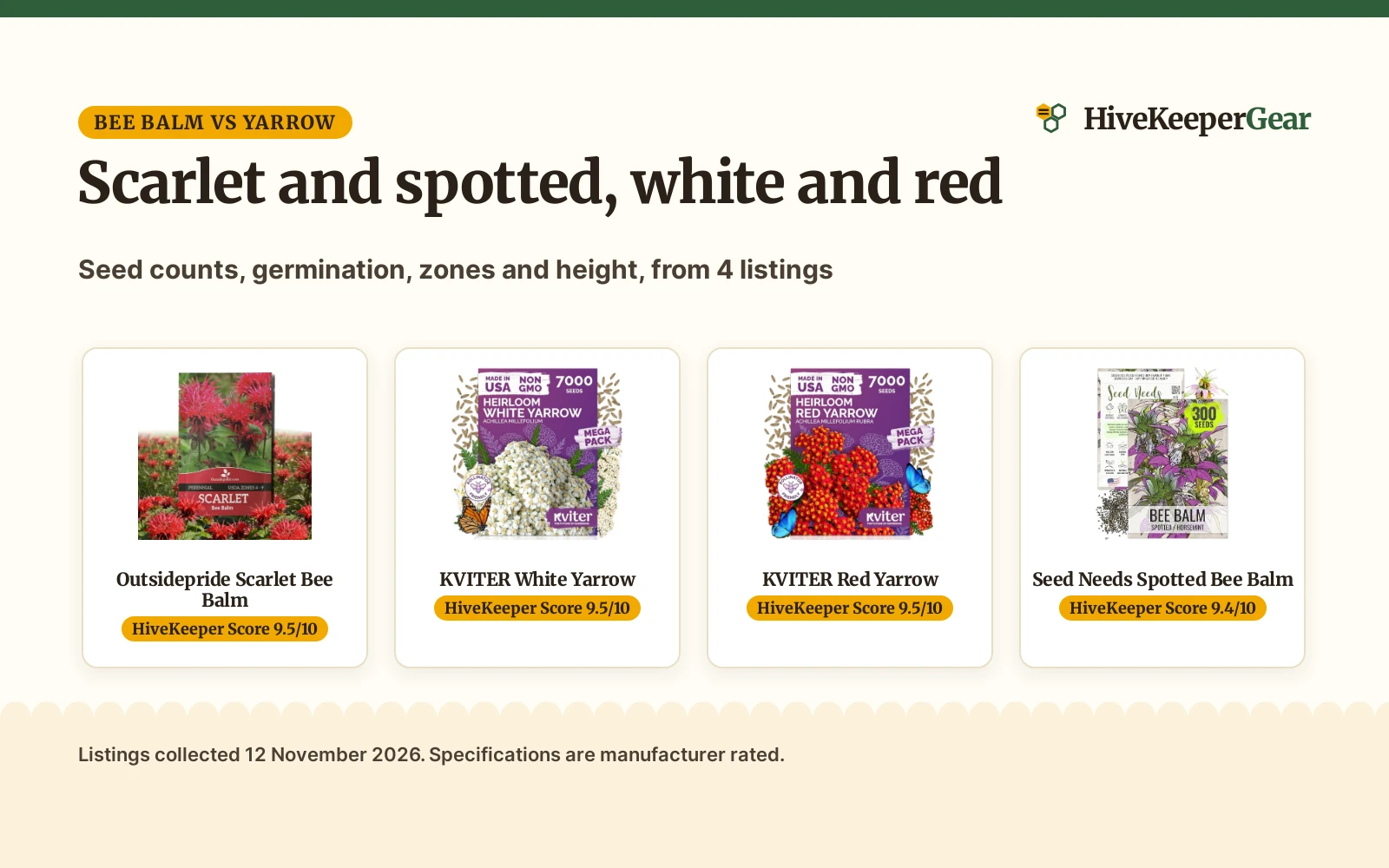
Bee balm seeds vs yarrow seeds, compared on 4 listings: seed counts, germination windows, zones, height and soil, with scarlet and spotted bee balm against white and red yarrow.

On this page
Top picks at a glance
As an Amazon Associate I earn from qualifying purchases.
- 1
 Outsidepride Scarlet Bee Balm9.5/10View on Amazon
- 2
 KVITER White Yarrow9.5/10View on Amazon
- 3
 KVITER Red Yarrow9.5/10View on Amazon
- 4
 Seed Needs Spotted Bee Balm9.4/10View on Amazon
At the first spring inspection, the yard is quiet and the forage is thin, and the planting you do now decides what the bees work all summer. Bee balm seeds vs yarrow seeds is the choice between two pollinator flowers for the beds around the hives: scarlet and spotted bee balm on one side, white and red yarrow on the other. We compared seed listings of both kinds, using only what each listing publishes.
HiveKeeperGear earns a commission when you buy through links on this page, at no extra cost to you. As an Amazon Associate I earn from qualifying purchases. Affiliate disclosure.
Quick verdict: choose bee balm seeds if you want red color and stated sowing figures, as the Outsidepride listing offers. Choose yarrow seeds if you want a large seed count and a wide zone range, as the KVITER listings offer. Both sides draw pollinators, so the real difference is bloom and the figures each listing states.
Examples of each side
| # | Product | HiveKeeper Score | Buy |
|---|---|---|---|
| 1 | Outsidepride Scarlet Bee Balm | 9.5/10 | Buy on Amazon |
| 2 | KVITER White Yarrow | 9.5/10 | Buy on Amazon |
| 3 | KVITER Red Yarrow | 9.5/10 | Buy on Amazon |
| 4 | Seed Needs Spotted Bee Balm | 9.4/10 | Buy on Amazon |
Outsidepride Scarlet Bee Balm
Scarlet bee balm seeds, 500 seeds per pack, a perennial with 36 inch red blooms for USDA zones 4 to 9, with mint-scented leaves and edible blooms.
Pros
- 500 seeds per pack
- Perennial for USDA zones 4 to 9, in full sun to partial shade
- Red blooms at 36 inch with mint-scented leaves
- Edible leaves and flowers, for teas and potpourri when properly boiled or dried
Cons
- No packet dimensions stated
- Sow at 4 seeds per plant, so each plant takes several seeds
- No warranty term stated
- Red blooms only; no other color in this listing
KVITER White Yarrow
White yarrow seeds, 7,000 heirloom non-GMO seeds per pack, a compact perennial with 2 to 3 ft stems for USDA zones 1 to 12.
Pros
- 7,000 seeds per pack
- Sprouts in 20 to 45 days at 65 to 75°F
- USDA zones 1 to 12, a wide range
- Deer and drought resistant, for sandy well drained soil
Cons
- No warranty term stated
- Needs light to germinate, sown just below the surface
- Divide every 3 to 4 years to curb spread
- White flowers only in this listing
KVITER Red Yarrow
Red yarrow seeds, 7,000 heirloom non-GMO seeds per pack, a compact perennial with 2 to 3 ft stems for USDA zones 1 to 12.
Pros
- 7,000 seeds per pack
- Sprouts in 20 to 45 days at 65 to 75°F
- USDA zones 1 to 12, a wide range
- Deer and drought resistant, for sandy well drained soil
Cons
- No warranty term stated
- Needs light to germinate, sown just below the surface
- Divide every 3 to 4 years to curb spread
- Red flowers only in this listing
Seed Needs Spotted Bee Balm
Spotted bee balm seeds in a 1 pack packet measuring 3.25 inches by 4.50 inches, from a maker that promises never to knowingly supply GMO seed.
Pros
- Maker promises never to knowingly supply GMO seed
- Packet shows sowing information on the reverse side
- Tear resistant and moisture resistant packaging
- Thrives in well-drained sandy or loamy soil, in full sun or partial shade
Cons
- No seed count stated for the pack
- No germination days stated
- No USDA zones stated
- No warranty term stated
As an Amazon Associate I earn from qualifying purchases.
Other hives and gear to compare
 14Check price on Amazon
 8000+ Yarrow Seeds for PlantingCheck price on Amazon
 CarpetC 500+ Bee Balm Seeds for PlantingCheck price on Amazon
 700 Spotted Bee Balm Heirloom Flower Seeds for PlantingCheck price on Amazon
 1050 Bee Balm SeedsCheck price on Amazon
 Sow Right SeedsCheck price on Amazon
Bee balm seeds vs yarrow seeds: side by side
| Seed | HiveKeeper Score | Seeds per pack | Germination | Zones | Height | Soil and sun |
|---|---|---|---|---|---|---|
| Outsidepride Scarlet Bee Balm | 9.5/10 | 500 seeds | 14 to 21 days | USDA zones 4 to 9 | 36 inch | Well drained, full sun to partial shade |
| KVITER White Yarrow | 9.5/10 | 7,000 seeds | 20 to 45 days | USDA zones 1 to 12 | 2 to 3 ft | Sandy well drained, sun not stated |
| KVITER Red Yarrow | 9.5/10 | 7,000 seeds | 20 to 45 days | USDA zones 1 to 12 | 2 to 3 ft | Sandy well drained, sun not stated |
| Seed Needs Spotted Bee Balm | 9.4/10 | Not stated | Not stated | Not stated | Not stated | Sandy or loamy, full sun or partial shade |
Sizes, materials and capacities are the manufacturer’s ratings as each listing states them, collected 12 November 2026.
Height and bloom
Where the listings state height, the figures overlap: the Outsidepride listing gives red blooms at 36 inch, and both KVITER listings give upright 2 to 3 ft stems. The Seed Needs listing gives no height for its spotted bee balm. The spotted bee balm blooms are tubular, with yellow petals spotted with purple, and the scarlet listing states mint-scented leaves, while the yarrow blooms are flat-topped and aromatic, white on one listing and red on the other.
Seed count and sowing
The counts differ widely. The Outsidepride listing states 500 seeds per pack, while both KVITER listings state 7,000 seeds per pack. The Seed Needs listing states no seed count, only 1 pack. Sowing differs too: the Outsidepride listing says to sow 4 seeds per plant with 30 inch spacing and germination in 14 to 21 days at 68F, while the KVITER listings say to sow just below the soil surface, with light to germinate, at 4 to 6 inch spacing and sprouting in 20 to 45 days at 65 to 75°F. The Seed Needs listing gives no sowing figures beyond the sowing information printed on the reverse of its packet.
Zones, soil and sun
The yarrow listings cover the wider zone range: both KVITER listings state USDA zones 1 to 12, while the Outsidepride listing states USDA zones 4 to 9 and the Seed Needs listing states no zones. All 4 listings state well drained soil: the KVITER listings and the Seed Needs listing state sandy soil, the Seed Needs listing adds loamy soil, and the Outsidepride listing adds a pH of 6.1 to 7.3. For sun, both bee balm listings state full sun to partial shade, and the yarrow listings state no sun range, with only the white listing mentioning shade, in a note to stake in shade.
What each listing leaves out
No listing here states a warranty term. The Seed Needs listing leaves out the most: no seed count, no germination window and no zone range, though it does state the packet size and the sowing information on the reverse. The Outsidepride listing states no packet size. The KVITER listings state no packet weight and no sun range. Check the gaps that matter to your bed before you order.
Which should you choose?
Choose bee balm seeds if you want red bloom with stated sowing figures and a stated seed count, as the Outsidepride listing offers. Our best bee balm seeds for gardens roundup compares more packs.
Choose yarrow seeds if you want a large seed count, a wide zone range and flat-topped bloom for dry beds. Our best yarrow seeds for pollinators roundup covers more yarrow packs.
Whichever you choose, sow by the figures on the packet, and read our guide on bee balm seeds vs coneflower seeds before you pick a second flower for the same bed.
In the Bee Yard
- The Seed Needs and KVITER packets measure 3.25 inches by 4.50 inches, so they fit a drawer or a seed box beside the hive tool.
- Save extra seed until the following season if properly stored, as the Seed Needs listing advises, and keep packets dry.
- Sow yarrow just below the surface, where light gets to it, and cover the scarlet bee balm thinly, as the Outsidepride listing states.
- Keep the packet after sowing: the Seed Needs packet prints sowing information on the reverse side.
Inside the HiveKeeper Score
| Product | HiveKeeper Score | Perf. /35 | Build /25 | Value /25 | Safety /10 | Warranty /5 |
|---|---|---|---|---|---|---|
| Outsidepride Scarlet Bee Balm | 9.5 | 32 | 21 | 21 | 0 | 0 |
| KVITER White Yarrow | 9.5 | 30 | 21 | 21 | 0 | 0 |
| KVITER Red Yarrow | 9.5 | 30 | 21 | 21 | 0 | 0 |
| Seed Needs Spotted Bee Balm | 9.4 | 28 | 20 | 20 | 0 | 0 |
HiveKeeper Scores sit between 9.2 and 9.8, and a hive item’s weighted total lands on that range in proportion, so a higher total always gives a higher score.
The HiveKeeper Score weighs performance, build, value, safety and warranty. How we pick explains the weights. Seeds earn safety points only for stated safety-relevant features, and none of these listings states one, so safety stays at zero across the set. No listing states a warranty term, so no product earns warranty points. The Outsidepride listing scores highest on performance for its stated sowing figures, and the KVITER listings score well for their seed count and zone range.
FAQs for beekeepers
Which draws more pollinators, bee balm or yarrow?
The listings do not rank them. Bee balm is described as attractive to bees, butterflies and hummingbirds, and yarrow as luring butterflies and lady beetles, so both sides feed the yard. Pick by bloom, height and the sowing figures each listing states.
How many seeds come in a pack?
The Outsidepride listing states 500 seeds, and both KVITER listings state 7,000 seeds. The Seed Needs listing states 1 pack with no seed count.
How long do the seeds take to sprout?
The Outsidepride listing states germination in 14 to 21 days at 68F, and the KVITER listings state sprouting in 20 to 45 days at 65 to 75°F. The Seed Needs listing states no germination window.
Can I plant bee balm and yarrow in the same bed?
The listings do not cover mixed planting. Both sides list well drained soil, and the bee balm listings state full sun to partial shade. Give each plant the spacing its listing states: 30 inch for the Outsidepride bee balm and 4 to 6 inch for the KVITER yarrow.
Do the seed packets state a warranty?
No. None of the 4 listings states a warranty term.
More hive guides
Related: the best bee balm seeds for gardens, the best yarrow seeds for pollinators, the bee balm seeds vs coneflower seeds comparison and the bee balm seeds vs zinnia seeds comparison.